
Providers & models
Providers & models
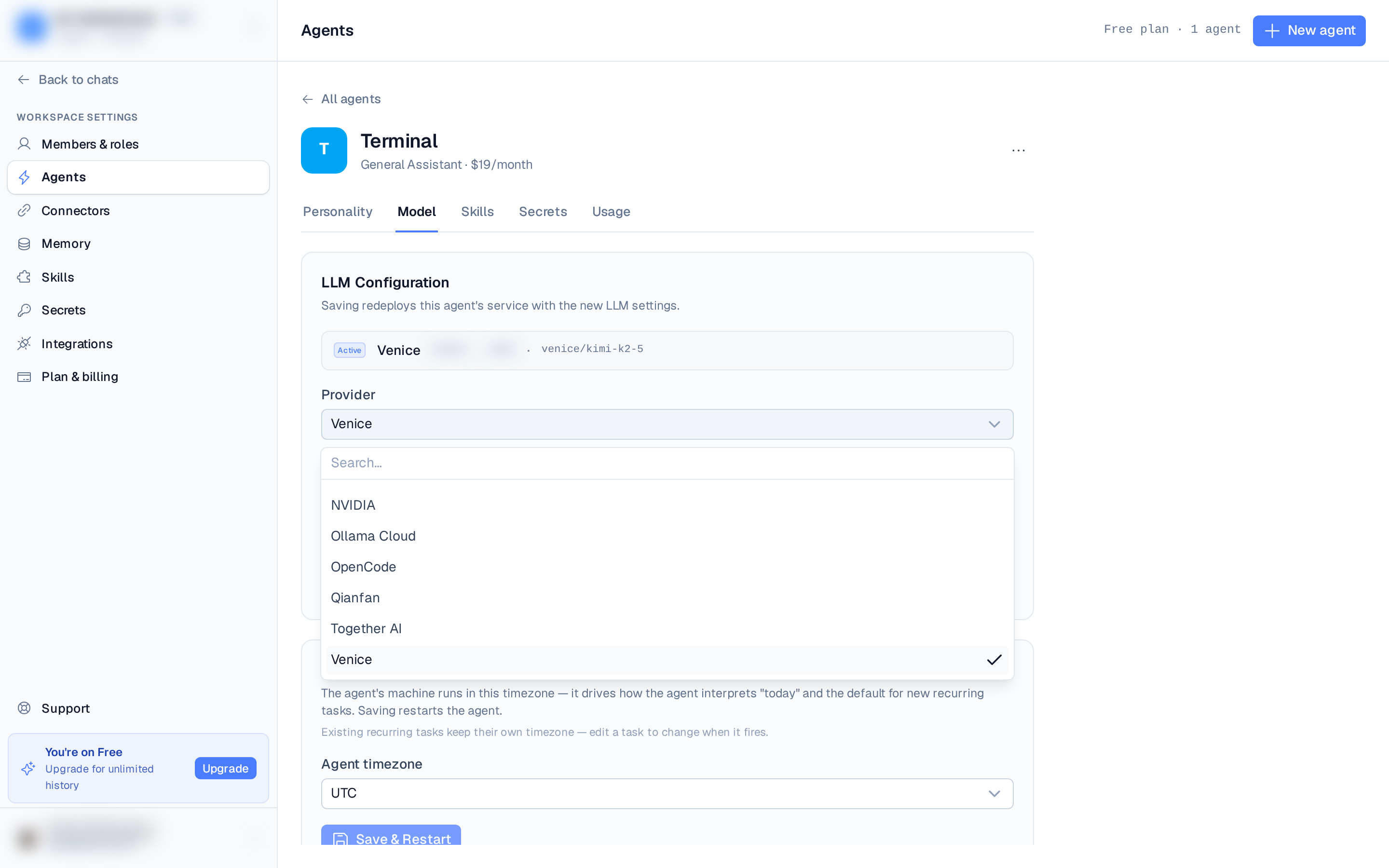
BetterClaw supports a wide range of model providers. On the Model tab of an agent's editor you pick a provider, then a specific model within it. A handful of providers are marked (Recommended) at the top of the list.
Recommended providers
- Anthropic — Claude models, led by Claude Fable 5.1.
- Google Gemini — Gemini Pro and Flash models.
- OpenAI — GPT and o-series models, led by GPT-6 Astra and GPT-6.1 Sol.
- ChatGPT Subscription — sign in with your ChatGPT plan instead of pasting a key. See Using a ChatGPT subscription.
- OpenRouter — a single key for many models across providers, including a free auto-router tier.
Anthropic models
Anthropic leads the list. The current lineup:
- Claude Fable 5.1 — the newest model, at the top of the picker.
- Claude Opus 5.5 — the Opus flagship. Also Opus 5, Opus 4.8, Opus 4.7, Opus 4.6, and Opus 4.5.
- Claude Fable 5 — with a native 1M-token context window.
- Claude Sonnet 5 — the default model, with native 1M context. Also Sonnet 4.6 (256K), Sonnet 4.6 (1M context) for the extended window, and Sonnet 4.5.
- Claude Haiku 4.5 — fastest and cheapest.
OpenAI models
The OpenAI list opens with the GPT-6 generation — GPT-6 Astra, GPT-6.1 Sol, GPT-6 Sol, and GPT-6 Luna — followed by GPT-5.6 Sol / Terra / Luna (GPT-5.6 Terra is the default), GPT-5.5, GPT-5.4, GPT-5.2, and o3.
GPT-6.1 Sol is also offered through ChatGPT Subscription and OpenRouter (where GPT-6.1 Sol Pro is listed too).
Groq
Choose Groq and supply your Groq API key to select one of these models:
- Llama 3.3 70B Versatile — the existing default.
- Llama 3.1 8B Instant.
- GPT OSS 120B and GPT OSS 20B.
- Qwen3.8 27B (Preview) — may change or be discontinued at short notice.
These models support the local tool calling used by BetterClaw agents. Speech, moderation, and Compound systems are not included in the agent model picker. Availability can depend on your Groq account; see Groq's model catalog.
DeepInfra
Choose DeepInfra and supply your DeepInfra API key to run open models hosted by DeepInfra:
- Kimi K2.6 — the default.
- DeepSeek V4 Flash and DeepSeek V4 Pro.
- GLM 5.3.
- Qwen 3.5 397B and Qwen3 Coder 480B.
- MiniMax M3.
- GPT OSS 120B.
- Gemma 4 31B.
- Llama 3.3 70B.
Usage is billed by DeepInfra to your own account. See DeepInfra's model catalog for prices and details.
More providers
BetterClaw also supports Cerebras, Cloudflare AI Gateway, DeepInfra, DeepSeek, Hugging Face, Kilocode, Kimi Coding, MiniMax, Mistral, Model Studio (Alibaba), Moonshot AI, NVIDIA, Ollama Cloud, OpenCode, Qianfan, Together AI, Venice, Vercel AI Gateway, Volcengine (Doubao), xAI (Grok), Xiaomi, and Z.AI Subscription (GLM) — plus OpenAI Custom for any OpenAI-compatible endpoint and Anthropic Custom for any Anthropic-compatible gateway.
The exact list of providers and models is shown in the picker when you configure an agent — it's the source of truth.
OpenAI Custom (any OpenAI-compatible endpoint)
If your provider isn't listed but exposes an OpenAI-compatible API — a self-hosted server, a gateway, or another vendor — choose OpenAI Custom. You then supply:
- a Model ID — the id your endpoint expects (e.g.
qwen3), - a Base URL — the endpoint's address (e.g.
https://api.my-provider.com/v1), and - an API key, which is sent to that endpoint as a Bearer token.
All three are required. OpenAI Custom has no model list and no thinking-level setting.
Anthropic Custom (any Anthropic-compatible gateway)
If you reach Claude through a gateway that speaks the Anthropic Messages API (/v1/messages)
— for example LiteLLM, Portkey or your company's own proxy — choose Anthropic Custom. Unlike
OpenAI Custom pointed at the same gateway, this keeps Claude's thinking level control and
prompt caching. You supply:
- a Model ID — the id your gateway expects (e.g.
claude-sonnet-5), - a Base URL — the gateway's address in front of
/v1/messages(e.g.https://gateway.example.com; a pasted/v1or/v1/messagesis trimmed), and - an API key, which is sent to the gateway in the
x-api-keyheader, the way Anthropic's own API expects.
All three are required: without a Base URL the agent will not fall back to api.anthropic.com. If
the model ID is one Anthropic publishes, the agent uses that model's real context window and output
limit; any other ID is treated as a Claude model with thinking support.
To run a model on your own computer instead, see Local models.
Choosing a model
Each provider exposes several models trading off capability, speed, and cost. Larger models (Opus, Pro, GPT) are the most capable; smaller "mini" / "flash" / "haiku" variants are faster and cheaper. Providers with a curated list also let you enter any model id the provider exposes — pick Custom in the model dropdown, or Use a model ID not listed here when connecting a model on a paid plan. You can switch models later without re-entering your key.
For Anthropic, Anthropic Custom, OpenAI, and ChatGPT Subscription models you can also set a Thinking level — how much reasoning effort the model spends before answering (Default, Minimal, Low, Medium, High, Extra high, or Max). Higher levels think longer and use more tokens.