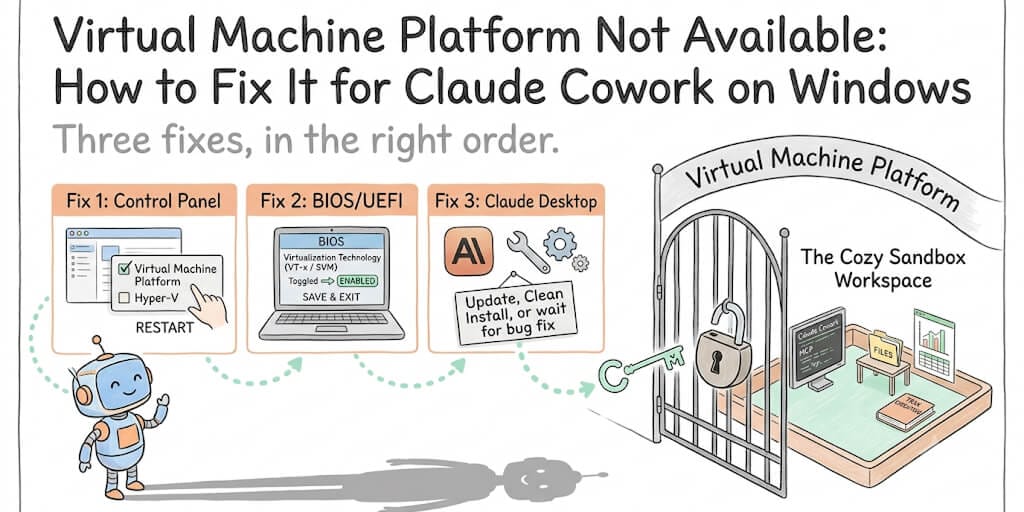
Three fixes, two checks to confirm each one worked, and the Windows Home answer nobody gives you straight.
If Claude Cowork shows "Virtual Machine Platform not available" or "Claude's workspace requires the Virtual Machine Platform on Windows. Enable this feature, then restart," it means Windows' built-in virtualization layer is switched off. Cowork runs its workspace inside a lightweight virtual machine, and it can't start until you enable Virtual Machine Platform (and usually Hyper-V) in Windows Features and make sure CPU virtualization is turned on in your BIOS. On most machines this takes under five minutes. Here's every step.
What this error actually means
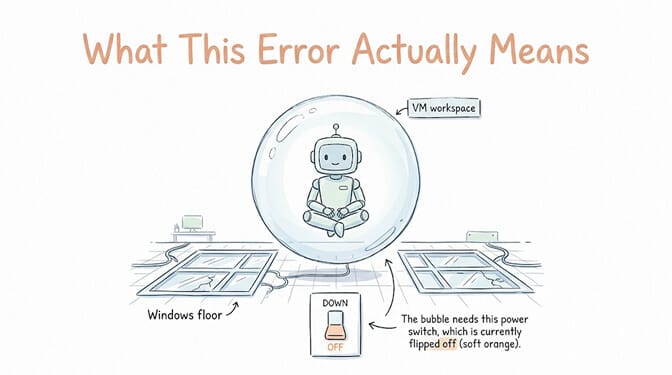
Claude Cowork doesn't run directly on Windows. It spins up an isolated workspace inside a virtual machine so its actions stay sandboxed from the rest of your system. That sandbox depends on a Windows component called Virtual Machine Platform, the same underlying feature that WSL2 and Docker Desktop use.
When you see "not available," one of three things is true. Virtual Machine Platform is turned off in Windows Features (most common, covers about 90% of cases). Hardware virtualization is disabled in your BIOS/UEFI. Or your Windows edition or hardware doesn't fully support the required components (rare, but real on Windows Home).
The fix order matters. Try Fix 1 first. Only move to Fix 2 if Fix 1 doesn't resolve it. Only touch BIOS if the first two fail.
Fix 1: Enable Virtual Machine Platform
This handles the vast majority of cases. The feature is installed on most Windows machines but not turned on by default.
The fast way (PowerShell): right-click Start, select Terminal (Admin) or Windows PowerShell (Admin), and run:
Enable-WindowsOptionalFeature -Online -FeatureName VirtualMachinePlatform -All
Then restart your PC (use Restart, not Shutdown and power on). Reopen Claude Desktop and try the Cowork tab.
The clickable way (no commands): press Win+S, type "Turn Windows features on or off," and open it. Scroll down to Virtual Machine Platform and check the box. Click OK, let it install, and restart when prompted.
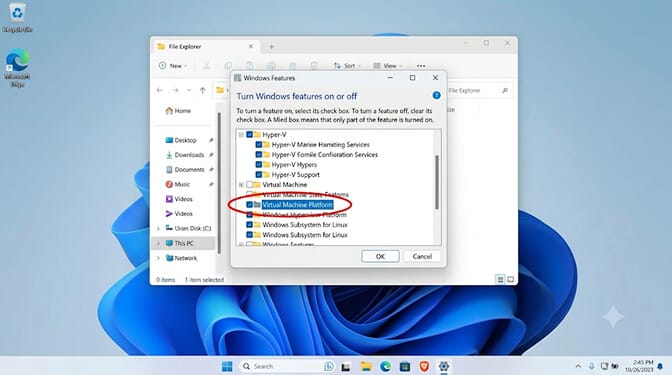
On Windows 11 25H2 and later: Microsoft moved the settings. If you can't find "Turn Windows features on or off," go to Settings → System → Virtual Workspaces. The Virtual Machine Platform toggle is there now.
How to verify it worked
Open PowerShell and run:
Get-WindowsOptionalFeature -Online -FeatureName VirtualMachinePlatform
If State shows Enabled, you're good. If it still shows Disabled after the restart, something deeper is wrong and you need Fix 2 or Fix 3.
Fix 2: Enable Hyper-V (if the error persists)
If Cowork still complains after enabling Virtual Machine Platform alone, enable the full Hyper-V stack. Run in an admin PowerShell:
Enable-WindowsOptionalFeature -Online -FeatureName Microsoft-Hyper-V -All
Restart afterward.
Here's the part that catches Windows Home users: full Hyper-V is only available on Windows Pro, Enterprise, and Education. If you're on Home, this command will fail. Skip to the Windows Home section below. You don't need full Hyper-V management tools — Virtual Machine Platform (Fix 1) is what Cowork requires, and Home does support it.
Fix 3: Turn on virtualization in your BIOS/UEFI
If the Windows features are enabled but Cowork still won't start, hardware virtualization is probably switched off at the firmware level. This is common on laptops that shipped with virtualization disabled by default.
Quick check before entering BIOS: open Task Manager (Ctrl+Shift+Esc), click Performance, click CPU. Look for "Virtualization" in the bottom-right details.
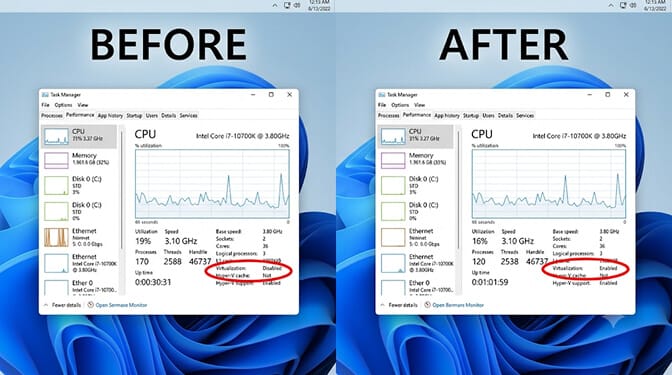
If it says Disabled, you need to enter BIOS:
Step 1: Restart your computer. Press the BIOS key during boot. The key varies: F2 for most Dell and Lenovo, F10 for HP, Del for most desktops, Esc for some Asus boards.
Step 2: Find the virtualization setting. It's called Intel VT-x or Intel Virtualization Technology on Intel CPUs, or AMD-V or SVM Mode on AMD CPUs. Usually under Advanced, CPU Configuration, or Security.
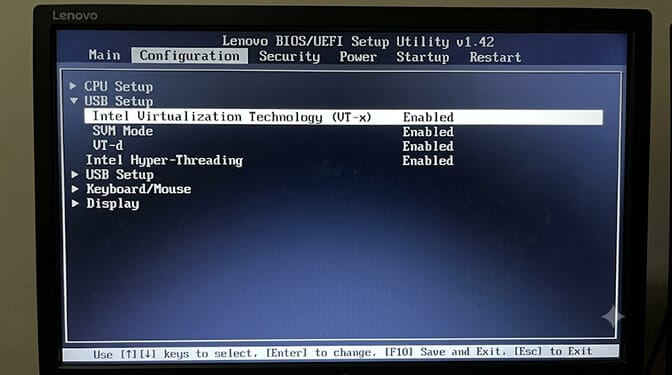
Step 3: Set it to Enabled. Save and exit. Your machine restarts.
After the restart, check Task Manager again. "Virtualization" should now read Enabled. Reopen Claude Desktop and try Cowork.
Claude Cowork on Windows 11 Home (and Windows 10 Home)
This is where most people get it wrong, and where most guides give you a half-answer.
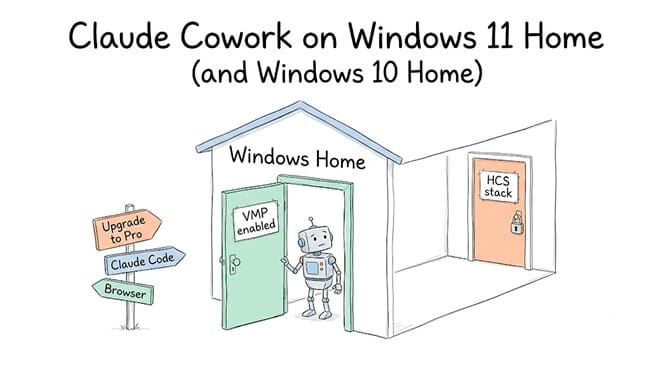
The official position: Anthropic's Claude Help Center states that Claude Desktop requires the Virtual Machine Platform to use Cowork. Virtual Machine Platform is available on Windows Home. You can enable it with Fix 1. So in theory, Cowork should work on Home.
The reality: multiple GitHub issues (#60262, #29887) document users on Windows 10 and 11 Home with Virtual Machine Platform fully enabled, CoworkVMService running, and hardware virtualization confirmed in Task Manager, where Cowork still fails to initialize. The VM never starts and no logs are generated.
The issue is that Cowork's sandbox relies on components from the full Hyper-V and HCS stack (vmcompute, hns, vfpext) that Home edition doesn't fully include. Virtual Machine Platform gives you the lightweight virtualization layer, but the complete service stack that Cowork's sandbox needs often requires Hyper-V components that only ship with Pro, Enterprise, and Education.
What to try on Home
Enable Virtual Machine Platform (Fix 1) and Windows Hypervisor Platform. Also run this in an admin PowerShell and restart:
bcdedit /set hypervisorlaunchtype auto
This combination works for some Home users, particularly on newer Windows 11 builds.
If Cowork still fails after all of that, your realistic options are:
- Upgrade to Windows Pro. Microsoft sells the upgrade for around $99 in the Microsoft Store. This gives you full Hyper-V and the complete HCS stack.
- Use Claude Code instead. Claude Code runs in your terminal without requiring a VM. You lose the visual Cowork workspace but keep all the AI coding capabilities.
- Use Claude.ai in your browser. No VM, no virtualization, no Windows edition requirement.
The honest version: Cowork on Windows Home is a gray area. It works for some. It fails for others. Anthropic's docs say VMP is enough. The GitHub issues say otherwise. If you're on Home and Fix 1 doesn't resolve it, don't spend three hours debugging. Check the options above.
If the whole idea of troubleshooting Windows virtualization settings, BIOS configurations, and service registration just to run an AI agent sounds like the wrong use of your afternoon, BetterClaw runs entirely in the cloud. No VM. No Windows features. No BIOS. No edition restrictions. Free plan, no credit card, 200+ verified skills, and your agent deploys in 60 seconds on any machine with a browser.
Can you install Claude Cowork without admin rights?
Short answer: no. Anthropic's official documentation states that users without admin access can still install Claude, but Cowork on desktop will not be available.
Enabling Virtual Machine Platform modifies Windows system features, which requires administrator permission. The MSIX installer needs admin rights to register CoworkVMService, the Windows service that manages the Cowork VM.
On a personal machine: right-click and "Run as administrator" when opening PowerShell for the Enable-WindowsOptionalFeature commands.
On a managed work or school machine: you can't enable it yourself. Send your IT administrator Fix 1, Fix 2, and Fix 3 from this page, plus this note — the MSIX package needs to be deployed via Add-AppxProvisionedPackage for CoworkVMService to register machine-wide. Standard LOB deployment through Intune may install in user context, which doesn't register the service.
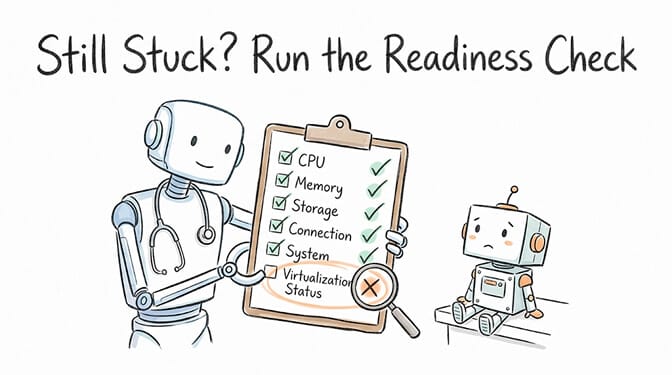
Still stuck? Run the readiness check
If you've tried all three fixes and Cowork still won't start, the readiness check tool pinpoints the exact failing component. Our readiness check walkthrough explains what each of the six tests checks and the exact fix for each failure.
If you're seeing a different error like "Missing HCS services: hns, vmcompute, vfpext," that's a related but distinct issue covered in our HCS services fix guide.
If the error is "Cowork requires Claude Desktop to be installed via a modern installer," the problem is the installer format, not virtualization. Our modern installer fix covers the Squirrel-to-MSIX migration.
And if Cowork starts but you're hitting usage limits, our Claude rate limit guide covers the five-hour rolling window and shared-pool mechanics.
An AI agent that runs in your browser, zero setup
No VM, no Windows features, no BIOS. BetterClaw runs entirely in the cloud. Start free → No credit card · Free plan with 1 agent and 500 credits/mo · 200+ verified skills · $49/mo for Pro · Deploy in ~60 seconds
Frequently Asked Questions
Does Claude Cowork need Hyper-V or just Virtual Machine Platform?
Virtual Machine Platform is what Cowork officially requires, and it's the first thing to enable. If that alone doesn't fix the error, enable full Hyper-V too (Windows Pro, Enterprise, and Education only). On Windows Home, Virtual Machine Platform is all you can enable, and it works for some users but not all, due to missing HCS components.
Will enabling Virtual Machine Platform slow down my PC?
No noticeable impact on everyday performance. It's the same lightweight component WSL2 and Docker use. The Cowork VM itself consumes about 1.8 GB of RAM when running, but the Virtual Machine Platform feature adds no overhead when a VM isn't active.
I enabled it and restarted but nothing changed. What's wrong?
Two common causes. First, make sure you used Restart, not Shutdown and power on — with Windows Fast Startup enabled, a shutdown cycle can leave the virtualization services uninitialized. Second, check BIOS virtualization (Fix 3). The Windows feature can show "Enabled" while the underlying hardware support is still off at the firmware level.
Can I run Claude Cowork on Windows Home?
Officially, Cowork requires Virtual Machine Platform, which Home supports. In practice, results are mixed. Multiple GitHub issues document Cowork failing on Home even with Virtual Machine Platform fully enabled, because the complete HCS service stack (vmcompute, hns, vfpext) requires Hyper-V components that Home doesn't include. Try Fix 1 first. If it doesn't work, upgrading to Pro ($99) or using Claude Code (no VM needed) are the reliable alternatives.
Do I need admin rights to enable Virtual Machine Platform?
Yes. Enabling the feature modifies Windows system components, and the MSIX installer needs admin rights to register CoworkVMService. Anthropic's documentation confirms that users without admin access can install Claude, but Cowork on desktop will not be available to them. On a managed machine, your IT administrator has to enable it for you.