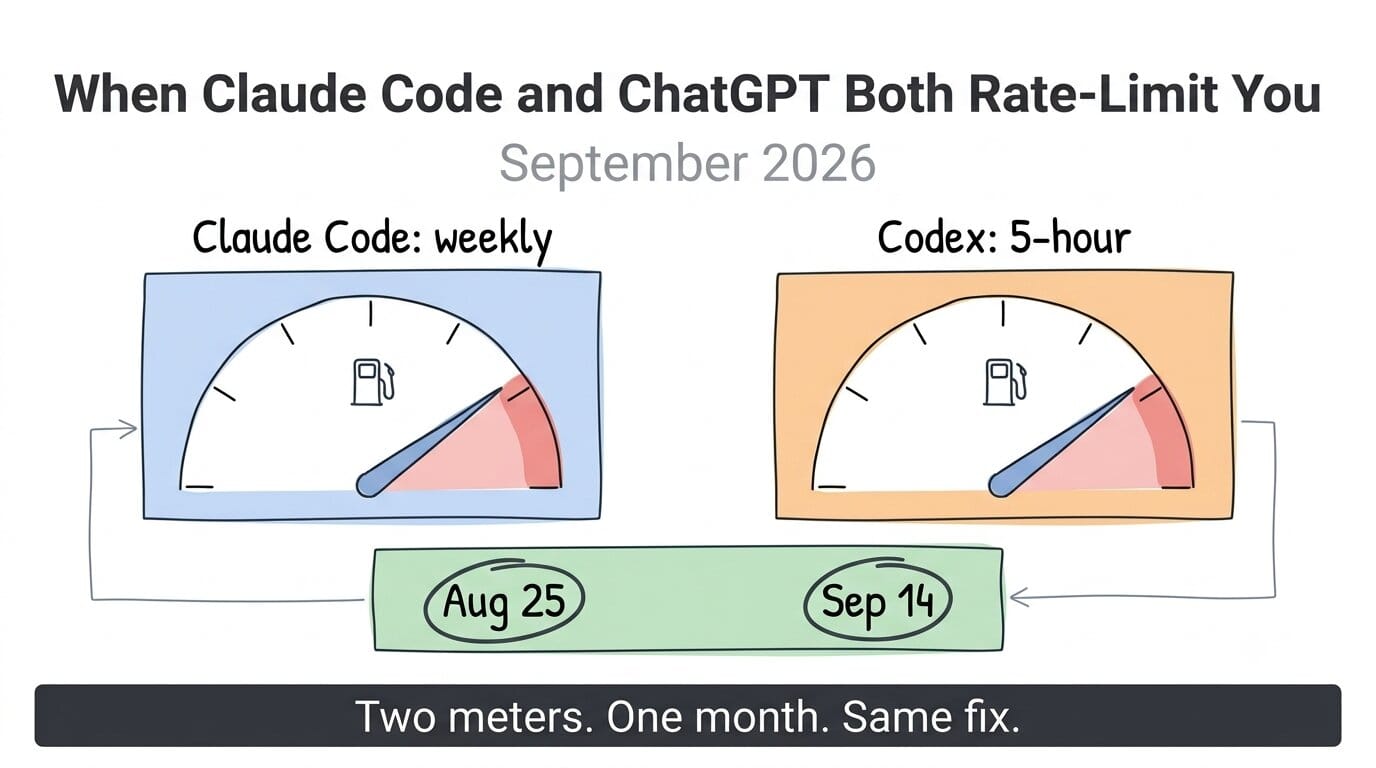
On August 25 OpenAI put the five-hour cap back on Plus. On September 14 Anthropic trimmed Claude Code's weekly limit by 17% against what you had the day before. Both meters, same month. Here's the math, the alternatives that actually work, and the routing setup that makes the meters stop mattering.
Sunday night. Claude Code says you've used your weekly allowance and it resets Wednesday. You switch tabs to Codex to finish the refactor, and Codex says come back in three hours. Two subscriptions, roughly $40 a month between them, and for the next three hours you have a text editor.
If that's been you this month, it isn't a coincidence and it isn't your usage. Both companies changed their meters within three weeks of each other. Here's what changed, with dates, then what to do about it.
What changed, exactly
OpenAI, August 25. Thibault Sottiaux, OpenAI's engineering lead for Codex and ChatGPT, announced on X that the rolling five-hour usage limit was coming back for ChatGPT Plus on both Codex and ChatGPT Work, effective the following day. Plus users had been running on a weekly-only quota since July 13. His stated reasons: smoothing compute load, and stopping casual users from accidentally burning a whole week in one session. Pro at $100 and $200 a month stays exempt from the five-hour gate "for the upcoming months."
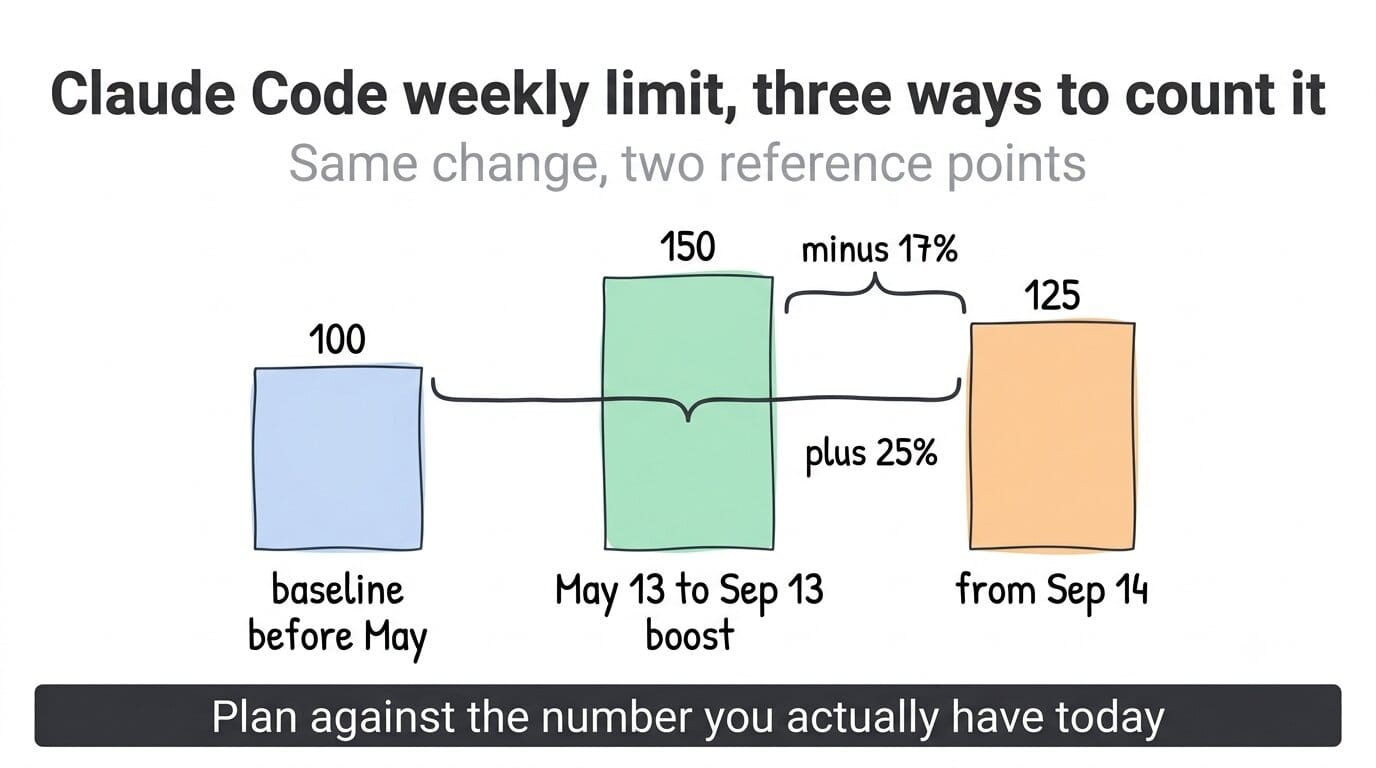
Anthropic, August 29, effective September 14. Anthropic's developer account announced that standard weekly limits in Claude Code would rise permanently by 25% for Pro, Max, Team, and seat-based Enterprise plans. The catch, which Anthropic itself stated in a follow-up post: a temporary 50% boost had been in place since May 13, so measured against the week before, September 14 was a 17% reduction. The doubled five-hour session limits from May stay.
| Before | After | Net for a heavy user | |
|---|---|---|---|
| ChatGPT Plus, Codex and Work | Weekly quota only (since Jul 13) | Five-hour rolling cap plus weekly (from Aug 26) | Same weekly total, but you can't spend it in one sitting |
| Claude Code, Pro/Max/Team | 150% of baseline weekly (May 13 to Sep 13) | 125% of baseline weekly (from Sep 14) | 17% less per week than before Sep 14 |
Anthropic's headline was "up 25%." Anthropic's own second sentence was "down 17% from today." Both are true. Plan against the second one.
If you're hitting these limits inside Cowork rather than Claude Code, the error strings are different and so are some of the fixes: our Claude Cowork rate limit guide decodes each message, and rate limit reached on Claude explains exactly when each limit resets.
Neither change is a scandal. Both companies are rationing a fixed-price product against real compute cost, and both said so. But if you've built a daily workflow around the summer's limits, the practical effect is the same as a price rise, and it's worth responding like one.
The distinction that makes this solvable
A subscription is a flat fee for rationed access. An API key is metered access with no weekly cap. That's the whole difference, and it's why the fix isn't "find a third subscription."
Subscriptions are the right deal for interactive work, where you're typing, reading, and thinking most of the time and the model is idle. They are the wrong deal for anything that runs unattended, because an agent that fires every fifteen minutes will hit a weekly cap by Tuesday no matter how generous the plan. Which is why you should know a few more dates: on April 4, Anthropic blocked Claude Pro and Max subscriptions from third-party tools like OpenClaw, reversed that on May 13, and on June 15 paused the "Agent SDK credit" plan meant to replace it, promising advance notice before revised terms take effect. If your agent runs outside Claude's own apps, subscription access is a moving target and an API key is the reliable option. (We covered the full timeline in the Anthropic subscription ban post.)
So the question becomes: keep the subscription for the work it's good at, and move everything else to metered access. Here's what metered access costs in September 2026.
Option one: pay up
The blunt option, and for some people the right one.
Codex on ChatGPT Pro ($100 or $200 a month) has no five-hour gate for the coming months and, per OpenAI, five times the Codex usage of Plus at the $100 tier. Claude Max at $100 or $200 gives you the same 125%-of-baseline weekly limit as Pro, just from a much larger baseline. If you are a full-time developer who bills by the hour and the subscription is the tool you use eight hours a day, $200 a month is a rounding error and the math ends here.
The reason it isn't the answer for most people: you're still on a meter, the meter still resets weekly, and neither company has promised the current terms past "the upcoming months." Paying up buys headroom, not immunity.
Not every Codex stop is a limit, either. If sign-in fails with codex_cli_workspace_disabled, it usually means your company workspace has local Codex switched off, and a bigger plan won't change that: see the codex_cli_workspace_disabled decoder. If a task dies with "stream disconnected before completion", that's a dropped connection, covered in the stream disconnected decoder.
Option two: API keys, and a router that makes them cheap
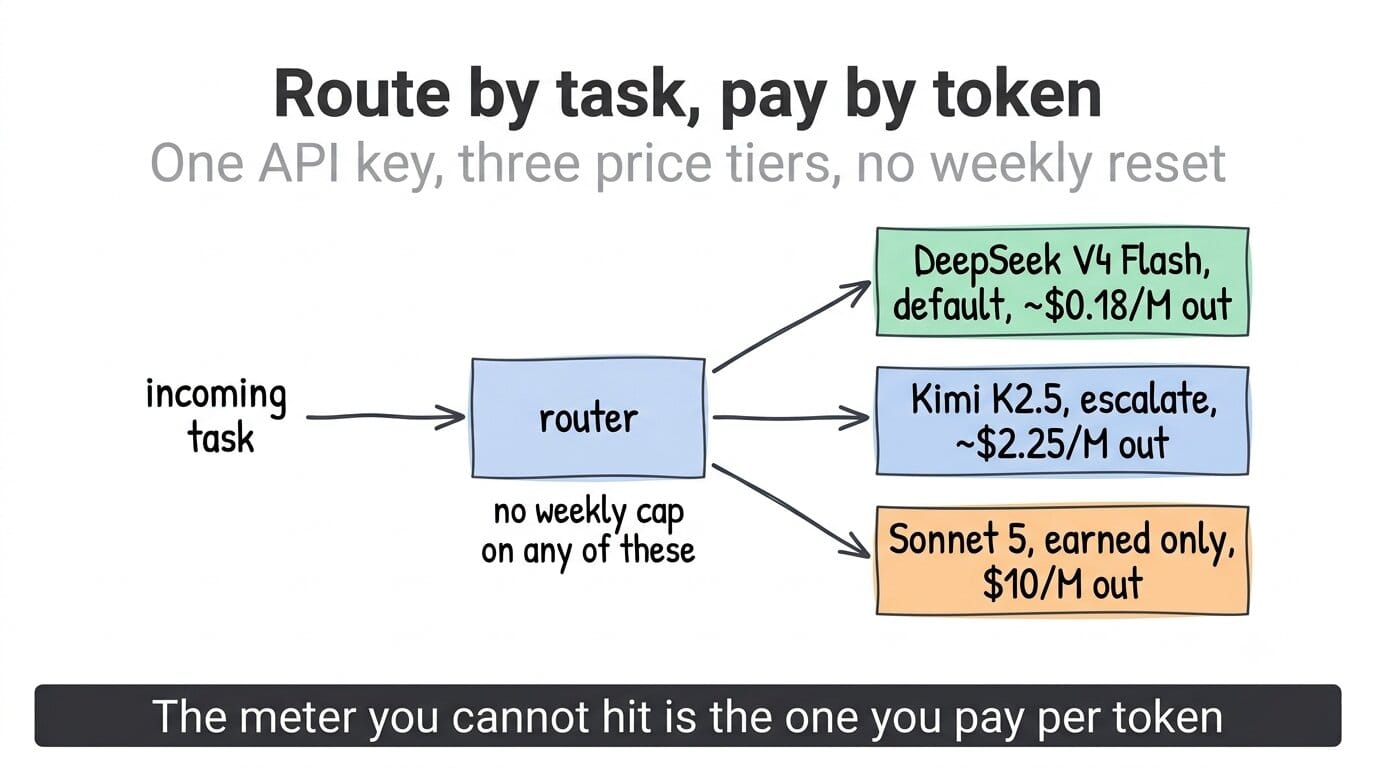
This is the option that changes the economics rather than the ceiling. One OpenRouter account gives you a single key for hundreds of models with automatic failover between providers, at catalog rates plus a 5.5% platform fee on pay-as-you-go. Prices below are per million tokens as listed in early September; check before you commit, because they move.
| Model | Input | Output | What it's good for |
|---|---|---|---|
| DeepSeek V4 Flash | ~$0.09 to $0.14 | ~$0.18 to $0.28 | The price floor. Classification, triage, drafts, summaries |
| GLM-5.3-Flash (Z.ai) | $0.15 | $0.50 | Multimodal, 1.3M context, strong for the price |
| Kimi K2.5 (Moonshot) | ~$0.45 to $0.60 | ~$2.25 to $3.00 | Visual coding, agent work, 256K context, no reasoning surcharge |
| Kimi K2.6 | $0.95 | $4.00 | Step up in capability, same family |
| GPT-5.6 Luna (OpenAI) | $0.20 | $1.20 | OpenAI's cheap tier (Sol is the flagship, Terra the middle), 1.1M context |
| Claude Sonnet 5 (API) | $2.00 | $10.00 | The model you were rationing, now metered |
Ranges reflect different providers on the router; DeepSeek's own endpoint lists V4 Flash at $0.14/$0.28 and Moonshot lists K2.5 at $0.60/$3.00, while cheaper third-party providers route below that. GLM-5.3-Flash had a 50% launch discount that ended September 9, so the standard rate is the one to budget on.
Put that against a subscription. A Claude Pro plan is $20 a month. At Sonnet 5 API rates, $20 buys 2 million output tokens (or 10 million input tokens), with no weekly reset. At DeepSeek V4 Flash's $0.18 output rate, the same $20 buys over 100 million output tokens. The subscription is a great deal only if you'd otherwise spend more than that on the API, and for interactive coding you very well might. For a scheduled agent doing triage fifty times a day, you won't come close.
The cheap open-weight models are not Sonnet 5 or GPT-5.6 Sol. For a research brief or a security review, the gap shows. For "sort these forty emails," it doesn't. Route accordingly and the expensive model stops being the bottleneck.
The routing logic itself is the same one we published for OpenClaw model routing: a cheap default, an escalation rule, a frontier model reserved for the tasks that earn it. If you want the numbers behind that, the GPT-6 Astra vs Fable 5.1 vs Sonnet 5 tests show three frontier models producing indistinguishable output on exactly the tasks a personal agent does most.
Option three: run it locally
Ollama, free forever, hardware required. On a 16GB machine, gemma4:e4b or qwen3.5:9b are usable for triage and drafting. With 24GB or more of VRAM or unified memory, qwen3-coder:30b for code and glm-4.7-flash for reasoning is the community combo that keeps coming up, at roughly 19GB each at 4-bit.
The honest caveats: local models are a tier below the cheap cloud open-weight models, which are themselves a tier below the frontier. Tool-calling reliability is the thing that suffers most. And "free" assumes you already own the hardware; a 24GB GPU is a lot of DeepSeek Flash tokens. Local is the answer when the data can't leave the building, not when the budget is tight. We ranked the options in best free model for OpenClaw agents and the verdict hasn't moved much.
Option four: free tiers, with the catch for each
They exist, and they're fine for experiments, and every one has a string attached.
OpenRouter's :free models run at 20 requests a minute and 50 a day, lifted to 1,000 a day once you've ever bought $10 of credit. The roster is open-weight only (Qwen3 Coder, gpt-oss, Gemma 4, Nemotron) and it changes without notice. Google's Gemini Flash family is free of charge through AI Studio, with the documented condition that free-tier content may be used to improve Google's products, and the Pro models aren't free at all. Groq serves gpt-oss-120b at 1,000 requests and 200,000 tokens a day, where the token cap is the real ceiling.
None of these is a production plan. All of them are enough to test a routing setup before you spend a dollar.
The setup I'd actually run
Keep one subscription for the interactive work you do with your hands on the keyboard. Whichever of Claude Code or Codex you reach for first, keep that one, and let the other lapse. You don't need two rationed meters for the same job.
Move every scheduled, background, or agent workload to API keys through a router. Cheap open-weight model as the default, a mid-tier model as the escalation, and Sonnet 5 or GPT-5.6 Sol reserved for the tasks that measurably need them. Put a hard daily spend cap on each agent so a runaway loop costs dollars, not hundreds.
That's the setup BetterClaw is built around. Bring your own keys, 28-plus providers including OpenRouter, per-agent model selection and per-agent cost caps, and zero markup on inference so the price in the table is the price you pay. We built it this way because rationed subscriptions were the first wall every one of our own agents hit, and the API was the way through. Free plan, no credit card.
Where this is going
Two companies moved their meters the same way in the same month, and both told you why: the flat fee doesn't cover the heavy tail. Expect more of it. The subscription is becoming the on-ramp, and the API is becoming the road.
That's less bad than it sounds. A rationed plan hides the cost of every request from you, and then surprises you on Sunday night. A metered key shows you the cost of every request, and then lets you route around it. One of those is a budget. The other is a coupon.
If any of this resonated, give BetterClaw a try. Free plan with 1 agent and 100 credits a month, bring your own API keys, no inference markup, and it never asks for a card. Pro is $49 a month for 5 agents and 12,000 credits. Route between DeepSeek, Kimi, GLM, OpenAI and Anthropic per task, with a cost cap on every agent. Start on the free plan or see full pricing.
Frequently Asked Questions
What are the new Claude Code and ChatGPT rate limits in September 2026?
From August 26, ChatGPT Plus users have a rolling five-hour cap on Codex and ChatGPT Work alongside the weekly quota; Pro at $100 and $200 is exempt for the coming months. As of September 14, Claude Code's standard weekly limit for Pro, Max, Team, and seat-based Enterprise is permanently 125% of the pre-May baseline, which Anthropic confirmed is a 17% reduction from the 150% boost that ran from May 13 to September 13. Five-hour session limits in Claude Code are unchanged.
How does using an API key compare to a Claude or ChatGPT subscription?
A subscription is a flat fee for rationed access with weekly and session resets. An API key is metered per token with no weekly cap, and the cost scales with what you actually use. Subscriptions win for interactive coding where the model idles most of the time; API keys win for agents and scheduled work, which hit any weekly cap quickly. Claude subscription terms for third-party tools like OpenClaw have also shifted repeatedly since April 4 (a ban, a May 13 reversal, and a credit change paused on June 15), so an API key is the most reliable option for agents.
How do I set up model routing so I stop hitting rate limits?
Get one API key through a router such as OpenRouter, set a cheap open-weight model (DeepSeek V4 Flash or GLM-5.3-Flash) as the default, add an escalation rule to a mid-tier model like Kimi K2.5 for multi-step tasks, and reserve Sonnet 5 or GPT-5.6 Sol for tasks that measurably need them. Put a daily spend cap on each agent. On BetterClaw this is per-agent configuration; on OpenClaw it's a config change covered in our routing guide.
Is it cheaper to use OpenRouter than a $20 subscription?
For agent and background work, usually yes by a wide margin: $20 buys over 100 million output tokens of DeepSeek V4 Flash or 2 million output tokens of Sonnet 5 at API rates, with no weekly reset, plus OpenRouter's 5.5% fee. For heavy interactive coding on a frontier model, the subscription can still be the better deal because you'd spend more than $20 on the API. Keep one subscription for hands-on work and meter everything else.
Are free tiers and local models reliable enough to replace Claude Code?
For experiments and low-volume triage, yes; for production coding, no. OpenRouter free models are capped at 50 requests a day (1,000 after a one-time $10 purchase) and the roster changes without notice; Gemini's free Flash tier may use your content to improve Google's products; Groq caps tokens per day. Local models via Ollama are unlimited but a tier below cheap cloud models, especially on tool calling, and need 16GB to 24GB of memory to be useful.