
BetterClaw vs Hermes Agent (2026)The Honest Hermes Alternative: Managed AI Agent vs Nous Research’s Self-Hosted Framework
Hermes Agent by Nous Research crossed 95K+ GitHub stars in 7 weeks with a genuine self-learning loop. BetterClaw replaces the entire self-hosting model with a managed platform that deploys in 60 seconds. Both are real. Here’s how to choose.
BetterClaw vs Hermes Agent: Two Different Approaches to AI Agents
This is not a “which is better” comparison. It’s a “which is better for YOU” comparison. They’re genuinely different products solving different parts of the same problem.
A self-hosted, self-improving AI agent framework from Nous Research. You install it on your own server, manage the infrastructure, and in return get full control plus a closed learning loop that auto-creates reusable skills from completed tasks. MIT licensed, 95K+ GitHub stars in 7 weeks. Built for developers and tinkerers who want to own their stack.
 BetterClaw
A managed AI agent platform. Sign up, build your agent visually, connect tools via OAuth, agent live in 60 seconds. No Docker, no config files, no terminal. Built for founders, ops teams, and anyone who wants agents doing work without becoming a sysadmin. Free plan to start, Pro at $49/month.
Hermes bet on making a smarter self-hosted agent. BetterClaw bet on making the infrastructure disappear entirely. Both bets paid off - for different audiences.
Hermes Agent Setup vs BetterClaw: Six Steps vs One Sign-Up
Hermes Agent
- 1
Provision a Linux VPS
Hetzner, DigitalOcean, or your cloud of choice. $5-25/mo.
- 2
Install Docker + Python 3.11
Plus dependencies. 10-20 min.
- 3
Clone Hermes repo, install
Run installer, configure environment.
- 4
Edit config.yaml + SOUL.md
Plus AGENTS.md. Hand-write your agent.
- 5
Manually wire OAuth per service
10-30 min × every integration you need.
- 6
Boot, debug, monitor
Then 2-4 hrs/month maintenance forever.
BetterClaw
- 1
Sign up at betterclaw.io
Browser-based. No install. No card.
- 2
Visual builder + 1-click OAuth
25+ services. 10 sec each.
- 3
Agent is live
Trust levels, spending caps, kill switch built-in.
Hermes Agent Review: What It Offers (and What It Doesn’t)
Hermes Agent launched February 25, 2026 and crossed 95,000 GitHub stars in 7 weeks - the fastest growth of any open-source agent framework that year. Its defining feature is a closed learning loop that auto-writes skill files from completed tasks. It’s also a self-hosted framework: you bring the server, the Docker setup, and the maintenance time.
- Self-learning loop - skills auto-created from completed tasks
- 15+ messaging channels including WeChat, DingTalk, Feishu, Matrix, QQ
- Voice support via Edge TTS, ElevenLabs, OpenAI TTS, MiniMax
- IDE integration (MCP Server Mode for VS Code, Cursor, Zed, JetBrains)
- Anti-detection browser automation (Camofox) for scraping workflows
- Reinforcement learning data generation via Atropos environments
- Full open-source ownership (MIT) - fork, modify, run commercially
- Manage your server, Docker, or infrastructure (you self-host on VPS)
- Provide a visual agent builder (config.yaml, SOUL.md, AGENTS.md)
- Offer one-click OAuth integrations (manual API setup per service)
- Include trust levels or action approval workflows
- Enforce per-agent spending caps to prevent runaway costs
- Auto-purge credentials from agent memory (standard config storage)
- Run on Windows natively (WSL2 only)
The self-learning loop is the architectural standout. Nous Research benchmarks show 40% faster completion on similar tasks after 20+ accumulated skills. The improvement is real and measurable - but domain-specific. A skill from one workflow doesn’t generalize to a different workflow. And the framework still demands the time and infrastructure of any self-hosted system.
Hermes Agent and BetterClaw Channel Support, Side by Side
Both support
Hermes-only channels
Asian platforms (WeChat, DingTalk, Feishu, QQ) and self-hosted chat (Matrix, Mattermost) ship out of the box.
BetterClaw bonuses
Plus 25+ one-click OAuth integrations (Gmail, Calendar, HubSpot, GitHub, Slack, Jira, Linear, LinkedIn, Airtable, more).
BetterClaw vs Hermes Agent: Feature-by-Feature Comparison
Platform & Setup
Capability & Integrations
Safety & Security
Cost & Operations
The BetterClaw Dashboard: Visual Builder, Verified Skills, Trust Levels
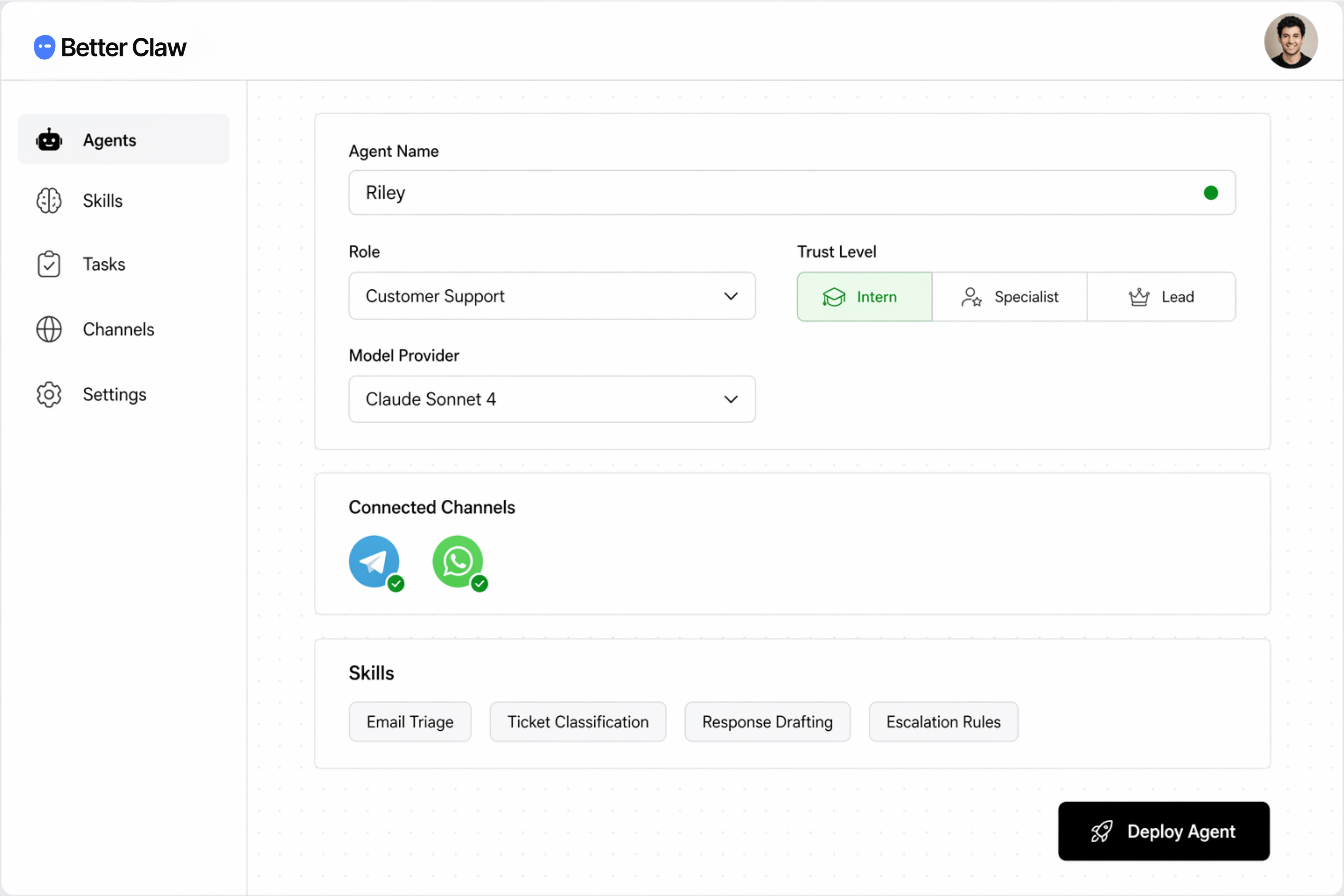
Visual Agent Builder
Replaces config.yaml, SOUL.md, and AGENTS.md. Point-and-click. Non-technical team members can ship agents.
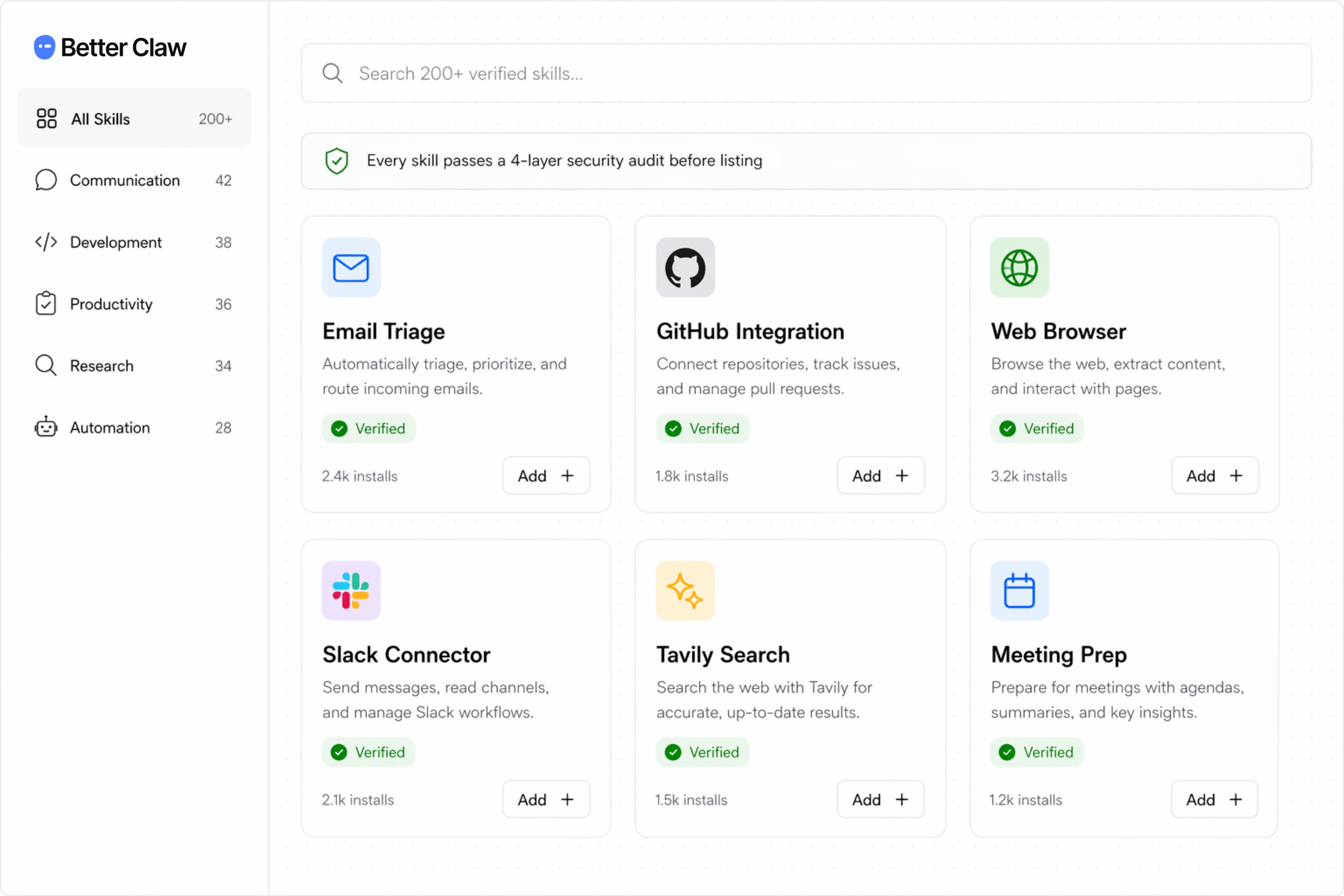
Verified Skills Marketplace
200+ skills, each through a 4-layer audit. 824+ submissions rejected. Hermes ships 118 bundled with no public audit process.
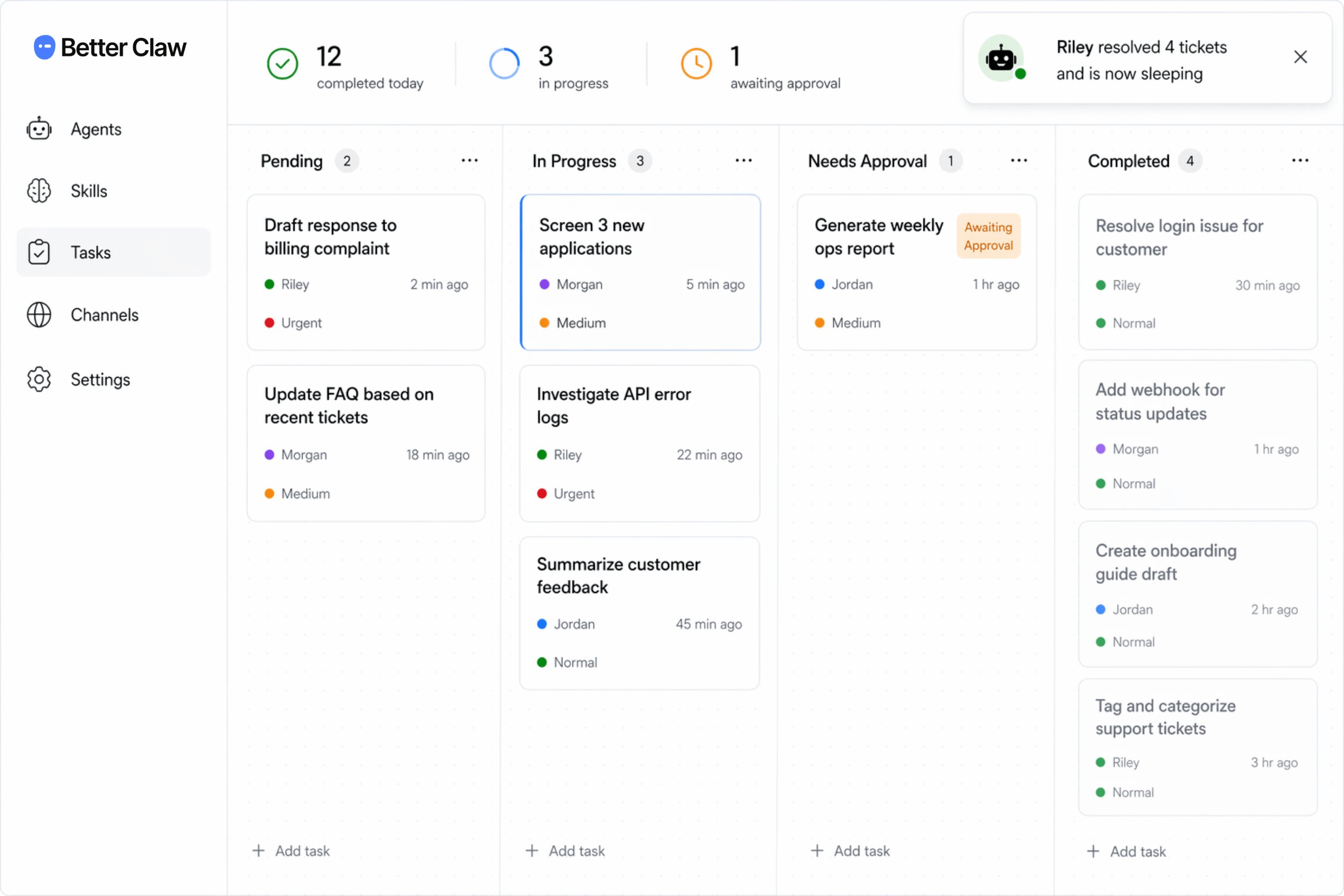
Trust Levels & Kill Switch
Intern → Specialist → Lead with action approval. Per-agent spending caps. One-click kill switch from any device.
5 Key Differences Between BetterClaw and Hermes Agent
The comparison table covers everything, but five differences have the biggest practical impact on which platform fits your use case.
1. Setup Philosophy: Browser vs. Terminal
Hermes Agent requires Docker (or alternative backends), Python 3.11, a VPS, and command-line proficiency. The first agent boots in 30 minutes if you know what you’re doing - longer if you don’t. config.yaml, SOUL.md, AGENTS.md all live on your filesystem. Updates and patches are your responsibility.
BetterClaw signs you up, runs you through a visual builder, and your agent is live in 60 seconds. Nothing to install. Nothing to configure beyond pointing-and-clicking. Updates ship to managed infrastructure - you never see them.
If you enjoy infrastructure work, Hermes’s approach is satisfying. If you want the agent doing work by lunch, the 60-second deploy isn’t a marketing line - it’s the actual setup time.
2. Self-Learning Loop: Hermes’s Killer Feature
After completing a task, Hermes auto-writes a reusable skill file documenting what it did. Next time a similar task arrives, it loads that skill instead of figuring it out from scratch. Nous Research benchmarks show 40% faster completion on similar tasks after 20+ accumulated skills. This is real and measurable.
BetterClaw learns implicitly. Persistent memory across sessions, trust levels that progress with demonstrated performance, pattern recognition through accumulated context. No skill files written, but your agent does get better at your specific workflows over time.
Hermes’s 40% improvement is domain-specific - a skill from "summarize a GitHub PR" doesn’t help with "plan a database migration." Cross-domain generalization is unsolved. The learning loop is real, but the improvement is narrow.
3. OAuth Integrations: 10 Seconds vs. 30 Minutes
BetterClaw connects to Gmail, Google Calendar, HubSpot, GitHub, Slack, Jira, Linear, LinkedIn, Airtable, and 15+ more services via one-click OAuth. The whole connection takes about 10 seconds per service. The agent has access immediately.
Hermes requires manual API setup for each integration. You register an OAuth client, generate credentials, paste them into config files, restart the agent. 10-30 minutes per service - and you’re responsible for token rotation.
For 1-2 integrations, the difference is annoying but tolerable. For an agent that touches 5+ services (most useful agents), Hermes’s manual setup compounds into hours of yak-shaving.
4. Guardrails: Trust Levels vs. Full Access on Day One
BetterClaw starts every agent as an Intern - approval required for everything that touches the outside world. You promote to Specialist, then Lead as you build confidence. Action approval workflows for sensitive operations. One-click kill switch from any device. Per-agent spending caps enforced by the platform.
Hermes gives agents full access from the moment they boot. No built-in trust progression. No action approval workflows. No spending caps. The kill switch is "manually terminate the process." If your agent makes a $40 mistake at 3am, you find out in the morning.
For solo developers iterating on personal projects, full-access defaults are fine. For anything customer-facing or anyone managing budget, the lack of guardrails is a real operational risk.
5. Open Source: Audit Everything vs. Trust the Platform
Hermes is MIT licensed. You can read every line of code, fork it, modify it, run it commercially. If you have compliance requirements that mandate auditable code, or you want to extend the framework in directions the maintainers haven’t prioritized, Hermes is the only choice.
BetterClaw is a managed platform. The skill format is open and the LLM providers are open (BYOK with zero markup), but you don’t get the source for the platform itself. You trade audit access for the convenience of not running it.
If your security review requires source-code audit, Hermes wins by default. Most teams don’t actually do that audit - but if you do, this matters.
Does BetterClaw Have a Self-Learning Loop Like Hermes Agent?
This is the question everyone asks. Both platforms get better at your workflows over time - they just do it differently.
Observe → Plan → Act → Learn
After completing a task, Hermes auto-writes a skill file documenting what it did and how.
Skill Library Grows Over Time
Next time a similar task arrives, the agent loads the skill instead of figuring it out from scratch.
Measurable: 40% Faster After 20+ Skills
Nous Research benchmarks. Domain-specific - doesn’t generalize across unrelated workflows.
Caveat: No Auto-Pruning
Bad skills persist alongside good ones. You manage the skill library yourself.
BetterClaw: Implicit MemoryPersistent Memory Across Sessions
Encrypted hybrid search remembers facts, preferences, and context the agent has accumulated.
Trust Levels Progress
Intern → Specialist → Lead. Performance over time unlocks broader autonomy.
Pattern Recognition
Accumulated context shapes future responses. No skill files to manage.
Predictable, Not Sophisticated
Simpler architecture means fewer surprises. No bad-skill drift, no manual pruning.
Hermes’s learning is more sophisticated architecturally. BetterClaw’s is simpler but requires zero management. Both work. Pick the one that matches how much you want to maintain.
Hermes Agent Pricing vs BetterClaw: Total Cost of Ownership
Hermes’s monetary cost is lower than BetterClaw Pro. But when you include 1–3 hours of setup and 2–4 hours/month of maintenance at $50/hour, the real total flips. BetterClaw Free with a free LLM key is genuinely $0 with zero time investment beyond the 60-second signup.
BetterClaw Free
- 1 agent, 100 credits/month
- 3 connectors (single account)
- Infrastructure included
- BYOK with free models (Gemini, Groq, OpenRouter)
- Zero setup time, zero maintenance
BetterClaw Pro
- Everything in Free
- 5 agents, 12,000 credits/month
- Unlimited connectors + multi-account
- 2 team seats
- 24h email support
Hermes (Budget)
- Platform free (MIT)
- Hetzner VPS ~$5/mo
- DeepSeek API ~$2-10/mo
- + 1-3 hrs setup
- + 2-4 hrs/mo maintenance
Hermes (Premium)
- Platform free (MIT)
- DigitalOcean VPS ~$24/mo
- Claude Sonnet API $30-60/mo
- + 1-3 hrs setup
- + 2-4 hrs/mo maintenance
Who Should Pick Hermes Agent vs BetterClaw?
You’re a…
Solo Developer / Tinkerer
You enjoy infrastructure work. You want voice support, IDE integration, and a self-improving agent you can fork and extend. You’re comfortable with Docker, Python 3.11, and YAML.
You’re a…
Founder / Ops Team
You want agents working for your business this week. Your team includes non-technical people who need to build and manage agents. Trust levels, spending caps, and OAuth integrations matter more than fork-ability.
You’re a…
Team With Both Needs
You want Hermes for dev workflows in your IDE (with the self-learning loop accumulating coding skills) and BetterClaw for business operations (support triage, lead qualification, ops reporting). Different tools for different jobs.
You want a self-improving agent that creates reusable skills.
Hermes’s closed learning loop auto-generates skill files from completed tasks. For repetitive domain-specific workflows (same PR review format, same research template), this compounds into a measurable 40% speedup after ~20 skills accumulated.
You need voice support out of the box.
Built-in TTS/STT across Edge TTS, ElevenLabs, OpenAI TTS, and MiniMax. BetterClaw doesn’t support voice yet. If your workflow involves talking to your agent or hearing its output, Hermes is the only option.
You want your agent inside your code editor.
Native MCP Server Mode for VS Code, Cursor, Zed, and JetBrains. The agent runs as part of your IDE instead of a separate channel. BetterClaw doesn’t have IDE integration yet.
You need Asian messaging platforms.
Hermes ships with WeChat, DingTalk, Feishu, QQ Bot, Mattermost, and Matrix. If your audience or team uses these, Hermes covers them out of the box where most managed platforms don’t.
You want full open-source ownership.
Hermes is MIT licensed. Fork it, modify it, run it commercially, audit every line. If your compliance requirements mandate source-code review, BetterClaw’s managed model isn’t a fit.
You’re comfortable with infrastructure work.
Docker, Python 3.11, terminal-based config files, manual API setup, monthly patches. If you enjoy that work and want fine-grained control, Hermes gives you everything BetterClaw abstracts away.
Where BetterClaw Is the Better Choice You want an agent doing real work by end of day.
Browser-based setup, visual agent builder, one-click channel connections, pre-built templates. Under 60 seconds from signup to a working agent. Hermes takes 30 minutes minimum if you know what you’re doing.
Your team includes non-technical people.
Operations managers, marketing leads, HR coordinators can build and manage their own agents through the visual dashboard. Hermes requires Docker, Python, and CLI proficiency that most non-engineers don’t have.
You need built-in trust levels and guardrails.
Every agent starts as an Intern - approval required for sensitive actions. Promote to Specialist, then Lead as confidence builds. Per-agent spending caps. One-click kill switch from any device. Hermes gives full access from the start.
You want secrets auto-purge by default.
API keys and OAuth tokens are AES-256 encrypted and auto-purge from agent memory after 5 minutes. Hermes uses standard credential storage. After the OpenClaw .env exfiltration incidents, this matters.
You want pre-vetted skills, not community uploads.
BetterClaw’s 200+ skills each pass a 4-layer security audit (code review, exfiltration analysis, prompt injection, permission scoping) before publication. 824+ submitted skills were rejected.
You want genuinely $0 total cost.
The Free plan runs 1 agent on 100 credits a month with BYOK and free LLM keys (Gemini, Groq, OpenRouter free tier). Zero infrastructure cost, zero maintenance time. Hermes’s software is free, but the VPS, LLM API, and 2-4 hours/month of your time aren’t.
You need 25+ one-click OAuth integrations.
Gmail, Google Calendar, HubSpot, GitHub, Slack, Jira, Linear, LinkedIn, Airtable, and more - 10 seconds per service. Hermes requires manual API client registration and credential setup per service.
You need Windows support.
BetterClaw is web-based, runs in any browser. Hermes does not support Windows natively (WSL2 only).
Can You Use Hermes Agent and BetterClaw Together?
Dev Workflows
Hermes inside your IDE for coding tasks - PR review, refactor planning, test scaffolding. The self-learning loop accumulates coding-specific skills over time.
Business Operations
BetterClaw for customer support, lead qualification, HR FAQ, ops reporting - the workflows where speed, OAuth, and trust levels matter more than learning loops.
Same Organization
Both run side-by-side. Same LLM API keys work on both (BYOK with zero markup). They serve complementary roles.
Coming from Self-Hosted Hermes (or OpenClaw)?
If you're running Hermes for everything and want to move business operations to BetterClaw, the move is straightforward. Both platforms support the same LLM providers, BYOK with zero markup, and the same chat platform integrations. Bring your agent's personality, channel preferences, and API keys over without starting from scratch. Most migrations take under an hour.
BetterClaw vs Hermes Agent: Common Questions
Is Hermes Agent free?
The software is free (MIT open source). But you need VPS hosting ($5-25/month) and LLM API costs ($2-60/month). Total: $7-85/month. BetterClaw’s free plan with a free LLM key is $0 total.
Does Hermes have a managed/cloud option?
No official managed option from Nous Research as of April 2026. Third-party services like FlyHermes exist but are separate products. BetterClaw is managed by default.
Is BetterClaw open source?
BetterClaw is built on the ZeroClaw Rust runtime. The platform is managed (not self-hostable). The skill format is open. LLM providers are open (BYOK). But you don’t get the source code to run your own BetterClaw instance.
Can I use the same LLM models on both?
Yes. Both support OpenRouter (200+ models), Anthropic, OpenAI, Google Gemini, DeepSeek, and custom endpoints. BYOK with zero markup on both.
Which is more secure?
Different strengths. Hermes has zero CVEs and a conservative security posture with namespace isolation. BetterClaw has AES-256 encryption, 5-minute secrets auto-purge, 4-layer skill verification, and built-in trust levels with action approval. Hermes gives you security through open-source transparency. BetterClaw gives you security through managed infrastructure and automated credential rotation.
Which is better for teams?
BetterClaw. Visual builder means non-technical team members can build and manage agents. Trust levels provide governance. OAuth integrations connect to business tools in one click. Hermes is built for individual developers and power users, not teams.
Does Hermes’s self-learning make it better long-term?
For domain-specific tasks that repeat frequently (same type of PR review, same research format), yes. The 40% improvement on repeated tasks is real. For general-purpose agent use across diverse tasks, the learning loop provides less compounding benefit. BetterClaw’s persistent memory gives you continuity without the explicit skill file management.
How does Hermes Agent compare to OpenClaw?
Hermes Agent is a separate framework, not a fork of OpenClaw. Hermes (95K+ stars in 7 weeks) emphasizes a closed self-learning loop and zero CVEs; OpenClaw (230K+ stars) has a larger skill marketplace (5,700+ on ClawHub) and longer track record. Both are self-hosted, both require Docker, both have similar setup overhead. Pick Hermes if the self-learning loop and conservative security posture matter most; pick OpenClaw if the skill ecosystem and community matter more. If you want a managed alternative to either, BetterClaw runs OpenClaw-compatible agents with secrets auto-purge, verified skills, and zero infrastructure.
Can I run both Hermes Agent and BetterClaw?
Yes. Many users run Hermes for development workflows (IDE integration, coding tasks) and BetterClaw for business operations (email triage, lead qualification, support). Different tools for different jobs. See how BetterClaw also compares to OpenClaw, self-hosting, and NemoClaw.
Try Both. Decide Based on Experience, Not Marketing.
Hermes Agent is free and open source. BetterClaw has a free plan you can start on today. Both support the same LLM models. The only way to know which fits your workflow is to try them.
Free plan to start · Pro $49/mo · BYOK with zero markup · No credit card