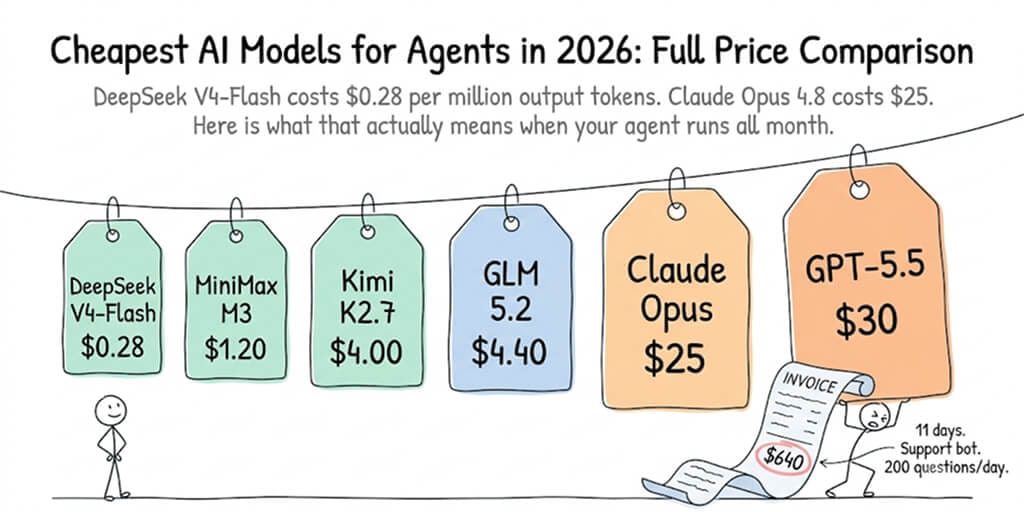
DeepSeek V4-Flash costs $0.28 per million output tokens. Claude Opus 4.8 costs $25. Here is what that actually means when your agent runs all month.
The agent ran for eleven days before anyone checked the invoice. Six hundred and forty dollars, for a support bot answering maybe two hundred questions a day.
Nothing was broken. The model was just expensive, the system prompt was long, and nobody had noticed that resending the same 12,000 tokens of tool definitions on every single turn was the entire bill.
But price per token is not price per task, and the gap between those two numbers is where most agent budgets die.
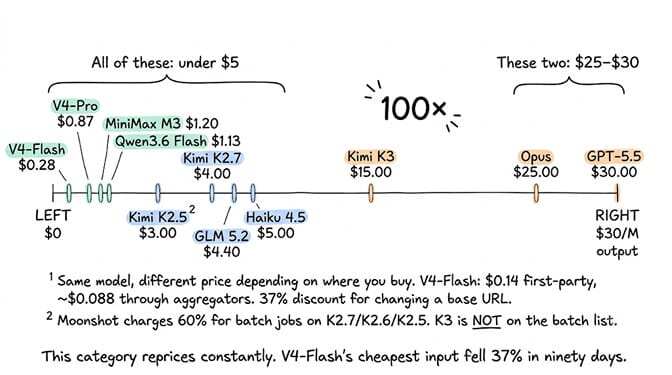
All prices below were checked on August 5, 2026. This category reprices constantly. DeepSeek V4-Flash's cheapest available input price fell 37% in ninety days.
The price table for agent-grade models
| Model | Input per 1M | Output per 1M | Cache-hit input | Context |
|---|---|---|---|---|
| DeepSeek V4-Flash | $0.14 | $0.28 | $0.003 | 1M |
| DeepSeek V4-Pro | $0.435 | $0.87 | $0.0036 | 1M |
| MiniMax M3 | $0.30 | $1.20 | Varies by provider | 1M |
| Qwen3.6 Flash | $0.19 | $1.13 | Varies | Large |
| Kimi K2.5 | $0.60 | $3.00 | $0.15 | 256K |
| Kimi K2.6 / K2.7 Code | $0.95 | $4.00 | $0.19 on K2.7 | 262K |
| GLM 5.2 | $1.40 | $4.40 | Yes, published | 1M |
| Claude Haiku 4.5 | $1.00 | $5.00 | Yes | Large |
| Kimi K3 | $3.00 | $15.00 | $0.30 | 1M |
| Claude Opus 4.8 | $5.00 | $25.00 | Yes | 1M |
| GPT-5.5 | $5.00 | $30.00 | Yes | 1.05M |
Two things worth knowing before you read another row. Moonshot charges 60% of standard rate for eligible batch jobs on K2.7 Code, K2.6, and K2.5, though K3 is not on the batch list. And the same model costs different amounts depending on where you buy it: DeepSeek V4-Flash lists $0.14 first-party but routes around $0.088 through some aggregators, which is a 37% discount for changing a base URL.
What agent workloads actually consume
Here is where the standard pricing article stops being useful.
Chat workloads are input-heavy. You send a question, you get a paragraph. Agent workloads are the opposite shape. An agent reasons before it acts, emits tool calls, reads the results, reasons again, and repeats. Every one of those loops produces output tokens.
Output is what bills you. Sort the table by input price and DeepSeek and Qwen look close. Sort by output and the spread opens to more than 100x.
Then there is the cost that appears on no pricing page at all: thinking tokens. A model in reasoning mode can produce a thousand tokens of internal deliberation before a single token of answer. That is why Moonshot cutting thinking tokens by roughly 30% on K2.7 Code versus K2.6, at identical list prices, is a genuine price cut. And why a cheaper per-token model that is more verbose can lose to a pricier one that is terse.
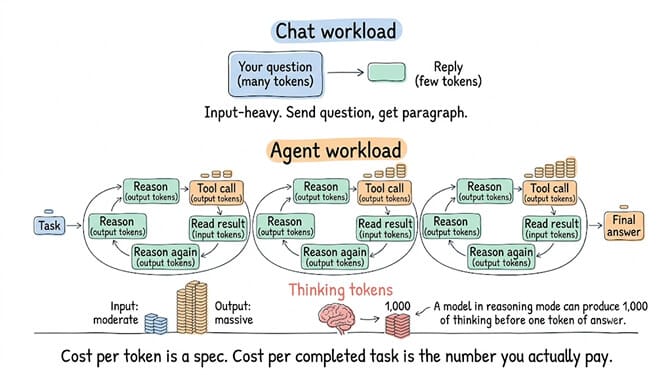
Cost per token is a spec. Cost per completed task is the number you actually pay.
The lever almost nobody pulls is caching. Your agent resends the same system prompt and the same tool definitions on every single turn. DeepSeek caches prompt prefixes automatically to disk, and cached input on V4-Flash costs $0.003 per million against $0.14 on a cache miss. That is roughly 47 times cheaper on the part of your prompt that never changes.
Moonshot publishes cache-hit rates too: $0.19 per million on K2.7 Code against $0.95 standard. Same idea, same size of win. Our writeup on prompt caching for agent cost savings covers how to structure prompts so the cacheable part actually stays stable.
What three real agents cost per month
Assumptions stated so you can argue with them: no caching applied unless noted, standard real-time rates, and token counts that include tool definitions and reasoning.
The personal daily driver. 30 tasks a day, roughly 15,000 input and 2,000 output tokens each. That is 13.5M input and 1.8M output a month.
- DeepSeek V4-Flash: about $2.40, or under $1 with caching working
- MiniMax M3: about $6.20
- Kimi K2.7 Code: about $20
- GLM 5.2: about $27
- Claude Opus 4.8: about $113
The small team support agent. 5,000 tasks a month at 8,000 input and 1,500 output each. 40M input, 7.5M output.
- DeepSeek V4-Flash: about $7.70
- MiniMax M3: about $21
- Kimi K2.7 Code: about $68
- Claude Haiku 4.5: about $78
- GLM 5.2: about $89
- GPT-5.5: about $425
The production coding agent. 500 runs a month, 200,000 input and 40,000 output tokens each, because repo context is enormous. 100M input, 20M output.
- DeepSeek V4-Flash: about $20, or under $9 with 80% cache hits
- DeepSeek V4-Pro: about $61
- Kimi K2.7 Code: about $175, or about $105 on batch rates
- GLM 5.2: about $228
- Claude Opus 4.8: about $1,000
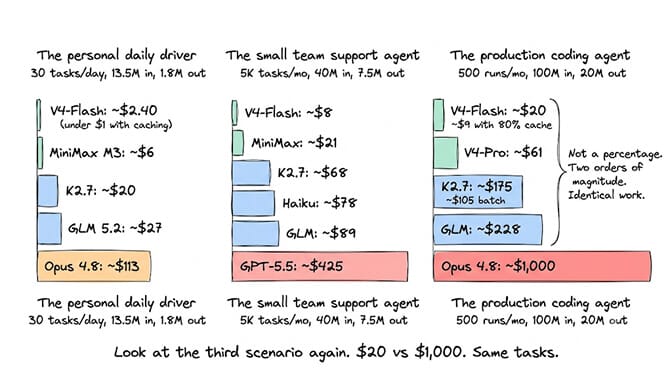
Look at the third scenario again. The gap between the cheapest and most expensive option is not a percentage. It is two orders of magnitude, on identical work.
Quality per dollar, where the interesting part is
Cheap is easy. Cheap and good enough is the actual question.
Here is the finding that should change how you shop. Five models cluster between 80.2% and 80.6% on SWE-bench Verified: DeepSeek V4 Pro Max, Gemini 3.1 Pro, MiniMax M3, Qwen3.7 Max, and Kimi K2.6. Within that four-tenths-of-a-point band, output prices run from $2.40 per million to $12. Same measured capability, 5x price spread.
Step up from that band to GPT-5.5 at 88.7% or Claude Opus 4.8 at 88.6% and you pay $25 to $30 per million output. Eight points of benchmark for roughly a 10x price step.
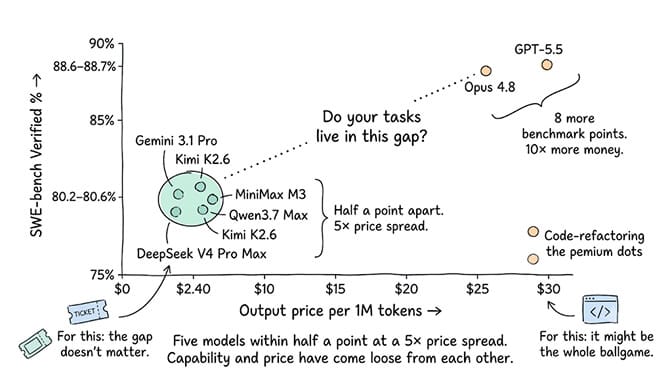
Whether those eight points matter depends entirely on whether your tasks live in the gap. For a support agent classifying tickets, they do not. For an agent refactoring production code unsupervised, they might be the whole ballgame.
On general intelligence, the Artificial Analysis Intelligence Index v4.1 puts GLM 5.2 at 51, ahead of MiniMax M3 and DeepSeek V4 Pro at 44 each. One honest caveat about that number: the index moved to v4.1 in June 2026 and reweighted toward agentic workloads, so MiniMax M3's score dropping from a previously reported 55 to 44 reflects a changed test, not a worse model. Do not plot scores from different index versions on the same chart.
Quick note on where we fit, since this is our blog. We are bring-your-own-key across 28 providers with zero markup on inference, which means we make exactly nothing whether you pick the $0.28 model or the $30 one. Our free plan is one agent with no credit card, and you paste your own DeepSeek or Moonshot key into it. That is the whole reason this article can be honest about which model is cheapest.
Which model to pick by budget
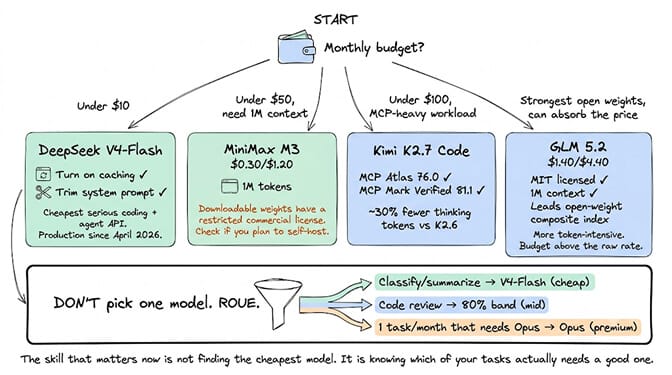
Under $10 a month. DeepSeek V4-Flash, with caching switched on and a system prompt you have actually trimmed. It is the cheapest serious coding and agent API available and it has been in production since April 2026.
Under $50 a month with a million-token context. MiniMax M3 at $0.30 and $1.20. The cheapest way to get a genuinely large context window for multimodal and agentic work. Note its downloadable weights carry a commercially restricted custom license, which matters if you plan to self-host later.
Under $100 and your workload is MCP-heavy. Kimi K2.7 Code. It leads tool-use benchmarks at 76.0 on MCP Atlas and 81.1 on MCP Mark Verified, and the reduced thinking-token count makes long agent runs cheaper than the list price suggests.
You want the strongest open weights and can absorb the price. GLM 5.2 at $1.40 and $4.40, MIT licensed, 1M context. It leads the open-weight field on the composite index, though it is described as more token-intensive, so budget above the raw rate.
Do not pick one model. Route. Classification and summarization go to V4-Flash. Code review goes to something in the 80% band. The one task a month that genuinely needs Opus goes to Opus. Our guide to model routing to reduce AI costs has the routing rules, and if you are running a self-hosted stack the cheapest provider options for OpenClaw covers the same ground from the framework side.
Worth separating two bills that people merge. Everything above is model spend. The platform running the agent is a second line entirely, and on a hyperscaler it fragments across a dozen meters — our AgentCore pricing breakdown shows how that side adds up.
How to switch between them without rebuilding anything
The good news is that this has become boring, which is the highest compliment available in infrastructure.
Almost every model on this page exposes an OpenAI-compatible endpoint. Switching providers is usually a base URL, an API key, and a model string. That is it. No SDK migration, no rewrite.
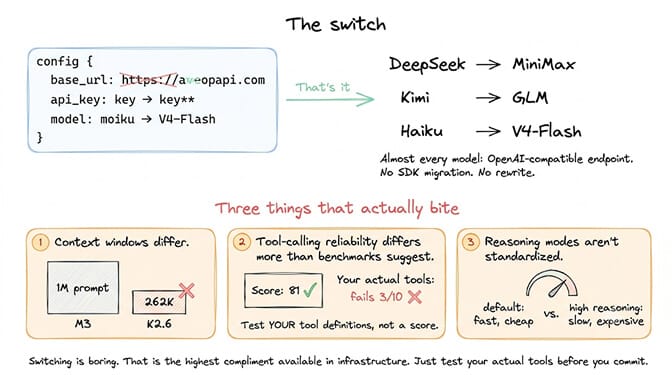
Three things that actually bite when you switch. Context windows differ, so a prompt that fits in MiniMax M3's million tokens will not fit Kimi K2.6's 262K. Tool-calling reliability differs more than benchmarks suggest, so test your actual tool definitions rather than trusting a score. And reasoning modes are not standardized, so a model that behaves at default settings may become expensive and slow at high reasoning effort.
On BetterClaw, switching is a dropdown. We support 28 model providers with bring-your-own-key and no inference markup, so you pay DeepSeek or Moonshot or Anthropic directly at their published rate and we take nothing from it. Point one agent at V4-Flash for volume work and another at something stronger for the hard tasks, with per-agent cost caps so a runaway loop cannot produce the $640 invoice from the top of this article. The provider setup docs cover the whole list.
If any of this resonated, start free with BetterClaw. One agent, every core feature, no credit card, your own API key. Pro is $49 a month for five agents, or $39 on annual, with a 7-day money-back guarantee. Full pricing is here. We charge for the platform, never for your tokens.
One closing thought worth more than any row in the table above. Two years ago the cheap models were bad and the good models were expensive, and picking was easy because you had no choice. That is over. Five models now sit within half a point of each other on the same benchmark at a 5x price spread, and the cheapest serious API costs a hundredth of the most expensive one. The skill that matters now is not finding the cheapest model. It is knowing which of your tasks actually needs a good one. Most teams have never asked. For a wider view of how rates are moving across every provider, our 2026 LLM pricing guide tracks the whole field.
Frequently Asked Questions
What is the cheapest AI model for agents in 2026?
DeepSeek V4-Flash is the cheapest serious option at $0.14 per million input tokens and $0.28 per million output, with automatic cache-hit input dropping to $0.003. It has a 1M-token context window and has been in production since April 2026. Some aggregators route it lower still, around $0.088 input, so check where you buy before assuming the first-party rate.
How does MiniMax M3 compare to GLM 5.2 on price and quality?
MiniMax M3 costs $0.30 input and $1.20 output against GLM 5.2 at $1.40 and $4.40, so M3 is roughly four times cheaper. GLM 5.2 leads on the Artificial Analysis Intelligence Index v4.1 at 51 against M3's 44, and ships under the more permissive MIT license. GLM is also described as more token-intensive, which narrows the real-world gap somewhat since you pay for the extra tokens.
How do I actually reduce my agent's token costs?
Start with prompt caching, because agents resend the same system prompt and tool definitions on every turn and cached input costs a fraction of standard rates. Then trim the system prompt itself, cap reasoning effort where the task does not need it, and route simple tasks to a cheaper model rather than sending everything to your best one. Those three together typically matter more than which model you picked.
Is a cheap model worth it, or do you get what you pay for?
Within the current mid-tier, you often do not get what you pay for. Five models sit between 80.2% and 80.6% on SWE-bench Verified while their output prices range from $2.40 to $12 per million tokens, which means capability and price have come loose from each other. The premium tier does buy roughly eight more benchmark points for a 10x price step, which is worth it only if your specific tasks fall in that gap.
Are Chinese-developed models like DeepSeek and Kimi safe to use for business workloads?
That depends on your data policy rather than the model's quality, and it is a question to answer deliberately rather than by default. If sending data to any given jurisdiction is a problem, several of these models ship open weights you can self-host, though you then trade per-token cost for GPU and operations cost. If it is not a problem, check the license terms specifically, since MiniMax M3's downloadable weights carry a commercially restricted custom license while GLM 5.2 is MIT and Kimi's line is Apache 2.0.