One costs half the price and scores higher on reasoning benchmarks. The other has the best computer-use capabilities in the industry. Here's how to pick the right one for your agent.
We ran the same agent workflow on both models for a week. A support triage agent that reads customer tickets, classifies priority, drafts responses, and escalates edge cases.
Qwen 3.7 Max was cheaper per run and handled the classification logic faster. Claude Sonnet 4.6 drafted better responses and caught more nuance in escalation decisions. The cost difference was real ($2.50 vs $3 per million input tokens). The quality difference was also real, but in different dimensions.
Here's the comparison most model benchmarks won't tell you: for AI agents, the right model depends on what your agent actually does, not which model has the higher headline score.
The numbers that matter for agent work
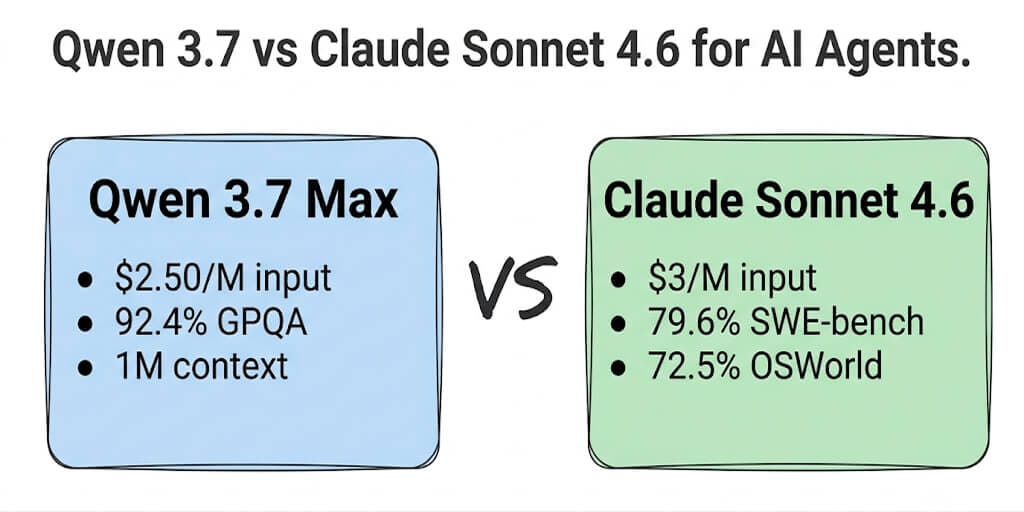
Qwen 3.7 Max launched May 20, 2026. API-only: Alibaba never released open weights for 3.7, and its open model in the next generation is Qwen 3.8 27B, which you can run locally (Qwen 3.8 on Ollama). 1M-token context window. Intelligence Index score of 56.6 on Artificial Analysis (5th overall, top Chinese model). Natively supports the Anthropic API protocol, which means agent frameworks built for Claude work with Qwen 3.7 without an adapter layer. Pricing: $2.50/$7.50 per million tokens via OpenRouter.
Claude Sonnet 4.6 launched February 17, 2026. Available on Anthropic API, Amazon Bedrock, and Google Vertex AI. Context: 1M tokens. SWE-bench Verified: 79.6%. OSWorld-Verified: 72.5% (within 0.2% of Opus 4.6). Pricing: $3/$15 per million tokens. Developers preferred it over the previous flagship Opus 4.5 in 59% of head-to-head comparisons.
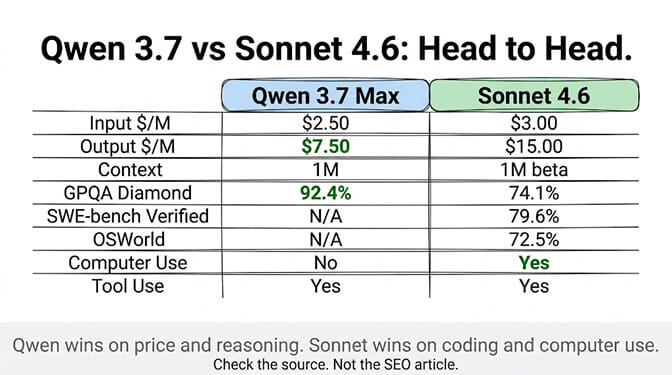
The pricing gap is real: Qwen 3.7 saves 17% on input and 50% on output compared to Sonnet 4.6. At scale, that compounds.
Where Qwen 3.7 wins: reasoning, math, and cost
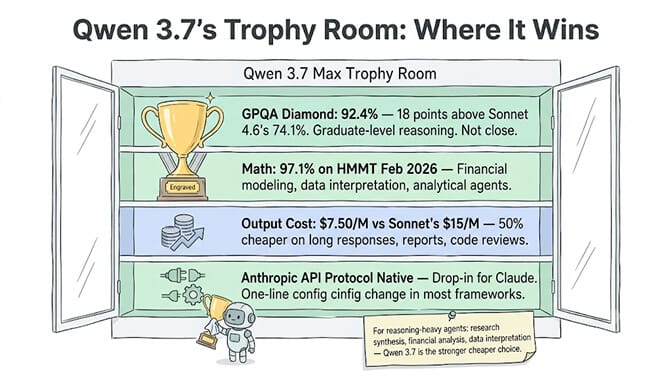
Qwen 3.7 Max dominates on pure reasoning benchmarks. 92.4% on GPQA Diamond versus Sonnet 4.6's 74.1%. That's an 18-point gap on graduate-level science questions. On math (97.1% on HMMT Feb 2026), it's similarly strong.
For agents that do heavy analytical work, research synthesis, data interpretation, or financial modeling, that reasoning edge matters. When your agent needs to reason through a complex multi-step problem before taking action, Qwen 3.7's higher reasoning ceiling gives it an advantage.
The cost structure is also significantly better on the output side. $7.50 per million output tokens versus Sonnet 4.6's $15. For agents that generate long responses (detailed reports, code reviews, research summaries), output tokens are where the bill lives. Qwen 3.7 is half the cost on output.
And the Anthropic API protocol compatibility is a clever move by Alibaba. It means you can test Qwen 3.7 as a drop-in replacement for Claude in most agent frameworks. Same API format, same tool-call schema. If your agent currently runs on Sonnet 4.6, switching to Qwen 3.7 for a test is often a one-line config change.
For a broader look at how Qwen 3.7 fits into the open-weight model space alongside MiniMax M3, check our GLM 5.2 vs Sonnet 4.6 vs MiniMax M3 comparison.
Where Sonnet 4.6 wins: coding, computer use, and MCP
Sonnet 4.6's strength is in the agent capabilities that go beyond pure reasoning.
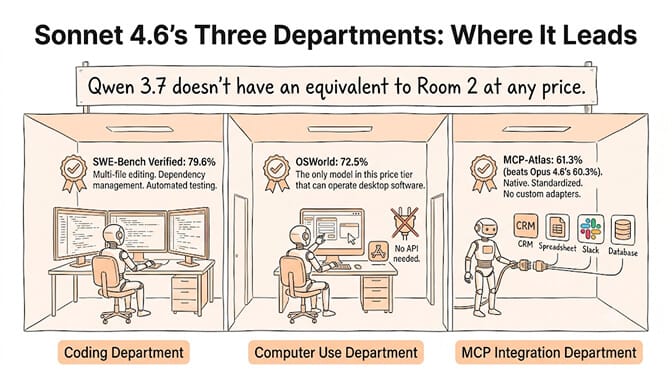
Computer use is the biggest gap. Sonnet 4.6 scores 72.5% on OSWorld-Verified, meaning it can control a desktop environment, interact with GUIs, fill out forms, and operate software. Qwen 3.7 doesn't have a comparable computer-use feature. If your agent needs to interact with applications that don't have APIs, Sonnet 4.6 is currently the only choice in this price tier.
Coding is stronger on Sonnet 4.6. 79.6% on SWE-bench Verified. Qwen 3.7 doesn't yet have independently verified SWE-bench scores published (vendor-reported numbers exist, but independent verification is pending). In the Claude Code IDE, Sonnet 4.6 handles multi-file editing, dependency management, and automated testing across large codebases with high reliability.
MCP (Model Context Protocol) support is native to Sonnet 4.6. MCP lets your agent connect to external data sources and tools through a standardized protocol. Sonnet 4.6 scored 61.3% on MCP-Atlas, actually beating Opus 4.6's 60.3%. For multi-tool agent workflows where the agent needs to pull data from a CRM, update a spreadsheet, and send a Slack notification in one sequence, MCP support matters. Qwen 3.7 supports the OpenAI and Anthropic API protocols for tool calling but doesn't have native MCP integration.
Safety and alignment are meaningfully better on Sonnet 4.6. Improved prompt injection resistance versus earlier Sonnet versions, with Constitutional AI baked in. For agents processing untrusted input (customer emails, web-scraped content, user uploads), Sonnet 4.6's safety profile reduces the risk of the agent being manipulated through adversarial prompts.
The cost math for agent workloads
This is where the comparison gets concrete.
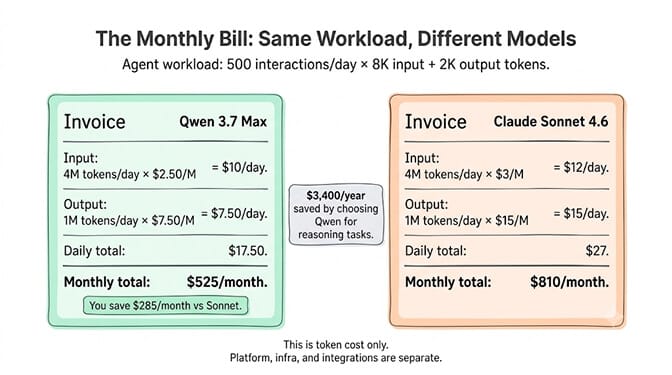
Take a typical agent that processes 500 interactions per day, with an average of 8,000 input tokens and 2,000 output tokens per interaction.
Qwen 3.7 Max: 4M input tokens/day × $2.50/M = $10. Plus 1M output tokens/day × $7.50/M = $7.50. Total: $17.50/day, roughly $525/month.
Claude Sonnet 4.6: 4M input tokens/day × $3/M = $12. Plus 1M output tokens/day × $15/M = $15. Total: $27/day, roughly $810/month.
That's a $285/month difference for the same workload. Over a year, $3,400 saved. For a startup running multiple agents, the gap widens fast.
But that's only the token cost. The total cost includes the agent platform, infrastructure, integrations, and monitoring. BetterClaw handles all of that with zero inference markup via BYOK. You pay Qwen or Anthropic directly. We don't take a cut on your token spend. Free plan with 1 agent and 100 credits a month, $49/month for Pro. Pricing details here.
The MCP factor for multi-agent workflows
MCP deserves a dedicated section because it changes the comparison for complex agent setups.
MCP (Model Context Protocol) is Anthropic's open standard for connecting AI models to external tools and data sources. It's rapidly becoming the de facto integration layer for agent frameworks. Hermes Agent, OpenClaw, Claude Code, and dozens of other tools now support MCP servers.
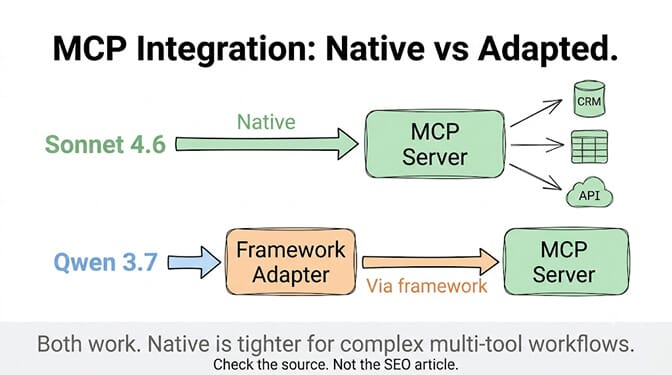
Sonnet 4.6 has native MCP support. When your agent needs to call a database, query a CRM, or interact with a third-party API, MCP provides a standardized way to do it without custom integration code for each tool.
Qwen 3.7 supports the Anthropic API protocol (which includes tool calling), and can work with MCP servers through agent frameworks that handle the MCP layer. But the integration isn't as tight as Sonnet 4.6's native support, and you're relying on the framework to bridge the gap.
For simple agent workflows (1 to 3 tools), this difference doesn't matter much. For complex multi-tool workflows with 10+ integrations, native MCP support reduces friction. BetterClaw's platform handles 25+ OAuth integrations natively, abstracting the MCP layer entirely regardless of which model you choose.
Our recommendation
Choose Qwen 3.7 Max if: Your agent is reasoning-heavy (analysis, research, financial modeling). You need the lowest cost per token, especially on output. You're comfortable with API-only access (3.7 has no open weights; for a local model, look at Qwen 3.8 27B). You want to test a Claude alternative without rewriting your agent (Anthropic API protocol compatible).
Choose Claude Sonnet 4.6 if: Your agent does coding work (SWE-bench 79.6%). You need computer use (GUI interaction, form filling). You want native MCP support for complex multi-tool workflows. Safety and prompt injection resistance are priorities (untrusted inputs).
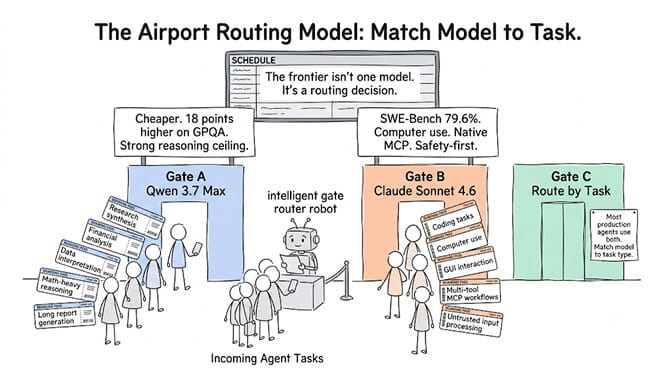
Use both in a routing setup if: You're optimizing for cost and capability simultaneously. Route reasoning-heavy tasks to Qwen 3.7 (cheaper, stronger on GPQA). Route coding and tool-use tasks to Sonnet 4.6 (better SWE-bench, native MCP). Gartner projects 40% of enterprise applications will embed AI agents by end of 2026. The teams that win will be the ones that treat model selection as a routing decision, not a one-time choice.
If any of this resonated, give BetterClaw a look. Free plan with 1 agent and 100 credits a month. $49/month for Pro. Connect Qwen 3.7, Claude Sonnet 4.6, or any of our 28+ supported providers via BYOK with zero inference markup. Your first deploy takes about 60 seconds. We handle the infrastructure. You pick the model that fits.
Start free here. | See full pricing.
The real takeaway
Six months ago, comparing a Chinese open-weight model to Anthropic's flagship mid-tier would have felt like comparing apples to something from a different grocery store entirely. The benchmarks wouldn't be close. The pricing wouldn't be comparable. The tool-use compatibility wouldn't exist.
That's no longer the case. Qwen 3.7 scores higher than Sonnet 4.6 on GPQA Diamond by 18 points. Sonnet 4.6 leads on SWE-bench by a wide margin. Both cost between $2.50 and $3 per million input tokens. Both support tool calling. Both have million-token context windows.
The frontier isn't one model anymore. It's a set of models, each strong in different dimensions, and the smart move is matching the model to the task. That's what BYOK platforms are built for.
Frequently Asked Questions
What are the main differences between Qwen 3.7 and Claude Sonnet 4.6 for AI agents?
Qwen 3.7 Max excels at reasoning and math (92.4% GPQA Diamond vs 74.1%) and costs less ($2.50/$7.50 vs $3/$15 per million tokens). Claude Sonnet 4.6 excels at coding (79.6% SWE-bench Verified), computer use (72.5% OSWorld), and has native MCP support for multi-tool agent workflows. Both have million-token context windows. Choose based on what your agent does most.
How does Qwen 3.7 compare to Sonnet 4.6 on coding benchmarks?
Claude Sonnet 4.6 has a clear lead on independently verified coding benchmarks: 79.6% on SWE-bench Verified and 59.1% on Terminal-Bench 2.0. Qwen 3.7 has vendor-reported coding scores but independent verification is still pending as of mid-2026. For production coding agents, Sonnet 4.6 has a more established track record with third-party validation from Cursor, GitHub, and Cognition.
How do I use Qwen 3.7 as a drop-in replacement for Claude in my agent?
Qwen 3.7 natively supports the Anthropic API protocol, so most agent frameworks that work with Claude can switch to Qwen 3.7 with a one-line config change (update the base URL and API key). In BetterClaw, switch providers in the visual builder by pasting your OpenRouter or Alibaba Cloud API key. No code changes, no framework rewiring. The BYOK model means you can test both models on the same agent and compare results.
Is Qwen 3.7 cheaper than Claude Sonnet 4.6 for agent workloads?
Yes. Qwen 3.7 Max costs $2.50/$7.50 per million tokens versus Sonnet 4.6's $3/$15. The input difference is modest (17%), but the output difference is 50%. For a typical agent processing 500 interactions per day, Qwen 3.7 costs roughly $525/month versus Sonnet 4.6's $810/month. BetterClaw adds zero inference markup on top of either model, starting at $0/month on the free plan.
Can I use both Qwen 3.7 and Sonnet 4.6 in the same agent setup?
Yes. BetterClaw supports multi-provider BYOK configurations. You can route reasoning-heavy tasks to Qwen 3.7 (where it's stronger and cheaper) and coding or tool-use tasks to Sonnet 4.6 (where it excels). This hybrid approach optimizes both cost and capability. Both models support tool calling and function calling natively, and Qwen 3.7's Anthropic API compatibility makes the routing straightforward.