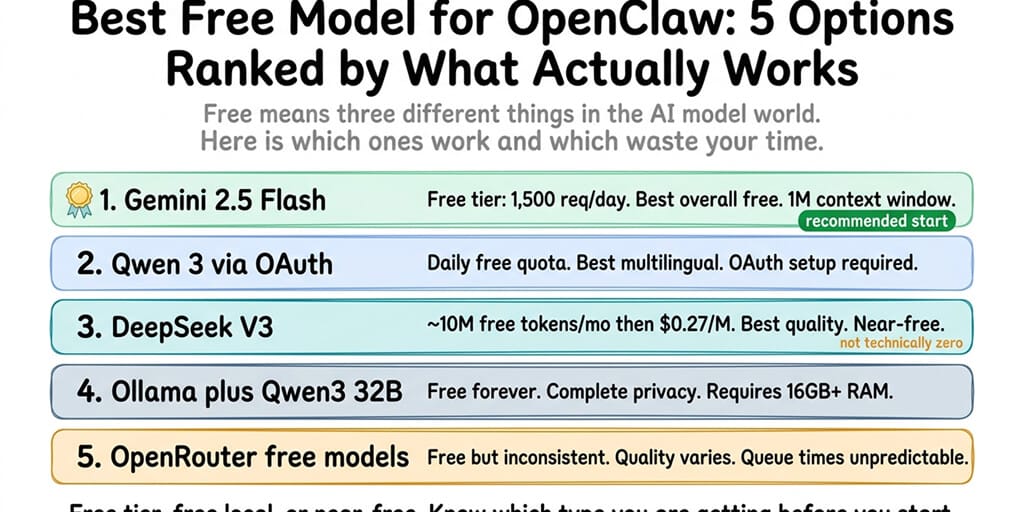
OpenClaw free models list
This is the OpenClaw free models list we keep current: every model with a free tier or a free local run that works with OpenClaw's tool calls. Limits last checked against each provider's own docs on October 9, 2026, and updated whenever a provider changes them.
| Model | Where to get it | Free or paid | Works with tools | Notes |
|---|---|---|---|---|
| Gemini 3.8 Flash | Google AI Studio | Free tier | Yes | Current #1 pick. Fast, reliable, no billing needed. |
| Qwen3.8-27B | Groq (free plan) | Free (30 req/min, 1,000 req/day, 200K tokens/day) | Yes | Best free option on Groq. Strong for coding. |
| gpt-oss-120b | Groq or Cerebras (free) | Free (Groq: same limits as Qwen; Cerebras: 5 req/min, 1M tokens/day) | Yes | Solid second key if Qwen's daily cap runs out. |
| GLM-4.7-Flash | Z.ai | Free | Yes | Z.ai's free API model. The newer GLM-5.3-Flash is paid ($0.15/$0.50). |
OpenRouter :free models | OpenRouter | Free (50 req/day, 1,000 after a $10 top-up) | Yes, on many | One key, many models. Availability changes without notice. |
| DeepSeek Flash | DeepSeek API | Not free: $0.15/$0.60 per M tokens off-peak | Yes | The near-free step up. Needs a topped-up balance. |
| Llama 3.3 70B | Ollama (local) | Free (your hardware) | Yes | No longer on Groq's or Cerebras's free tier. Needs 48 GB+. |
| Qwen3.8 27B | Ollama (local) | Free (your hardware) | Yes | Best local option. Plan on 24 GB+ VRAM. |
| Gemma 4 12B | Ollama (local) | Free (your hardware) | Yes | Best under 12 GB VRAM. |
Last verified: October 9, 2026. Models and free-tier availability change frequently.
The best free models for OpenClaw in October 2026 are Gemini 3.8 Flash (free tier on Google AI Studio), Qwen3.8-27B (free on Groq, or local via Ollama), and GLM-4.7-Flash (free on Z.ai's API). All support tool calling and work as OpenClaw agent models.
The best free model for OpenClaw is Gemini 3.8 Flash on Google AI Studio's free tier: no billing needed, a 1M-token context window, and function calling. The best second free option is Qwen3.8-27B on Groq's free plan, which is fast and genuinely free, with tight per-minute token limits. For privacy or offline work, Ollama runs qwen3.5:9b free forever on a 16GB machine, and qwen3.8:27b is the quality pick if you have 24GB or more. When you outgrow free tiers, DeepSeek's deepseek-flash is the cheapest paid step up.
Update (September 14, 2026): Two things settled since this post was written. Anthropic banned Claude Pro/Max subscriptions from third-party tools like OpenClaw on April 4, 2026, then reversed the ban on May 13. The replacement "Agent SDK credit" system was scheduled for June 15 — and Anthropic paused it on the day it was due to take effect. It never activated, there is no credit to claim, and Agent SDK usage,
claude -p, and third-party tools built on the Agent SDK continue drawing from Pro, Max, Team, and Enterprise subscription limits exactly as before. Anthropic says it is reworking the plan and will give notice before any revised version ships. Whether a given third-party tool works on a subscription right now is still unsettled, and Anthropic has signalled the terms may change again, so an API key is the reliable way to run Claude in OpenClaw; the free picks below remain the zero-cost path.
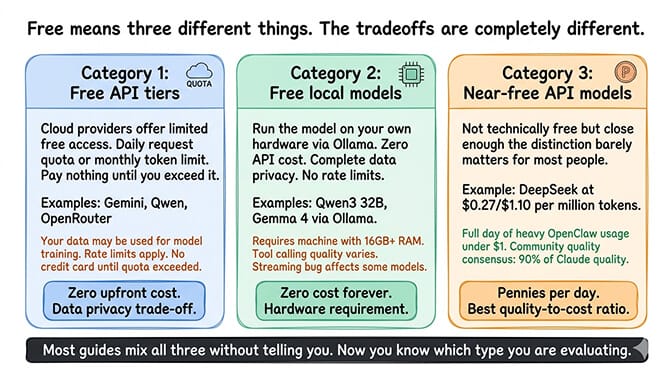
"Free" means three different things in the AI model world: free API tiers with rate limits and potential data training, free local models that require your own hardware, and near-free API models that cost pennies but aren't actually zero. I tested all three categories. Here's what works, what doesn't, and where the traps are.
Cheapest models for OpenClaw (not free, but close)
If you need better quality or higher limits than free tiers offer, these are the cheapest paid options that work well with agents:
| Model | Cost per M tokens (input/output) | Why it's worth paying |
|---|---|---|
| Sonnet 5.5 | $2 / $10 | Best quality-to-cost ratio for agent work |
DeepSeek Flash (deepseek-flash) | $0.15 / $0.60 off-peak ($0.30 / $1.20 at peak) | Cheapest usable model for classification and triage |
| GLM-5.3-Flash | $0.15 / $0.50 | Same price tier as DeepSeek, MIT license |
| Gemini 3.8 Flash (paid tier) | $0.75 / $3.75 until Dec 31, 2026, then $1.50 / $7.50 | Higher limits than the free tier, and your data isn't used for training |
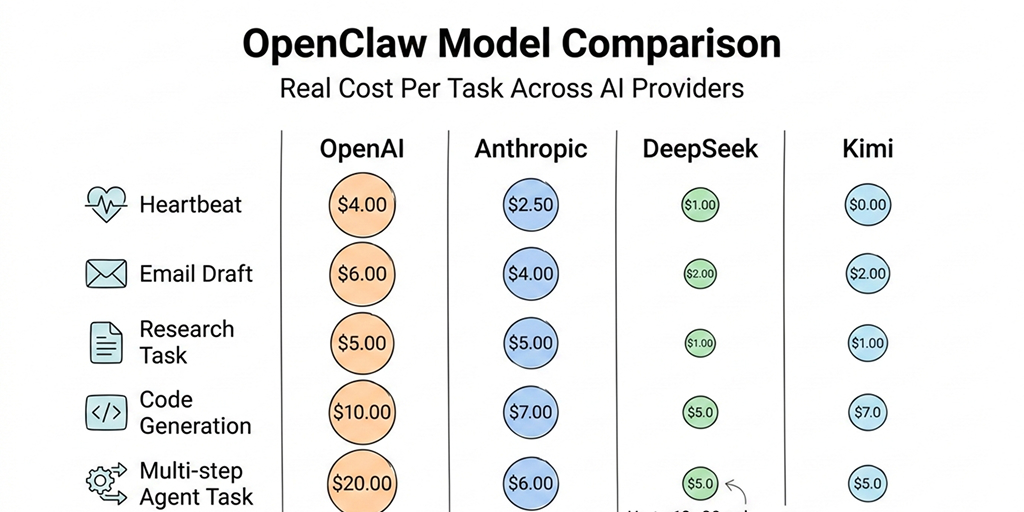
At typical agent usage (200 calls a day at ~2,000 tokens per call, taken as 1,500 input and 500 output, no caching):
- GLM-5.3-Flash: ~$0.10/day = ~$2.85/month
- DeepSeek Flash (off-peak): ~$0.11/day = ~$3.15/month
- Gemini 3.8 Flash (paid): ~$0.60/day = ~$18/month
- Sonnet 5.5: ~$1.60/day = ~$48/month
- Opus 5.5 ($4 / $20): ~$3.20/day = ~$96/month
Prompt caching cuts the input side substantially on repeated context. BYOK on BetterClaw means you pay these providers directly with zero markup. For per-task costs across Claude Haiku 5.5, Qwen3.8 Flash, MiniMax M3 and more, see our guide to the cheapest model for OpenClaw.
The three categories of "free" (this matters)
Category 1: Free API tiers. Cloud providers offer limited free access. You get a quota (requests or tokens per minute and per day), pay nothing, and your data may be used for model training. Gemini, Groq, and OpenRouter fall here.
Category 2: Free local models. You run the model on your own hardware via Ollama. Zero API cost. Complete data privacy. But you need a machine with 16GB+ RAM for usable models, and tool calling quality varies significantly.
Category 3: Near-free API models. DeepSeek's deepseek-flash (now DeepSeek-V4.1-Flash) at $0.15 / $0.60 per million input/output tokens off-peak. Not technically free, but light personal usage costs pennies. Close enough to free that the distinction barely matters for most people.
Most "best free model" guides mix all three without telling you. The tradeoffs are completely different.
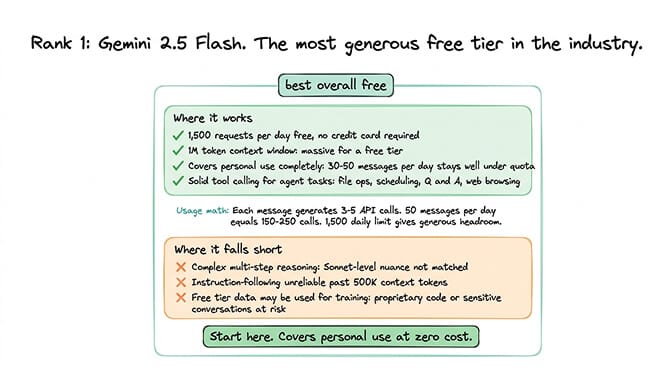
1. Gemini 3.8 Flash (best free API tier overall)
The name to use has moved again. Google released Gemini 3.8 Flash (gemini-3.8-flash) as a stable model on September 2, 2026, and it is on the free tier. The model most guides still recommend, Gemini 3 Flash, only exists as gemini-3-flash-preview, which Google's pricing page now labels its "legacy Flash model". Point OpenClaw at 3.8 Flash instead. It has a 1,048,576-token input limit and supports function calling, which is what an agent needs.
Pro models are the part of the free tier to stop counting on. Gemini 3.1 Pro Preview is "Not available" on the free tier, so anything Pro-level you see in an older guide is a paid feature now. The free Gemini API tier is effectively a Flash tier.
One thing to stop copying from guides, including the earlier version of this one: there are no fixed free-tier rate-limit numbers to copy. Google's rate-limits page no longer publishes per-model free-tier tables. It says limits "depend on a variety of factors" and that "specified rate limits are not guaranteed." The only authoritative figure is the one for your own project at aistudio.google.com/rate-limit, and the official pricing page shows which models are currently free.
For a personal OpenClaw agent doing a modest number of messages per day, the free tier is usually enough. Remember that each message generates several API calls for reasoning, tool use, and the response, so check your per-minute and per-day ceilings in AI Studio against calls, not messages.
Where it works
Simple agent tasks. File operations. Scheduling. Q&A. Web browsing. For routine agent work the quality is well clear of what the free tier offered a generation ago.
Where it falls short
Complex multi-step reasoning and creative writing quality. If your tasks require Sonnet-level nuance, Flash won't match it. And because Google doesn't guarantee free-tier capacity, don't build anything business-critical on it.
The catch
Google's pricing page states free-tier content is "used to improve our products"; paid-tier content is not. If you're processing proprietary code or sensitive conversations, this matters. Use the paid API (3.8 Flash is $0.75 / $3.75 per million input/output tokens through December 31, 2026, rising to $1.50 / $7.50 from January 1, 2027) or run local instead.
For the full model-by-model comparison including paid options, our model guide covers the complete roster.
Best Gemini model for OpenClaw
Gemini 3.8 Flash on Google AI Studio's free tier. It needs no billing to start, supports tool calling, and handles everyday agent workloads reliably. In OpenClaw, set the Google/Gemini provider with your AI Studio API key and use the model name gemini-3.8-flash (config below). On BetterClaw, connect the same key via BYOK on any plan, including Free.
Don't reach for Gemini Pro for agent work unless you specifically need its extra reasoning depth. Pro isn't on the free tier at all (Gemini 3.1 Pro Preview is paid-only), and Flash handles routine agent work (scheduling, file operations, Q&A, browsing) at no cost.
2. Qwen3.8-27B on Groq (best second free API)
This slot used to belong to Qwen via OAuth, which is gone (see the note at the end of this list). The best live replacement is the same model family, served free by someone else: Groq's free plan includes qwen/qwen3.8-27b, the model that is also the top local pick below.
Groq publishes its free-plan limits, which is refreshingly rare. For qwen/qwen3.8-27b they are 30 requests per minute, 1,000 requests per day, 8,000 tokens per minute, and 200,000 tokens per day. The same limits apply to openai/gpt-oss-120b and openai/gpt-oss-20b. Groq only asks for a payment method when you upgrade to its Developer tier. The model supports tool use, has a 131K-token context window on Groq, and runs at around 450 tokens per second, so agent turns feel close to instant.
Check your organisation's live numbers on Groq's limits page in the console, because Groq notes there can be exceptions to the published table.
Where it works
Interactive agent sessions where speed matters. Coding and tool-heavy tasks, where Qwen3.8 is strong. Anything you'd run on a local qwen3.8:27b but don't have the GPU for.
Where it falls short
The 8,000 tokens-per-minute cap is the real constraint. OpenClaw sends the system prompt, tool definitions, and conversation history on every call, so a long-running session with lots of context can hit the per-minute ceiling within a turn or two. Keep context lean, or use Groq for short sessions and Gemini for long ones. Groq also lists the model as Preview.
The catch
The 200,000 tokens-per-day cap goes faster than 1,000 requests suggests once context replays add up. For the cheapest providers once free tiers run out, our cost guide covers the paid options.
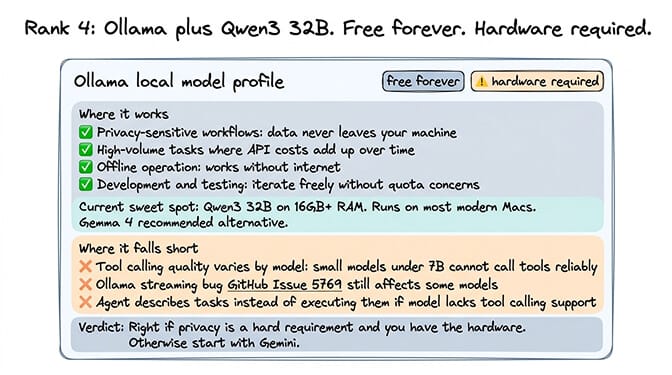
3. Best free local models for OpenClaw (Ollama)
Running models locally via Ollama costs nothing per token. Your data never leaves your machine. Complete privacy. No rate limits. No quota.
Sizing matters more than people expect. The download size on Ollama is only the weights, and context memory comes on top. qwen3.5:9b is a 6.6GB download, and Ollama's own OpenClaw docs put qwen3.5 at ~11GB VRAM, so it is the comfortable 16GB pick. gemma4:e4b is a 9.5GB download, and Ollama suggests ~16GB VRAM for gemma4, so on a 16GB machine it works but leaves little headroom. Both are tagged for tool use.
The local roster moved in August 2026, and this is the part most guides have not caught up on. qwen3.8:27b (released August 14, 2026, a dense 27B under Apache 2.0) is the current community pick for local agent and coding work. Its default q4_K_M build is an 18GB download with a 256K context window, so plan on 24GB or more. The other headline release, GLM-5.3-Flash (August 26, 320B total with 18B active), is not a realistic local model: Ollama only offers it as a :cloud tag. Read the skip section below before wiring it into an agent loop anyway.
If you run inference on your own hardware, everything is free. The cost is electricity and VRAM, not API calls.
| Model | Ollama tag | Size at Q4 | Tool calling | Best for |
|---|---|---|---|---|
| Qwen3.8 27B | qwen3.8:27b | 18 GB download, plan on 24 GB+ | Yes | Best all-round local model |
| Gemma 4 12B | gemma4:12b | 7.7 GB download, fits 12 GB | Yes | Best under 12 GB VRAM, plus image and audio input |
| Ornith-1.5-35B-A3B | hf.co/ornith-ai/Ornith-1.5-35B-A3B-GGUF:Q4_K_M | 21.7 GB (only 3B active, so it runs fast) | Yes | Coding agents on a 24 GB card |
| Qwen 3.5 9B | qwen3.5:9b | 6.6 GB download, ~11 GB VRAM for OpenClaw | Yes | Budget GPUs and 16 GB machines |
| Llama 3.3 70B | llama3.3:70b | 43 GB download, 48 GB+ | Yes | Quality-first, if you have the memory |
All of these run on Ollama. Pull with ollama pull <tag> (the Ornith build pulls straight from Hugging Face with ollama run). Use that Hugging Face tag for Ornith-1.5: Ollama's library build (ollama pull ornith-1.5) isn't tagged for tools, so agents get a "does not support tools" error. If you'd rather use the Ollama library, ornith:35b (Ornith 1.0) is tagged for tools. For which local models call tools reliably, see our OpenClaw tool-calling compatibility guide, and for hardware, benchmarks and the full setup, our Ornith 1.5 35B guide.
Note: Qwen 3.7 is NOT available on Ollama. It's API-only, with no open weights. Use Qwen 3.8 instead.
The setup is one command, and Ollama configures OpenClaw's bundled Ollama provider for you:
ollama launch openclaw --model qwen3.5:9b # or gemma4:e4b on 16GB
Where it works
Privacy-sensitive workflows. High-volume tasks where API costs add up. Offline operation. Development and testing.
Run these models for your BetterClaw agents with the BetterClaw desktop app: it connects Ollama on your computer to your agents and shows which models handle tools.
Where it falls short
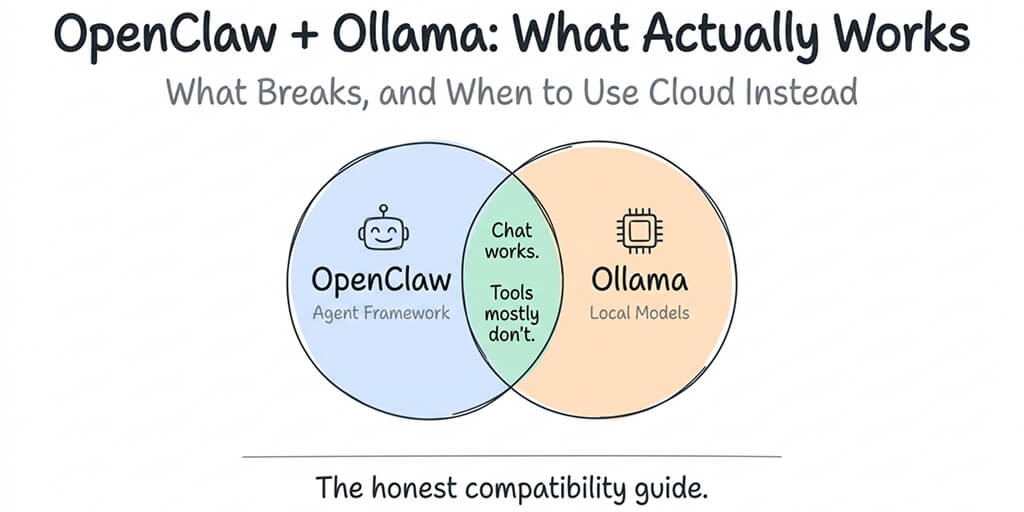
Use OpenClaw's native Ollama provider (baseUrl: http://127.0.0.1:11434, no /v1) rather than the OpenAI-compatible endpoint; ollama launch sets this up for you. Small local models (under 7B parameters) generally can't call tools reliably even with the correct provider. For the troubleshooting guide on local model tool calling, our Ollama guide covers which models work and which don't.
4. DeepSeek Flash (best quality per dollar, not free)
DeepSeek is not free. Its current docs don't publish a standard signup credit; they only say charges come from your "topped-up balance or granted balance". Check your billing dashboard before assuming you have free tokens. It earns a place here because it is the cheapest sensible step up once a free tier stops being enough.
The model changed again on September 10, 2026. DeepSeek released DeepSeek-V4.1-Flash and renamed the API model to deepseek-flash. V4-Flash is retired: the old deepseek-v4-flash name is still accepted but served by V4.1-Flash. The older deepseek-chat and deepseek-reasoner names were scheduled for discontinuation on July 24, 2026 and no longer appear in the docs, so don't use them in new configs.
Prices dropped with the release. deepseek-flash is $0.15 / $0.60 per million input/output tokens off-peak and $0.30 / $1.20 at peak, with cache hits at $0.003 off-peak. Peak hours are 01:00-04:00 and 06:00-10:00 UTC, Monday through Friday; everything else is off-peak. It has a 1M context window and supports tool calls.
Where it works
Nearly everything. DeepSeek's quality-to-cost ratio is hard to beat, and it's the default recommendation from multiple community guides for a reason. It is also enough to run a real agent on the free tier of an AI agent builder at very low cost.
Where it falls short
Peak hours cost double, so schedule heavy batch work off-peak. For complex reasoning that needs Opus-level depth, Flash won't match the premium models. That is what deepseek-v4-pro is for, at $0.66 / $1.98 off-peak. DeepSeek says it will keep serving V4-Pro after September 14, 2026, with billing unchanged.
The catch
You need a topped-up balance, so a card on file. For the cheapest providers including current DeepSeek pricing, our cost guide covers the specifics.
5. OpenRouter
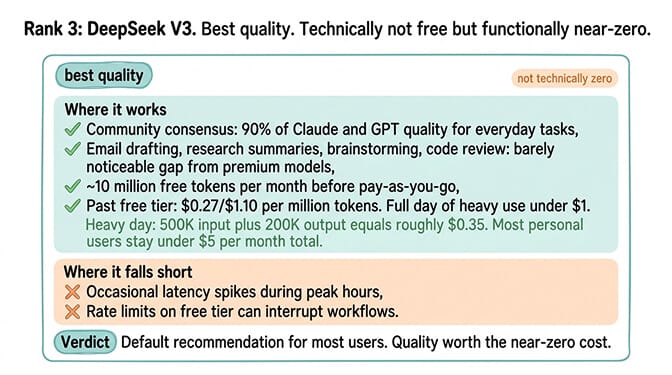
OpenRouter aggregates models from multiple providers. Model variants with a :free suffix route to free endpoints, at zero cost through a single API key.
The limits are published. Free variants are capped at 20 requests per minute. The daily cap is 50 requests per day if you have bought less than $10 of credits in total, and 1,000 requests per day once you have bought at least $10. Fifty requests is only a handful of agent messages, so the $10 top-up is effectively the price of making :free usable for OpenClaw.
Where it works
Experimentation. Trying different models without creating accounts with each provider. One API key, many models. It is also the fastest way to sanity-check whether a new release is worth configuring properly.
Where it falls short
Free model availability changes without notice. Quality of free endpoints varies. Queue times during peak hours can make the agent feel slow. The free models on OpenRouter are generally the smallest and least capable versions.
Best free model on OpenRouter for OpenClaw
OpenRouter currently lists 15 free models, 14 of which support tool calling. Qwen3.8-27B is not one of them on OpenRouter (only the paid qwen/qwen3.8-27b is listed), so use Groq for that model. The best free options for agent work as of October 2026:
nvidia/nemotron-3-ultra-550b-a55b:free— the largest free model on OpenRouter (550B total, 55B active), with tool support and a 1M context, for harder reasoning steps.google/gemma-4-31b-it:free— Gemma 4's top dense model, with tool support, a good fit for multimodal tasks.
Note: OpenRouter's free models have rate limits and may go offline. For production agents, a paid model on OpenRouter (credit purchases carry a 5.5% fee by card) or a direct API key is more reliable.
A note on Qwen OAuth (deprecated as of April 15, 2026)
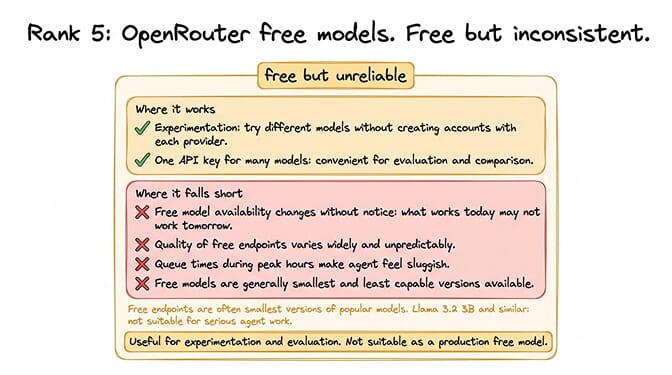
Qwen via OAuth used to rank near the top of this list. It is dead. Qwen's maintainers announced on April 13, 2026 that the free quota was cut from 1,000 to 100 requests a day, effective immediately, and that the Qwen OAuth free entry point would close completely on April 15, 2026 (QwenLM/qwen-code issue #3203). If an older guide tells you to run OpenClaw's qwen-portal-auth device-code login, skip it (OpenClaw GitHub issue #49557).
If Chinese, Japanese, or Korean workloads brought you here, Qwen is still the strongest choice for CJK agent work. The free routes are now Qwen3.8-27B on Groq (#2 above) or local qwen3.5:9b / qwen3.8:27b via Ollama. For a paid key, use Alibaba Cloud Model Studio.
The models we'd skip (with caveats)
A few free options come up in community threads but tend to disappoint for OpenClaw-style agent work. Two of these are "softer" calls — your mileage may vary, especially as the models keep updating.
The GLM-5 family, including GLM-5.3-Flash
Z.ai's GLM-5 line is technically excellent, and GLM-5.3-Flash (August 26, 2026) is a genuinely impressive release: 320B total parameters with 18B active, natively multimodal, 1M context, MIT licensed.
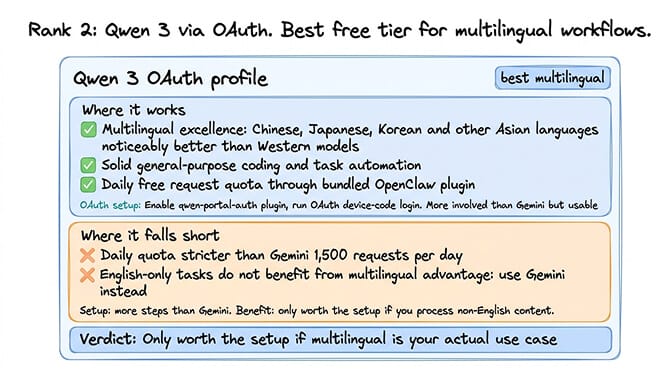
The problem is specific and it did not go away with the new version. Under agentic prompts — a complex system prompt, several tool definitions, tool_choice=auto — GLM-5.3-Flash's reasoning output can degenerate into an endless run of repeated characters, and the session hangs stuck on a tool call. Bug reports describe this across SGLang, vLLM, and OpenCode. Separately, forced tool calls with demanding JSON schemas can run all the way to max_tokens and return truncated arguments. That is precisely the shape of workload OpenClaw generates.
So the earlier caution on GLM-5 and GLM-5.1 carries forward rather than expiring. If you want to run it, put a repetition guard on thinking blocks and a hard reasoning budget in front of it, and test on your own workload first — our guide to picking a model for an OpenClaw agent covers where GLM fits against Sonnet and MiniMax. For a drop-in model with no such caveat, qwen3.8:27b (local or on Groq) is the safer pick.
Kimi "free tier"
There isn't really one on the API. Moonshot's recharge and rate-limit page says you "need to recharge at least $1 to start using" the API. The Kimi chat app is free; the API that OpenClaw would call is not. It can be a cheap option, but don't plan around it as a free one.
Any local model under 7B parameters
Tool calling is unreliable or nonexistent at this size — the agent will describe tasks instead of executing them. If you're going local, go 8B+ (qwen3.5:9b is the floor) or stick with a cloud free tier. For an honest look at the local Qwen line, our Qwen and Ollama review covers what runs locally and what doesn't.
Start with the Gemini 3.8 Flash free tier. It covers personal use at zero cost. Add Groq's free Qwen3.8-27B as a fast second key. Go local (Ollama) if data privacy is a hard requirement and you have the hardware. When free limits start getting in the way, DeepSeek's deepseek-flash is the near-zero-cost step up.
Which free model is right for you?
| Use case | Privacy needed? | Hardware available? | Pick |
|---|---|---|---|
| Personal assistant, low volume | No | No | Gemini 3.8 Flash (free tier, limits live per project in AI Studio) |
| Fast agent turns, short sessions | No | No | Qwen3.8-27B on Groq (free: 30 RPM, 1K RPD, 8K TPM, 200K TPD) |
| Sensitive data, privacy-first | Yes | Yes (24GB+) | Ollama + qwen3.8:27b |
| 16GB machine, privacy or offline | Yes | 16GB | Ollama + qwen3.5:9b (or gemma4:e4b, tighter fit) |
| High quality, budget-conscious | No | No | DeepSeek deepseek-flash ($0.15/$0.60 per M off-peak, not free) |
| Multilingual (CJK) | No | No | Qwen3.8 on Groq or local Qwen (free Qwen OAuth closed April 15) |
| Model experimentation | No | No | OpenRouter :free (50 RPD, 1,000 RPD after a $10 top-up) |
Quick-start configs
Setup snippets for the top three picks, plus DeepSeek for when you outgrow them:
# Gemini 3.8 Flash — get an API key at aistudio.google.com
export GEMINI_API_KEY="your_gemini_key"
# In OpenClaw config, set the Google/Gemini provider and model: gemini-3.8-flash
# Qwen3.8-27B on Groq — get a free API key at console.groq.com
export GROQ_API_KEY="your_groq_key"
# In OpenClaw config, set the Groq provider and model: qwen/qwen3.8-27b
# Ollama local (one command configures OpenClaw's Ollama provider)
ollama launch openclaw --model qwen3.5:9b   # gemma4:e4b on 16GB; qwen3.8:27b on 24GB+
# DeepSeek (paid, near-free) — sign up at platform.deepseek.com
export DEEPSEEK_API_KEY="your_deepseek_key"
# In OpenClaw config, set provider: deepseek, model: deepseek-flash
Full Ollama configuration (provider block, native /api/chat path, context window) is covered in our OpenClaw Ollama guide.
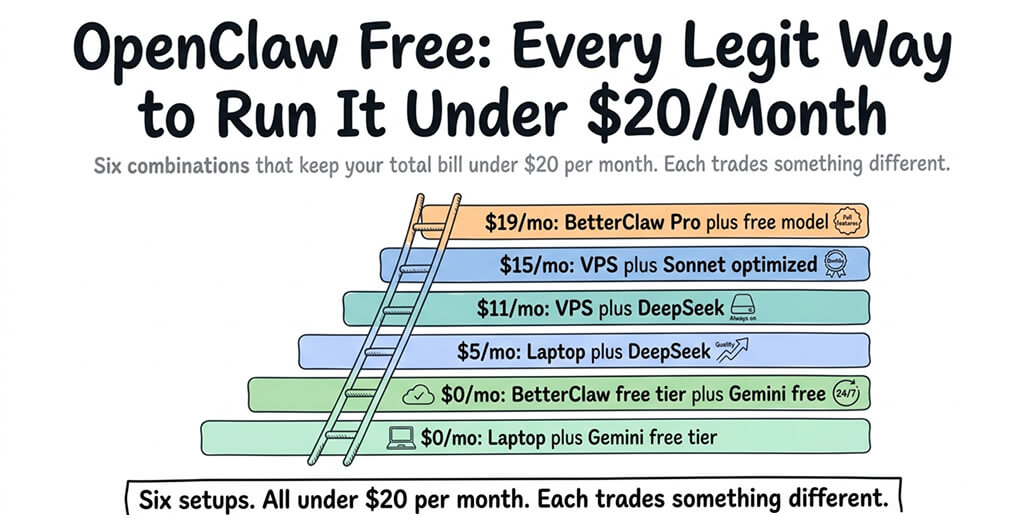
If the model configuration, provider setup, and free tier management feels like more work than you want, BetterClaw supports 28+ model providers from a dropdown. The Free plan includes 1 agent, 100 credits a month, and BYOK. Basic is $19/month, and Pro is $49/month for 5 agents. Smart context management means you use fewer tokens per interaction regardless of which model you choose, which stretches free tiers further.
Which model should I use with OpenClaw?
It depends on your budget and what the agent does:
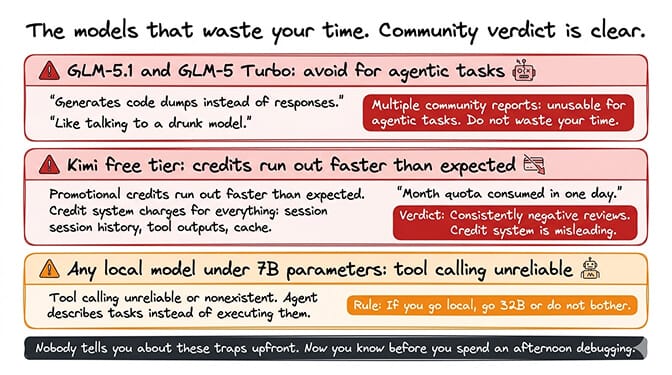
$0 budget, cloud inference: → Gemini 3.8 Flash (free tier on Google AI Studio). Add Qwen3.8-27B on Groq's free plan as a fast second key.
$0 budget, own hardware (8-12 GB VRAM): → Gemma 4 12B or Qwen 3.5 9B on Ollama
$0 budget, own hardware (24+ GB VRAM): → Qwen3.8 27B on Ollama
$5-25/month budget: → DeepSeek Flash or GLM-5.3-Flash for high volume (a few dollars a month at 200 calls a day), or Sonnet 5.5 via BYOK ($2/$10 per MTok) for better quality at lighter volume. About 100 calls a day on Sonnet 5.5 lands near $24/month.
Best quality regardless of cost: → Opus 5.5 via BYOK ($4/$20 per MTok) or GPT-6 Astra ($10/$50)
Just want it to work, no configuration: → BetterClaw's Free plan: 1 agent, 100 credits a month, and BYOK, with hosting and model setup handled from a dropdown. Managed keys, where you don't need your own API key at all, start on Pro at $49/month.
Data privacy: what each free provider does with your prompts
The cost of "free" sometimes shows up in the privacy column.
| Provider | Data handling on the free tier |
|---|---|
| Google AI Studio (Gemini) | Free-tier prompts may be used to improve Google's models. The paid tier is not used for training. |
OpenRouter :free | Requests go to whichever upstream provider serves the model, so data handling varies per provider. Check the provider's policy, or restrict providers in your OpenRouter privacy settings. |
| Groq | Serves third-party open-weight models; check Groq's data policy and the model's own license. |
| DeepSeek (direct API, paid) | Stored on DeepSeek's infrastructure in China. Data residency, not training, is the usual compliance concern. |
| Ollama (local) | Nothing leaves your machine. The clearest privacy story of the lot. |
If you're processing proprietary code, customer PII, or anything subject to compliance, default to Ollama or a paid, non-training tier for those workloads, and keep free API tiers for low-sensitivity work.
The uncomfortable truth about free models
Free models work for personal use, learning, and experimentation. They struggle on business-critical agent deployments where response quality, reliability, and uptime matter. The quality gap between a free Flash tier and a frontier Claude model is real. So is the reliability gap between a rate-limited free tier with no guaranteed capacity and a paid tier. So is the privacy gap between a free tier that may train on your data and a paid API that doesn't. Most people who start on free models end up on DeepSeek (near-free) or a mid-tier hosted model within a month, because the quality-to-cost ratio at those price points is dramatically better than zero.
If you're evaluating OpenClaw agents and want to start free, give BetterClaw's free tier a try. 1 agent, 100 credits a month, and BYOK (bring your Gemini, Groq, or DeepSeek key), hosting included. No credit card. Your first deploy takes 60 seconds. When you need more, Basic is $19/month and Pro is $49/month for 5 agents. Start free. Upgrade when the agent is worth it to you.
Frequently Asked Questions
Is there a list of free models for OpenClaw?
Yes. The table at the top of this page is the current OpenClaw free models list: five free API options (Gemini 3.8 Flash, Qwen3.8-27B and gpt-oss-120b on Groq, GLM-4.7-Flash on Z.ai, and OpenRouter's :free models) and three free local models for Ollama, with their limits. We re-check it whenever a provider changes its free tier.
What is the best free model for OpenClaw?
Gemini 3.8 Flash (gemini-3.8-flash) on Google AI Studio's free tier. It needs no billing, has a 1M-token context window, and supports function calling. It replaced Gemini 3 Flash, which only exists as the legacy gemini-3-flash-preview. Google no longer publishes fixed free-tier rate limits, so check your project's current limits at aistudio.google.com/rate-limit rather than trusting a number in any article. The best second free option is Qwen3.8-27B on Groq's free plan.
What happened to Claude on OpenClaw?
Anthropic banned Claude Pro/Max subscriptions from third-party tools like OpenClaw on April 4, 2026, then reversed the ban on May 13. A replacement "Agent SDK credit" system was announced for June 15, 2026, but Anthropic paused it on the day it was due to take effect and it never activated. As of September 2026 there is no separate Agent SDK credit to claim, and the Agent SDK, claude -p, and third-party tools built on the Agent SDK continue drawing from Pro, Max, Team, and Enterprise subscription limits exactly as before. Anthropic has said it will give advance notice before any revised version ships.
Can I run OpenClaw completely free?
Yes, in two ways. First, use a free API tier: Gemini 3.8 Flash on Google AI Studio, or Qwen3.8-27B on Groq's free plan. Second, run models locally via Ollama. qwen3.5:9b fits comfortably on a 16GB machine, gemma4:e4b is a tighter fit, and qwen3.8:27b (an 18GB download) needs 24GB+. The trade-offs: free API tiers have rate limits and may train on your data; local models require hardware and work best with OpenClaw's native Ollama provider.
Is Qwen OAuth still free for OpenClaw?
No. The Qwen OAuth free tier was cut to 100 requests a day on April 13, 2026, and its free entry point closed entirely on April 15, 2026. The free ways to use Qwen now are Qwen3.8-27B on Groq's free plan or local Qwen models through Ollama.
Which free models support tool calling in OpenClaw?
Cloud free tiers: Gemini 3.8 Flash, Qwen3.8-27B and gpt-oss on Groq, and many OpenRouter :free models. Local via Ollama (use the native provider, not /v1): qwen3.8:27b, qwen3.5:9b, and gemma4:e4b, all tagged for tools. Models under 7B parameters generally cannot call tools reliably regardless of provider config. GLM-5.3-Flash supports tool calling but can degenerate into a repetition loop under multi-tool agent prompts, so treat it as a risk pick.
Is DeepSeek actually free for OpenClaw?
No. DeepSeek's current docs don't publish a standard free credit for new accounts; they bill a topped-up or granted balance, so check your dashboard. Its current model, deepseek-flash (DeepSeek-V4.1-Flash, released September 10, 2026), costs $0.15 / $0.60 per million input/output tokens off-peak and $0.30 / $1.20 at peak. That's functionally near-free for personal use, but not zero.
Does BetterClaw support free models?
Yes. BetterClaw's Free plan includes 1 agent, 100 credits a month, and BYOK (bring your own API key). You can connect your Gemini free-tier key, Groq key, DeepSeek key, or any of 28+ supported providers. Paid plans start at $19/month for Basic, and Pro is $49/month for 5 agents. You pay your model provider directly at their rates, including free tiers. Smart context management stretches free-tier quotas further by keeping per-turn token volume lean.