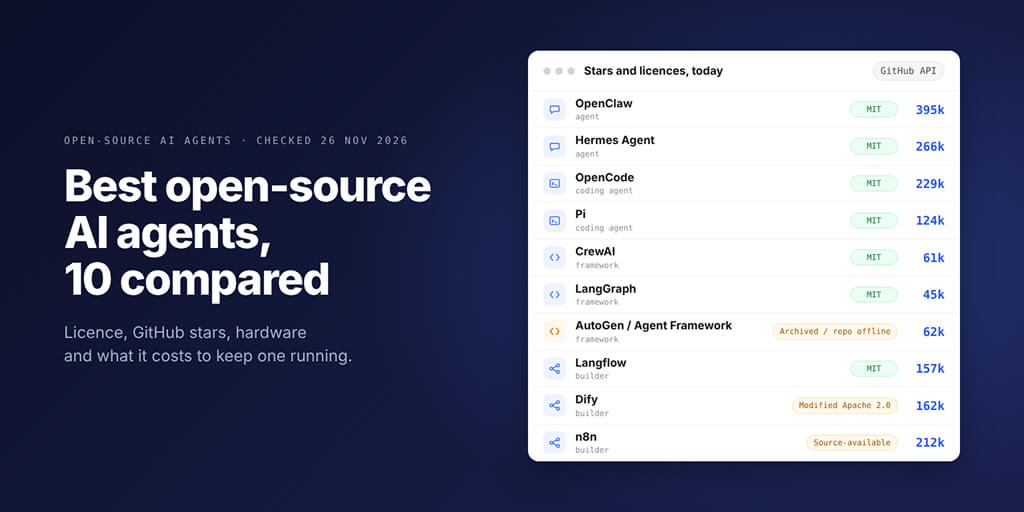
Updated Nov 2026: the best open-source AI agents are OpenClaw and Hermes Agent for an always-on assistant, OpenCode and Pi for coding, CrewAI and LangGraph for building your own, and Langflow or Dify on a visual canvas. Open source means the licence costs nothing, but you still pay for the machine it runs on, the model it calls and your time.
| If you want... | Pick | Licence |
|---|---|---|
| An always-on assistant in your chat apps | OpenClaw | MIT |
| An agent that learns your routines | Hermes Agent | MIT |
| A coding agent with plan mode and apps | OpenCode | MIT |
| The lightest coding agent | Pi | MIT |
| To code your own multi-agent app | CrewAI or LangGraph | MIT |
| To build agents on a canvas | Langflow or Dify | MIT, or modified Apache 2.0 |
Checked: 26 November 2026
Picture this: you search GitHub for "AI agent", sort by stars and clone the top three.
One wants your chat apps and a machine that never sleeps. One is a Python library that does nothing until you write the code. One is a web app that asks for Docker, two CPU cores and 4 GiB of RAM.
Wait. Which of these is actually an agent?
All three. That's why most lists of open-source AI agents are hard to use, and it's what this one fixes.
Open-source AI agents compared: licence, stars and what each needs
We read each project's licence file and pulled its star count from the GitHub API on 26 November 2026, then checked its own docs for what it needs to run. Stars are rounded.
| Agent | What it does on its own | Licence | GitHub stars | Hardware / hosting needed | Best for |
|---|---|---|---|---|---|
| OpenClaw | Always-on assistant in WhatsApp, Telegram, Slack, iMessage and 20+ more chat apps | MIT | about 395k | Your computer or a small VPS; Node 24.16+ (the installer adds it) | A personal assistant where you already chat |
| Hermes Agent | Always-on agent with memory, skills it writes itself, cron jobs and a chat gateway | MIT | about 266k | Your computer or, per its README, a $5 VPS | An agent that learns your routines |
| OpenCode | Coding agent that reads and edits your repo from a terminal UI, a desktop app or your phone | MIT | about 229k | The machine you code on; nothing to host | Coding with plan mode and subagents built in |
| Pi | Minimal terminal coding agent with four tools you extend in TypeScript | MIT | about 124k (whole Pi toolkit repo) | The machine you code on; Node 22.19+ | The smallest context and full control |
| CrewAI | Nothing until you code it: a Python library for crews of role-based agents | MIT | about 61k | Wherever your Python app runs (3.10 to 3.13) | Role-based multi-agent apps |
| LangGraph | Nothing until you code it: graphs of stateful, durable agents in Python or JS | MIT | about 45k | Wherever your app runs | Production agents with explicit state |
| AutoGen / Microsoft Agent Framework | Nothing until you code it: multi-agent frameworks for Python and .NET | MIT (code) | AutoGen about 62k, archived; Agent Framework repo offline | Your own app (Python 3.11+ or .NET) | .NET and Azure teams (Agent Framework) |
| Langflow | Visual canvas for agents and flows, served as an API or an MCP server | MIT | about 157k | 2 GB RAM minimum, 4 GB recommended; desktop app or Docker | Prototyping agents visually |
| Dify | Web platform for agentic workflows, RAG pipelines and chat apps | Modified Apache 2.0 (extra conditions) | about 162k | Docker Compose; 2+ CPU cores and 4 GiB+ RAM | Teams building RAG and chat apps |
| n8n | Workflow automation with AI agent nodes and 1,500+ integrations | Sustainable Use License (source-available, not open source) | about 212k | Docker, or Node 24+ for npm installs | Internal automations with AI steps |
Checked: 26 November 2026
Two notes on the stars. Pi's count belongs to the whole earendil-works/pi repository, which also holds its LLM library and terminal UI kit. And Microsoft Agent Framework has no count today, because its GitHub repository returns Not Found (more on that below).
Stars measure attention, not fit. The licence and the hardware column will shape your month far more than any star count.
Agents vs frameworks vs builders: what you actually get
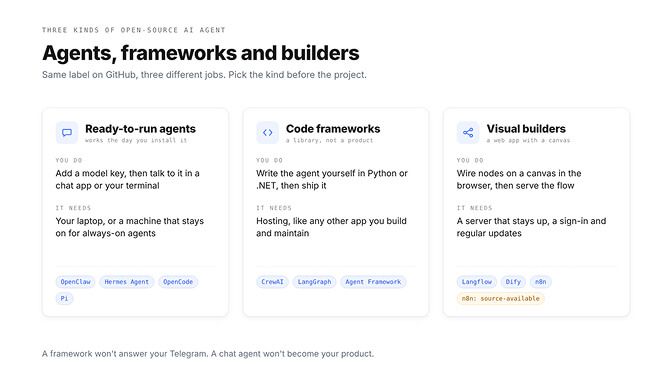
Most lists of open-source AI agents mix three kinds of software. They solve different problems, so pick the kind before you pick the project.
Ready-to-run agents (OpenClaw, Hermes Agent, OpenCode, Pi) work the day you install them. You connect a model key and talk to them, in a chat app or in your terminal.
Code frameworks (CrewAI, LangGraph, Microsoft Agent Framework) are libraries. Nothing happens until you write the agent in Python or .NET, and then you host it like any other app you've built.
Visual builders (Langflow, Dify, n8n) put the agent on a canvas you wire up in the browser. They're web apps, so self-hosting one means a server that stays up and a sign-in you keep secure.
If what you really want is a builder without the server, our comparison of no-code AI agent builders covers the hosted ones, on price and on one real job.
A framework won't answer your Telegram messages, and a chat agent won't turn into your product. Most bad picks start with mixing up the two.
The 10 best open-source AI agents, one by one
Each entry covers what it is, the licence, what it's good at and the catch. Versions are the latest stable releases on 26 November 2026.
OpenClaw
OpenClaw is an open-source assistant that runs on your own computer and answers in the chat apps you already use, from WhatsApp and Telegram to Slack, Discord and iMessage. It's MIT-licensed, stewarded by the OpenClaw Foundation, and the most-starred project on this list at about 395k. The latest stable release is 2026.11.10, published on 25 November.
Good at: a personal assistant that lives where you chat, with native apps for macOS, iOS, Android, Windows and Linux. The catch: tools run on the host for the main session unless you set up sandboxing, and it moves fast, with ten stable releases so far this month.
Hermes Agent
Hermes Agent, from Nous Research, is a general agent with persistent memory, skills it creates and improves while it works, a cron scheduler and one gateway for Telegram, Discord, Slack, WhatsApp, Signal and more. It's MIT-licensed with about 266k stars. v0.23.4 is the latest stable release, published on 24 November.
Good at: daily automation that gets better the longer it knows you, with command checks on by default. Shell commands that match its dangerous list go to a second model, which approves low-risk ones, blocks clearly dangerous ones and asks you about the rest. The catch: it carries a lot into every request, about 10,800 tokens before you type in our 16 November test of v0.23.1, and it ships patches every few days.
If you're torn between the two always-on agents, our OpenClaw vs Hermes comparison covers memory, skills, security and how to migrate in either direction.
OpenCode
OpenCode is the open-source coding agent built by Anomaly: it reads and edits your repo from a terminal UI, a desktop app (still marked beta in its README) or a mobile app. It's MIT-licensed with about 229k stars, and the repository now lives at anomalyco/opencode. V2's latest release is 2.4.2, published on 26 November.
Good at: plan-then-build coding, with Build and Plan agents, subagents and, since 2.4.0, automations that run a prompt or command on a timer or a cron schedule. The catch: its default permission policy allows almost everything, including paths outside the project, so add "ask" rules before you point it at a real repo.
Pi
Pi is a minimal terminal coding agent. It gives the model four tools (read, bash, edit and write) and lets you add the rest with TypeScript extensions and packages. It's MIT-licensed, and its latest release is 1.6.1, published on 25 November.
Good at: leaving room in the context window, at about 1,350 tokens before you type in our 25 November test of 1.6.0. The catch: it doesn't ask for approval before each tool call, and its own security docs call a container, VM or sandbox usually the strongest practical option.
Our Pi vs OpenCode comparison has the full token test and the safety settings we'd use for each.
CrewAI
CrewAI is a Python framework for teams of role-based agents, called Crews, and the event-driven workflows around them, called Flows. It's MIT-licensed with about 61k stars, and 1.15.45 is the latest release, from 24 November.
Good at: getting a multi-agent prototype working fast when a job splits into roles, say a researcher, a writer and a reviewer. The catch: it supports Python 3.10 to 3.13, its managed deployment (CrewAI AMP) is a commercial product, and it collects anonymous usage telemetry such as versions, the model used, agent roles and tool names, though not your prompts.
LangGraph
LangGraph is LangChain's low-level orchestration framework for long-running, stateful agents, with a JavaScript twin, LangGraph.js. It's MIT-licensed with about 45k stars, and 1.2.24 is the latest release, from 20 November.
Good at: production agents where you want to see every step, with durable execution that resumes after failures and human-in-the-loop checks. The catch: you draw the graph yourself, which gets verbose, and the managed hosting LangChain points you to, LangSmith Deployment, is a separate product.
AutoGen and Microsoft Agent Framework
AutoGen is archived. Its README says Microsoft no longer provides bug fixes, security fixes, new features or support, and it points new users to Microsoft Agent Framework, which Microsoft's docs call the direct successor to AutoGen and Semantic Kernel.
Agent Framework is MIT-licensed for Python and .NET. Its Python package is at 1.26.0 (12 November) and its .NET package at 1.28.0 (6 November), but its GitHub repository returns Not Found today.
Here's what happened. On 17 November, two unauthorised versions of the agent-framework Python package, 1.26.1 and 1.26.2, reached PyPI with credential-stealing code, and both were removed. On 25 November Microsoft said the repository is temporarily unavailable as a precaution, that the framework hasn't been discontinued, and that you should pin agent-framework==1.26.0 for now.
Good at: .NET and Azure teams, and anyone moving AutoGen code, with five named orchestrations (sequential, concurrent, handoff, group chat and Magentic). The catch: right now you can't read its source on GitHub, and if you might have installed 1.26.1 or 1.26.2, Microsoft says to treat that machine as compromised, rotate every credential it could reach and rebuild from a clean image.
Our AI agent frameworks comparison puts Agent Framework next to 11 others, including where AutoGen users can go.
Langflow
Langflow is a visual builder for agents and flows. You can deploy any flow as an API or as an MCP server, so other agents can call it as a tool. It's MIT-licensed with about 157k stars, and 1.13.4 is the latest release, from 24 November.
Good at: prototyping an agent visually, then customising any component in Python, with a desktop app if you'd rather not manage Python yourself. The catch: self-hosting means a machine with at least 2 GB of RAM (4 GB recommended) and a sign-in you keep secure, though the official Docker images do require authentication by default.
Dify
Dify is a web platform for LLM apps that puts agentic workflows, RAG pipelines, agents, model management and observability in one interface. It has about 162k stars, and 1.20.0 is the latest stable release, from 18 November, with 2.0 in beta.
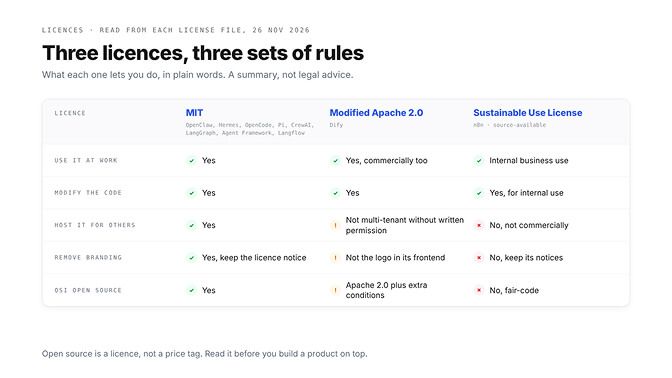
Read the licence before you build on it. Dify uses a modified Apache 2.0 licence: commercial use is allowed, but running it as a multi-tenant service needs Dify's written permission, and you can't remove the Dify logo or copyright from its frontend.
Good at: teams that want a self-hosted app platform with RAG built in. The catch: besides the licence terms, its README asks for at least 2 CPU cores and 4 GiB of RAM, and it runs as a Docker Compose stack you keep updated.
n8n
n8n is a workflow automation platform with AI agent nodes, and it's the one entry here that says plainly it isn't open source. Its code is under the Sustainable Use License, which n8n itself calls fair-code and source-available, and files marked .ee need a separate enterprise licence.
The licence lets you use and modify n8n for your own internal business purposes or for personal or non-commercial use, and share it only at no charge for non-commercial purposes. It has about 212k stars, and 2.49.7 is the latest stable release, published on 26 November.
Good at: automations with AI steps that touch many apps, built on a canvas. The catch: you can't sell it as a service or ship a paid product on its code without a separate agreement with n8n, and it ships constantly, with more than 40 versions on npm this month across its release lines.
Open-source agent orchestration tools
Orchestration is how several agents share one job: in a fixed order, in parallel, under a supervisor, or by handing the conversation to a specialist. These open-source tools do it in code, and our guide to AI agent orchestration walks through each approach with examples.
| Tool | Licence | How it orchestrates | GitHub stars |
|---|---|---|---|
| LangGraph | MIT | Graphs of shared state, with checkpoints and human-in-the-loop | about 45k |
| CrewAI Flows | MIT | Event-driven flows that wrap role-based crews | about 61k |
| Microsoft Agent Framework | MIT | Sequential, concurrent, handoff, group chat and Magentic, plus graph-based workflows | Repo offline |
| OpenAI Agents SDK | MIT | Agents as tools and handoffs, with guardrails, sessions and tracing; works with 100+ other LLMs | about 31k |
| Google ADK | Apache 2.0 | A graph-based workflow runtime; tuned for Gemini but model-agnostic | about 22k |
Checked: 26 November 2026
The visual builders orchestrate too, only on a canvas instead of in code. And of the ready-to-run agents, Hermes can spawn isolated subagents for parallel work, so you may not need a framework at all for a two-step job.
What it really costs to run open-source AI agents
The licence is the only line on the bill that's zero. A real month has three more: the machine, the model and your time.
The machine
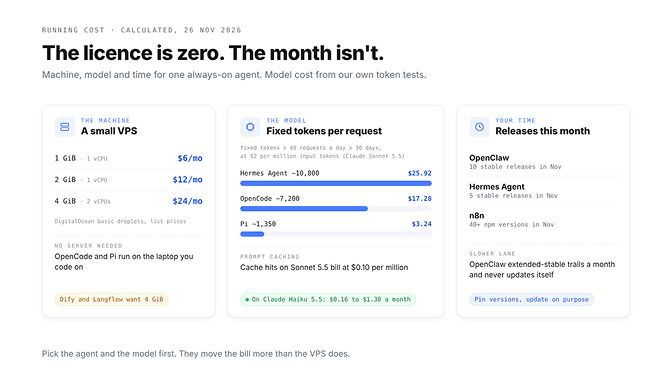
OpenCode and Pi run on the laptop you already code on. Always-on agents and builders need something that stays up: on DigitalOcean today, a basic droplet costs $6 a month with 1 GiB of RAM, $12 with 2 GiB and $24 with 4 GiB.
That last size matters, because Dify asks for 4 GiB and Langflow recommends it. Hermes says it runs on a $5 VPS, and OpenClaw's prebuilt npm install suits small hosts, though building it from source needs more than 4 GiB.
Our BetterClaw vs VPS hosting comparison prices more providers for OpenClaw, including setup time and maintenance.
The model
Every request re-sends the agent's system prompt and tool definitions before your message. In our own tests that fixed part came to about 10,800 tokens for Hermes Agent v0.23.1, 7,200 for OpenCode 2.4.1 and 1,350 for Pi 1.6.0.
Here's what that floor costs at 40 requests a day, which is light for an agent, because one task can take several requests.
| Agent (our test) | Fixed tokens per request | Per month at 40 a day | At $2 per million (Claude Sonnet 5.5) | At $0.10 per million (Claude Haiku 5.5) |
|---|---|---|---|---|
| Hermes Agent v0.23.1 | about 10,800 | 12.96 million | $25.92 | $1.30 |
| OpenCode 2.4.1 | about 7,200 | 8.64 million | $17.28 | $0.86 |
| Pi 1.6.0 | about 1,350 | 1.62 million | $3.24 | $0.16 |
Checked: 26 November 2026. Calculated from our measurements and Anthropic's list input prices, before prompt caching and before your own messages, tool results and output.
Prompt caching cuts the repeated part when requests land close together: Anthropic bills cache hits on Sonnet 5.5 at $0.10 per million tokens, a twentieth of its base input price. Either way, the server is often the cheap part, and the agent and model you pick move the bill more than the VPS does.
Your time
Our self-hosting OpenClaw vs BetterClaw comparison sets hours against dollars, and the release logs explain why the hours add up. OpenClaw has shipped ten stable releases so far in November (2026.11.1 to 2026.11.10), Hermes five (v0.23.0 to v0.23.4), and n8n more than 40 versions on npm across its release lines.
OpenClaw's extended-stable channel helps if that sounds like a lot: it trails a month behind and never updates on its own. Security is upkeep too, and the Agent Framework incident could reach anyone who installed or upgraded agent-framework on 17 November without a pinned version.
The cheapest agent to run is the one you update on purpose, on a pinned version, with a model that fits the job.
Run one without a server
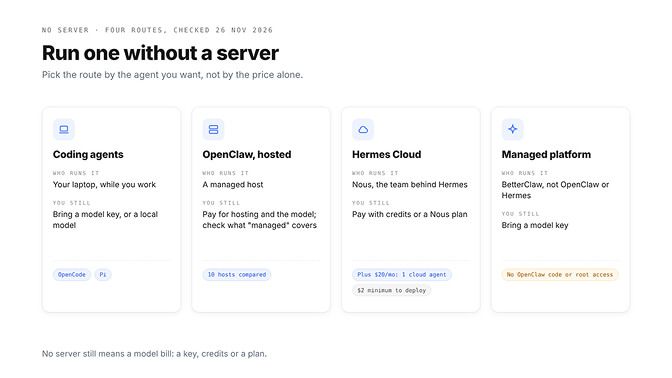
You can skip the server for most of the ten, but "no server" means something different for each. Here's the route by agent, and what you still own on each one.
Coding agents need none. OpenCode and Pi run in your terminal while you work and stop when you close the lid. You bring a model key, or a local model if your machine can run one.
OpenClaw on a managed host. A host installs OpenClaw on a server it runs and keeps it going, but "managed" isn't one standard: when we compared hosts, what each one actually patched and backed up varied a lot. Our OpenClaw hosting comparison checks ten providers on that, and on the price after the promo ends.
Hermes Agent on Hermes Cloud. Nous runs it for you in its own container that scales to zero when idle. You need at least $2 in credits or an active subscription, and its paid plans, from Plus at $20 a month, each include one cloud agent.
| Route | Who runs it | You still pay for | What you give up |
|---|---|---|---|
| OpenCode or Pi on your laptop | You, while you work | The model | Nothing runs when the laptop sleeps |
| OpenClaw on a managed host | The host | Hosting plus the model | Some control; check what "managed" covers |
| Hermes on Hermes Cloud | Nous | Credits or a Nous plan | A server you control |
| A managed agent platform (BetterClaw) | BetterClaw | A plan plus the model, on your key | OpenClaw's and Hermes's code, skills and root access |
Checked: 26 November 2026
Our Hermes Agent hosting guide compares nine Hermes routes on real monthly cost and on what you still manage, from a VPS with a one-click Hermes app to plain Docker on your own box.
The last row isn't OpenClaw or Hermes at all. BetterClaw is a managed agent platform that does the same everyday job, an always-on agent that works in your apps on a schedule and remembers context, with nothing to install or patch. The trade is real: there's no OpenClaw code, skill ecosystem or root access, and no WhatsApp.
The entry option is BetterClaw Free. As its page describes it today, it gives you 1 agent, 100 credits a month (one credit is one minute of the agent's machine running), 3 connectors and 7-day memory on your own model key, with Telegram and Slack on paid plans only. Every limit is listed on the BetterClaw Free page.
The honest answer
There's no single winner here, because the ten aren't competing for the same job. So start with the job: write down what the agent should do every day, then pick the kind of software, then the licence, and only then the project.
Stars tell you what's popular. The licence tells you what you're allowed to build, and the release log tells you what your evenings will look like. The model bill follows you everywhere, hosted or not.
The best open-source agent is the one whose upkeep you'll actually do.
Want the always-on agent without the upkeep?
If you've read this far and the always-on part appeals more than the maintenance, that's the job BetterClaw does: managed agents on your own model key, with zero markup across 28+ providers and 500+ connectors. Every plan includes sandboxed execution, a kill switch and AES-256 encryption for your keys.
Plans start at $19 a month, and your first workspace starts on a 7-day trial of any plan. BetterClaw verifies your card with a $5 charge it refunds right away, and the plan is charged when the trial ends unless you cancel. See plans and start your trial
Frequently Asked Questions
What is the best open-source AI agent?
It depends on the job. For an always-on assistant in your chat apps, OpenClaw has the most channels and the most stars (about 395k), while Hermes Agent suits people who want an agent that learns routines and screens risky commands by default. For coding, pick OpenCode or Pi, and for building your own, LangGraph or CrewAI.
Is there an open-source AI agent builder?
Yes. Langflow is the visual builder with the simplest licence (MIT), and Dify is the other big one you can self-host, under a modified Apache 2.0 licence with extra conditions. n8n is a popular source-available option, and if you'd rather write code, CrewAI and LangGraph are MIT-licensed frameworks.
Are open-source AI agents free?
The software costs nothing under its licence, but running it doesn't. You pay for the machine (a small DigitalOcean droplet starts at $6 a month), for the tokens every request sends and for your time on updates. In our calculation, the fixed part of Hermes Agent's requests alone comes to about $26 a month at 40 requests a day on Claude Sonnet 5.5, before caching.
Which open-source agent is safest?
None is safe out of the box, so judge them by their defaults. Hermes Agent screens flagged shell commands with a second model and asks you about unclear ones, OpenClaw runs tools on the host unless you set up sandboxing, OpenCode's base policy allows almost everything, and Pi's docs recommend a container. Whichever you run, pin versions, keep it off the open internet and vet every skill before you install it, the way we vet skills at BetterClaw.
Is n8n open source?
No. n8n describes its licence as fair-code and source-available: the Sustainable Use License lets you use and modify n8n for internal business, personal or non-commercial use, but not sell it to others as a service. Enterprise features in files marked .ee need a separate licence.
What happened to AutoGen?
Microsoft archived it and no longer fixes bugs or security issues in it, and its README sends new users to Microsoft Agent Framework. That framework's GitHub repository is temporarily unavailable after unauthorised, credential-stealing versions of its Python package reached PyPI on 17 November. Microsoft says the framework isn't discontinued and recommends pinning agent-framework==1.26.0 until it gives further guidance.