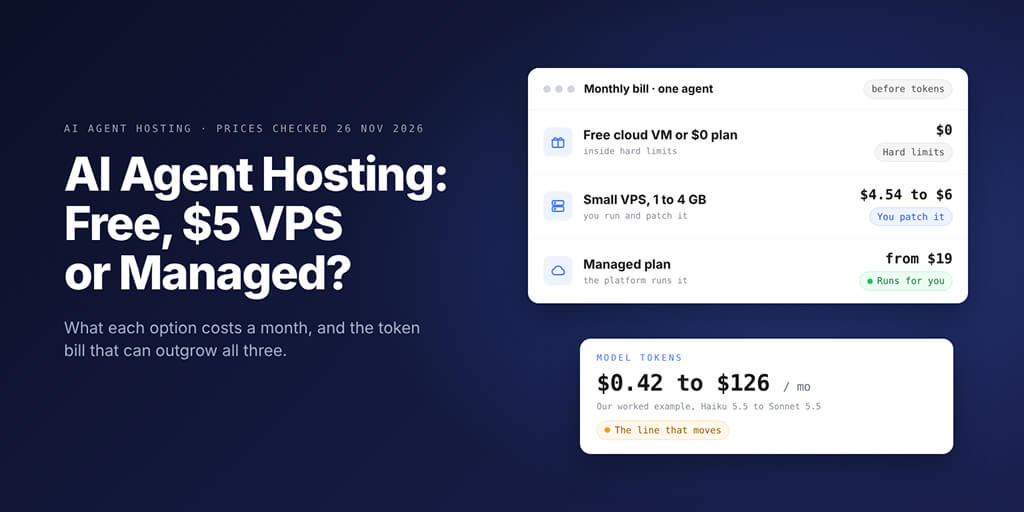
AI agent hosting for one agent costs $0 to $49 a month before model tokens: $0 on free tiers with tight limits, $4.54 to $6 for a small VPS, or $19 to $49 for a managed plan, plus a token bill that ran from $0.42 to $126 a month in our worked example below.
| Your situation | Cheapest sensible option | Monthly cost |
|---|---|---|
| Trying an agent before you spend | A free cloud VM or a $0 managed plan | $0, inside the limits |
| Text-only agent, you know Linux | A 1 GB VPS (Linode, Vultr) | $5 |
| Browser tools or several channels | OVHcloud VPS-1 with 4 GB | from $4.54 |
| Your own agent code, idle most of the day | A usage-billed agent runtime | about $0.08 to $0.16 per busy hour (calculated) |
| The agent without the server | A managed platform such as BetterClaw | from $19 |
Checked: 26 November 2026
Picture this: your agent finally works on your laptop. You open three pricing tabs to give it a permanent home.
One says $0. One says $5. One says $19.
So which one is lying?
None of them. They're pricing three different jobs, and the job you forget to price is the one that ends up on your card.
This guide works for any agent, from OpenClaw and Hermes to a LangGraph app you wrote yourself. Still picking one? Our roundup of the best open-source AI agents compares ten of them.
The three ways to host an AI agent
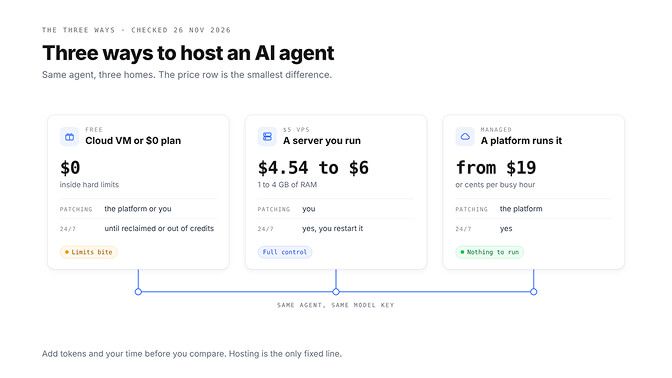
Every option trades money against time and control. Here's how the three line up, with prices we checked with each provider on 26 November 2026.
| Free (cloud VM or $0 managed plan) | $5 VPS | Managed, paid | |
|---|---|---|---|
| Monthly cost | $0, inside hard limits | $4.54 to $6 for 1 to 4 GB of RAM | From $19 flat, or about $0.08 to $0.16 per busy hour, plus tokens |
| Setup time | Minutes on a managed plan; an evening on a cloud VM | About 20 minutes in OpenClaw's own Hetzner guide, longer if Linux is new to you | Minutes |
| Who patches it | The platform (managed); you (cloud VM) | You: OS, runtime and agent | The platform |
| Runs 24/7 | Managed: on schedule until the month's credits run out. Cloud VM: yes, until reclaimed or the credits end | Yes, once you set up restarts | Yes |
| Uptime | Oracle can reclaim idle Always Free VMs | The host covers the machine (Hetzner's SLA is 99.9%); the agent process is yours | The platform watches and restarts the agent |
| Security | Platform isolation (managed); your firewall and SSH (cloud VM) | All yours: firewall, SSH, keys, gateway exposure | Platform isolation and secret storage |
Checked: 26 November 2026
Read the table by rows, not columns. The cost row is the one everybody compares, and once you add tokens and time it's often the smallest number on the bill. If OpenClaw is your agent, our OpenClaw hosting costs compared runs the same sums over six months.
Hosting is the only line on an agent's bill with a fixed price. That's why everyone shops for it first, and why it's rarely the line that decides what you pay.
Free AI agent hosting: what is actually free
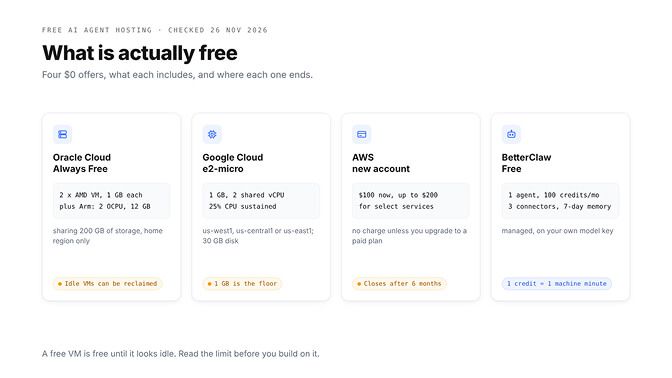
Free hosting is real. It just ends somewhere specific, and you want to know where before you build on it.
| Free offer | What you get | Where it ends |
|---|---|---|
| Oracle Cloud Always Free | Two AMD VMs with 1 GB each plus Arm capacity equal to 2 OCPUs and 12 GB, sharing 200 GB of block storage | Idle VMs may be reclaimed; capacity errors are common |
| Google Cloud e2-micro | One VM a month with 2 shared vCPUs and 1 GB in us-west1, us-central1 or us-east1, 30 GB of disk, 1 GB of egress | 1 GB is the bare minimum; the CPU sustains 25% |
| AWS credits for new accounts | $100 in credits at sign-up, up to $200 in total | The account closes after 6 months or when the credits run out |
| BetterClaw Free | One managed agent, 100 credits a month, 3 connectors, 7-day memory, your own model key | A credit is one minute of the agent's machine running |
Checked: 26 November 2026
Oracle's row hides two catches. First, its own Always Free page now puts the Arm allowance at 1,500 OCPU hours and 9,000 GB hours a month, which it says equals 2 OCPUs and 12 GB of memory. Plenty of guides, including OpenClaw's Oracle page today, still promise 4 OCPUs and 24 GB.
Second, Oracle may reclaim an Always Free VM if, over 7 days, its 95th-percentile CPU, its network use and (on Arm) its memory use all stay under 20%. An agent that mostly waits for messages can look exactly like that.
A free VM is free until it looks idle. An agent spends most of its life looking idle.
Google's e2-micro is small: 1 GB of memory and a quarter of a CPU sustained, in three US regions. AWS gives new accounts credits for select services: $100 up front, up to $200 in all, and the account closes itself after six months, or sooner if the credits run out, unless you upgrade to a paid plan.
Then there's the managed route: BetterClaw's free AI agent runs on managed infrastructure with 100 credits a month and 3 connectors, on your own model key. A credit is one minute of the agent's machine running, so that's about 100 minutes of work a month (calculated): enough for a short daily briefing, not for an agent that works all day.
And the model is the other half of free. A free server running a paid model key isn't a free agent.
Best AI agent hosting under $5
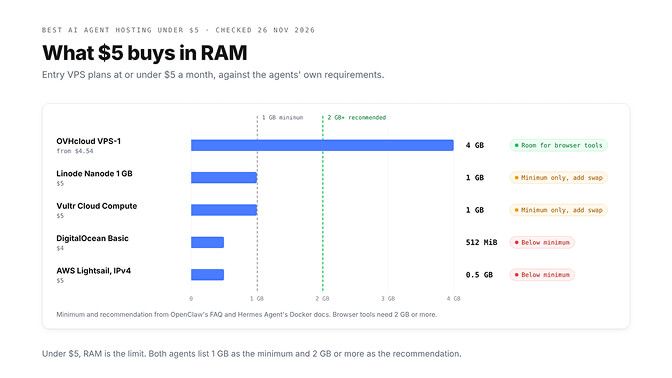
Here's the part the $5 headlines skip. Under $5 a month, most VPS plans give you 0.5 to 1 GB of RAM, and both OpenClaw and Hermes list 1 GB as their minimum.
| Provider and plan | vCPU | RAM | Disk | Price a month | Enough for OpenClaw or Hermes? |
|---|---|---|---|---|---|
| OVHcloud VPS-1 | 2 vCores | 4 GB | 40 GB NVMe | from $4.54 | Yes, with room for browser tools |
| Linode (Akamai) Nanode 1 GB | 1 | 1 GB | 25 GB | $5 | Minimum only: add swap |
| Vultr Cloud Compute 1 GB | 1 | 1 GB | 25 GB | $5 | Minimum only: add swap |
| DigitalOcean Basic | 1 | 512 MiB | 10 GiB | $4 | No: under the minimum ($6 buys 1 GiB) |
| AWS Lightsail with IPv4 | 2 | 0.5 GB | 20 GB | $5 | No: under the minimum ($7 buys 1 GB) |
Checked: 26 November 2026
OVHcloud is the outlier, and on today's prices it's the one we'd pick under $5. It's the only plan here that clears the 2 GB both projects recommend, and it clears it twice over.
Two names are missing on purpose. Hetzner, a long-time favourite for cheap servers, lists its 4 GB CX23 at €5.99 a month but marks it not available, and the cheapest server it will sell you today is the new CPX02 with 1 GB, from €5.49 before VAT. Hostinger's KVM 1 has 4 GB for $6.49 a month, but only on a 24-month prepay of $155.76, and it renews at $11.99.
Vultr's public plan list also shows a $0 plan with 512 MB in three locations. At half the 1 GB minimum, it isn't an agent host.
For the wider view, including the setup and upkeep that come with any server, see our VPS hosting comparison.
Is 1 to 2 GB enough for OpenClaw or Hermes?
Both projects publish their numbers, and they agree more than you'd expect.
- OpenClaw: its FAQ puts the absolute minimum at 1 vCPU, 1 GB of RAM and about 500 MB of disk, and recommends 1 to 2 vCPUs with 2 GB or more for logs, media and multiple channels. It warns that Node tools and browser automation can be resource hungry.
- Hermes Agent: its Docker docs list 1 GB as the minimum and 2 to 4 GB as recommended. Without browser tools, 1 GB is enough; with browser tools active, give it at least 2 GB.
So 1 GB runs a text-only agent on an API model. Two GB is the floor once the agent browses the web, and 4 GB is comfortable headroom.
Two traps catch people on small servers. Don't build OpenClaw from source there: its install docs say a source build needs at least a 4,352 MiB Node heap, more than a 4 GiB machine can give, so use the npm installer or the pre-built Docker image. And add swap, the way OpenClaw's own DigitalOcean guide does on its 1 GB example:
sudo fallocate -l 2G /swapfile
sudo chmod 600 /swapfile
sudo mkswap /swapfile
sudo swapon /swapfile
echo '/swapfile none swap sw 0 0' | sudo tee -a /etc/fstab
Swap stops a 1 GB box from falling over at the first memory spike. It won't make it fast, and local models are out: the same guide says local LLM inference does not fit in 1 GB.
If Hermes is your agent, our Hermes Agent hosting comparison prices nine places to run it, renewal prices included.
Managed AI agent hosting platforms
Managed means someone else keeps the agent alive. It covers two different products, though: runtimes for agent code you wrote, and platforms where you don't write code at all.
| Platform | You bring | Runtime price | Billed while idle? | Model tokens |
|---|---|---|---|---|
| BetterClaw | Nothing to deploy: you build the agent in the app | Starter $19 a month (1 agent, 2,000 credits, 2 vCPU / 4 GB server); Pro $49 (5 agents, 12,000 credits) | Credits count only the minutes the agent's machine runs | Your own key at zero markup |
| Claude Managed Agents (Anthropic, beta) | A configurable agent Anthropic runs for you | $0.08 per session-hour | No: only running time counts | Claude's standard rates |
| AWS Bedrock AgentCore Runtime | Your agent code or container | $0.1276 per vCPU-hour and $0.0169 per GB-hour (v2), billed per second | CPU isn't billed during I/O wait | Your model's price |
| Google Agent Runtime | ADK, LangGraph, LangChain, AG2 or LlamaIndex agents | $0.085 per vCPU-hour and $0.009 per GiB-hour | Idle time between turns isn't billed | Your model's price |
| LangSmith Deployment | LangGraph or LangChain agents | Plus: $39 per seat a month with 1 small serverless Agent Server; more at $0.0675 per vCPU-hour and $0.009 per GiB-hour, plus database time | Serverless scales to zero; dedicated stays on | Your model's price |
Checked: 26 November 2026
The usage-billed runtimes all reward an agent that waits a lot. Price one vCPU and 2 GB working for an hour and you get about $0.16 on AgentCore v2, $0.10 on Google and $0.09 on LangSmith before its database charge, while Claude Managed Agents is a flat $0.08 per running hour (calculated from the rates above).
Now compare a server. OVHcloud's $4.54 plan works out to about $0.006 an hour if it runs all month (calculated), so an agent that's busy all day belongs on a server, and one that wakes for a few minutes an hour can be cheaper on a runtime.
Usage billing rewards an agent that waits. A flat server rewards an agent that never stops.
One naming note if you're searching for Google's option: the old Vertex AI Agent Engine docs now redirect to Gemini Enterprise Agent Platform, where the product is called Agent Runtime.
BetterClaw is the no-code entry in this table, and it's ours, so here's the plain version. You describe the job, connect apps from 500+ connectors and pick a model from 28+ providers on your own key, at zero markup. Starter's 2,000 credits come to about 33 hours of agent machine time a month (calculated), since one credit is one minute.
What you give up is control: no root access and no custom Docker images. It also isn't an OpenClaw or Hermes host, so if you need either of those exact projects, a VPS or a host built for them is the honest answer.
If you're weighing no-code platforms against each other rather than against servers, our no-code AI agent builders compared covers that side.
The hidden costs: model tokens, your time and patching
Model tokens: the line that moves
Every call an agent makes resends its instructions, its tool list and the recent conversation. In our October tests, Hermes sent about 10,400 tokens before you typed a word, OpenCode about 5,100 and Pi about 1,500, so 12,000 input tokens per call is a fair figure for a busy tool-using agent.
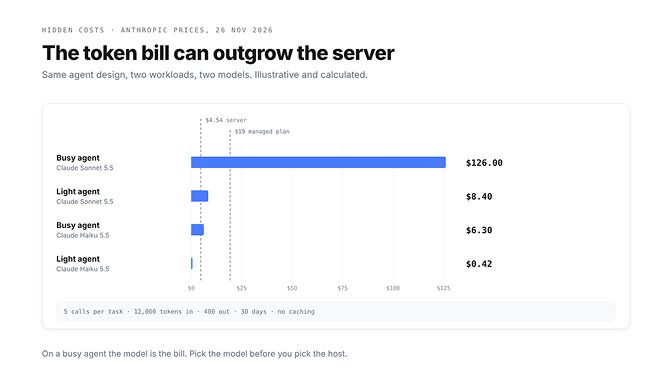
Here's a worked example on Anthropic's prices today: Claude Haiku 5.5 at $0.10 per million input tokens and $0.50 per million output (for prompts up to 100,000 tokens), and Claude Sonnet 5.5 at $2 and $10. Each task takes 5 model calls, and each call sends 12,000 tokens and gets 400 back, over a 30-day month with no caching.
| Illustrative workload | Calls a month | Input / output tokens | Claude Haiku 5.5 | Claude Sonnet 5.5 |
|---|---|---|---|---|
| Light: 2 tasks a day | 300 | 3.6M / 0.12M | $0.42 | $8.40 |
| Busy: 30 tasks a day | 4,500 | 54M / 1.8M | $6.30 | $126.00 |
Checked: 26 November 2026
Look at the corners. The light agent on Haiku 5.5 costs less than a tenth of the $4.54 server, so hosting is nearly its whole bill. The busy agent on Sonnet 5.5 costs about 28 times that server (calculated), and no hosting choice will rescue it.
Two levers move this line more than any host can: the model and the cache. Cache hits on Sonnet 5.5 bill at $0.10 per million tokens, a twentieth of the base input price.
Your time: the line no one invoices
Say updates, restarts and checks take 2 hours a month once things settle (our assumption; the first month takes longer). At $50 an hour that's $100 a month: more than five times a $19 managed plan and about 22 times the $4.54 server (calculated).
If you enjoy running servers, that time is a hobby, not a cost. If you'd rather spend it on anything else, it's the biggest number on the bill, and our managed vs self-hosted comparison shows what it buys you.
Security patching: the job that can't wait
Patching is the part of your time with a deadline. Between 27 October and 26 November 2026, OpenClaw tagged 17 stable releases on GitHub and Hermes Agent tagged 7. That's an OpenClaw release roughly every two days (calculated).
Underneath sits a runtime with its own fixes: OpenClaw's install docs strongly recommend Node 24.22.1+ or 26.12.1+ for security. Then come the OS updates and your SSH setup.
OpenClaw's VPS guide spells out the safe default: keep the gateway on loopback, reach it through an SSH tunnel or Tailscale Serve, and harden admin access before you install anything. On a managed platform those choices are made for you, and that's most of what the monthly fee buys.
The server is the cheap part. The model is the variable part. Your time is the expensive part.
Which AI agent hosting option should you pick?
Match the option to the job, not to the smallest number on a pricing page.
- Just testing an idea: take a $0 offer. A managed plan if you never want to see a server; Google's e2-micro or Oracle's Always Free if you want to learn the server side and can live with the limits above.
- A text-only agent on an API model: a 1 GB VPS at $5 from Linode or Vultr, with swap, meets both projects' own minimum.
- Browser tools or several chat channels: go to 2 GB or more. OVHcloud's 4 GB VPS-1 from $4.54 was the best value we found on 26 November.
- Your own agent code that sits idle most of the day: a usage-billed runtime such as Claude Managed Agents, AgentCore, Google's Agent Runtime or LangSmith Deployment.
- The agent, not the server: a managed platform such as BetterClaw, from $19 a month.
Whatever you pick, price the tokens before the server. In our example the same agent design costs $0.42 or $126 a month, depending on workload and model.
The real price of a $5 agent
Hosting is the easiest number to compare and the least likely to decide your bill. It's printed on a pricing page, it's the same every month, and it feels like the decision.
The real decision is quieter. Pick the model you can afford at your busiest, count the hours you're willing to give it, and then buy the cheapest home that leaves you using the agent instead of minding it.
Want the agent without the server?
If the managed column won on your numbers, BetterClaw runs your agent with no server to rent or patch. Plans start at $19 a month for one agent, on your own model key with zero markup, and the connector catalogue runs to 500+ apps.
Your first workspace starts with a 7-day trial on any plan. BetterClaw verifies your card with a $5 charge that it refunds right away, and the plan is charged when the trial ends unless you cancel first. See plans and start your trial
Frequently Asked Questions
How much does it cost to host an AI agent?
For one agent, $0 to about $49 a month before tokens: $0 on free tiers, $4.54 to $6 for a small VPS and $19 to $49 for a managed plan. Model tokens come on top, from $0.42 to $126 a month in our worked example, depending on the model and how busy the agent is.
Can I host an AI agent for free?
Yes, inside limits. Oracle Cloud's Always Free VMs and Google Cloud's e2-micro give you a small server at no charge, and BetterClaw Free runs one managed agent with 100 credits a month. Each has a catch (idle reclaim on Oracle, 1 GB on Google, a credit cap on BetterClaw), and you still pay for the model unless you use a free model allowance or a local one.
Do I need a VPS?
Only if the agent must stay up while your laptop sleeps and you want to own the machine. If you use the agent only at your desk, your own computer works; if you want it always on without a server, a managed platform does that job.
Is 1 GB of RAM enough to run an AI agent?
For a text-only agent on an API model, yes: OpenClaw and Hermes both list 1 GB as their minimum. Add swap, and plan on 2 GB or more for browser tools or several channels, which is what both projects recommend. Local models need far more.
What is the best AI agent hosting under $5?
On our 26 November check, OVHcloud's VPS-1 at $4.54 a month with 2 vCores and 4 GB was the only plan at or under $5 with room for browser tools. Linode's Nanode and Vultr's 1 GB plan cost $5 and meet the 1 GB minimum, while DigitalOcean's $4 plan and Lightsail's $5 IPv4 bundle fall below it.
What is an AI agent hosting platform?
A service that runs your agent for you, so you don't manage a server. Some run code you wrote and bill by usage, such as AWS Bedrock AgentCore, Google's Agent Runtime, LangSmith Deployment and Claude Managed Agents. Others, like BetterClaw, let you build the agent without code for a flat monthly plan.