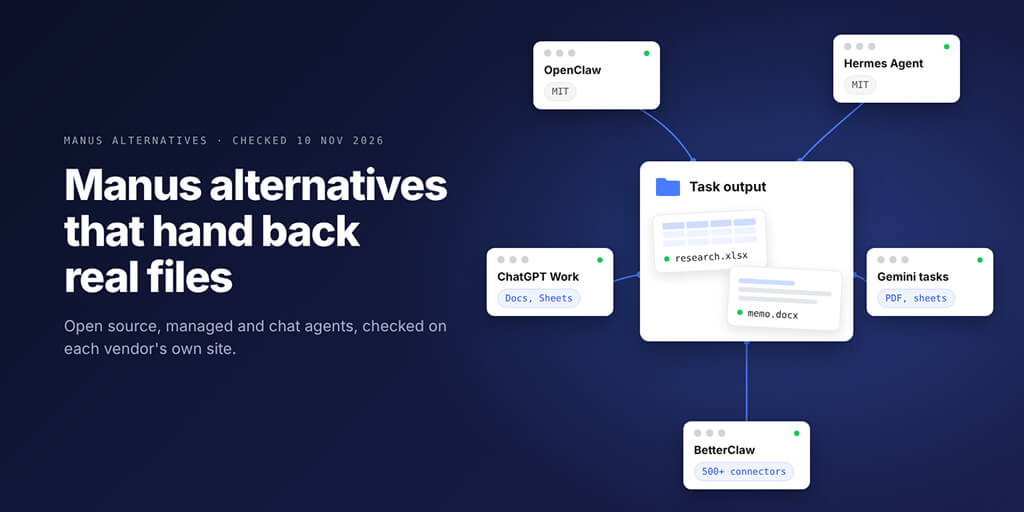
Eleven tools, three kinds of agent, one question: does the job end in a file you can open? We checked each one on its own site so you can pick by job.
| If the job is | Start with |
|---|---|
| A spreadsheet and a memo by tomorrow | ChatGPT Work, Gemini tasks |
| Free, open source, on your own server | OpenClaw, Hermes Agent |
| Clicking through websites | browser-use, Grok Bot |
| A daily job on your own model keys | Hermes Agent, BetterClaw |
Picture this: it's 11 PM. The client wants a comparison spreadsheet and a one-page memo by 9 AM, and your Manus credits for the month are nearly gone.
Is there something else that just hands me the files?
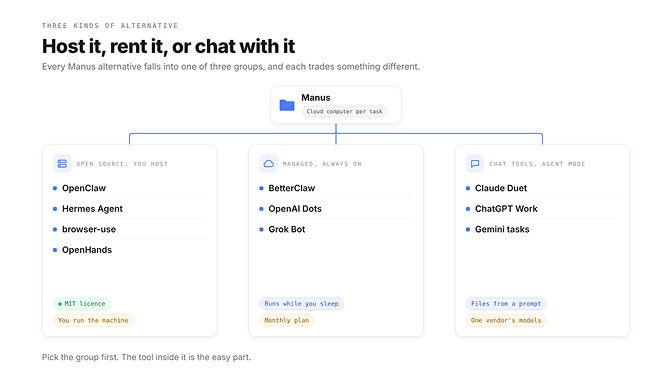
There is, and there are more than a few. Manus runs each task in its own cloud computer and hands back the result. The alternatives split three ways: open source agents you host, managed always-on agents, and chat tools with an agent mode.
One honest note before the list: we did not run one test task across all eleven tools.
We read what each one documents it can deliver, on its own site, on 10 November 2026, and we say so wherever it matters. If you're still deciding whether Manus is the wrong tool at all, our Manus AI use cases roundup shows where it shines.
Manus alternatives at a glance
Prices are US list prices for the cheapest plan that includes the agent.
| Tool | Type | Open source | Hands back files | Your own keys | Runs on a schedule | Price to start |
|---|---|---|---|---|---|---|
| Manus (for reference) | Managed task agent | No | Yes, in the task | Beta (Manus Flex) | Yes | $0 Free; Pro from $20/mo |
| OpenClaw | Self-hosted agent | Yes, MIT | To its workspace | Yes | Yes | $0 plus model costs |
| Hermes Agent | Self-hosted agent | Yes, MIT | To local files or chat | Yes | Yes | $0 plus model costs |
| browser-use | Browser agent library | Yes, MIT | Downloads folder | Yes | Not documented | $0 locally; Cloud $0.02 per browser-hour |
| OpenHands Agent Canvas | Self-hosted coding agents | Yes, MIT | In the repo or workspace | Yes | Yes | $0 self-hosted; Teams $500/mo |
| BetterClaw | Managed always-on agents | No | Through connected apps | Yes, 28+ providers | Yes | From $19/mo |
| OpenAI Dots | Agent with its own cloud computer | No | Yes | No | Yes | ChatGPT Pro, from $100/mo |
| Grok Bot | Agent with a shared cloud computer | No | Yes | No | Yes | Premium, $30/mo |
| Claude Duet | Proactive agent app | No | Yes, in its Create tab | No | Checks every few hours | Claude Pro, $20/mo |
| ChatGPT Work | Agent mode in ChatGPT | No | Docs, sheets, slides | No | Yes | Limited on ChatGPT Free; Plus $20/mo |
| Gemini tasks | Agent mode in Gemini | No | PDFs, docs, sheets, slides | No | Yes | Google AI Pro, $19.99/mo |
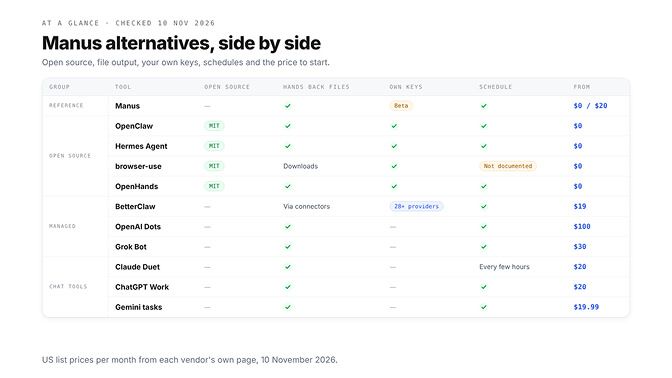
Two rows surprise people. Manus now takes your own API key, through a beta called Manus Flex. And four of the eleven cost nothing to install.
What people mean by "Manus alternative"
Three different frustrations hide behind that search.
The first is credits. Manus bills in credits, and its help centre says they're consumed by model tokens, virtual machines and third-party APIs, so the cost depends on how complex and long a task is. Monthly credits don't roll over. Pro starts at $20 a month for 4,000 credits plus 300 refresh credits a day, with $40 and $200 tiers above it.
Manus's own help centre also admits it can't tell you what a task will cost before you start it. That's the part that stings when a client job runs long.
The second is availability. Meta announced a deal for Manus in December 2025, and in August Manus said it "will soon resume operating as an independent company". During that change it paused new subscriptions in some regions it didn't name, and deleted task data created since 29 December 2025 for affected accounts.
The third is the one Manus does best: the job has to end in actual files. Not a chat reply. A spreadsheet you can sort, a memo you can forward, a deck you can present.
If your real question is how Manus compares with a self-hosted agent, our Manus vs OpenClaw vs managed agents breakdown covers the three operating models.
Manus has kept moving, too: Manus 2.0, from 1 October, added a desktop app for local files, Cloud Computer servers at $30 or $50 a month, and Automations.
If bring-your-own-key was your reason to leave, look at Manus Flex first. It's in beta, takes keys from OpenAI, Anthropic, Google AI Studio, xAI, Meta, OpenRouter, Fireworks and Modal, and your provider bills the model. Images, video, Cloud Computer and hosting still use Manus credits.
Open source Manus alternatives you host
All four are MIT-licensed. You pay nothing for the software and everything for the setup.
OpenClaw
OpenClaw is an open-source assistant that runs on your own computer and talks to you where you already are: Discord, iMessage, Slack, Teams, Telegram, WhatsApp and 20+ more channels. Models are plugins, so you can swap Claude, Codex or a local model without rebuilding anything.
It has a built-in scheduler. openclaw automations creates jobs that wake the agent at a set time and deliver the output to a chat channel or a webhook. The latest stable release is v2026.11.2, tagged on 7 November.
The catch is in its own README: tools run on the host for the main session unless you configure sandboxing. Manus gives every task a fresh computer; OpenClaw uses yours.
Our roundup of OpenClaw alternatives compared covers the hosted and self-hosted routes if that trade worries you.
Hermes Agent
Hermes Agent from Nous Research is the closest open source match for "do this every morning and hand me the result". Its cron jobs can deliver results back to the chat they came from, to local files, or to a platform you've connected. A job can pin its own model, and a script-only mode runs with no model at all.
It also keeps a memory of you between sessions, in its own MEMORY.md and USER.md files. The current release is v0.23.1.
browser-use
browser-use is a Python library where the model writes code in a live session that drives Chrome. Version 1.0.0 shipped on 9 November. Files the browser downloads land in the agent's workspace folder, and the default setup uses Browser Use's own model and cloud browser unless you point it at a local Chrome.
It handles the research half of a Manus task well. It doesn't build the memo for you.
OpenHands Agent Canvas
OpenHands has become Agent Canvas, a self-hosted control centre for coding agents: its own agent plus Claude Code, Codex, Gemini CLI, Pi and OpenCode. Automations run on a schedule or a webhook, for jobs like posting a report to Slack.
It runs on your laptop by default. Pick it for engineering work, not for a client memo.
Manus brings the computer. The open source options use the one you already have, which is cheaper and also the whole security question.
Managed always-on agents, BetterClaw included
These run on someone else's servers, keep going when your laptop is shut, and charge a monthly plan. Manus itself now sits here too, with Cloud Computer, which our Manus Cloud Computer vs OpenClaw explainer covers in depth.
BetterClaw
We build BetterClaw, so here are our limits first. There is no cloud computer per task: you don't get a sandbox to install software in, and nothing hands you a downloaded file from a VM. Output goes into the apps you connect, through 500+ connectors, or back to you in chat.
What you do get: always-on agents that run on a schedule, your own keys across 28+ providers with zero markup, ISO 27001 certification and a SOC 2 Type II audit in progress. Telegram comes on Pro and above, WhatsApp isn't live, and BetterClaw is not a Hermes host.
OpenAI Dots
A dot is an always-on agent inside ChatGPT with its own cloud computer, and it keeps working between conversations. You can schedule its tasks and review them under Scheduled in its profile. Your first dot comes with ChatGPT Pro, from $100 a month, for users outside the European Economic Area, Switzerland and the UK, or with a Business Premium seat.
Grok Bot
Grok Bot comes with The X Subscription's Premium plan at $30 a month, with Super at $100 and Ultra at $200. Your Bots share one persistent cloud computer with a browser, file system and terminal. Routines run a saved workflow on a schedule.
Its docs give an example that fits this page: reconcile a spreadsheet against a PDF and "return a new spreadsheet plus a short summary". It can save files to Google Drive, OneDrive or SharePoint, and its usage comes from a weekly pool shared with Grok and Cursor.
Our Grok Bot vs Dots vs Muse comparison goes deeper on these two and on Meta's Muse.
Chat tools with an agent mode: Claude Duet, ChatGPT Work, Gemini
The quickest route from a prompt to a finished file, tied to one vendor's models and usage limits.
Claude Duet
Claude Duet is Anthropic's proactive agent, in research preview by waitlist for US Pro, Max and Ultra subscribers. Pro is $20 a month billed monthly. It works on a virtual machine with its own browser, checks your connected apps every few hours, and asks before it sends, pays, signs or deletes anything.
Finished work, such as research summaries, financial models and decks, lands in its Create tab.
ChatGPT Work
OpenAI calls Work "an agent designed for longer, multi-step work and finished deliverables". It creates and edits documents, spreadsheets, presentations and reports, including native Google Docs, Sheets and Slides when you connect them. On the desktop app, Excel works through an add-in.
Work can run once, on a schedule, or when something happens in a connected app. ChatGPT Free includes limited Work access on desktop; Plus at $20 a month expands it to web and mobile.
Gemini tasks
Tasks in Gemini plan the steps, use a remote browser, and can package research into downloadable PDFs, documents, spreadsheets and presentations. You can schedule them, and up to 15 can run at once.
You need Google AI Pro ($19.99 a month in the US) or Ultra, a personal Google account, and a location outside the European Economic Area, Nigeria, Switzerland and the UK.
None of the three takes your own key: the model and the usage pool come with the subscription. For Anthropic's version, our Claude Duet guide covers the waitlist and the usage-limit catch.
Free Manus alternatives, and how long free lasts
"Free" means three different things here.
| Option | What you get for $0 | Where it stops |
|---|---|---|
| OpenClaw, Hermes Agent, browser-use, OpenHands | The full software | You pay for models and a machine, or run a local model |
| Manus Free | 300 refresh credits a day, capped at 1,500 a month | Lite mode only, 1 task at a time, 2 scheduled automations |
| ChatGPT Free | Limited Work access on desktop | Web and mobile Work start at Plus |
| Browser Use Cloud | A one-time $1 credit for eligible signups | Then $0.02 per browser-hour plus traffic |
The open source tools are free the way a puppy is free. The software costs nothing. The care and feeding is the bill.
Local Manus alternatives: what your own machine can do
Start with the model your hardware can hold, then pick the agent. OpenClaw and Hermes both run with local models, Hermes through llama.cpp.
browser-use drives the Chrome on your desk, and OpenHands Agent Canvas runs locally unless you point it elsewhere. A local setup can do the research and write the files.
What it can't do is keep a schedule while your laptop sleeps. OpenClaw's onboarding can install its gateway as a background service with openclaw onboard --install-daemon, which helps on a desktop that stays on, not on a laptop in a bag. The model you can fit in memory also caps how much context a long task can hold.
Manus Studio, the desktop app in Manus 2.0, works with files on your computer. It still runs on Manus credits, so it isn't a local alternative.
If what you want is the always-on half, an agent that runs on a schedule with your own keys and reaches your apps through 500+ connectors without a machine of yours to keep awake, that's the job BetterClaw does. Plans start from $19 a month, and your first workspace starts with a 7-day free trial. See BetterClaw plans
Three sources, one spreadsheet, one memo: what each tool says it delivers
Here's the task people use to judge a Manus alternative: research three sources, put the findings in a spreadsheet, write a one-page memo. We haven't run it on every tool yet, so there are no times or costs below. This is what each vendor documents it can hand back.
| Tool | Spreadsheet | Memo | Where the files land |
|---|---|---|---|
| Manus | Data analysis with charts; exports to PDF, PowerPoint or a webpage | Report in the task | In the task |
| ChatGPT Work | Yes, including native Google Sheets | Yes | Library or Space, or your Google Drive |
| Gemini tasks | Yes, downloadable | Yes, document or PDF | The task's work panel |
| Grok Bot | Yes, per its own example | Yes, a short summary | Its computer, or Drive, OneDrive, SharePoint |
| Claude Duet | Financial models and dashboards | Research summaries | Its Create tab |
| OpenClaw, Hermes Agent | Whatever the model writes in its workspace | Same | Your machine, or a chat via a scheduled job |
| browser-use | No, downloads only | No | A workspace downloads folder |
| BetterClaw | Into a connected app | Into a connected app or chat | Your connected apps |
Notice where Manus sits. Its sandbox can write any file a script can, but its data analysis docs list PDF, PowerPoint and webpage exports, not a spreadsheet. ChatGPT Work, Gemini tasks and Grok Bot name spreadsheets outright.
Which of the Manus alternatives to pick, by job
Start with the job, then the group, then the tool. If the agent is for life admin rather than client work, our list of the best AI agent for personal use is a better starting point.
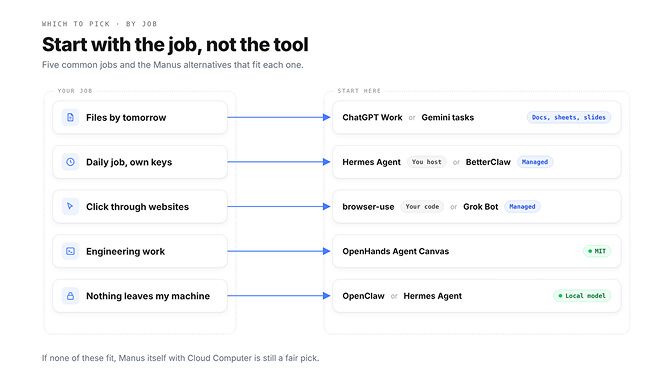
You need the files by tomorrow. Use ChatGPT Work, or Gemini tasks if you're outside the regions Google excludes.
You want a daily job on your own model keys. Host Hermes Agent if you'll run a server. Use a managed platform if you won't.
The job is clicking through websites. Write it with browser-use if you code, or hand it to Grok Bot if you'd rather not.
It's engineering work. OpenHands Agent Canvas runs your coding agents on a schedule.
Nothing can leave your machine? Run OpenClaw or Hermes with a local model, and accept that the model you can fit sets the limits.
The file was never the hard part
Most tools on this page can write a memo, and several can build the spreadsheet. That stopped being impressive a while ago.
What still separates them is everything around the file: whose computer did the work, whose model wrote it, who pays when it runs long, and whether it runs again tomorrow without you asking.
Ask what happens on day thirty, not what happens on the first task.
Frequently Asked Questions
What is the best Manus alternative?
It depends on the job. For finished files from a prompt, ChatGPT Work and Gemini tasks both document spreadsheets and documents. For open source, OpenClaw or Hermes Agent. For an agent with its own cloud computer, OpenAI Dots or Grok Bot.
Is there a free Manus alternative?
Yes. OpenClaw, Hermes Agent, browser-use and OpenHands Agent Canvas are MIT-licensed and cost nothing to install, though you pay for models and a machine or run a local model. ChatGPT Free also includes limited Work access on desktop.
Is there an open source Manus alternative?
Yes, four. OpenClaw and Hermes Agent are general agents with schedulers and chat apps, browser-use automates a browser, and OpenHands Agent Canvas runs coding agents. All four are MIT-licensed.
Manus vs OpenClaw, which is better?
Manus is better if you want a fresh cloud computer for each task and no setup. OpenClaw is better if you want free, self-hosted software with your own models and 20+ chat channels, and you're willing to run and secure the machine yourself.
Can Manus alternatives run on a schedule?
Most can. OpenClaw, Hermes Agent, OpenHands, BetterClaw, OpenAI Dots, Grok Bot, ChatGPT Work and Gemini tasks all document scheduled runs. Claude Duet checks your apps every few hours, and browser-use doesn't document a scheduler.
Does Manus support bring your own key?
Yes, in beta. Manus Flex lets you connect a key from OpenAI, Anthropic, Google AI Studio, xAI, Meta, OpenRouter, Fireworks or Modal, and your provider bills the model. Images, video, Cloud Computer and hosting still use Manus credits.