
Self-Hosting OpenClaw vs BetterClaw
Self-hosting gives you total control. BetterClaw gives you total convenience. Both are legitimate paths to running AI agents. This page lays out the real tradeoffs: cost, time, security, maintenance, and what each path demands from you.
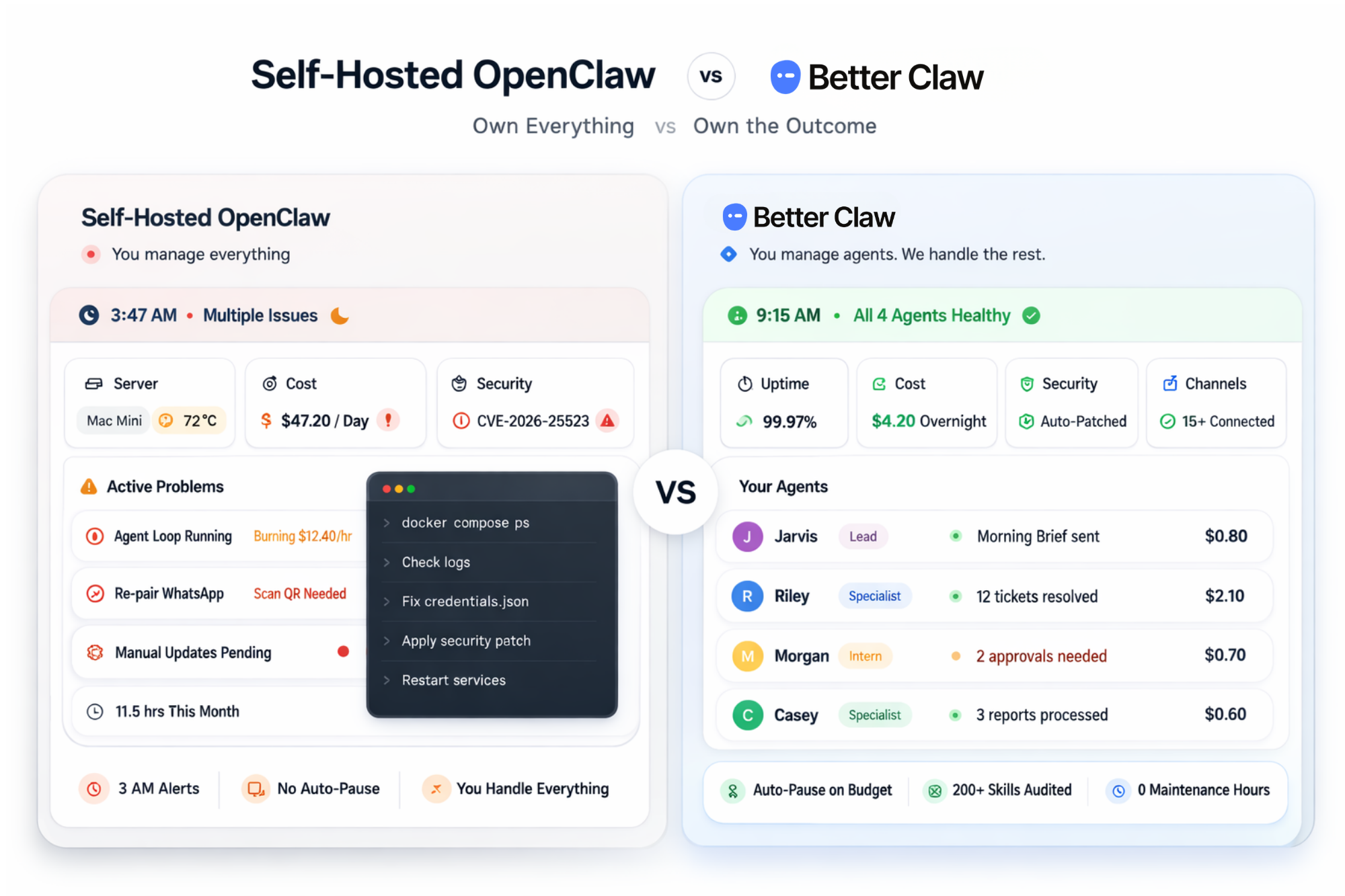
Your Biggest Competitor Isn’t Another Platform. It’s the DIY Path.
Most people evaluating BetterClaw aren’t choosing between BetterClaw and xCloud, or BetterClaw and ClawHosters. They’re choosing between BetterClaw and doing it themselves.
And the thing is, self-hosting OpenClaw is a completely valid option. OpenClaw is one of the most impressive open-source projects in recent memory. 230K+ GitHub stars. 5,700+ community skills. The ability to run your own AI assistant on your own hardware with full control over every detail.
The question isn’t whether self-hosting works. It does. The question is whether the work it requires is work you want to do, and whether the risks it introduces are risks you’re equipped to manage.
The Self-Hosting Checklist Nobody Puts on the Landing Page
Here’s everything involved in getting a self-hosted OpenClaw deployment to production-grade reliability. Not all of it is hard, but all of it is your responsibility.
Initial Setup (4–20 hours depending on experience)
Hardware or VPS provisioning — Mac Mini ($600+) or VPS ($7–24/mo). Min 2GB RAM, recommended 4GB+.
Docker installation and configuration — Docker Engine, Docker Compose, container networking, volume mounts, port mapping.
OpenClaw installation — Clone repo, configure openclaw.json, set up SOUL.md, install daemon, run onboarding.
SSL/TLS certificate setup — Reverse proxy (Nginx/Caddy) with Let’s Encrypt. OpenClaw warns: "Do not expose port 18789 without TLS."
Firewall configuration — Block direct port access, SSH key-only auth, fail2ban for brute force protection.
Chat channel pairing — Each platform has its own OAuth flow, webhook, or QR pairing mechanism.
API key management — Keys stored in plain text config files by default.
Skill installation — Browse ClawHub (5,700+ unvetted), evaluate, install, configure permissions.
Security hardening — Seven layers required. Most self-hosters skip multiple layers. 42,000+ exposed instances found.
Ongoing Maintenance (2–10 hours/month)
OpenClaw updates — 4 releases in a single week in March 2026. Each needs pulling, testing, deploying.
Security patching — 3 CVEs in one week, including CVE-2026-25253 (CVSS 8.8, one-click RCE).
Docker and OS updates — Engine, images, Ubuntu/macOS patches, dependency updates.
Channel re-pairing — WhatsApp sessions expire, OAuth tokens refresh, IP changes break webhooks.
Memory management — 20–50GB of logs and memory over 6 months. Compaction and cleanup are manual.
Cost monitoring — No built-in spending cap. Community reports include $3,600 monthly API bills from agent loops.
Troubleshooting — When your agent stops at 3 AM, you diagnose it.
Community reports consistently put ongoing maintenance at 5 to 10 hours per month for a single agent. One enterprise consultancy documented teams spending 20 hours per week managing OpenClaw infrastructure.
What BetterClaw Handles So You Don’t Have To
| Self-Hosting Task |  BetterClaw Equivalent BetterClaw Equivalent |
|---|---|
| VPS/hardware provisioning | Cloud-hosted, nothing to provision |
| Docker installation and config | No Docker, no containers to manage |
| OpenClaw installation | Sign up and deploy in under 2 minutes |
| SSL/TLS setup | Handled automatically |
| Firewall configuration | Managed infrastructure |
| Chat channel pairing | One-click connect for 15+ platforms |
| API key management | AES-256 encrypted vault |
| Skill installation from ClawHub | 200+ security-audited skills marketplace |
| Security hardening (7 layers) | Docker-sandboxed per agent, pre-configured |
| OpenClaw version updates | Automatic, zero downtime |
| Security patching (CVEs) | Applied automatically across all instances |
| Docker/OS updates | Managed |
| Channel re-pairing | Persistent connections, managed |
| Memory management | Hybrid vector + keyword search, fully managed |
| Cost monitoring | Per-agent tracking with anomaly alerts and auto-pause |
| Troubleshooting at 3 AM | 99.9% uptime, managed monitoring |
| Agent guardrails | Trust levels, action approval, kill switch |
| Audit trail | Full log of every action |
Setup time: under 2 minutes. Ongoing maintenance: zero.
Side-by-Side: Self-Hosting vs BetterClaw
Overview
Control
Agent Management
Security
Memory
Chat Platforms
Reliability
Total Cost of Ownership: The Math Nobody Wants to Do
“OpenClaw is free” is the most expensive misconception in the AI agent space. The software is free. Running it is not. Deep dive on how API costs add up.
Mac Mini Self-Hosted
| Mac Mini hardware (amortized 3 yrs) | ~$17 |
| Electricity (24/7) | ~$10 |
| API costs (moderate, Claude/GPT) | $50–130 |
| Your time: setup (16 hrs ÷ 12 mo) | ~$67 at $50/hr |
| Your time: maintenance (7 hrs/mo) | $350 at $50/hr |
| Total | $494–574/month |
VPS Self-Hosted (Hostinger/Hetzner)
| VPS hosting (4GB RAM, 2 vCPU) | $7–24 |
| API costs (moderate) | $50–130 |
| Your time: setup (12 hrs ÷ 12 mo) | ~$50 at $50/hr |
| Your time: maintenance (7 hrs/mo) | $350 at $50/hr |
| Total | $457–554/month |
VPS Self-Hosted (time valued at $0)
| VPS hosting | $7–24 |
| API costs (moderate) | $50–130 |
| Your time | $0 (you enjoy it) |
| Total | $57–154/month |
Cheapest path if infrastructure is your hobby
BetterClaw
| Platform (Pro: 5 agents, 12,000 credits) | $49 |
| API costs (Heartbeat, 60%+ savings) | $20–55 |
| Your time: setup | $0 (2 minutes) |
| Your time: maintenance | $0 (fully managed) |
| Total | $69–104/month |
The comparison comes down to one question: what is your time worth? If the answer is “nothing, I genuinely enjoy managing infrastructure,” Scenario 3 wins. If your time has a dollar value, even a modest one, the math flips fast. At $50/hour, the maintenance hours alone cost more than BetterClaw’s entire platform fee.
Security: The Risk You Can’t Spreadsheet
Cost and convenience are debatable. Security is where self-hosting gets genuinely dangerous if you’re not careful. Read about the OpenClaw security incidents.
Security researchers found tens of thousands of OpenClaw instances running without authentication, accessible to anyone on the internet.
CVE-2026-25253 (CVSS 8.8) allowed one-click remote code execution through authentication token theft. Self-hosted instances without monitoring stayed vulnerable for weeks.
Cisco’s security team confirmed data exfiltration and prompt injection in third-party OpenClaw skills. 5,700+ submissions with no systematic security review.
OpenClaw stores API keys, OAuth tokens, and secrets in config files on your server. Server compromise = credential exposure.
No action approval. No spending limits. No kill switch beyond SSHing into the server. A Meta researcher documented 200+ emails deleted while stop commands were ignored.
Managed hosting doesn’t eliminate all risk, but it changes who bears it. BetterClaw patches CVEs fleet-wide within hours, vets every skill, encrypts credentials in an AES-256 vault, sandboxes each agent, and provides action approval workflows and a kill switch from your phone.
Choosing the Right Path
You need full control over every layer.
Root access, source code modification, custom Docker builds, custom networking. If any of these are requirements, self-hosting is the only option.
You want to run local models with Ollama.
Eliminates API costs entirely and keeps all data on your hardware. Requires 16GB+ RAM for useful model sizes.
You have specific compliance requirements.
Hosting in a specific country, on specific hardware, or under specific security certifications that a managed SaaS can’t guarantee.
You’re building a product on top of OpenClaw.
If OpenClaw is a component in a larger system, you need the ability to fork, modify, and integrate at the code level.
You genuinely enjoy infrastructure work.
If managing Docker and hardening Linux servers is fun for you (not just tolerable, but actually enjoyable), self-hosting turns a cost into a hobby.
Budget is the absolute primary constraint.
A $7 VPS with Ollama gets you a running instance for under $10/month. If your time isn’t a factor, self-hosting wins on raw cost.
Where BetterClaw Is the Better Choice Your time is more valuable than server management.
BetterClaw eliminates 5–10 hours/month of maintenance so you can focus on the work your agents are supposed to handle.
Non-technical people need to deploy agents.
The visual agent builder means marketing, ops, HR, and support teams can create agents without filing a ticket with engineering.
You need security guardrails on agent behavior.
Trust levels, action approval, kill switch from your phone, per-agent cost tracking with auto-pause, and a full audit trail.
You need agents in production for a business.
When consequences are measured in dollars and reputation, not just inconvenience, managed security and monitoring are requirements.
You don’t want to respond to CVEs at midnight.
BetterClaw patches vulnerabilities fleet-wide within hours. Self-hosting means you find, evaluate, test, and deploy patches yourself.
You want Heartbeat scheduling to cut API costs.
Always-on agents burn tokens checking for work. BetterClaw’s Heartbeat system saves 60%+ on API spend.
You want persistent memory that actually persists.
OpenClaw’s file-based memory breaks during context compaction. BetterClaw’s hybrid vector + keyword search retrieves relevant memories on demand.
How to Decide: Three Questions
1. How many hours per month are you willing to spend on infrastructure?
BetterClaw
Self-host
Consider a managed VPS like xCloud or ClawHosters as a middle ground — compare options
2. Who will be creating and managing agents?
Self-hosting works
BetterClaw’s visual builder is the only path
3. What happens if your agent does something wrong?
Self-hosting’s lack of guardrails is manageable
BetterClaw’s trust levels, action approval, kill switch, and audit trail are requirements
Tried Self-Hosting? Ready for the Easy Path?
Most BetterClaw customers tried self-hosting first. They know exactly what Docker setup, YAML configuration, and 3 AM troubleshooting sessions feel like. Deploy your first agent in under 2 minutes. Migrate your existing OpenClaw config in under an hour.
Self-Hosting Guides & Alternatives
Hardware
OpenClaw Local Model Hardware: What You Need
16GB+ RAM minimum, but tool calling is broken for all Ollama models. The real hardware and cost math.
Troubleshooting
Local Model Not Working? Here's Why
The streaming bug, tool calling trap, and 3 other causes. Real fixes from 50+ GitHub issues.
Dashboard
OpenClaw Mission Control: What It Is
It's 7+ competing dashboards. Which version to use, when you need one, and when to skip it.
Self-Hosting OpenClaw vs BetterClaw: Common Questions
Is self-hosting OpenClaw really free?
The software is free (MIT license). Running it is not. You need hardware or a VPS ($7–17+/month), API keys ($5–200+/month), and your time for setup (4–20 hours) and ongoing maintenance (5–10 hours/month). When you factor in time costs, self-hosting typically costs more than managed alternatives. See BetterClaw pricing for comparison.
How long does it take to set up self-hosted OpenClaw?
Community reports range from 4 to 8 hours for experienced Linux administrators to 12 to 20 hours for those learning Docker, networking, and security hardening as they go. BetterClaw setup takes under 2 minutes.
Is self-hosted OpenClaw secure?
It can be, but security is entirely your responsibility. The default configuration stores credentials in plain text, exposes the Gateway without TLS, and runs with no authentication. Three CVEs were disclosed in a single week in early 2026. 42,000+ instances were found exposed without authentication. Self-hosting is secure if you complete all seven hardening layers and maintain them. Most operators don’t.
How much maintenance does self-hosted OpenClaw require?
Community reports cite 5 to 10 hours per month for a single agent. This includes OpenClaw updates, security patching, Docker/OS updates, channel re-pairing, memory management, cost monitoring, and troubleshooting. Even VPS hosting doesn’t eliminate this burden.
Can I avoid API costs by running local models?
Yes. Self-hosting with Ollama and a local model eliminates API costs entirely. This requires hardware with 16GB+ RAM. BetterClaw doesn’t support local models, so this is a genuine advantage of self-hosting.
What's the biggest hidden cost of self-hosting?
Time. At $50/hour, maintenance alone ($350+/month) exceeds BetterClaw’s entire platform fee. The second biggest is unmonitored API spend — no built-in spending caps means agent loops can generate hundreds in unexpected charges.
Can I start with self-hosting and switch to BetterClaw later?
Yes. BetterClaw supports the same skill format and chat platform integrations. Most teams migrate in under an hour. Our migration guide walks through the process step by step.
Can I start with BetterClaw and switch to self-hosting later?
Yes. Your agent configurations, personality settings, and workflow logic are portable. You’ll need to set up infrastructure, security, and monitoring yourself, but your agent’s logic transfers.
Does BetterClaw support everything OpenClaw supports?
Most things, but not everything. BetterClaw doesn’t support local models (Ollama), root server access, custom Docker builds, or source code modification. It adds features OpenClaw doesn’t have: visual agent builder, security-audited skills, trust levels, action approval, Heartbeat scheduling, per-agent cost tracking, kill switch, persistent memory, and full audit trail.
I'm a developer comfortable with Docker and Linux. Should I still consider BetterClaw?
Maybe. The question isn’t whether you can self-host. The question is whether you want to spend your engineering time on infrastructure management or on the actual agent workflows that create value. Many developers choose BetterClaw not because they can’t self-host, but because they’d rather spend their hours building, not maintaining. If you want a middle ground, see ClawHosters for managed VPS with SSH access.
Tried Self-Hosting? Ready for the Easy Path?
Most BetterClaw customers tried self-hosting first. They chose BetterClaw because they'd rather spend their time on work that matters.
Free plan available · Pro $49/mo · BYOK · 7-day money-back guarantee