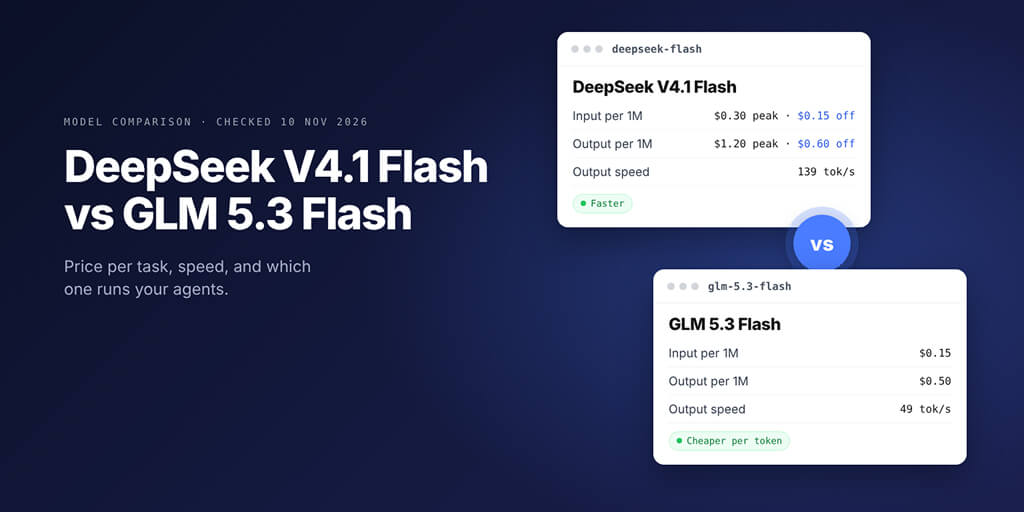
GLM 5.3 Flash wins the price sheet. DeepSeek V4.1 Flash wins the clock. Here's what each one costs per finished task, how fast it really is, and where each belongs in an agent stack.
| Quick answer | Pick |
|---|---|
| Agents that run in DeepSeek's weekday peak hours | GLM 5.3 Flash |
| Overnight and weekend batches, heavy caching | DeepSeek V4.1 Flash, off-peak |
| Speed per task | DeepSeek V4.1 Flash (or GLM 5.3 FlashX) |
| Terminal-heavy coding agents | GLM 5.3 Flash (Vals' Terminal-Bench 4.0) |
| Self-hosting on 128 GB | GLM 5.3 Flash |
Picture this. You move your nightly research agent to the model that's half the price per token. A week later the bill hasn't moved, and the run that used to finish at 1 AM now finishes at 4.
How is the cheaper model not cheaper?
Because price per token is one number out of four. The other three are how many tokens the model burns, when you run it, and how fast it finishes. We checked all of them on Z.ai's, DeepSeek's and OpenRouter's own pages on 10 November 2026.
New to the GLM name itself? Our explainer on what GLM is and how it differs from an LLM covers that first.
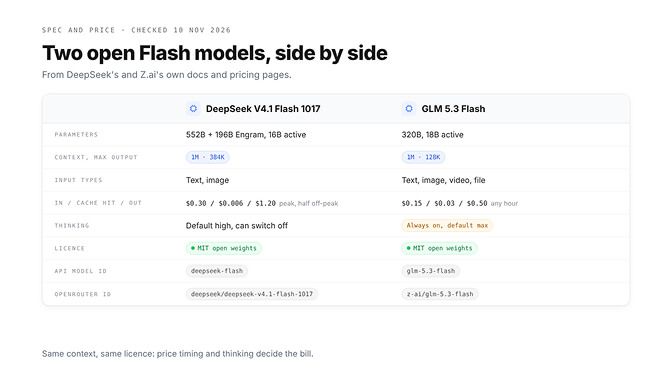
DeepSeek V4.1 Flash vs GLM 5.3 Flash: the spec table
Both are open-weight mixture-of-experts models with a 1M-token context and an MIT licence. After that, they part ways.
| DeepSeek V4.1 Flash (1017) | GLM 5.3 Flash | |
|---|---|---|
| Maker | DeepSeek | Z.ai |
| Released | 17 Oct 2026 (V4.1 Flash: 10 Sep) | 26 Aug 2026 |
| Parameters | 552B backbone plus 196B Engram table; 8B active for input, 16B for output | 320B total, 18B active |
| Context / max output | 1M / 384K | 1M / 128K |
| Input | Text, image | Text, image, video, file |
| Price per 1M: input / cache hit / output | $0.30 / $0.006 / $1.20 peak, half off-peak | $0.15 / $0.03 / $0.50, any hour |
| Thinking | On by default (high), can be switched off | Always on: low, high or max (default max) |
| Weights | Open, MIT | Open, MIT |
| API model ID | deepseek-flash | glm-5.3-flash |
| OpenRouter ID | deepseek/deepseek-v4.1-flash-1017 | z-ai/glm-5.3-flash |
One ID trap. On OpenRouter, deepseek/deepseek-v4.1-flash is still listed, but it's the 10 September build, served only by third-party hosts. The current model is deepseek/deepseek-v4.1-flash-1017, which is what DeepSeek's own deepseek-flash points at.
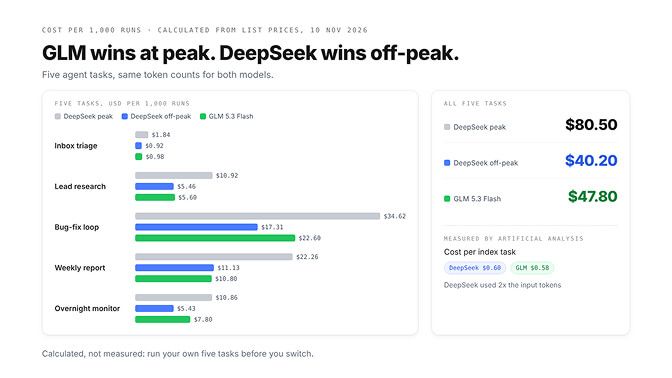
DeepSeek V4.1 Flash vs GLM 5.3 Flash price per finished task
Per token, GLM 5.3 Flash is half DeepSeek's peak price on input and 42% of it on output. But agents don't buy tokens. They buy finished jobs, and two DeepSeek rules move the result.
First, the clock. DeepSeek's peak runs 01:00 to 04:00 and 06:00 to 10:00 UTC on weekdays, and every other hour costs half. Our DeepSeek V4.1 Flash pricing and hardware guide converts those windows to IST and US time.
Second, the cache. A DeepSeek cache hit costs $0.006 per million tokens; on GLM it's $0.03, five times more. Agents resend the same system prompt and tools every turn, so this line matters more than it looks.
Here are five agent tasks with fixed token counts. They're our assumptions, the same for both models, and the costs are calculated from list prices on 10 November 2026, not measured.
| Task (per run) | Tokens in (cached) / out | DeepSeek peak | DeepSeek off-peak | GLM 5.3 Flash |
|---|---|---|---|---|
| Inbox triage | 8K (6K) / 1K | $1.84 | $0.92 | $0.98 |
| Lead research | 40K (20K) / 4K | $10.92 | $5.46 | $5.60 |
| Bug-fix loop, 12 turns | 300K (270K) / 20K | $34.62 | $17.31 | $22.60 |
| Weekly report | 60K (10K) / 6K | $22.26 | $11.13 | $10.80 |
| Overnight monitor | 120K (110K) / 6K | $10.86 | $5.43 | $7.80 |
| All five | $80.50 | $40.20 | $47.80 |
All costs are per 1,000 runs. At peak, GLM wins every row. Off-peak, DeepSeek wins four of five, and the cache-heavy bug-fix loop by 23%.
Search changes the research row. DeepSeek's Search API costs $0.75 per 1,000 successful requests; Z.ai's built-in Web Search costs $0.01 per use. Three searches add $2.25 per 1,000 runs on DeepSeek and $30 on Z.ai.
Now the reality check. Same token counts is the weak assumption, and Artificial Analysis measured the real thing on its Intelligence Index. DeepSeek V4.1 Flash 1017 used about twice the input tokens and 1.4 times the output tokens of GLM 5.3 Flash on the same tasks.
On Artificial Analysis's measured run, the cost per task was $0.60 for DeepSeek and $0.58 for GLM 5.3 Flash. Half the token price bought a 3% saving.
That $0.60 is at DeepSeek's listed peak price. Every DeepSeek rate halves off-peak, so the same run off-peak works out to about $0.30 (our calculation). If your agents can wait for off-peak, DeepSeek is the cheaper model per task.
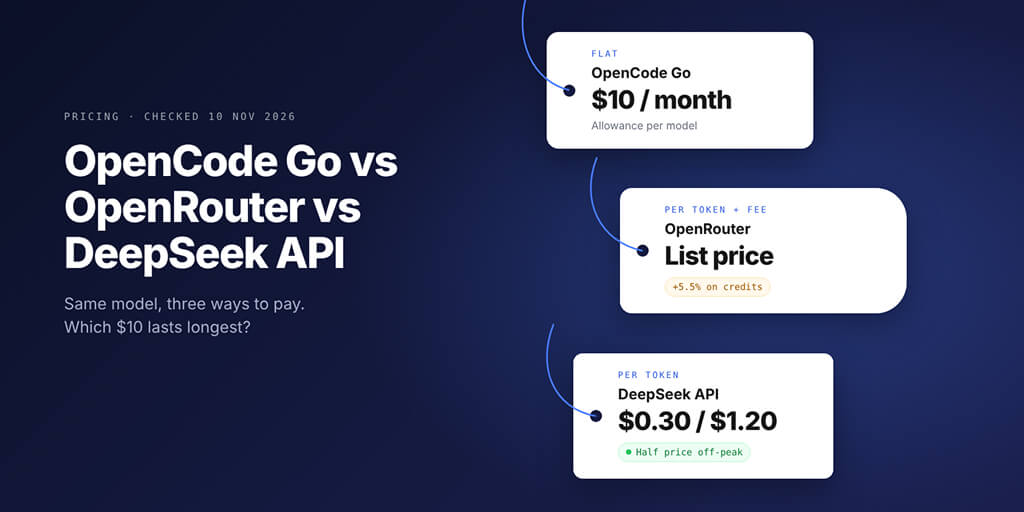
Paying through a router or a subscription instead? Both models also run free inside OpenCode for a limited time, as glm-5.3-flash-free and deepseek-v4.1-flash-free, but only in OpenCode's own client. Our OpenCode Go vs OpenRouter vs DeepSeek API breakdown covers which $10 lasts longest.
Speed and time to first token
Speed is where the gap stops being close. These are Artificial Analysis's figures for each maker's own API, checked 10 November 2026.
| First-party API, per Artificial Analysis | DeepSeek V4.1 Flash 1017 | GLM 5.3 Flash (Z.ai) |
|---|---|---|
| Output speed | 139 tokens/s | 49 tokens/s |
| Time to first answer token (thinking included) | 49.00 s | 75.08 s |
| Minutes per Intelligence Index task | 16.6 | 45.6 |
| Error rate | 5.3% | 0.9% |
That first-token time includes the model's thinking, which is why both look slow. GLM can't skip it: Z.ai's docs say thinking can't be disabled, and the default effort is max. DeepSeek can switch thinking off for simple steps.
Two ways to buy speed. Z.ai's GLM 5.3 FlashX runs at 200 tokens per second, per Z.ai, for $0.37 input and $1.25 output. Or pick a faster host: Artificial Analysis clocks the quickest DeepSeek endpoint at 2.7 minutes per task and the quickest GLM endpoint at 5.3 minutes.
Look at the error column too. DeepSeek's endpoint failed more often on the day we checked, so an agent on it needs retries with backoff.
Agent behaviour: tool calls, long tasks and the "done" check
Both models support function calling, structured output and caching. On published benchmarks, DeepSeek leads most rows, but not the one terminal agents care about.
| Benchmark | DeepSeek V4.1 Flash 1017 | GLM 5.3 Flash | Who ran it |
|---|---|---|---|
| DeepSWE v1.1 | 77.0 | 63.4 | Each maker, own setup |
| Automation-Bench | 60.5 | 48.8 | Each maker, own setup |
| Terminal-Bench 4.0 | 31.82% | 37.37% | Vals AI |
| Vals Index | 61.26% (#11 of 36) | 50.86% (#30 of 36) | Vals AI |
| Intelligence Index v5.0.1 | 33 | 28 | Artificial Analysis |
You may see Z.ai quote a score of 57 for GLM 5.3 Flash. That's Artificial Analysis's older v4.1.1 index, so don't compare it with the 33 and 28 above.
Two tool-calling gotchas, both from the makers' docs. On DeepSeek, when a request carries tools, you must pass every earlier turn's reasoning_content back, or the API returns a 400 error. On GLM, Z.ai recommends thinking.clear_thinking: false and, when streaming, tool_stream: true.
One more from OpenRouter's endpoint data: neither first-party endpoint accepts tool_choice: "required". If your framework forces a tool call that way, route around it.
Then there's the failure mode benchmarks miss: the agent that says "done" when it isn't. We haven't run this test yet, so here's the method instead of a number.
- Give each model 10 runs of a task with one impossible step, such as a file that doesn't exist or an API key that returns 403.
- Check the real state afterwards: the file, the ticket, the sent folder.
- Count runs where the final message claims success anyway.
A model that fails loudly is cheaper than a model that succeeds quietly and wrong. Test for the second one before you trust either.
Refusals and filters
Some users report that DeepSeek V4.1 Flash refuses more often since the 1017 update. DeepSeek's change log says nothing about refusals or filters, and we haven't measured it, so treat it as a report, not a finding.
The fair test: 20 ordinary prompts your agents actually send, including the security and scraping tasks that trip filters. Run each on both models and count refusals. Ten minutes of work beats a week of guessing.
GLM 5.3 Flash vs GLM 5.3: what Flash drops
GLM 5.3 Flash isn't a quantised GLM 5.3. Z.ai built it on a new hybrid of sparse and linear attention, and says it cuts attention compute 3.0x and KV cache 4.4x against GLM 5.3.
Also weighing Xiaomi's models? Our MiMo v2.6 Pro setup and cost guide has its numbers, and our GLM 5.3 vs MiMo v2.6 Pro comparison puts the two big models head to head.
| GLM 5.3 Flash | GLM 5.3 | |
|---|---|---|
| Parameters | 320B, 18B active | 744B, 40B active |
| Input | Text, image, video, file | Text only |
| Price per 1M (in / out) | $0.15 / $0.50 | $1.40 / $4.40 |
| Licence | MIT | GLM-5.3 License (custom) |
| DeepSWE v1.1 (Z.ai) | 63.4 | 66.9 |
| Z.ai Code Bench, max effort | 29.0% | 34.5% |
| Intelligence Index v5.0.1 | 28 | 32 |
So Flash gives up a few points of coding accuracy for roughly a ninth of the price, adds vision, and swaps a custom licence for MIT. On Z.ai's GLM Coding Plan, Flash also gets three times GLM 5.3's quota.
Running them: local, DGX Spark, OpenRouter or the direct API
Local. Ollama lists both only as cloud tags, which run on Ollama's servers. For your own hardware, Unsloth's GGUFs are the route, and GLM is far easier to fit:
| Unsloth guide, total memory | DeepSeek V4.1 Flash 1017 | GLM 5.3 Flash |
|---|---|---|
| Smallest build | 1-bit, 122.4 GB minimum | 1-bit, about 100 GB |
| On a 128 GB machine | 1-bit only, at the edge | 3-bit UD-IQ3_XXS fits |
| Full download, 4-bit | 500.7 GB | 199.7 GB |
DGX Spark. Still deciding on the box? Our DGX Spark alternatives piece compares it with the other options first.
Unsloth names the 128 GB DGX Spark as a fit for GLM 5.3 Flash at 3-bit. DeepSeek fits only at 1-bit with almost no room for context, and NVIDIA also lists a 64 GB Spark, which fits neither.
Direct API. DeepSeek's base URL is https://api.deepseek.com with model deepseek-flash. Z.ai's OpenAI-format examples use https://api.z.ai/api/paas/v4/ with model glm-5.3-flash.
OpenRouter. DeepSeek's own endpoint there now carries the peak and off-peak hours, and Z.ai's charges its list price. Dozens of other endpoints serve both, quantised to FP8 or FP4 in many cases, so pin the provider in your request if accuracy matters more than price.
Using either in BetterClaw
Here's the part we care about. The model is a setting; the agent around it is the work. BetterClaw runs your agents on your own keys with zero markup across 28+ providers, and DeepSeek and OpenRouter are both in the provider list.
For Z.ai's pay-per-token API, choose OpenAI Custom and paste the base URL above. Pick the model per agent, so triage runs on one Flash and the hard step on something bigger. Plans start from $19 a month, and your first workspace starts with a 7-day free trial. See BetterClaw plans
DeepSeek V4.1 Flash vs Opus 5.5, Kimi K3 and Gemini 3.8 Flash
Short rows, same yardstick: one standard agent run of 20K input tokens (15K cached) and 5K output, calculated from each maker's list price on 10 November 2026, cache writes not counted.
| Model | In / out per 1M | 1,000 standard runs | Intelligence Index v5.0.1 | Open weights |
|---|---|---|---|---|
| GLM 5.3 Flash | $0.15 / $0.50 | $3.70 | 28 | Yes |
| DeepSeek V4.1 Flash, off-peak | $0.15 / $0.60 | $3.80 | 33 | Yes |
| DeepSeek V4.1 Flash, peak | $0.30 / $1.20 | $7.59 | 33 | Yes |
| Gemini 3.8 Flash | $0.75 / $3.75 | $23.63 | 31 | No |
| Kimi K3 | $3 / $15 | $94.50 | Not scored | Yes |
| Claude Opus 5.5 | $4 / $20 | $123.00 | 59 | No |
Gemini 3.8 Flash's price doubles to $1.50 and $7.50 on 1 January 2027. Moonshot's newer Kimi K3.1 Pro costs $2 and $10 and scores 46. Of these models, only Gemini 3.8 Flash takes audio input, per OpenRouter's model data, which matters if your agent handles voice notes.
Opus 5.5 is in a different class: 26 points higher on the index, at 16 to 33 times the cost per run. That gap is the whole case for two tiers: pay Opus prices only for the turns that need Opus. For more budget picks, see our ranking of the cheapest AI models for agents.
The two-tier setup: Flash for volume, a frontier model for the hard step
Neither Flash should run everything. The cheap model does the volume: reading, sorting, drafting, checking. A frontier model does the one step where a wrong answer costs real money.
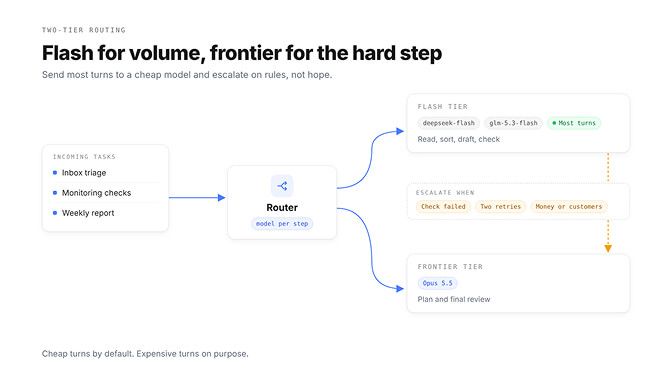
Our rule of thumb: escalate on a failed check, on the second retry, or whenever money or a customer is on the line. Write those rules into the agent before the first run, not after the first surprise bill.
Which Flash goes in the bottom tier? GLM 5.3 Flash if your agents run in DeepSeek's peak hours or need video and file input. DeepSeek V4.1 Flash if they run off-peak, cache heavily or need to finish fast.
The cheapest model is the one you schedule well
"Flash" used to mean cheap and a bit dim. Both of these now land within a few index points of models that cost several times more.
So the choice isn't really about quality anymore. It's about when your agents run, how much they repeat themselves, and how long you'll wait for an answer.
Run your five most common tasks on both, at the hour you'd really run them. Your own bill will settle DeepSeek V4.1 Flash vs GLM 5.3 Flash faster than any table, ours included.
Frequently Asked Questions
Is DeepSeek V4.1 Flash better than GLM 5.3 Flash?
On most published benchmarks, yes: it leads the Vals Index (61.26% to 50.86%) and Artificial Analysis's index (33 to 28), and it's nearly three times faster per task there. GLM 5.3 Flash leads Vals' Terminal-Bench 4.0 run and costs less per token. For agents that run off-peak, DeepSeek is the better buy; during DeepSeek's weekday peak hours, GLM is.
How much does GLM 5.3 Flash cost?
On Z.ai's API it's $0.15 per million input tokens, $0.03 for cached input and $0.50 per million output tokens, at any hour. The faster GLM 5.3 FlashX costs $0.37 input and $1.25 output. Z.ai's Web Search tool adds $0.01 per use.
Is GLM 5.3 Flash free?
Not on Z.ai's API, where it's a paid model; Z.ai's free models are older ones like GLM-4.7-Flash. OpenCode offers glm-5.3-flash-free for a limited time with a daily request limit, inside OpenCode's own client only.
Which is better for coding agents?
It depends on the kind of coding. DeepSeek V4.1 Flash scores higher on DeepSWE v1.1 (77.0 to 63.4, each maker's own run), while GLM 5.3 Flash leads on Vals' Terminal-Bench 4.0 (37.37% to 31.82%). For repo edits, start with DeepSeek; for terminal-heavy agents, test GLM first.
Can I run GLM 5.3 Flash on a DGX Spark?
Yes, on the 128 GB model. Unsloth says its 3-bit UD-IQ3_XXS build works on 128 GB devices like a DGX Spark, and the smallest 1-bit build needs about 100 GB. The 64 GB Spark is too small for either Flash model.
What is the OpenRouter model ID for DeepSeek V4.1 Flash?
Use deepseek/deepseek-v4.1-flash-1017 for the current model. The older deepseek/deepseek-v4.1-flash ID points at the 10 September build. On DeepSeek's own API the model name is deepseek-flash.