Updated September 28, 2026 for OpenClaw 2026.9.6 and Hermes Agent v0.21.5, with NanoClaw added. Every feature claim below is checked against each project's current docs and release notes.
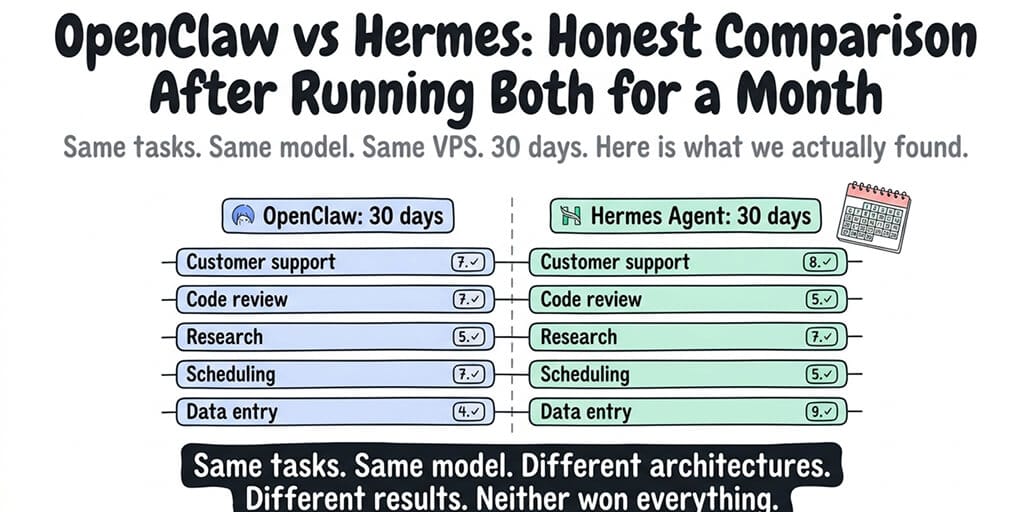
When we first compared OpenClaw and Hermes Agent in April, the story was simple. OpenClaw was the broad one: more chat platforms, a huge skill marketplace, lots of knobs. Hermes was the deep one: fewer platforms, but a learning loop that turned repeated work into reusable skills.
Five months later, that framing is mostly wrong.
OpenClaw 2.0 (v2026.8.1) shipped built-in memory with background "Dreaming" and automatic self-learning skills, both on by default. Hermes, meanwhile, went from a handful of messaging platforms to more than twenty-five, and now installs natively on Windows. The two projects have converged a lot. The differences that remain are real, but they're not the ones most comparison posts still describe.
And there's a third name in the searches now: NanoClaw. So we've added it.
OpenClaw vs Hermes vs NanoClaw at a glance
| OpenClaw | Hermes Agent | NanoClaw | |
|---|---|---|---|
| Release compared | 2026.9.6 (Sep 23, 2026; 2026.10.3 is now latest) | v0.21.5 / v2026.9.24 (Sep 24, 2026) | v2.4.0 (Sep 23, 2026) |
| Built by | OpenClaw Foundation (project started by Peter Steinberger) | Nous Research | nanocoai (MIT-licensed, like the other two) |
| Language | TypeScript / Node.js (Node 24.16+ or 26.1+) | Python (3.11 to 3.14) | TypeScript / Node.js |
| GitHub stars | ~390K | ~250K | ~31K |
| Chat platforms | 30+ channels in the official catalog | 25+ platforms from one gateway | WhatsApp, Telegram, Discord, Slack, Teams, iMessage and more, added as skills |
| Models | Any major provider, local models | Any provider (Nous Portal, OpenRouter, OpenAI, custom endpoints, more) | Claude via Anthropic's Claude Agent SDK by default; Codex, OpenCode and Ollama as add-ons |
| Memory | Built-in Memory, Dreaming on by default | Agent-curated memory, session search, Honcho user modeling | Per-agent memory in each agent's workspace |
| Self-learning skills | Yes, Skill Workshop, on by default since 2.0 | Yes, the core of the product | No; you customize by having Claude Code change the code |
| Isolation default | Sandboxing optional, off by default | Command approval on by default; containers opt-in | Every agent runs in its own container |
| Windows | Native (Windows Hub app, PowerShell) or WSL2 | Native (PowerShell) or WSL2 | macOS, Linux, WSL2 |
| Config | JSON5 at ~/.openclaw/openclaw.json | YAML at ~/.hermes/config.yaml | Code changes in your own fork |
Setup: all three are much easier than they were
OpenClaw now has one-line installers for every OS (curl -fsSL https://openclaw.ai/install.sh | bash on macOS, Linux and WSL2; iwr -useb https://openclaw.ai/install.ps1 | iex in PowerShell), a native Windows Hub app and a macOS app. Onboarding's Quick start finds an existing API key or Claude Code or Codex login, verifies it with a real completion, and opens the web dashboard. The official getting-started guide targets about five minutes to a first chat.
Hermes is also a one-liner (curl -fsSL https://hermes-agent.nousresearch.com/install.sh | bash, or iex (irm https://hermes-agent.nousresearch.com/install.ps1) on native Windows), followed by hermes setup or hermes model. If you'd rather not collect separate keys for the model, search, image generation and TTS, hermes setup --portal puts everything behind a Nous Portal subscription. That's optional; bring-your-own-key still works.
NanoClaw takes a different approach: git clone, then bash nanoclaw.sh. The script installs Node, pnpm and Docker if they're missing, sets up a credential gateway, builds the agent container and pairs your first channel. When a step fails, it hands off to Claude Code to diagnose and resume.
Moving between OpenClaw and Hermes goes both ways now. hermes claw migrate imports OpenClaw's SOUL.md, memories, user-created skills, allowlists, messaging settings and allowlisted API keys (with --dry-run to preview). In the other direction, openclaw migrate hermes --dry-run previews an import of Hermes' model config, MCP servers, prompts, memory and skills into a fresh OpenClaw setup.
For the complete OpenClaw setup walkthrough, our setup guide covers every step.
Breadth: no longer a one-sided fight
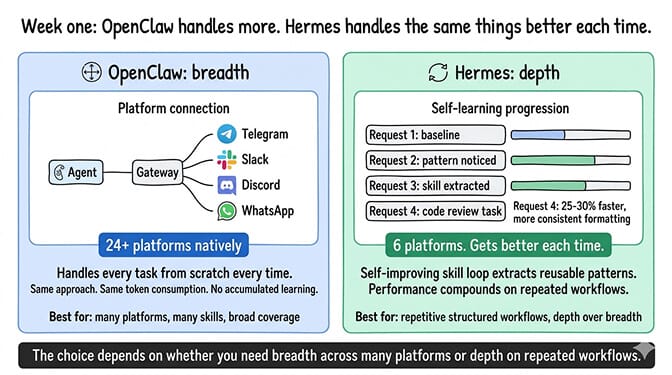
This used to be OpenClaw's easy win. In April, Hermes listed six platforms. Today its messaging docs list Telegram, Discord, Slack, WhatsApp (including the Cloud API), Signal, SMS, Email, Home Assistant, Mattermost, Matrix, Microsoft Teams, Google Chat, Feishu/Lark, WeCom, Weixin, QQ, LINE, iMessage bridges and more, all from a single gateway process.
OpenClaw's official channel catalog is still a bit wider (30+ entries, including IRC, Nostr, Twitch, Zalo and agent-to-agent protocols like A2A), plus mobile apps for iOS and Android and desktop apps for macOS and Windows. For most people, both cover every platform they actually use.
The bigger breadth gap is the skill ecosystem. OpenClaw has ClawHub, a public registry where the most popular skills have been downloaded hundreds of thousands of times (see our ranked list of the best OpenClaw skills). Hermes supports the agentskills.io open standard and has a Skills Hub, but it leans more on skills the agent writes itself.
NanoClaw goes the other way on purpose. The core ships with no channel adapters at all. You run /add-telegram, /add-slack and so on, and a skill copies only that module into your fork.
Learning: Hermes' signature feature, now in OpenClaw too
Hermes calls itself "the self-improving AI agent," and the learning loop is still the core of the product: agent-curated memory with periodic nudges, autonomous skill creation after complex tasks, skills that improve during use, full-text search over past sessions with LLM summaries, and Honcho user modeling that builds a picture of you over time.
What changed is that OpenClaw now does much of this by default. Since OpenClaw 2.0 (v2026.8.1, released August 31, 2026):
- Built-in Memory with Dreaming. Dreaming runs model-backed background memory consolidation and promotes material into long-term memory, with a Dream Diary so you can see what it kept. It's on by default and can be turned off.
- Automatic self-learning. After substantial work, OpenClaw can run a background review that turns corrections and working procedures into reusable skills through its Skill Workshop. Learned skills go through a security scanner, hash binding and rollback capture. The default mode is
auto; setskills.workshop.autonomous.modetoproposeif you want to approve each new skill, oroffto disable it.
So the honest version today: both agents learn from experience. Hermes has been doing it longer, it's more central to how the product is designed, and its user modeling goes further. OpenClaw's version is newer, with more governance built in (proposals, review, quarantine). If self-learning is the whole reason you're considering Hermes, test OpenClaw 2.0 first.
NanoClaw doesn't try to learn in this sense. Its philosophy is "customization = code changes": you ask Claude Code to modify your fork.
For more on how OpenClaw's memory tiers fit together, see our OpenClaw memory fix guide.
Security: three different defaults
This is where the three projects differ most, and where older comparisons (including our April version) got things wrong.
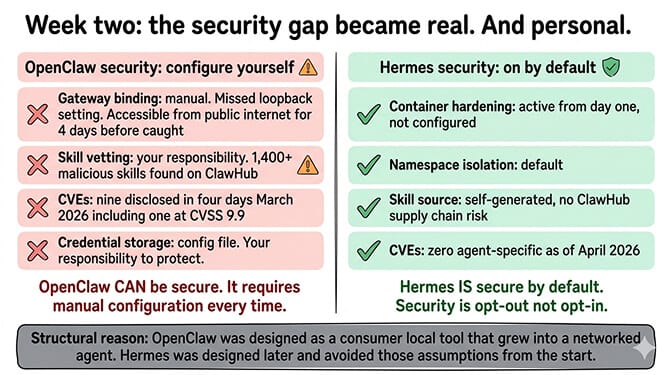
OpenClaw binds the Gateway to loopback by default, and onboarding generates a Gateway token by default. Tool sandboxing (Docker, Podman, SSH and other backends) is optional and off by default. So out of the box, the agent's tools run on your host with your user's permissions. The historical risks are well documented: public exposure of misconfigured gateways, and the ClawHavoc campaign, where a Koi Security audit published in February 2026 found 341 malicious skills out of 2,857 on ClawHub. ClawHub now runs security audits on listings, and skill installs use owner-scoped names (@owner/slug) that make typosquats easier to spot.
Hermes describes an eight-layer model: user authorization (allowlists, DM pairing), dangerous-command approval, file-write safety, container isolation, MCP credential filtering, context-file scanning for prompt injection, cross-session isolation and input sanitization. The default approval mode, smart, uses an auxiliary model to auto-approve low-risk commands, auto-deny dangerous ones and ask you about uncertain cases. One correction to our earlier version: container hardening is not on by default. It applies when you choose the docker terminal backend, and Hermes' own docs recommend a container or remote backend (docker, modal, daytona or vercel_sandbox) for production gateways.
NanoClaw is built around isolation. Every agent runs in its own Linux container and only sees what you explicitly mount. Agents never hold raw API keys: outbound requests go through a credential gateway that injects credentials at request time and enforces per-agent policies. Its README is blunt about why it exists: it argues that OpenClaw's security lives "at the application level (allowlists, pairing codes) rather than true OS-level isolation."
The practical takeaway: if isolation-by-default is your top priority, NanoClaw is the only one of the three that gives it to you without configuration. With OpenClaw or Hermes, turn on a sandbox or container backend yourself before you give the agent anything important.
For the full OpenClaw security breakdown, our security guide covers specific vulnerabilities and mitigations.
Cost: the software is free, the tokens aren't
All three are free, open-source software under the MIT license. What you pay for is hosting and model usage.
Hosting. All three run fine on a small VPS. Hermes' README pitches a "$5 VPS"; it can also use serverless backends (Daytona, Modal) that hibernate when idle. NanoClaw needs Docker on the host. OpenClaw's Node 24/26 requirement drops support for old macOS versions (below 13.5) and 32-bit ARM boards, which matters if you planned to reuse an old machine.
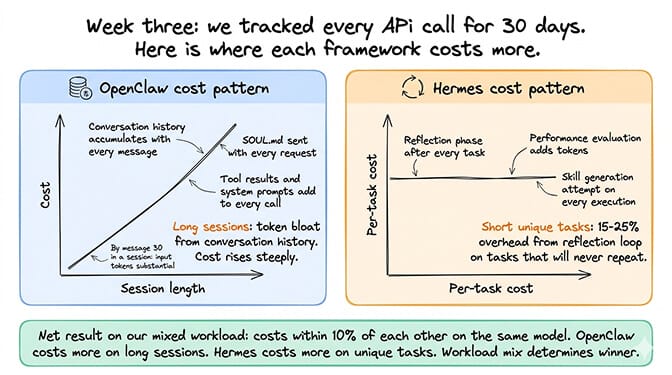
Tokens. The learning features that make these agents better also spend tokens in the background: Hermes' memory nudges and skill creation, OpenClaw's Dreaming and self-learning reviews. None of the projects publishes a standard per-task overhead figure, so measure it on your own workload before you assume one is cheaper. Long sessions get expensive on any agent; Hermes gives you /compress and /usage to manage context, and OpenClaw lets you set separate cheaper models for heartbeats and subagents (agents.defaults.heartbeat.model, agents.defaults.subagents.model).
Model choice. NanoClaw is built on Anthropic's Claude Agent SDK, so Claude is the default path. The other providers are add-ons. OpenClaw and Hermes are both provider-agnostic from the start.
If managing infrastructure, context and security feels like more work than the agent is worth, BetterClaw is a no-code AI agent platform that handles it for you: smart context management, unlimited skills and secrets auto-purge. It's a separate product, not a hosted version of any of these three. The free plan includes 1 agent, 100 credits a month and BYOK; Pro is $49/month for 5 agents.
Maintenance: fast release trains everywhere
All three ship quickly, which is great for features and hard on stability.
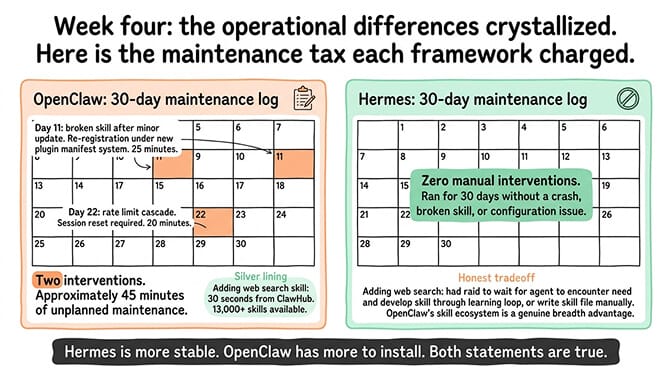
- OpenClaw shipped six stable releases in September 2026 alone (2026.9.1 through 2026.9.6). 2026.9.3 raised the Node floor to 24.16/26.1, and 2.0 included breaking migrations handled by
openclaw doctor --fix. For people who want fewer updates, OpenClaw also publishes anextended-stableline (currently 2026.7.35, gateway-only) that it describes as its LTS equivalent. - Hermes v0.21.5 is a patch release that rolls up about 460 merged PRs since v0.21.4, three days earlier.
hermes updateandhermes doctorare your friends, and if Hermes won't start after an update, our Hermes Agent not working guide matches each startup error to its fix. - NanoClaw is deliberately small, but because customization happens in your own fork, you own the merges when upstream changes. The v1 to v2 jump shipped with a
migrate-v2.shscript.
For the comparison of OpenClaw alternatives, including Hermes and managed platforms, our comparison hub covers the full decision space.
Where NanoClaw fits
NanoClaw deserves its own paragraph, because it isn't really trying to be a bigger or smaller OpenClaw. It's a different philosophy.
- Small enough to read. One process and a handful of source files. Its author built it because they didn't want software they couldn't understand having full access to their life.
- Claude Code does the customizing. There's no configuration sprawl and no dashboard. Want different behavior? Ask Claude Code to change your fork. Setup failures hand off to Claude Code automatically.
- Containers by default. Every agent group gets its own container, its own
CLAUDE.md, its own memory and only the mounts you allow. - Claude-first. It runs on Anthropic's Claude Agent SDK, with Codex, OpenCode (OpenRouter, Google, DeepSeek and others) and Ollama available as add-on providers.
Pick NanoClaw if you're a developer who's comfortable with Claude Code, wants strong isolation, and would rather own a small codebase than configure a big one. Skip it if you want a large skill marketplace, lots of built-in integrations, or something you can run without touching code.
The verdict
Choose OpenClaw if you want the widest ecosystem: the most channels, the biggest skill registry, native apps on every desktop and mobile platform, and now built-in memory and self-learning. The cost is complexity and a fast-moving release train. Turn on sandboxing before you trust it with anything important.
Choose Hermes if the learning loop and user modeling are the point, you prefer Python, or you like the idea of one subscription (Nous Portal) covering models and tools. Its approval defaults are sensible, but set a container or remote backend yourself for production.
Choose NanoClaw if you're a Claude-first developer who wants each agent in its own container and a codebase small enough to read in an afternoon.
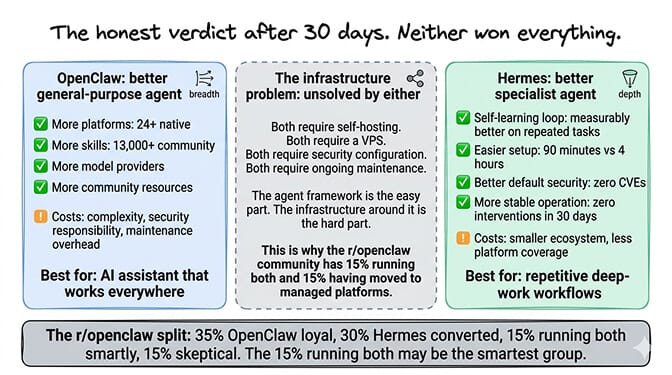
None of them solves the infrastructure problem. All three are self-hosted. You still need a machine that stays on, updates you apply and test, and security configuration you get right. If you want to explore the wider field, our guide to the best OpenClaw alternatives covers every category, including NanoClaw, ZeroClaw and n8n. For the managed-platform angle on Hermes specifically, see the Hermes Agent vs BetterClaw comparison page.
That's why we built BetterClaw: a no-code AI agent platform that runs your agents without the infrastructure tax. Smart context management prevents token bloat. Unlimited skills, with a 4-layer security audit on our curated set, remove the supply-chain risk. Secrets auto-purge closes the credential exposure vector.
If the maintenance is taking more time than your agent saves, start with BetterClaw's free plan: 1 agent, 100 credits a month, BYOK. Pro is $49/month for 5 agents, with a 7-day money-back guarantee.
Frequently Asked Questions
What is the main difference between OpenClaw and Hermes Agent?
OpenClaw (TypeScript/Node.js) has the broader ecosystem: 30+ official chat channels, native desktop and mobile apps, and the ClawHub skill registry. Hermes (Python, by Nous Research) is built around a self-improving learning loop with user modeling and cross-session search. Since OpenClaw 2.0 added built-in memory and automatic self-learning skills, the gap is smaller than it used to be. Both are open source and self-hosted.
What is NanoClaw, and how is it different from OpenClaw and Hermes?
NanoClaw is a lightweight, open-source TypeScript agent that runs each agent in its own Linux container and uses Anthropic's Claude Agent SDK by default. Instead of configuration, you customize it by having Claude Code modify your own fork, and channels like Telegram or Slack are added as skills. It trades ecosystem size for a small codebase and isolation by default.
Is Hermes Agent more secure than OpenClaw?
It has safer defaults in one area: Hermes turns on dangerous-command approval (the smart mode) and DM pairing out of the box. But neither isolates the agent's tools by default. Hermes' container hardening applies only when you pick the Docker backend, and OpenClaw's sandbox is off until you enable it. If you want isolation without configuration, NanoClaw runs every agent in a container by default.
Can I migrate between OpenClaw and Hermes?
Yes, in both directions. hermes claw migrate imports OpenClaw's persona, memories, skills, allowlists, messaging settings and allowlisted API keys (use --dry-run to preview). openclaw migrate hermes --dry-run previews importing Hermes' model config, MCP servers, memory and skills into a fresh OpenClaw setup.
Which is cheaper to run: OpenClaw, Hermes or NanoClaw?
The software is free for all three. Costs are hosting (a small VPS is enough) plus model tokens. The background learning features in OpenClaw and Hermes spend extra tokens, and neither project publishes a standard overhead figure, so measure on your own workload. NanoClaw defaults to Claude models, so your Anthropic usage will drive its cost.
Should I use OpenClaw, Hermes, NanoClaw or BetterClaw?
Use OpenClaw for maximum platform coverage and the biggest skill ecosystem. Use Hermes if the learning loop and user modeling are what you want most. Use NanoClaw if you're a Claude-first developer who wants container isolation and a tiny codebase. Use BetterClaw if you want a no-code AI agent platform without the infrastructure work: free plan with 1 agent and BYOK, Pro at $49/month for 5 agents.