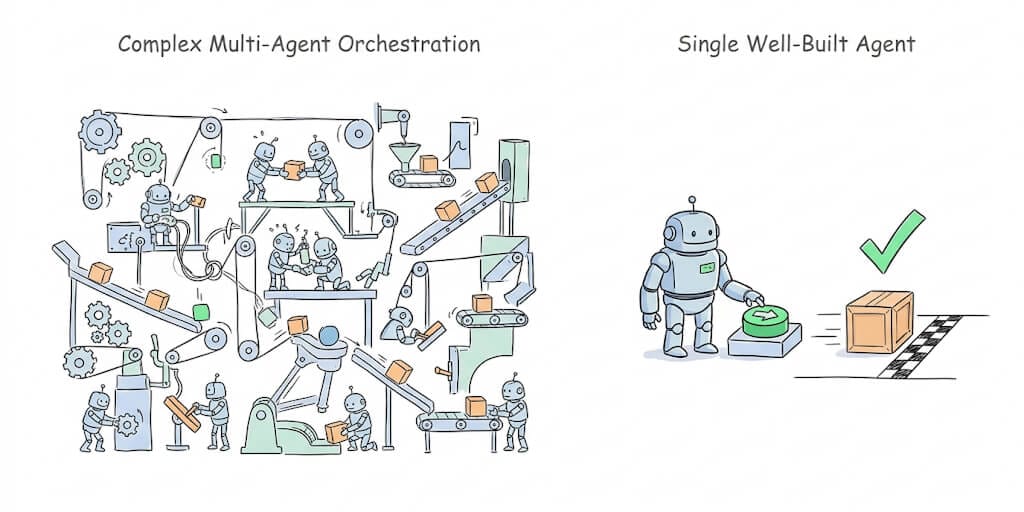
You just came back from a conference buzzing about multi-agent systems. Before you spend 6 weeks building one, read this. One well-configured agent probably solves your actual problem.
A CTO I know spent three weeks building an AI agent orchestration pipeline with CrewAI.
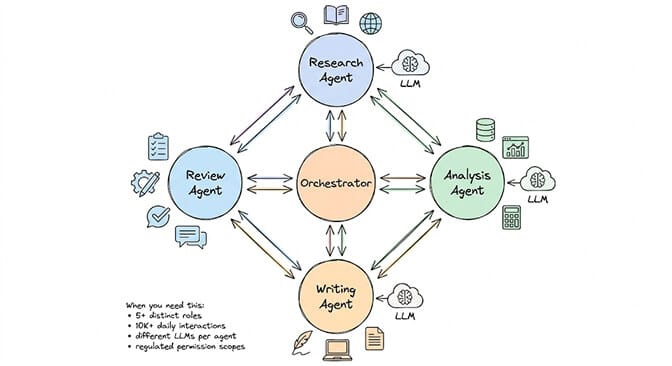
Four agents. A research agent that scraped competitor websites. An analysis agent that compared the data. A writing agent that drafted a summary. A review agent that checked for accuracy. Custom orchestration logic routing between them. Docker setup. Error handling for when one agent failed and the others needed to know.
Three weeks. Four agents. One output: a weekly competitor summary.
Here's the thing. I asked him to try something. We set up a single BetterClaw agent with Gmail and web search connected. Gave it instructions: "Every Monday, research these 5 competitors. Check their blog, pricing page, and recent announcements. Write a summary comparing changes to last week. Email me the report."
Same output. One agent. Ten minutes to set up.
His multi-agent orchestration worked. I'm not saying it didn't. But the engineering investment was wildly disproportionate to the problem. And that's a pattern I see constantly.
What is AI agent orchestration?
Let me give it proper credit first.
AI agent orchestration is a system where multiple specialized AI agents collaborate on complex tasks. Each agent has a defined role, specific tools, and a particular expertise. A coordinator (sometimes called an "orchestrator" or "supervisor") routes tasks between them based on the requirements.
Think of it like a team. The research agent gathers information. The analysis agent processes it. The writing agent creates the deliverable. The review agent checks the work. The orchestrator decides who works on what and in what order.
Frameworks like CrewAI (47K+ GitHub stars, used by IBM, PepsiCo, DocuSign), LangGraph, and AutoGen make this possible. The technology is real. The use cases are real. At scale, with the right requirements, orchestration is the correct architectural choice.
But here's what nobody at the conference told you: most teams don't have the requirements that justify orchestration.
When AI agent orchestration actually makes sense
I want to be fair here. Orchestration isn't a gimmick. It's engineering for specific problems.
You genuinely need orchestration when:
You have 5+ distinct agent roles with fundamentally different toolkits. Not "one agent that does 5 things." Five agents that each need different integrations, different prompt strategies, and different LLM providers. A reasoning agent on Claude Opus for complex analysis. A fast lookup agent on Gemini Flash for real-time data. A code agent on a specialized model for development tasks.
You're in a regulated industry where each agent needs different permission scopes. The research agent can read public data but not customer records. The customer-facing agent can access CRM data but not financial systems. The compliance agent has read-only access to everything. These permission boundaries are architectural, not just configuration.
You're handling 10,000+ interactions daily with specialized routing. At this scale, a single agent becomes a bottleneck. Different query types need different processing pipelines. Load balancing across specialized agents makes performance sense.
You're a platform company where multi-agent is the product. If you're building an AI product where the orchestration IS the value proposition (like a research platform that combines web scraping, analysis, and report generation as separate billable services), then orchestration is your architecture.
IBM uses CrewAI for this. PepsiCo uses it. They have the scale, the use cases, and the engineering teams to justify the investment. If you're operating at that level, orchestration is worth every hour of engineering.
The 90% case: one agent is enough
Here's the uncomfortable truth.
These use cases don't need orchestration:
- Email triage and response
- Lead qualification and follow-up
- Customer support triage
- Morning briefing reports
- Competitor monitoring
- Meeting scheduling
- HR screening for inbound applications
- Invoice processing
- Internal FAQ answering
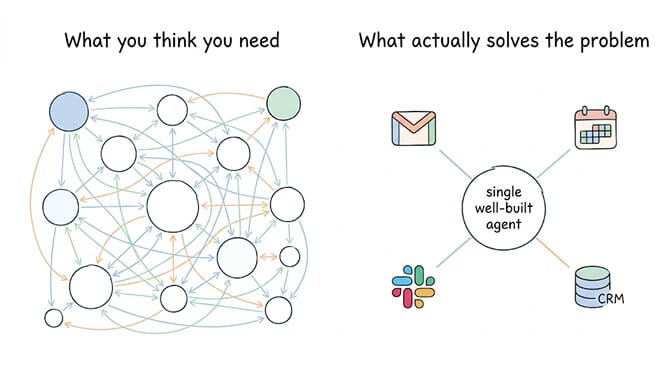
Every single one of these is a single-agent problem. One agent with the right integrations (Gmail, Calendar, Slack, CRM, knowledge base) and clear instructions handles all of them.
The CTO who built a four-agent research pipeline? Email triage. Lead qualification. Support triage. Those were his actual business problems. He built orchestration for the wrong problem because orchestration was the concept stuck in his head.
If you can describe your use case as "read input, reason about it, take action, report back," you need one agent, not four.
The best AI agent builders in 2026 are designed for exactly these use cases. Single-agent, well-configured, connected to the right tools.
The hidden cost of premature orchestration
Building orchestration when you don't need it isn't just unnecessary. It actively hurts.
Inter-agent communication latency. Every handoff between agents adds time. Agent A finishes, passes output to the orchestrator, orchestrator routes to Agent B, Agent B processes. For a simple support ticket that one agent could handle in 3 seconds, a four-agent pipeline might take 15-20 seconds. Your customer doesn't care about your architecture. They care about response time.
Error cascading. When one agent in a multi-agent pipeline fails, the downstream agents either fail too or process garbage data. Debugging "which agent broke?" is fundamentally harder than debugging "why did the agent break?" One failure surface vs four (or more).
Higher LLM costs. Each agent in an orchestration pipeline consumes tokens independently. The orchestrator itself consumes tokens just to route and coordinate. A four-agent pipeline processing the same task uses 3-5x more tokens than a single well-prompted agent. At scale, that's real money.
Maintenance overhead. Four agents means four sets of instructions to maintain, four sets of integrations to keep updated, four potential points of failure to monitor. When you need to change how support tickets are handled, you're updating one agent's instructions... or you're updating the research agent, the classification agent, the response agent, and the routing logic between them.
The Gartner warning. Gartner predicts 40% of agentic AI projects will be canceled by end of 2027. The top failure modes? Specification errors (42%) and agent misalignment (37%). Multi-agent systems multiply both risks. More agents means more specifications to get wrong and more alignment to maintain.
This isn't theoretical. I've watched teams spend months building orchestration that could have been replaced by a single well-configured agent that took 10 minutes to deploy.
How BetterClaw approaches this differently
We made a deliberate architectural choice: single-agent with graduated trust levels instead of multi-agent orchestration.
One BetterClaw agent can connect to 25+ integrations via OAuth, access 200+ verified skills, work with any of 28+ LLM providers, and maintain persistent memory across interactions. That single agent handles email triage, lead qualification, support triage, reporting, and scheduling without needing a second agent.
The trust levels (Intern, Specialist, Lead) solve the problem that some teams try to solve with orchestration: different levels of autonomy for different task types.
Instead of building a "research agent" and a "response agent" with different permission scopes, you configure one agent with Specialist-level trust. Routine queries go through autonomously. Complex queries get flagged for human review. No inter-agent communication. No error cascading. No coordination overhead.
Does BetterClaw handle every use case? No. And that's the honest part.
If your support agent needs to run a deep cost analysis using one LLM, write a customer response using a different LLM, and generate a report using a third, that multi-LLM routing is an orchestration problem. BetterClaw's single-agent architecture handles one LLM at a time per agent.
If you need 5 specialized agents with entirely different toolsets collaborating at 10,000+ daily interactions, orchestration is the right call. BetterClaw won't pretend otherwise.
But for the 90% of teams reading this article? The ones with 3-5 support reps, a founder who wants email help, and a head of sales who wants lead qualification? One agent. Ten minutes. Free plan. Done.
If that 90% case sounds like your situation, BetterClaw's free plan gives you 1 agent, 100 credits a month, and 3 connectors to validate whether a single well-built agent solves your problem. No credit card. $49/month for Pro when you scale. Start here.
If you genuinely need orchestration
I'll be straight. If after reading all of this, your use case still requires multiple specialized agents collaborating with different toolsets and permission scopes, here are the frameworks that do it well.
CrewAI is the best option for role-based multi-agent design. 47K+ GitHub stars. Used by IBM, PepsiCo, DocuSign. 100K+ certified developers. If you write Python and want to define agents as "researcher," "analyst," "writer" with explicit collaboration patterns, CrewAI's abstractions are the cleanest. We wrote a detailed comparison with CrewAI that covers the tradeoffs honestly.
LangGraph is the best option for graph-based orchestration. If your multi-agent workflow has complex branching logic (if Agent A finds X, route to Agent B, but if Agent A finds Y, route to Agent C, and if both fail, route to Agent D), LangGraph's graph abstraction maps naturally to that architecture.
AutoGen (Microsoft) is the best option for experimental multi-agent research. If you're in a research context exploring how agents negotiate, debate, or collaboratively reason, AutoGen is designed for that experimental space.
All three require Python. All three require you to manage hosting. None have built-in trust levels or managed infrastructure. But if you need orchestration, they're the right tools.
The test that tells you which you need
Before you commit to an architecture, ask yourself one question.
"Can I describe my use case as: one entity reads input, reasons about it, takes actions, and reports back?"
If yes: single agent. BetterClaw, Lindy, or any well-configured agent builder.
If no, because you genuinely need multiple entities with different toolsets, different LLMs, or different permission scopes collaborating on the same task: orchestration. CrewAI, LangGraph, or AutoGen.
Gartner predicts 40% of enterprise applications will embed AI agents by end of 2026. McKinsey estimates the addressable value at $2.6 to $4.4 trillion. Most of that value will come from single agents doing specific jobs well. Not from multi-agent orchestration architectures.
The most productive AI teams I've seen aren't the ones with the most sophisticated architecture. They're the ones that deployed a simple agent three months ago and have been compounding value since. If you are stuck in that debate now, the shortest way out is to deploy one simple agent this week and let the architecture question wait. While other teams are still debating orchestration frameworks.
Build the agent you need, not the architecture you admire
There's a specific kind of engineering decision that looks smart but isn't. Building infrastructure you don't need yet. Designing for scale you haven't reached. Choosing complexity when simplicity solves the problem.
AI agent orchestration is real, valuable technology. For the right use cases. At the right scale.
For everyone else, one well-built agent with the right integrations and clear trust levels is the answer. And it takes 60 seconds to find out.
If any of this resonated, give BetterClaw a shot. Free plan with 1 agent and 100 credits a month. $49/month for Pro. Deploy in 60 seconds. Validate whether a single agent solves your problem before investing in orchestration. If it doesn't, you've lost 60 seconds. If it does, you've saved weeks. See full pricing here.
Frequently Asked Questions
What is AI agent orchestration?
AI agent orchestration is a system where multiple specialized AI agents collaborate on complex tasks, coordinated by an orchestrator that routes work between them. Each agent has a defined role (researcher, analyst, writer) and specific tools. Frameworks like CrewAI (47K+ GitHub stars), LangGraph, and AutoGen enable orchestration. It's valuable for enterprise-scale operations with 5+ distinct roles, but most teams don't need it for common use cases like email triage, support, or lead qualification.
How does multi-agent orchestration compare to a single well-built agent?
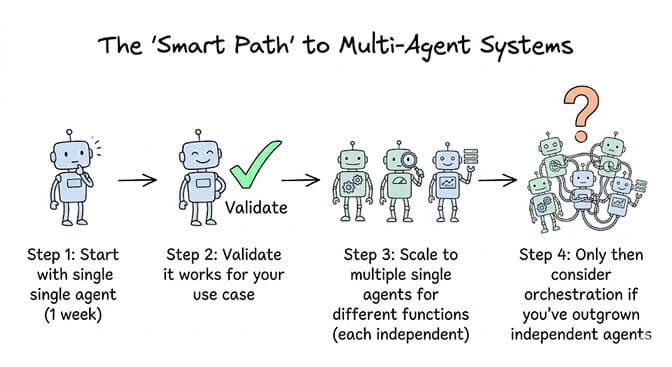
Multi-agent orchestration excels when you need different LLMs per agent, different permission scopes, or specialized routing at 10,000+ daily interactions. A single agent excels for the 90% of use cases that involve reading input, reasoning about it, and taking action (support triage, email automation, lead qualification). Multi-agent adds inter-agent latency, error cascading, higher LLM costs, and maintenance complexity. Start with one agent and scale to orchestration only when you outgrow it.
How do I decide if I need AI agent orchestration or a single agent?
Ask: "Can I describe my use case as one entity that reads input, reasons, acts, and reports back?" If yes, use a single agent (BetterClaw, 60-second deploy, $0 free plan). If you genuinely need 5+ specialized agents with different toolsets, different LLMs, or different permission scopes collaborating on the same task, use an orchestration framework (CrewAI, LangGraph, or AutoGen). Most teams discover one agent is enough.
How much does AI agent orchestration cost compared to a single agent?
A single BetterClaw agent: $0/month (free) or $49/month (Pro) plus $10-15/month LLM costs via BYOK. Multi-agent orchestration with CrewAI: free framework but $30-100/month self-hosting per agent cluster, plus 3-5x higher LLM costs (each agent consumes tokens independently), plus engineering time (weeks of setup vs 60 seconds). The cost difference grows with complexity. A four-agent pipeline can cost 10-20x more than a single agent solving the same problem.
Will a single agent be enough as my company scales?
For most use cases, yes. BetterClaw Pro includes 5 agents (and Business includes 25), each handling different functions independently (support agent, sales agent, ops agent). Independent agents don't need orchestration. They each do their job. You only need orchestration when agents must collaborate on the same task with different specializations. BetterClaw's Enterprise plan supports unlimited agents with SSO, audit logs, and a dedicated CSM for companies operating at scale.