
| You're asking | The short answer |
|---|---|
| How much per month? | $22 to $307 in cash for one agent doing one job in our examples, plus 1 to 4 hours of your time (calculated) |
| How much to run? | Model tokens, plus a platform or hosting fee, paid tools and your time. Tokens swing 20x or more with the model |
| How much to build? | No build fee on a no-code platform. Your own hours on an open-source framework. AI engineers on Upwork: $35 to $60 an hour median |
| Per task, seat or token? | $0.10 per Salesforce Agentforce action, $30 per Microsoft 365 Copilot user a month, $0.10 to $4 per million input tokens on six popular models |
Checked 16 November 2026.
Picture this: three quotes land in your inbox for the same support agent. One says $2 per conversation, one says $49 a month flat, and one is a rate card in dollars per million tokens.
Which of these is actually cheapest for us?
You can't tell from the headline numbers. You need your volume, the work behind each task and the four lines every agent bill is made of. So let's build it up, line by line.
How much does an AI agent cost to run? Four lines on every bill
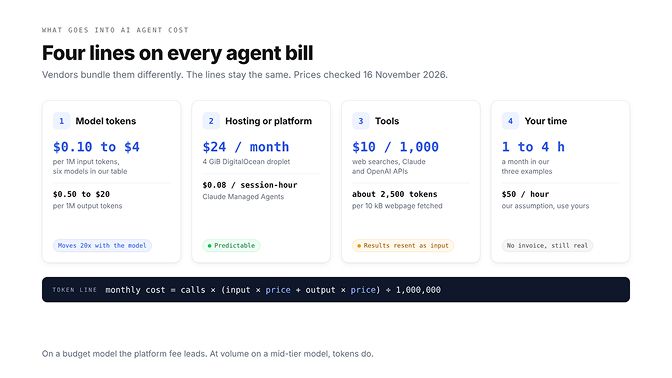
Every agent bill, whoever sends it, comes down to the same four lines. Vendors just bundle them differently, which is why their headline prices are so hard to compare.
1. Model tokens: the line that moves
Each time your agent thinks, it sends text to a model and gets text back, and you pay per million tokens in and out. The input is bigger than you'd guess. An agent resends its instructions, tool definitions, memory and the conversation so far on every call, so even a one-line request can carry thousands of tokens.
Here is the whole formula:
monthly token cost = model calls a month × (input tokens per call × input price
                     + output tokens per call × output price) ÷ 1,000,000
| Model | Input, per 1M tokens | Output, per 1M tokens | Worth knowing |
|---|---|---|---|
| GPT-6 Luna (OpenAI) | $0.10 | $0.50 | Cached input $0.01 |
| Claude Haiku 5.5 (Anthropic) | $0.10 | $0.50 | A prompt over 100,000 tokens bills the whole request at $0.50 / $2.50 |
| DeepSeek V4.1 Flash | $0.30 | $1.20 | Peak rate, charged 01:00 to 04:00 and 06:00 to 10:00 UTC on weekdays; other hours are half price |
| Gemini 3.8 Flash (Google) | $0.75 | $3.75 | Output includes thinking tokens; rises to $1.50 / $7.50 on 1 January 2027 |
| Claude Sonnet 5.5 (Anthropic) | $2.00 | $10.00 | Cache hits $0.10; GPT-6.1 Sol is also $2 / $10 |
| Claude Opus 5.5 (Anthropic) | $4.00 | $20.00 | Fast mode doubles it to $8 / $40 |
Checked 16 November 2026, on each provider's own pricing page. Standard rates: batch processing halves the price at Anthropic, OpenAI and Google, but it suits background jobs, not live replies. Our Anthropic pricing guide lists every Claude model and discount.
Opus 5.5 costs 40 times as much as Haiku 5.5 per token. Model choice moves your bill more than any other decision on this page.
Two more things change the count. Anthropic says the newer tokenizer in Claude 4.7 and later models produces about 30% more tokens for the same text, so token counts don't carry over cleanly between models. Caching cuts the repeated part: a cache hit on Sonnet 5.5 bills at $0.10 per million instead of $2.
If you bring your own key, you pay these list prices straight to the provider. A platform that resells tokens inside its own credits can add a margin, so ask.
2. Hosting or platform fee: the predictable line
This is the number people compare first, and the easiest to know in advance. There are three ways to pay it.
- A server you run. A DigitalOcean Basic droplet with 2 vCPUs and 4 GiB of memory is $24 a month, or $0.03571 an hour, billed per second since 1 January 2026.
- A runtime billed by the hour. Claude Managed Agents charges $0.08 per session-hour while a session is running, plus tokens, so a session running around the clock for 30 days would add $57.60 (calculated).
- A platform plan. A flat monthly fee, a per-seat licence or a credit pool, compared in the pricing table further down.
For a self-hosted agent, AI agent hosting cost is mostly that server. On a managed cloud runtime, AI agent cloud cost follows the hours and the tokens, and our AgentCore pricing breakdown shows how AWS meters it.
3. Tools and connectors: small fees, big context
Some tools charge per call. Web search on the Claude and OpenAI APIs costs $10 per 1,000 searches, and DeepSeek charges $0.75 per 1,000. Connector calls are metered on some platforms (on Zapier, every step and connector call uses tasks) and included on others, while the apps themselves, like your CRM or helpdesk, keep their own subscriptions.
The bigger cost is what tools bring back. Anthropic puts an average 10 kB webpage at about 2,500 tokens and a 100 kB documentation page at about 25,000, and fetched content becomes part of the conversation, billed as input on every later call that carries it.
Tool definitions cost tokens too. Declaring Anthropic's browser-use toolset adds about 6,600 input tokens to a request before the agent has looked at a single page.
4. Your time: the line no vendor invoices
Someone writes the instructions, checks the first week of output, fixes misroutes and updates the agent when a tool or model changes. On a self-hosted agent, add server updates, restarts and security patches.
Prices move under you as well. Google's Gemini 3.8 Flash doubles to $1.50 / $7.50 on 1 January 2027, and Gemini 4 Argon doubles to $4 / $20 on 1 December, so someone has to notice and rerun the numbers.
We count this line at $50 an hour in the examples below. Put in your own rate.
Three worked examples: what an AI agent costs per month
Every figure in this section is calculated from the list prices above and the assumptions stated with it. Change an assumption and rerun the formula; nothing else needs to change.
Example 1: a personal assistant
This agent reads your inbox and calendar, sends a morning briefing and answers quick questions in chat. If you're still deciding what yours should do, our guide to the best AI agents for personal use has ideas.
Our assumptions:
- 20 tasks a day, so 600 a month
- 3 model calls per task, so 1,800 calls a month
- 15,000 input and 600 output tokens per call
- BetterClaw Starter at $19: one agent, up to 3 connectors such as Gmail and Calendar, schedules at most once a day
- 1 hour a month of your time
| Line | On Claude Haiku 5.5 | On Claude Sonnet 5.5 |
|---|---|---|
| Model tokens (27M in, 1.08M out) | $3.24 | $64.80 |
| Platform (BetterClaw Starter) | $19.00 | $19.00 |
| Paid tools | $0.00 | $0.00 |
| Cash per month | $22.24 | $83.80 |
| Your time (1 hour at $50) | $50.00 | $50.00 |
| All-in per month | $72.24 | $133.80 |
Calculated. Checked 16 November 2026.
On the budget model, the platform fee is 85% of the cash bill (calculated). Starter's 2,000 credits are 2,000 minutes of agent machine time, so this agent fits if it averages under about 3.3 minutes of machine time per task (calculated).
Want it in Telegram or Slack instead of BetterClaw's chat? Those are listed on Pro ($49) and above.
Example 2: a lead qualifier
This agent reads each new inbound lead, researches the company, scores it hot, warm or cold, updates your CRM and drafts a reply for your approval. It is the job our lead qualification template is built around.
Our assumptions:
- 300 leads a month
- 6 model calls per lead: read, two searches, CRM lookup, score, draft
- 20,000 input and 800 output tokens per call, since search results and CRM records join the context
- 2 web searches per lead at $10 per 1,000 searches
- BetterClaw Pro at $49 for more than 3 connectors and hourly checks, plus 2 hours a month of your time
| Line | On Claude Haiku 5.5 | On Claude Sonnet 5.5 |
|---|---|---|
| Model tokens (36M in, 1.44M out) | $4.32 | $86.40 |
| Platform (BetterClaw Pro) | $49.00 | $49.00 |
| Web search (600 searches) | $6.00 | $6.00 |
| Cash per month | $59.32 | $141.40 |
| Your time (2 hours at $50) | $100.00 | $100.00 |
| All-in per month | $159.32 | $241.40 |
Calculated. Checked 16 November 2026.
That's 20 to 47 cents of cash per lead (calculated). This is the job where we'd pay for the bigger model, because a single missed hot lead can be worth more than the $82 a month between the two columns.
Example 3: support triage
This agent reads each new ticket, sets category and priority, drafts a first reply from your help docs and flags edge cases for a person, whether tickets live in Help Scout, Intercom, Zendesk or a shared inbox.
Our assumptions:
- 1,500 tickets a month, about 50 a day
- 4 model calls per ticket: read the ticket and history, search help docs, classify, draft
- 18,000 input and 700 output tokens per call
- BetterClaw Pro at $49 for the helpdesk and Slack connectors and an hourly run
- 4 hours a month of your time reviewing drafts and fixing misroutes
| Line | On Claude Haiku 5.5 | On Claude Sonnet 5.5 |
|---|---|---|
| Model tokens (108M in, 4.2M out) | $12.90 | $258.00 |
| Platform (BetterClaw Pro) | $49.00 | $49.00 |
| Paid tools | $0.00 | $0.00 |
| Cash per month | $61.90 | $307.00 |
| Your time (4 hours at $50) | $200.00 | $200.00 |
| All-in per month | $261.90 | $507.00 |
Calculated. Checked 16 November 2026.
At this volume tokens take over: on Sonnet 5.5 they are 84% of the cash bill (calculated). Per ticket, that's about 4 to 20 cents in cash, and Pro's 12,000 credits leave about 16.7 minutes of machine time for each hourly run (calculated).
Swap the model and only the token line moves. On Gemini 3.8 Flash the triage tokens cost $96.75, or $193.50 after the January price rise, and on DeepSeek V4.1 Flash they cost $37.44 at peak rates or $18.72 off-peak (calculated). Our support triage template is built for exactly this workload.
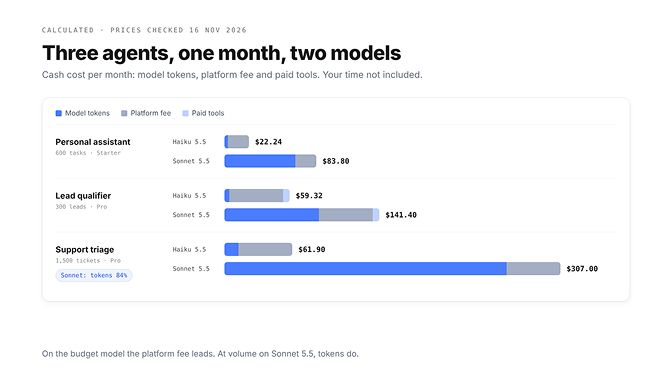
On a budget model you mostly pay for the platform. At volume on a mid-tier model you mostly pay for tokens. And in all three examples, on the budget model, your own hours cost more than the whole cash bill.
AI agent pricing models explained: seat, credit, token, outcome, flat
AI agent platform pricing comes in five shapes. Two quotes with the same headline can produce very different bills, because each shape grows with something different.
| Pricing model | You pay for | Real examples | Watch out for |
|---|---|---|---|
| Per seat | Each person with access | Microsoft 365 Copilot: $30 per user a month, paid yearly. Salesforce Agentforce add-ons: $125 per user a month. Lindy: every active user, from $29.99 a month with 3,000 credits each | Cost grows with headcount, not with work done |
| Per task or credit | Each action, activity or run | Agentforce Flex Credits: $500 per 100,000, and an action uses 20 ($0.10). Microsoft Copilot Studio: $200 a month per 25,000-credit pack. Zapier Agents Pro: $33.33 a month billed annually for 1,500 activities. n8n Starter: $20 a month billed annually for 2,500 workflow executions | Multi-step tasks multiply the count |
| Per token or runtime | Tokens in and out, sometimes hours running | Model APIs: $0.10 to $4 per million input tokens in our table. Claude Managed Agents: tokens plus $0.08 per session-hour | Context growth and loops |
| Per outcome | Each conversation the agent handles | Intercom Fin: $0.99 per outcome. Salesforce Agentforce: $2 per conversation | How the vendor defines an outcome |
| Flat plan plus your own key | A fixed platform fee, with tokens billed by your provider | BetterClaw: $19, $49 or $149 a month, zero token markup | You still watch the token bill yourself |
Checked 16 November 2026, on each vendor's own pricing page.
Intercom counts a Fin outcome when the customer confirms the issue is resolved, doesn't ask for more help, or Fin completes a workflow, handoffs included, and charges once per conversation. Relevance AI, a regular on these lists, now shows only a custom Enterprise plan, priced in actions and vendor credits. For a fuller AI agent builder pricing comparison, feature by feature, see our roundup of the best no-code AI agent builders.
Here's what the models do to one workload. Take Example 3's 1,500 support tickets a month (all calculated):
- Salesforce Agentforce at $2 per conversation: $3,000
- Intercom Fin at $0.99 per outcome: $742.50 if half the tickets count, $1,485 if all do
- Agentforce Flex Credits at 3 actions per ticket: $450
- BetterClaw Pro with your own key: $61.90 on Haiku 5.5, $307 on Sonnet 5.5
Why 3 actions? Salesforce's own case-management example on its pricing page uses three: identify the customer, fetch their cases, add a comment.
These don't buy the same thing. Fin and Agentforce bring the helpdesk or CRM layer, reporting and human handoff with them; on the bring-your-own-key route you connect and maintain those yourself.
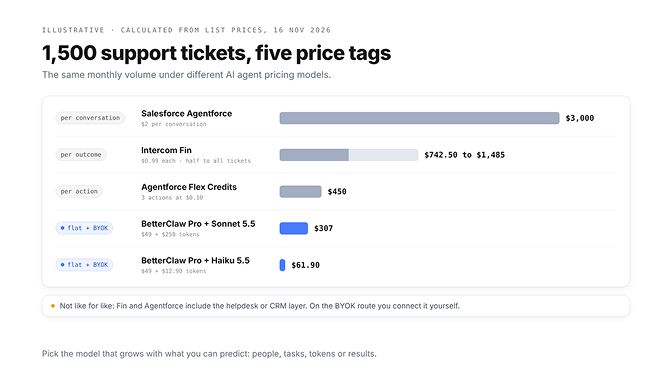
Which model fits? Per seat suits a fixed team living inside one suite. Per credit suits short, predictable tasks, and per outcome suits high-volume support on a helpdesk you already pay for.
Flat plus your own key suits several agents doing different jobs, because the fee doesn't grow with every message and you see the real token cost on your provider's dashboard. It's the model we chose for BetterClaw: plans start at $19 a month, and your model bill stays with your provider at list price. See BetterClaw plans
How much does an AI agent cost to build?
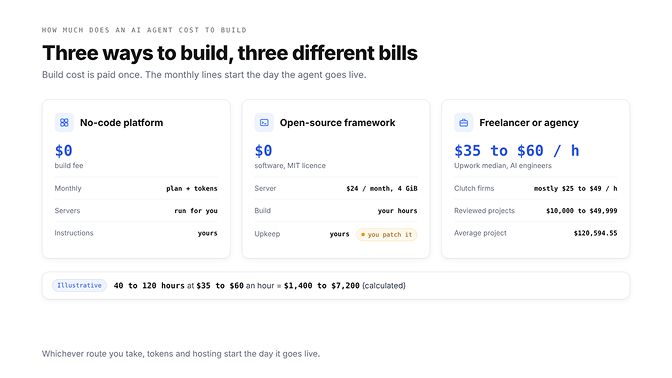
Build cost and running cost are two different bills, so make sure any quote shows both. There are three routes.
| No-code platform | Open-source framework | Freelancer or agency | |
|---|---|---|---|
| Upfront | No build fee | Free software, your hours | Hours × rate |
| Price anchors | Plan fee from $19 a month (BetterClaw) | 4 GiB DigitalOcean server: $24 a month | Upwork: $35 to $60 an hour median for AI engineers. Clutch: most AI firms $25 to $49 an hour |
| Every month after | Plan, plus tokens | Server, tokens and your upkeep | Tokens, hosting and any maintenance contract |
| Who fixes it at 2am | The platform runs the servers; you own the instructions | You | Whoever your contract names |
Checked 16 November 2026.
OpenClaw and Hermes Agent are both MIT-licensed, so downloading them costs nothing. The build is your time: Docker, connectors, skills, testing, then the upkeep. If you want the agent and not the server, that's the case for a managed platform; BetterClaw runs its own agents and doesn't host OpenClaw or Hermes.
Upwork's hiring guide puts the median rate for AI engineers on its platform at $35 to $60 an hour, with experts at $75 to well over $100. Clutch's AI pricing guide, updated 21 September 2026, says most AI development firms it lists charge $25 to $49 an hour and that projects reviewed there range from $10,000 to $49,999, yet it puts the average project at $120,594.55.
An average that far above the range means a few large projects pull it up, and Clutch's figures cover AI development in general, not agents alone. Illustrative, not a quote: if a single-workflow agent takes 40 to 120 hours to scope, build, connect, test and hand over (our assumption), Upwork's median band puts it at $1,400 to $7,200 (calculated).
Then the meter starts. Whatever route you take, the monthly lines from the examples above still apply, and if you self-host, our guide to Hermes Agent hosting options compares where to run it.
Build vs buy vs run: what each actually costs, and who charges a setup fee
"How much does an AI agent cost?" has three different answers depending on which of three things you're buying.
Build (a developer or agency makes one for you). This is what most "cost to build an AI agent" articles price. You pay for hours, scoping and a handover, and you pay again when the model or your process changes. Using the Upwork and Clutch figures above, a single-workflow agent is typically a low four-figure to mid four-figure job from a freelancer, and agency projects run far higher once integrations, testing and a maintenance retainer are included. We don't sell builds, so treat those as typical ranges, not quotes.
Buy (a platform where you configure the agent yourself). No build fee: you pay a subscription and set up the agent in an afternoon. Entry plans are typically $0 to $50 a month, mid-tier plans more for extra agents, seats and runs, and enterprise plans are quoted. On BetterClaw that's the free plan (1 agent, 100 credits a month, 3 connectors) or Starter at $19 a month. The platform comparison has other vendors' current numbers. This is the right answer for most small businesses asking the question, which is why most of this page is about running cost. An all-in-one AI receptionist such as Zanus starts at $299 a month; see our Zanus AI pricing breakdown.
Run (what the agent costs once it exists). Tokens, hosting or a platform fee, connectors and your time: the four lines at the top of this page. Our three worked examples land between $22 and $307 a month in cash. If you'd rather host it yourself, OpenClaw hosting options start at a few dollars a month for the server, plus your time.
Which AI agent companies charge no setup or build fee? Self-serve platforms generally don't, because there's nothing to set up for you: you sign up and configure the agent yourself. BetterClaw has no setup or onboarding fee on any plan, and self-serve plans from builders such as Lindy, Zapier Agents and n8n Cloud are typically sold the same way. Where you will see setup or implementation fees: enterprise contracts, deployments sold through partners or with professional services, and any agency build, where the fee is the build itself. If a vendor's pricing page says "contact us", assume implementation is part of the conversation and ask for it in writing.
Rule of thumb. If you can describe the agent's job in one paragraph and it touches apps that already have connectors (Gmail, Slack, Sheets, HubSpot, Notion, Stripe), buy, don't build: a $19 to $49 plan gets you running this week, and you can always have a developer extend it later. Build when the agent needs a system nobody has a connector for, or when compliance requires code you own. Either way, budget for the run cost from month one; it's the only one that never stops.
BetterClaw's own numbers
We're a no-code AI agent platform, so here is exactly what we charge, and what we don't.
| Plan | Monthly | Billed annually | Agents | Credits a month | Connectors |
|---|---|---|---|---|---|
| Starter | $19 | $15 a month | 1 | 2,000 | 3, one account each |
| Pro | $49 | $39 a month | 5 (+$12 each) | 12,000 | Unlimited |
| Business | $149 | $119 a month | 25 (+$8 each) | 40,000 | Unlimited |
| Enterprise | Custom | Custom | Unlimited | Custom | Unlimited |
Checked 16 November 2026, on our pricing page and docs.
A credit is one minute of your agent's machine running. Model usage on your own key is billed by your provider and never draws credits; on Pro and above you can use our managed keys instead, and that usage converts to credits.
If credits run out on Starter, the agent pauses until they reset on the 1st (UTC), and you're charged nothing extra. On Pro and Business, 1,000-credit packs top you up at $5 or $4, auto-buy stops at 5 packs a month, and you can cap it in the dashboard.
BYOK works on every plan with zero markup, across 28+ providers including Anthropic, OpenAI, Google Gemini, DeepSeek and OpenRouter, plus any OpenAI-compatible or Anthropic-compatible endpoint. Agents reach 500+ connectors and any remote MCP server; Telegram and Slack start on Starter, and schedules run at most daily on Starter and hourly on Pro and Business.
Where we're not the cheapest: a single light agent on a server you already maintain costs less in cash, and a support team that wants a helpdesk vendor's built-in handoff and reporting may be better off on per-outcome pricing. Starter's 2,000 minutes can also run short for an agent that works in long sessions.
Five ways to keep the bill from creeping
The formula assumes every call costs the same. Real agents drift, and these five habits hold the line:
- Pick the smallest model that does the job, and send only the hard steps to a bigger one. Sonnet 5.5 is 20 times Haiku 5.5 per token.
- Cache the parts that repeat. Instructions and tool definitions are the same on every call, and our prompt caching guide shows the setup.
- Cap turns and retries. Every retry resends the full context, so a stuck loop multiplies the bill.
- Watch the thresholds. A Haiku 5.5 prompt over 100,000 tokens bills the whole request at five times the rate, and Opus 5.5 fast mode doubles the price.
- Schedule honestly. An hourly check is 720 runs in a 30-day month (calculated), whether or not there's work.
On BetterClaw, every plan has a kill switch and cost tracking, and Business adds cost alerts.
The cheapest token is the one your agent never sends.
How much should an AI agent cost?
Here's our rule of thumb. For one job, the cash bill should be a two- or three-digit number a month, and the cost per task should be counted in cents: our examples run from about 4 to 47 cents per task (calculated).
If a quote for one workflow agent runs to thousands a month, ask what's inside it. Sometimes it's a helpdesk, a CRM and human review, which can be worth it; sometimes it's a markup on tokens you could buy at list price.
Ask every vendor the same three questions:
- What is metered: seats, tasks, tokens or outcomes?
- Are model tokens included, marked up or billed by my own provider?
- What stops the bill if usage doubles next month?
An agent isn't cheap or expensive by the month. It's cheap or expensive by the task, measured against the minutes it hands back to you.
Want these numbers worked out for your team?
If you'd rather not build the spreadsheet yourself, our AI automation audit starts with a 30-minute call about how your team works, and within 5 business days you get a written report on where agents fit. Book an AI automation audit
Frequently Asked Questions
Are there AI agent companies with no setup or build fee?
Yes. Self-serve agent platforms generally have no setup fee: you create the agent yourself. BetterClaw has a free plan (1 agent, 100 credits a month, 3 connectors) and paid plans from $19 a month, with no onboarding or implementation charge on any of them. Setup fees typically appear with enterprise contracts, partner-led deployments and any agency build, where the fee is the build itself.
What are the different pricing plans for AI agent software?
Five shapes, often combined: per seat, per task or credit, per token or runtime, per outcome, and a flat plan with your own model key. Flat plans usually include a monthly allowance of runs or credits; with bring-your-own-key, the platform fee covers hosting and tooling and you pay the model provider directly, so look for "zero markup". Most small teams do best on a flat plan with their own key.
Which AI agents offer the best value for the price?
For a single scheduled job, a free plan that never expires beats a trial: BetterClaw's free plan covers one agent and three connectors. For a small team, a $19 to $49 subscription with your own key and zero markup is usually the lowest total cost, because the model bill stays at provider prices. Self-hosting OpenClaw or Hermes is the cheapest in software and the most expensive in time once you count updates and uptime. Enterprise platforms earn their price when you need their compliance and admin features.
How much does an AI agent cost per month?
For one agent doing one job, about $22 to $307 a month in cash in our three worked examples, plus 1 to 4 hours of your time. Most of the spread comes from the model: the same workload costs 20 times more in tokens on Claude Sonnet 5.5 than on Claude Haiku 5.5. Flagship models and multi-agent setups can cost far more.
How much does an AI agent cost to build?
Nothing upfront on a no-code platform, where you pay a monthly plan instead. OpenClaw and Hermes Agent are MIT-licensed and free to download, so a self-built agent costs your time plus a server. If you hire it out, Upwork lists a median of $35 to $60 an hour for AI engineers, and Clutch puts the average AI development project at $120,594.55.
How much does an AI agent cost per hour?
Model tokens are billed per use, so an hourly price usually describes runtime. Claude Managed Agents charges $0.08 per session-hour while a session runs, plus tokens, and a 4 GiB DigitalOcean droplet costs $0.03571 an hour. On BetterClaw a credit is one minute of machine time, so Pro's extra credit packs work out to $0.30 per machine-hour (calculated).
What are the main AI agent pricing models?
Five: per seat, per task or credit, per token or runtime, per outcome, and a flat plan with your own model key. Microsoft 365 Copilot is $30 per user a month, Salesforce charges $0.10 per Agentforce action, Intercom charges $0.99 per Fin outcome and BetterClaw is a flat $19 to $149 a month. Pick the one that grows with what you can predict.
Is it cheaper to host an AI agent yourself?
On the server bill, often yes: a 4 GiB DigitalOcean droplet is $24 a month and frameworks like OpenClaw are free. Counting your time, usually not, because updates, restarts and security fixes are yours. At $50 an hour, two hours of upkeep a month is $100, more than five times a $19 BetterClaw Starter plan (calculated).
How does an AI agent subscription work?
Usually you pay the platform a monthly fee, and model usage is billed separately unless the plan bundles it as credits. Some model subscriptions can help: BetterClaw can run an agent on a ChatGPT Plus or Pro subscription instead of an API key, and Anthropic's Max plan includes $100 a month in API credits.
Does BetterClaw mark up model tokens?
No. Every plan supports BYOK (bring your own key), so your model provider bills you directly at its published rates, and that usage never draws BetterClaw credits. Pro, Business and Enterprise can also use managed keys, whose usage converts to credits.