Both pricing pages changed completely this month. Here's the side-by-side with the hidden costs, three worked scenarios, and the strategy most developers miss.
I rewrote this comparison from scratch on September 28, 2026. The June version compared GPT-5.5 against Opus 4.7, and almost every number in it is now out of date. OpenAI shipped GPT-6 Astra on September 3 and GPT-6 Sol and Luna on September 22. Anthropic's current lineup is Fable 5.1, Opus 5.5, Sonnet 5 and Haiku 4.5.
The answer to "which is cheaper, OpenAI or Anthropic?" is still: it depends on your tier, how much you cache, and how long your prompts are. But the shape of the answer has changed. At two of the three main tiers the sticker prices are now identical. So here's the actual breakdown. (For rates across every major provider, not just these two, see our complete LLM pricing guide.)
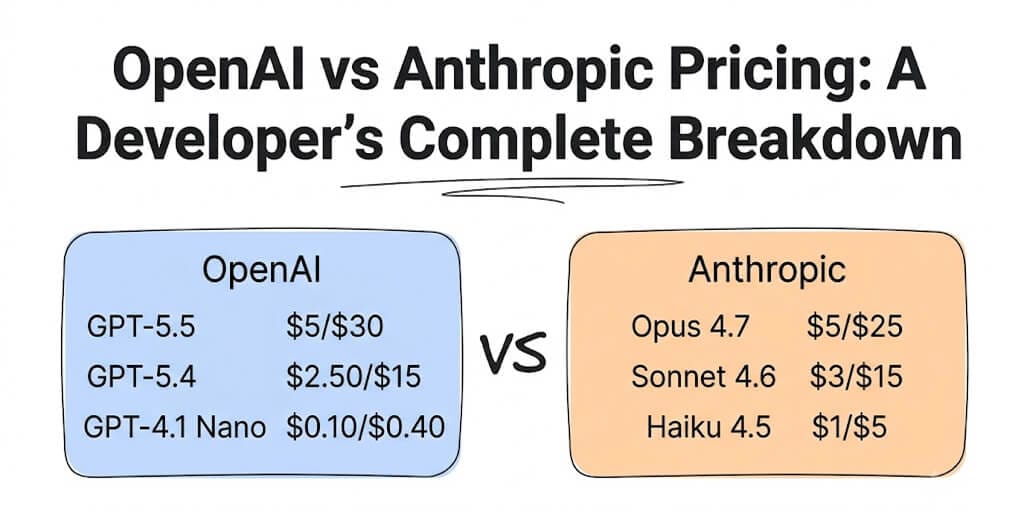
The side-by-side that matters: standard API pricing
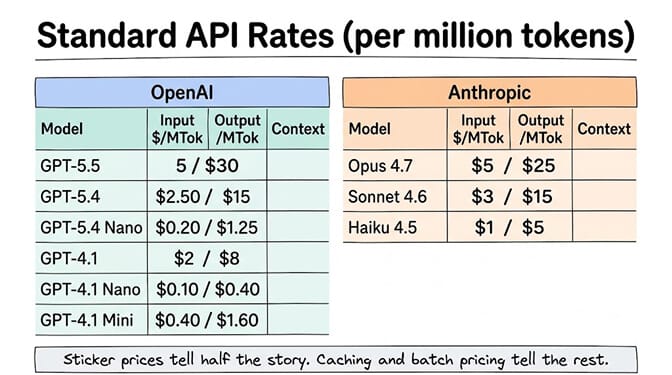
All prices per million tokens (MTok). Standard direct API rates, global routing, prompts under 272K tokens.
| Tier | OpenAI | Anthropic |
|---|---|---|
| Top | GPT-6 Astra: $10 / $50 | Claude Fable 5.1: $10 / $50 |
| Upper-mid | (no equivalent) | Claude Opus 5.5: $4 / $20 |
| Mid | GPT-6 Sol: $2 / $10 | Claude Sonnet 5: $2 / $10 |
| Budget | GPT-6 Luna: $0.10 / $0.50 | Claude Haiku 4.5: $1 / $5 |
Top tier: GPT-6 Astra and Claude Fable 5.1 cost exactly the same, $10 input and $50 output. OpenAI calls Astra "our most capable model, built for the hardest end-to-end work." Anthropic positions Fable 5.1 for "demanding reasoning and long-horizon agentic work." At $50 per million output tokens, both are for the tasks where getting it right matters more than the bill.
Upper-mid tier: This is Anthropic's one tier with no OpenAI counterpart. Opus 5.5 at $4/$20 costs 60% less than Astra or Fable on both input and output. Anthropic positions it for long-running agentic coding and knowledge work. OpenAI's lineup jumps straight from Sol at $2/$10 to Astra at $10/$50.
Mid tier: GPT-6 Sol and Claude Sonnet 5 are identical: $2 input, $10 output, $0.20 for a cache hit, $2.50 for a 5-minute cache write. On a normal-length prompt the bill is the same to the cent. Pick on quality for your task, not price.
Budget tier: OpenAI wins decisively. GPT-6 Luna at $0.10/$0.50 is 10x cheaper than Claude Haiku 4.5 on both input and output. Anthropic has nothing near Luna's price. (To see how both compare with budget challengers like DeepSeek, see our cheapest AI providers guide.)
Still on the previous generation? Both providers keep the older models running at their old prices. GPT-5.5 is still $5/$30. Opus 4.6, 4.7 and 4.8 are still $5/$25, and Sonnet 4.6 is still $3/$15. Moving from Opus 4.8 to Opus 5.5 cuts 20% off both rates. Moving from Sonnet 4.6 to Sonnet 5 cuts input by a third and output by a third. And if you used GPT-4.1 Nano as your cheap tier, OpenAI shuts it down on October 23, 2026.
The hidden costs that change the math
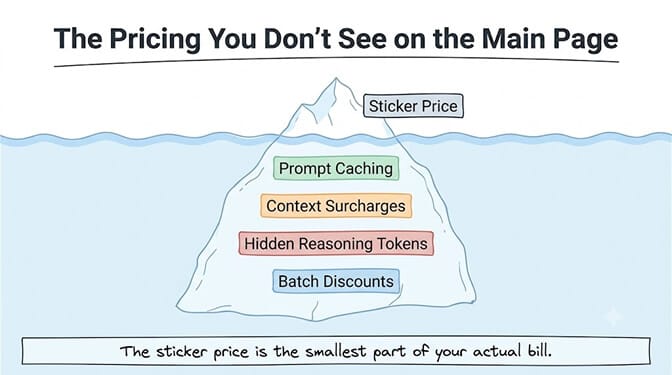
Prompt caching: similar mechanics, cheaper hits on Anthropic's top models
OpenAI: Caching is automatic. Cached input costs 10% of the standard input rate on GPT-6: $1.00 on Astra, $0.20 on Sol, $0.01 on Luna. OpenAI now also bills cache writes on GPT-6, at 1.25x the input rate.
Anthropic: Add one cache_control field at the top level of your request and caching is automatic, or place it on individual blocks for finer control. A 5-minute cache write costs 1.25x the input rate, and a 1-hour write costs 2x. A cache hit costs 10% of input on Sonnet 5 and Haiku 4.5, but only 5% on Opus 5.5 ($0.20) and 2.5% on Fable 5.1 ($0.25).
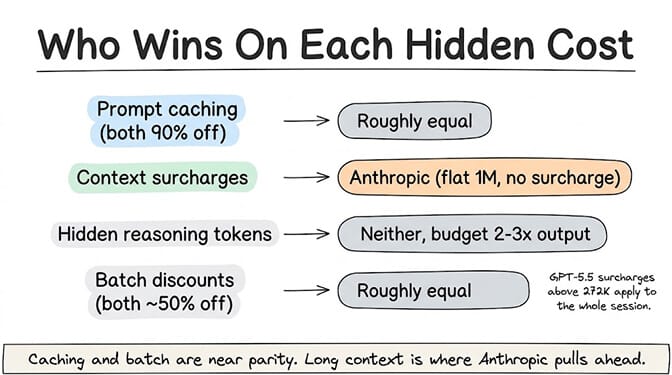
Who wins: A tie at the mid tier, where Sol and Sonnet 5 charge the same $0.20 per cached million. At the top, Anthropic wins clearly. A cache hit on Fable 5.1 costs $0.25 against $1.00 on Astra, at the same $10 list price. For agents that resend a large system prompt and tool list on every turn (most agents), that gap shows up fast.
Context window surcharges: Anthropic's biggest advantage
OpenAI (GPT-6 Astra, Sol and Luna): Every GPT-6 model has a 1.05M-token context window. Standard rates apply up to 272K input tokens. Past that, the whole request is billed at 2x the input and cache rates and 1.5x the output rate, not just the tokens over the line. GPT-5.5 had the same 272K threshold.
Anthropic (Claude 4.6 and later, including Fable 5.1, Opus 5.5 and Sonnet 5): The full 1M-token context window is billed at standard rates. Anthropic's own example: a 900K-token request costs the same per token as a 9K-token one.
Who wins: Anthropic, clearly. If your agent processes long documents, keeps long conversation histories, or loads large codebases, flat pricing is a real advantage. Scenario 3 below shows how big the gap gets.
Hidden reasoning tokens: the cost you never see
OpenAI: All three GPT-6 models are reasoning models. Reasoning tokens are billed as output ($50/MTok on Astra, $10 on Sol) even though they aren't part of the reply. You control how much the model thinks with reasoning.effort, from low up to xhigh and max (Sol and Luna also accept none, and default to medium).
Anthropic: Extended thinking tokens are also billed as output. There's a second, quieter cost: Anthropic says the tokenizer used by Claude 4.7 and later models produces about 30% more tokens for the same text than its previous tokenizer. Your per-token rate went down with Sonnet 5 and Opus 5.5, but the same prompt now counts as more tokens.
Who wins: Neither. Both charge for thinking you don't see. Budget 2 to 3x the visible output tokens for reasoning-heavy work, then measure your real ratio. And don't assume a million tokens of your text is a million tokens on both providers. Count them with each provider's token counter before you compare bills.
Batch, Flex and Fast mode: near parity
OpenAI: Batch and Flex processing are both 50% off standard rates. GPT-6 Sol on Batch is $1/$5. Fast mode (the old Priority processing, renamed on July 30, 2026) costs 2x.
Anthropic: The Batch API is 50% off input and output. Opus 5.5 on Batch is $2/$10, Sonnet 5 is $1/$5. Fast mode, in research preview on Opus 5.5, costs $8/$40, also 2x.
Who wins: Equal. If your agent can wait for non-urgent work, either provider halves the bill. Both also charge about 10% extra for regional data residency on current models.
Three real-world scenarios: actual monthly cost compared
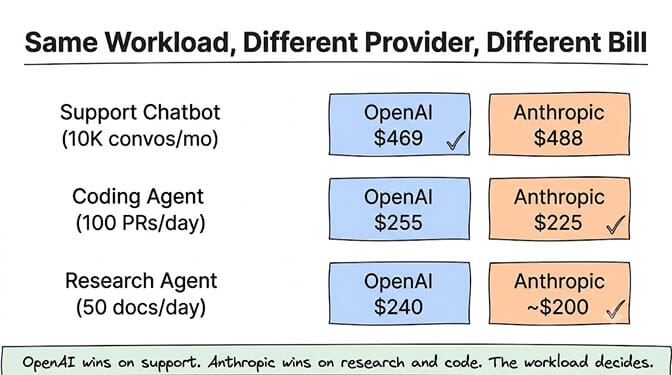
Scenario 1: Customer support chatbot (10,000 conversations/month)
Average conversation: 5 messages. Input per conversation: ~7,500 tokens (question + context + history). Output per conversation: ~2,500 tokens.
Monthly totals: 75M input tokens. 25M output tokens.
- On GPT-6 Sol ($2/$10): $150 input + $250 output = $400/month. If half the input tokens are cache hits at $0.20: $332.50/month.
- On Claude Sonnet 5 ($2/$10): $150 input + $250 output = $400/month. Half cached: $332.50/month.
- On GPT-6 Luna ($0.10/$0.50): $7.50 + $12.50 = $20/month.
- On Claude Haiku 4.5 ($1/$5): $75 + $125 = $200/month.
(The cached figures leave out the one-off cache writes, which cost the same 1.25x on both.)
Winner: A tie at the mid tier. The real decision is whether your support traffic needs a mid-tier model at all. If GPT-6 Luna handles your tickets well, it costs a twentieth of Sol or Sonnet 5, and a tenth of Haiku.
Scenario 2: Coding agent reviewing 100 PRs per day
Average PR: 5,000 tokens of code input. 2,000 tokens of review output. Monthly: 15M input, 6M output.
- On GPT-6 Astra ($10/$50): $150 + $300 = $450/month.
- On Claude Fable 5.1 ($10/$50): $150 + $300 = $450/month.
- On Claude Opus 5.5 ($4/$20): $60 + $120 = $180/month.
- On GPT-6 Sol or Claude Sonnet 5 ($2/$10): $30 + $60 = $90/month.
Winner: Anthropic, if you want something above the mid tier. Astra and Fable cost the same, but Opus 5.5 gives you a step up from Sonnet or Sol for $180 instead of $450. OpenAI has no model at that price point. Test whether Sonnet 5 or Sol reviews your PRs well enough first, because at $90 they're half the price of Opus 5.5.
Scenario 3: Research agent working over long document sets
50 requests per day, each loading a 300,000-token bundle of documents and returning a 3,000-token summary. Monthly: 1,500 requests, 450M input tokens, 4.5M output tokens. Every request is over OpenAI's 272K line.
- On GPT-6 Sol (every request billed at $4 input / $15 output): $1,800 + $67.50 = $1,867.50/month.
- On Claude Sonnet 5 (flat $2/$10): $900 + $45 = $945/month.
- On GPT-6 Astra (every request billed at $20 / $75): $9,000 + $337.50 = $9,337.50/month.
- On Claude Fable 5.1 (flat $10/$50): $4,500 + $225 = $4,725/month.
Winner: Anthropic, by nearly 2x at both tiers. Flat long-context pricing decides research workloads. There's a second way out on OpenAI: keep each request under 272K tokens. Split the same bundle into two 150K-token requests and Sol goes back to standard rates, at the cost of more calls and more output. Caching the shared part of each bundle cuts both bills further.
Scenario 4: A multi-turn agent running all day
Agents cost differently from chatbots. Every turn resends the system prompt, memory, conversation history and the last tool outputs, so the same context gets billed again and again. This scenario models that.
50 sessions a day, 30 turns per session, 2,000 input tokens and 500 output tokens per turn. Monthly: 45,000 turns, 90M input tokens, 22.5M output tokens. With caching, assume 70% of input tokens are cache hits (agents that resend a stable prefix typically land somewhere in the 60-80% range).
- On GPT-6 Sol or Claude Sonnet 5 ($2/$10): $180 + $225 = $405/month. With caching: $291.60/month.
- On Claude Opus 5.5 ($4/$20): $360 + $450 = $810/month. With caching: $570.60/month.
- Mixed, 70% of turns on GPT-6 Luna and 30% on Opus 5.5: about $257/month. With caching: about $181/month.
- Mixed, 70% of turns on GPT-6 Luna and 30% on Sonnet 5: about $136/month. With caching: about $98/month.
(As above, the cached figures leave out the one-off cache writes.)
Winner: Routing. The mixed setup with Opus 5.5 on the hard 30% costs less than running everything on Sonnet 5 or Sol, and the Luna-plus-Sonnet mix costs about a third of it. Notice where the money goes once caching is on: on Sonnet 5, output is $225 of the $291.60, about 77% of the bill. Caching shrinks input to almost nothing, so for agents the output rate, and how many reasoning tokens each turn burns, becomes the number that decides the bill.
This is the spot where most developers realize something: the answer isn't OpenAI OR Anthropic. It's OpenAI AND Anthropic. Use GPT-6 Luna for high-volume simple tasks. Use Sonnet 5 or Sol for standard work. Use Claude for anything with long context.
BetterClaw supports BYOK across both providers (plus 26 others) with zero inference markup. Paste your OpenAI key for one task type. Your Anthropic key for another. Switch models without rebuilding anything. Free plan available, $49/month on Pro for 5 agents.
The tier strategy that saves the most money
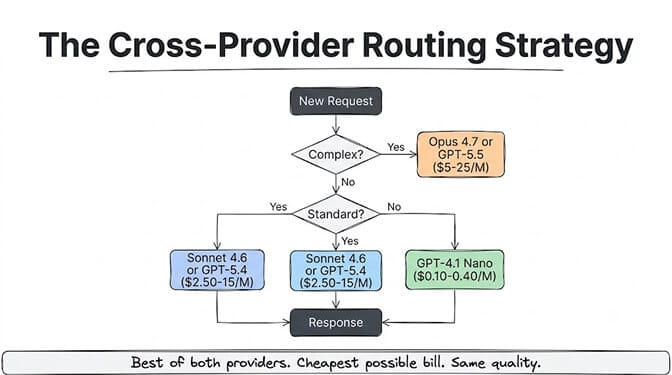
Don't pick one provider. Pick models from both based on what each does best.
Simple tasks (classification, extraction, routing): GPT-6 Luna at $0.10/$0.50. Anthropic has nothing this cheap. OpenAI owns the budget tier.
Standard tasks: Claude Sonnet 5 or GPT-6 Sol, both $2/$10. Same price. Pick whichever does your task better. If the prompts run long, pick Sonnet 5 and skip the 272K surcharge.
Complex tasks: Claude Opus 5.5 at $4/$20. Nothing from OpenAI sits at this price.
The hardest tasks: GPT-6 Astra or Claude Fable 5.1, both $10/$50. Keep them for the small share of work where the extra capability pays for itself. On cache-heavy workloads, Fable's $0.25 cache hits make it the cheaper of the two.
Cheaper per token isn't always cheaper per task
The routing works in one direction only. When we moved an email triage agent from Claude Sonnet to OpenAI's nano tier, the weekly bill dropped 94% and we couldn't measure any quality difference on 200 classifications a day. When we tried the same kind of swap on our research agent, moving it from Opus to a cheaper OpenAI model, quality dropped noticeably on multi-step reasoning. Failed tasks had to be re-run, and the re-runs ate the savings.
So test the cheap model on your real task before you move traffic to it. A model that costs a tenth as much but fails one task in three, with each failure needing a re-run on the expensive model anyway, is not saving you anything. Spending frontier-model money on classification is waste. Running a reasoning task on a classification-grade model creates failures you pay more to fix.
The savings come from sending each request to the cheapest model that can handle it, not from picking a cheaper provider. For a deeper look at how model routing works and why single-model setups are expensive, our routing guide covers the full strategy.
The verdict: when to pick which provider
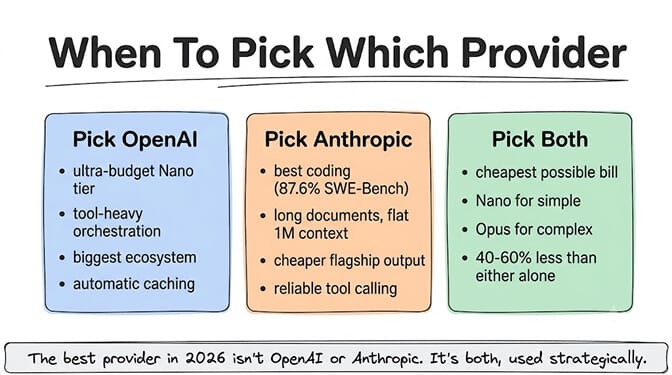
Pick OpenAI when: You need an ultra-budget model (GPT-6 Luna, $0.10/$0.50). Your prompts stay under 272K tokens. You want fine control over reasoning cost through reasoning.effort. You want the largest developer ecosystem.
Pick Anthropic when: You process long documents regularly (flat 1M context, no surcharge). You want a step above the mid tier without paying top-tier prices (Opus 5.5 at $4/$20). You run cache-heavy agents on the top models (Fable 5.1 cache hits cost a quarter of Astra's).
Pick both when: You want the cheapest possible bill. Mixing GPT-6 Luna for simple tasks with Claude for long-context and complex work beats either provider alone. If you're weighing a third provider, our GPT vs Claude vs DeepSeek breakdown adds the budget frontier option to the mix, and our complete LLM pricing guide lists the older models too. For how routing, caching and context compression stack up to cut an agent's bill, see our guide to cutting agent token costs.
If you're building agents and want to use both providers without managing multiple API integrations, give BetterClaw a look. BYOK across both OpenAI and Anthropic (plus 26 other providers) with zero markup. Assign different models to different tasks through the visual builder. Smart context management keeps token costs down. Per-agent cost caps prevent surprises. Free plan with 1 agent and 100 credits a month. $49/month for Pro with 5 agents.
The best provider in 2026 isn't OpenAI or Anthropic. It's both, used strategically.
Frequently Asked Questions
Is OpenAI or Anthropic cheaper for API usage?
At the mid and top tiers, neither: GPT-6 Sol and Claude Sonnet 5 both cost $2/$10 per million tokens, and GPT-6 Astra and Claude Fable 5.1 both cost $10/$50. At the budget tier OpenAI is 10x cheaper: GPT-6 Luna costs $0.10/$0.50 against Claude Haiku 4.5 at $1/$5. Anthropic is cheaper for long prompts, because GPT-6 bills any request over 272K input tokens at 2x input and 1.5x output, and Claude doesn't.
How does GPT-6 pricing compare to Claude?
GPT-6 Astra costs $10 input / $50 output, the same as Claude Fable 5.1. GPT-6 Sol costs $2/$10, the same as Claude Sonnet 5. GPT-6 Luna costs $0.10/$0.50, a tenth of Claude Haiku 4.5. Claude Opus 5.5 ($4/$20) has no GPT-6 equivalent. GPT-6 was released in September 2026: Astra on September 3, Sol and Luna on September 22.
What hidden costs should I watch for with OpenAI and Anthropic APIs?
Three big ones. First, reasoning tokens: GPT-6 and Claude both bill thinking as output tokens even though you don't see it. Budget 2 to 3x the visible output. Second, long context: GPT-6 charges 2x input and 1.5x output on the whole request once input passes 272K tokens. Anthropic doesn't. Third, tokenizers: Anthropic says Claude 4.7 and later models produce about 30% more tokens for the same text than its older tokenizer, so compare real token counts, not just rates.
How much does it cost to run an AI agent on OpenAI or Anthropic per month?
For an agent handling 50 sessions a day at 30 turns each (2,000 input and 500 output tokens per turn), GPT-6 Sol and Claude Sonnet 5 both come to about $405 a month, or about $292 with 70% of input served from cache. Claude Opus 5.5 for everything is about $810 ($571 cached). Routing 70% of turns to GPT-6 Luna and 30% to Sonnet 5 brings it down to about $136 a month, or about $98 with caching. Once caching is on, output tokens make up most of the bill.
Can I use both OpenAI and Anthropic in the same AI agent?
Yes. Platforms like BetterClaw support BYOK across both providers (plus 26 others). You paste API keys from each, assign models to different task types, and the platform routes requests accordingly. The common split is GPT-6 Luna for cheap, simple steps and Claude for complex or long-context steps, so every request goes to the cheapest model that can handle it.
Which provider is better for building AI agents in 2026?
On price, it depends on the tier: OpenAI owns the budget tier with GPT-6 Luna, Anthropic owns long context and the $4/$20 Opus 5.5 tier, and the mid and top tiers cost the same. On quality, test both on your own tasks, since benchmark leads change with every release. The best agent setups use both: Anthropic for long-context and complex work, OpenAI's Luna for cheap simple tasks.