Three big companies shipped an always-on agent in seven weeks. They look alike in the launch videos. They aren't alike on the bill, in your country, or in who picks the model.
Grok Bot on 11 August. Meta Muse on 8 September. OpenAI Dots on 29 September.
Three always-on AI agents, each with its own cloud computer, each promising to finish work while you sleep. And half the launch coverage this week calls Dots "the Muse rival," which is why "dots vs muse" is suddenly a search people are making.
We build BetterClaw, a managed AI agent builder, so we read every launch post, help page and pricing table for all three. Here's how Dots vs Muse vs Grok Bot actually shakes out, without the keynote glow.
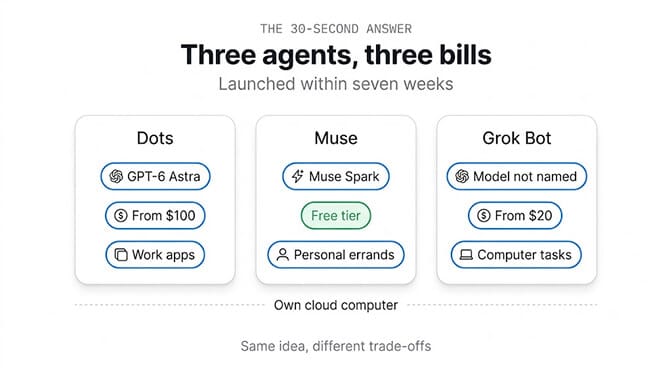
The 30-second answer
If you only read one thing, read this table.
| OpenAI Dots | Meta Muse | Grok Bot | |
|---|---|---|---|
| Launched | 29 Sept 2026 | 8 Sept 2026 | 11 Aug 2026 (beta) |
| Who can get it | ChatGPT Pro (not EEA, UK, Switzerland), Business Premium, Enterprise beta | US and Canada | Paid Cursor plans, Cursor Teams, SuperGrok plans, Enterprise |
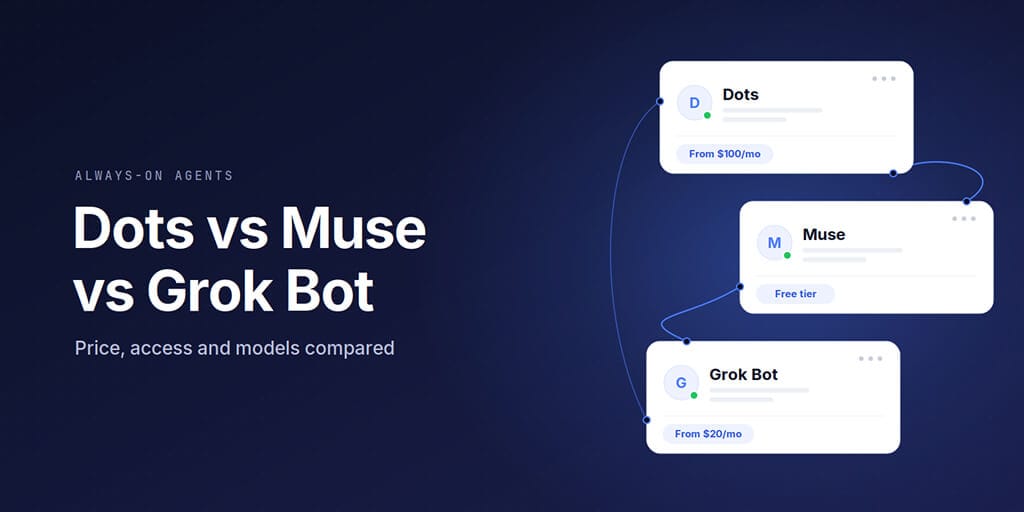
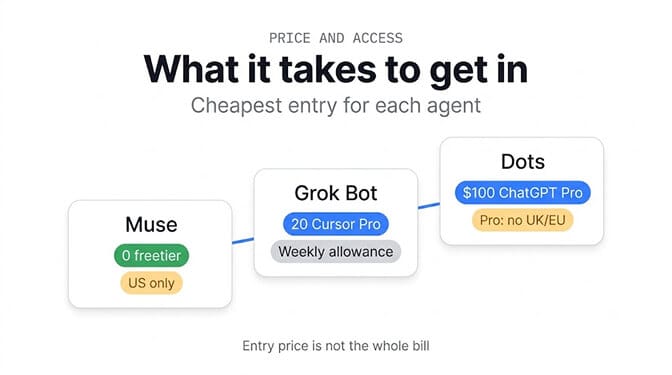
| Entry price | $100/month (ChatGPT Pro 100) | Free; paid tiers $20 and $100/month | $20/month (Cursor Pro) or $30/month (SuperGrok) |
| Model | GPT-6 Astra | Muse Spark | Not named by xAI, no model picker |
| Where it runs | ChatGPT web, desktop, mobile, plus Slack and Teams | Muse app on iOS and Android, muse.ai, WhatsApp | Desktop app on macOS, Windows, Linux; iOS; Android in beta |
| Best for | Work across your apps | Shopping, bookings, personal errands | Coding and computer tasks, especially for Cursor users |
Muse is the cheapest to start. Grok Bot is the cheapest paid entry. Dots is the most expensive, and the only one you can't buy on a personal plan in the UK or EU.
What each one costs, and who's allowed in
This is where the three split hardest.
OpenAI Dots: a $100+ ChatGPT plan
Dots isn't in ChatGPT Plus. Your first Dot comes with ChatGPT Pro, which now has three tiers at $100, $200 and $500 a month, or with a Business Premium seat at $100 a month billed annually ($125 monthly). Every plan, limit and region is in our OpenAI Dots vs BetterClaw comparison.
Extra Dots are planned, but OpenAI hasn't priced them. Chatting with your Dot doesn't count toward ChatGPT usage limits. Tasks it starts in Codex or ChatGPT Work do.
Here's the catch for half our readers. Pro users in the EEA, the UK and Switzerland are excluded at launch. Business Premium works in all supported regions, but a Business workspace starts at two users.
Meta Muse: free first, then pay by usage
Muse has a free tier, then two paid plans: Power at $20 a month and Max at $100 a month. Reporting from launch week describes the paid tiers as more headroom for heavier use rather than different features.
The limit isn't price. It's geography. Muse launched in the US only, through its own app, muse.ai and WhatsApp, and reached Canada on 18 September. Nowhere else yet. The full plan-by-plan breakdown is in our Meta Muse vs BetterClaw comparison.
Grok Bot: included with Cursor or SuperGrok
Grok Bot has no price of its own. It comes with every paid individual Cursor plan (Pro starts at $20 a month), with Cursor Teams, and with SuperGrok at $30, SuperGrok Plus at $100 and SuperGrok Heavy. Enterprise access goes through sales.
Usage comes as a weekly allowance that resets each week, with extra usage billed at model and token cost. xAI doesn't publish how much work the weekly allowance covers. We dug into that in our Grok Bot vs BetterClaw comparison, including what heavier use costs once you go past the allowance.
Models: who picks the model?
This is the question nobody's launch post leads with, and it matters more than the mascot.
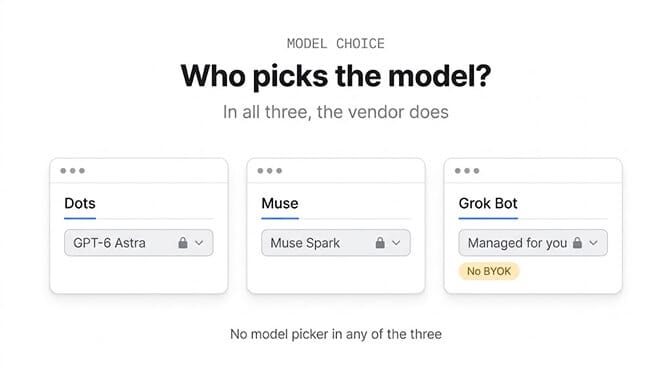
Dots runs on GPT-6 Astra. Muse runs on Muse Spark, Meta's own model family. Neither launch announcement offers you a model picker.
Grok Bot goes a step further and says it plainly. xAI's docs don't name the model, model selection is managed for you, and there's no picker and no bring-your-own-key. SpaceXAI did announce in August that Grok 4.6 was available in Grok Bot, but the product docs don't commit to a specific model.
Here's the weird part. All three are "your" agent, yet none of them lets you decide what thinks for it.
That's fine if you trust the vendor's model for everything. It's less fine when you'd rather run a cheap model for inbox triage and a stronger one for the contract review, or when the vendor quietly swaps models under you.
In all three, the model comes with the subscription. You're buying a brain you can't change.
Where each one lives
Where you talk to an agent decides whether you'll actually use it.
Dots lives inside ChatGPT on web, desktop and mobile, and you can message it in Slack and Microsoft Teams. You create it on desktop, and texting is a limited beta for US Pro users.
Muse lives in its own iOS and Android apps, on muse.ai and inside WhatsApp. For a consumer agent, WhatsApp is a smart place to be. It's where errands already get discussed.
Grok Bot is a separate desktop app for macOS, Windows and Linux, plus iOS, with Android in beta since 2 September. Every Bot you create shares one persistent cloud computer, so Bots can pass files and logins between each other.
Dots vs Muse vs Grok Bot: what each is actually best at
Stay with me here, because "always-on agent" covers three quite different jobs.
Dots is a work agent. It connects to 4,000+ apps through OpenAI's plugins, follows you into Slack and Teams, and is built for the developer turning feedback into fixes or the sales lead updating a proposal as requirements change. If your work already happens in ChatGPT, it fits.
Muse is an errands agent. Email, calendar, bookings, dining and shopping are front and centre, with a free tier generous enough to try it on real life. Meta's own promo shows it comparing strollers and asking before it buys. Our Muse breakdown against BetterClaw goes deeper on the personal-agent side.
Grok Bot is a computer-use agent. It signs into your tools and works them like a person, and you can teach it a workflow once and save it as a routine. xAI's examples lean on bug reproduction, outbound and account health, and if you live in Cursor already, it's the natural pick.
If we were choosing for a friend: errands, Muse. Work inside ChatGPT, Dots. Coding and clicking through dashboards, Grok Bot.
And if what you really want is an agent without the lock-in, that's the gap we built BetterClaw for. Pick the model per agent, bring your own key, from $19 a month. Start with BetterClaw whenever you're ready. But read the privacy section below before you connect any agent to your email.
Privacy and data: what each company actually says
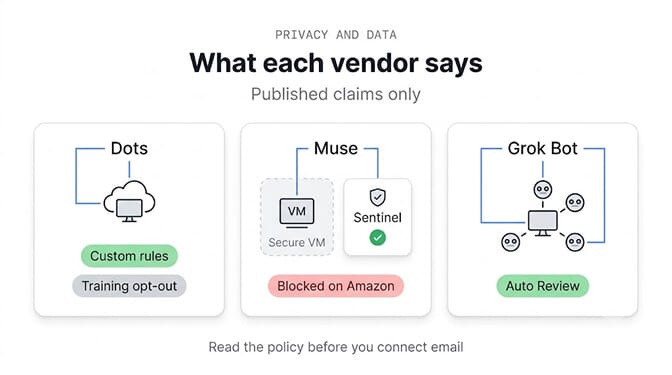
We're only repeating what each company publishes here, not guessing.
| OpenAI Dots | Meta Muse | Grok Bot | |
|---|---|---|---|
| Where it works | Its own cloud computer; your laptop stays separate unless you connect it | Its own Muse Secure VM, with a separate Sentinel agent that must approve anything Muse sends out | One shared cloud computer per user, encrypted in transit and at rest |
| Passwords | Can use saved passwords without exposing them to the model | Meta says Muse has no visibility into passwords or payment methods | Uses Cursor's sign-in and privacy mode |
| Model training | Business, Enterprise and Edu content not used by default; personal plans can opt out | Users must opt out; otherwise Meta says it scrubs critical personal details before use | Training opt-out available |
| Approvals | Built-in rules plus Custom Rules for what needs your approval | Asks before sensitive steps like checkout | Sensitive actions can go through Auto Review |
The relevant documents are OpenAI's Dots safety post and ChatGPT data controls, Meta's Muse launch materials and privacy policy, and xAI's Grok Bot FAQ with Cursor's privacy settings.
One Muse detail to know: Meta says a Muse Confidential VM, encrypted with a key you hold so even Meta can't read it, arrives later in 2026. It isn't the default yet.
The Amazon dispute over Muse
Around 20 September, Amazon started blocking Muse from shopping on Amazon.com. Users saw a popup saying continued access by an unauthorized AI agent violates Amazon's Conditions of Use.
Amazon alleged three things. Meta didn't tell Amazon that Muse would access its store. The agent doesn't identify itself while browsing. And it appears to capture and store customer credentials. Amazon says it asked Meta to remove Amazon from Muse and that the two companies are in direct talks.
Meta's reply is that Muse has no visibility into people's passwords or payment methods, which sit in secure storage the agent can't see. Neither side's account of the credential question has been independently verified.
Meanwhile Shopify went the other way and confirmed Muse will be able to complete purchases on its platform. If Muse shopping matters to you, that split is the thing to watch.
If you want one agent that runs any model
Here's the bit where we talk about us, briefly.
All three agents above tie you to one company's model, one company's apps and, for two of them, one company's subscription. That's a reasonable trade for a lot of people. It's the trade we built BetterClaw to avoid.
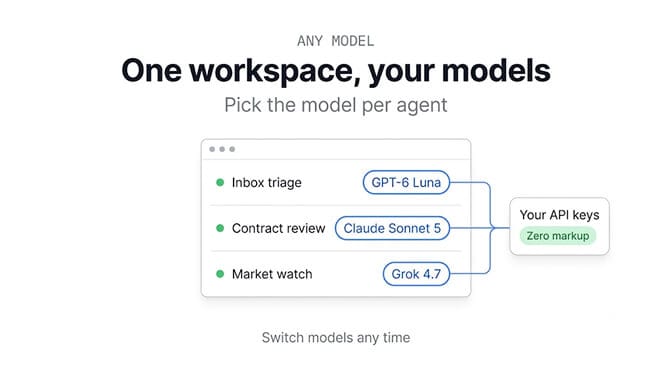
BetterClaw is a managed AI agent builder. You pick the model per agent from 28+ providers, bring your own key, and pay your provider directly with zero markup. One agent can run Claude on contract review while another runs a cheap model on inbox triage.
And you don't have to leave OpenAI or xAI behind. You can run OpenAI and Grok models inside BetterClaw too, with an API key from either, or by signing in with your ChatGPT subscription for OpenAI models. You talk to your agents in the web app, Slack, Telegram, Discord or Gmail, and they connect to 99 tools with one-click sign-in.
What we don't do: we don't give your agent its own computer that clicks through websites like a person. BetterClaw works through connectors and skills. If browser-style computer use is the job, Grok Bot or Dots will suit you better.
The real fight isn't Dots vs Muse
It's bundled versus open.
Seven weeks, three launches, and every one of them says the same thing about the next few years: the agent is becoming part of the subscription you already pay for. That's great for convenience. It also means the company that sells you the agent decides the model, the apps it can reach, and, as Muse just found out at Amazon's front door, which stores will even let it in.
Pick the agent that fits your life today. Just know which doors it can open, and who holds the key.
If any of this resonated, give BetterClaw a try. Basic is $19 a month for one agent, Pro is $49 for five, Business is $149 for 25, and every paid plan has a 7-day money-back guarantee. Bring any model, pay your provider directly, zero markup. See full pricing. We handle the infrastructure. You handle the interesting part.
Frequently Asked Questions
Is Dots in ChatGPT Plus?
No. OpenAI Dots isn't included in ChatGPT Free, Go or Plus. Your first Dot comes with ChatGPT Pro, from $100 a month, or a Business Premium seat, and Enterprise, Edu and Healthcare workspaces can try a beta once an admin enables it.
Is Meta Muse free?
Yes, Muse has a free tier. Heavier use moves you to Power at $20 a month or Max at $100 a month, and reporting so far describes those tiers as more usage rather than extra features. Muse is available in the US and Canada only.
Is Dots available in the UK or EU?
Not on ChatGPT Pro. At launch, Pro users in the European Economic Area, the UK and Switzerland are excluded. Business Premium users get Dots in all supported ChatGPT regions, and Business workspaces start at two users.
Which is better, Dots or Muse?
It depends on the job. Dots is built for work, with 4,000+ apps through OpenAI's plugins and access in Slack and Teams, but it starts at $100 a month. Muse is built for personal errands like shopping and bookings, has a free tier, and works only in the US and Canada.
Can Grok Bot use Claude or GPT?
No. xAI's Grok Bot docs say model selection is managed for you, with no model picker and no bring-your-own-key, and they don't name the model. If you want Claude, GPT and Grok side by side, an agent builder like BetterClaw lets you choose a model per agent.
Can Muse shop on Amazon?
Not right now. Around 20 September, Amazon began blocking Muse from shopping on Amazon.com, saying it violates Amazon's Conditions of Use, and the two companies say they're in direct talks. Shopify has confirmed Muse will be able to complete purchases on its platform.
Do any of them let me choose my own model?
Not in a model picker. Dots runs GPT-6 Astra, Muse runs Muse Spark, and Grok Bot's model is managed by xAI with no bring-your-own-key. If choosing the model matters to you, BetterClaw supports 28+ providers on your own keys with zero markup.