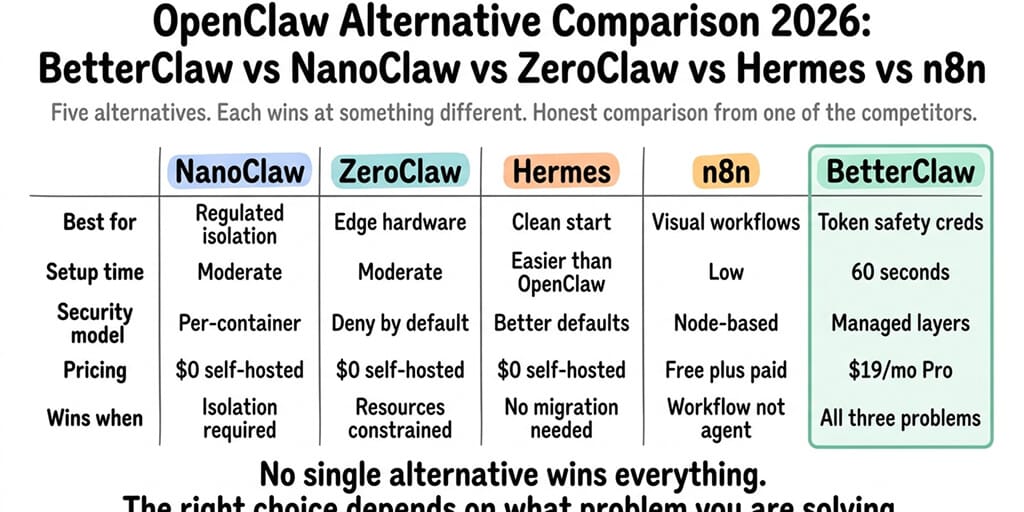
Five alternatives. Each wins at something different. Here's an honest comparison from one of the competitors.
Fifteen roundup articles rank for "openclaw alternatives" and none of them include BetterClaw. That's partly our fault (we were positioning as a hosting service when most of those articles were written) and partly because the roundup sites list every GitHub project with "claw" in the name without evaluating what each actually solves.
This is our comparison. Yes, we're biased. We built BetterClaw. But we're also going to be honest about where each alternative wins, because you'll find out anyway and dishonesty would cost us more than honesty.
Five alternatives. Each genuinely good at something specific. Here's where each one wins and where each one falls short. (If you'd rather see them sorted by category than head to head, our best OpenClaw alternatives guide groups every option by what it actually does.)
NanoClaw: when container isolation is the only thing that matters
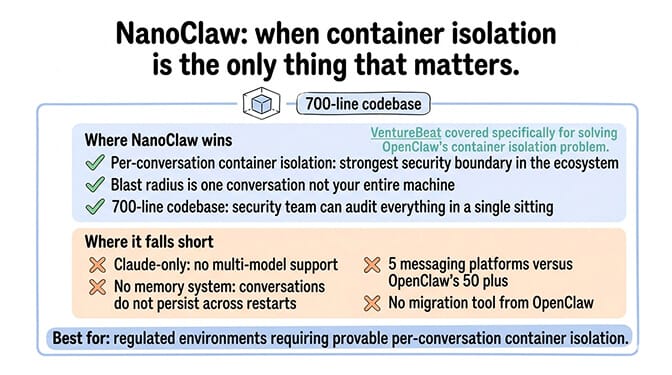
What it is: A 700-line TypeScript agent framework built by Gavriel Cohen as a direct response to OpenClaw's security problems. Every chat group gets its own sandboxed Docker container with separate memory and filesystem access.
Where NanoClaw wins: Container isolation per conversation is the strongest security boundary in the ecosystem. VentureBeat covered it specifically for solving "OpenClaw's container isolation problem." If a skill goes rogue, it can only affect the container it's running in. The blast radius is one conversation, not your entire machine. The 700-line codebase means your security team can audit everything in a single sitting.
Where NanoClaw falls short: Claude-only (built on Anthropic's Claude Agent SDK). No multi-model support. No memory system (conversations don't persist across restarts). Minimal skill ecosystem. 5 messaging platforms versus OpenClaw's 50+. No migration tool from OpenClaw.
Best for: Teams handling sensitive data in regulated environments (finance, healthcare, legal) who need provable container isolation and don't need multi-model flexibility.
For the complete OpenClaw security analysis that explains why alternatives like NanoClaw exist, our security guide covers all 138+ CVEs.
ZeroClaw: when every megabyte counts
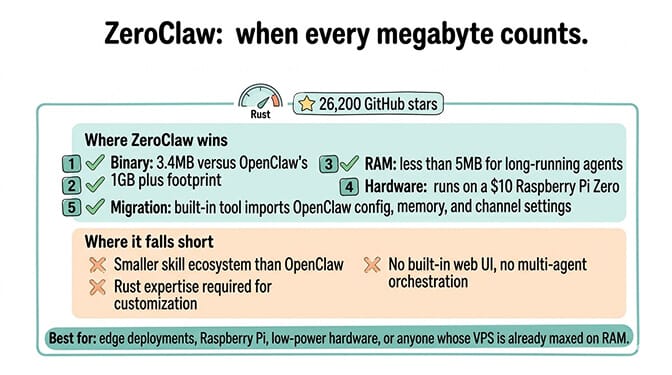
What it is: A ground-up Rust rewrite of the AI agent concept by Harvard and MIT students alongside the Sundai.Club community. The entire runtime compiles to a 3.4MB static binary. 26,200+ GitHub stars.
Where ZeroClaw wins: Performance. The numbers are not subtle. 3.4MB binary (versus OpenClaw's 1GB+ footprint). Boots in under 10 milliseconds. Uses less than 5MB of RAM for long-running agents. Runs on a $10 Raspberry Pi Zero. Deny-by-default security model. Built-in migration tool that imports OpenClaw config, memory, and channel settings. 15+ channel integrations. The most complete OpenClaw migration path available.
Where ZeroClaw falls short: Smaller skill ecosystem than OpenClaw. Requires Rust expertise for customization. No built-in web UI (use Open WebUI). Single-agent architecture (no multi-agent orchestration). The community is growing fast but still smaller than OpenClaw's 850+ contributors.
Best for: Developers who want OpenClaw's functionality with 99% less resource consumption. Edge deployments, Raspberry Pi, low-power hardware, or anyone whose VPS is already maxed on RAM.
Hermes: when you want to start fresh
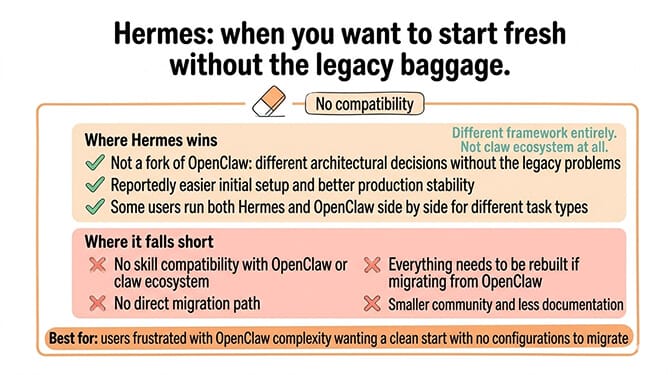
What it is: A different framework entirely. Not a fork of OpenClaw. Not "claw" ecosystem at all. Built with different architectural decisions and reportedly easier setup with better stability.
Where Hermes wins: Reportedly easier initial setup than OpenClaw. Better stability for production use. Some users in the community run both Hermes and OpenClaw side by side, using each for different tasks. If you're starting from scratch and don't have existing OpenClaw configurations to migrate, Hermes removes the legacy baggage.
Where Hermes falls short: Different framework means no skill compatibility with OpenClaw or the claw ecosystem. Smaller community. Less documentation. If you're migrating from OpenClaw, everything needs to be rebuilt. No direct migration path.
Best for: Users who are frustrated with OpenClaw's complexity and want a clean start without migrating existing configurations. Also good for teams evaluating agent frameworks for the first time with no OpenClaw history.
For a head-to-head between BetterClaw and Hermes specifically, see our BetterClaw vs Hermes comparison.
n8n: when you need visual workflows, not conversational agents
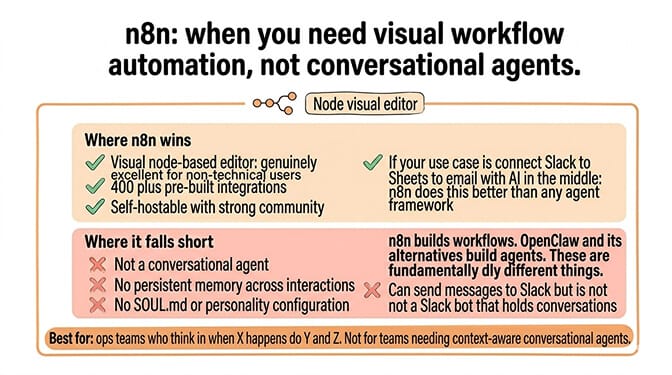
What it is: An open-source workflow automation platform with 400+ integrations and a visual node-based editor. Not an AI agent framework. A workflow builder that can include AI nodes.
Where n8n wins: Visual workflow builder is genuinely excellent for non-technical users. 400+ pre-built integrations. Self-hostable. Strong community. If your use case is "connect Slack to Google Sheets to email with an AI step in the middle," n8n does this better than any conversational agent framework because it was built for workflow automation, not conversational AI.
Where n8n falls short: Not a conversational agent. No persistent memory across interactions. No SOUL.md or personality configuration. No multi-channel messaging (it can send messages to Slack, but it's not a Slack bot that holds conversations). Fundamentally different architecture: n8n builds workflows, OpenClaw (and its alternatives) build agents.
Best for: Non-technical founders and ops teams who need workflow automation with AI components. If you think in "when X happens, do Y and Z," n8n is the right tool. If you think in "I need an agent that understands context and holds conversations," it's not. (For the deeper workflow-versus-agent split, see our BetterClaw vs n8n comparison.)
The honest comparison: NanoClaw wins on isolation. ZeroClaw wins on performance. Hermes wins on fresh-start simplicity. n8n wins on visual workflows. None of them solve the three problems BetterClaw was built to address: token waste, skill supply chain risk, and credential exposure.
BetterClaw: when the problem is token waste, skill risk, and credential exposure
Now the biased part. But we'll be specific about what we solve and what we don't.
What BetterClaw is: A managed platform that runs OpenClaw agents with three added layers: smart context management (reduces token waste), verified skills marketplace (eliminates supply chain risk), and secrets auto-purge (erases credentials from agent memory after 5 minutes).
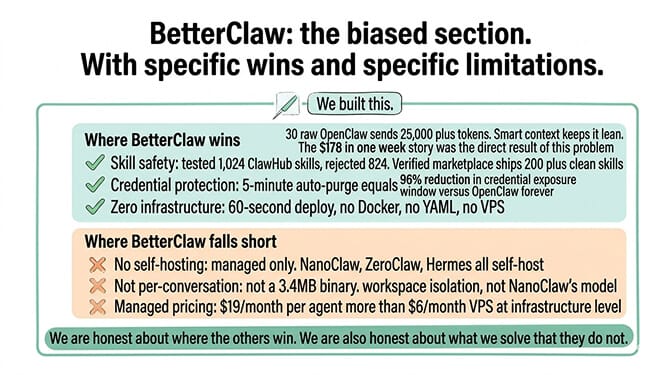
Where BetterClaw wins:
Token economics. OpenClaw sends the full conversation context with every request. By message 30, a single request costs 25,000+ tokens of input. The viral "$178 in one week" Medium post was the direct result. BetterClaw's smart context management keeps the context lean automatically. Same agent quality, fewer tokens per request, lower API bills.
Skill safety. We tested 1,024 skills from ClawHub and rejected 80%. Credential exfiltration, prompt injection, unauthorized network calls. Our verified marketplace ships 200+ skills that passed security review. You install from a clean catalog.
Credential protection. OpenClaw stores API keys in plaintext .env files indefinitely. Kaspersky confirmed infostealers already target these files. BetterClaw purges credentials from agent memory after 5 minutes. 96% reduction in credential exposure window. See our secrets auto-purge deep-dive for the full architecture.
Zero infrastructure. No Docker setup. No YAML configs. No VPS to manage. 60-second deploy. Free tier with 1 agent and BYOK. $49/month for Pro. 15+ channel integrations.
Where BetterClaw falls short:
No self-hosting option. If you need to run the agent on your own infrastructure, BetterClaw doesn't support that. NanoClaw, ZeroClaw, and Hermes all self-host. BetterClaw is managed-only.
No Rust performance. BetterClaw runs on managed infrastructure, not a 3.4MB binary. If you need to run on a Raspberry Pi or $10 hardware, ZeroClaw is the right choice.
No container-per-conversation isolation. BetterClaw uses workspace isolation and Docker-sandboxed execution, but not NanoClaw's per-conversation container model. If container isolation per chat group is a compliance requirement, NanoClaw is stronger on this specific point.
Managed pricing. $49/month for Pro is more than self-hosted options at the infrastructure level (a VPS costs $6/month). The value is in the three layers above infrastructure (context management, verified skills, secrets auto-purge) plus zero maintenance time. If you only need hosting, a VPS is cheaper. For the complete self-hosted versus managed comparison, our self-hosting vs managed breakdown covers the ten scenarios where each makes sense.
The decision framework (skip the feature matrix)
Here's what nobody tells you about choosing an OpenClaw alternative.
Feature matrices don't help. Every alternative has a different philosophy. Comparing checkboxes is misleading because the checkboxes don't capture what each tool actually does well. The right question isn't "which has more features." It's "what problem am I solving."
If your problem is container isolation: NanoClaw. If your problem is resource constraints: ZeroClaw. If your problem is wanting a clean start: Hermes. If your problem is visual workflow automation: n8n. If your problem is token waste + skill safety + credential security + zero infrastructure management: BetterClaw.
Most teams don't have just one problem. Some run ZeroClaw for edge deployment and BetterClaw for production agents. Some use n8n for workflow automation and BetterClaw for conversational agents. The tools aren't mutually exclusive.
If your specific problems are token costs, skill safety, and credential exposure, and you don't want to manage infrastructure, give BetterClaw a try. Free tier with 1 agent and BYOK. $49/month for Pro. 60-second deploy. Smart context management, verified skills, secrets auto-purge. We're honest about where the others win. We're also honest about what we solve that they don't.
Frequently Asked Questions
What is the best OpenClaw alternative in 2026?
It depends on your primary concern. NanoClaw for container isolation (700-line codebase, per-conversation sandboxing). ZeroClaw for performance (3.4MB Rust binary, runs on Raspberry Pi). Hermes for a clean start without OpenClaw baggage. n8n for visual workflow automation. BetterClaw for token optimization, skill safety, and credential protection with zero infrastructure management. No single alternative wins across all criteria.
How does BetterClaw compare to NanoClaw?
NanoClaw wins on per-conversation container isolation (stronger security boundary for individual chat groups). BetterClaw wins on token economics (smart context management), skill safety (verified marketplace vs community uploads), credential protection (5-minute auto-purge vs permanent plaintext), infrastructure management (zero vs self-hosted Docker), and multi-model support (28+ providers vs Claude-only). Choose NanoClaw for maximum isolation. Choose BetterClaw for the broader platform.
How does BetterClaw compare to ZeroClaw?
ZeroClaw wins on resource efficiency (3.4MB binary, 5MB RAM, runs on $10 hardware) and has the best OpenClaw migration tool. BetterClaw wins on zero infrastructure management (no server to maintain), verified skills (tested marketplace vs community skills), and credential protection (secrets auto-purge). ZeroClaw is self-hosted and free. BetterClaw is managed at $49/month for Pro. If you love managing servers and need edge deployment, ZeroClaw. If you want managed everything, BetterClaw.
Is BetterClaw more expensive than self-hosting?
At the infrastructure level, yes. A VPS costs $6/month vs BetterClaw Pro at $49/month. At the total cost of ownership level (including 2-4 hours/month maintenance time at $50/hour), BetterClaw is cheaper: $49/month vs $106-206/month (VPS + time). Smart context management also reduces API costs by sending fewer tokens per request. The price comparison changes depending on whether you count your time.
Can I migrate from OpenClaw to BetterClaw?
Yes. BetterClaw runs OpenClaw agents. Your SOUL.md, memory files, and skill configurations work on the platform. Import your existing configuration and deploy in 60 seconds. ZeroClaw also has a built-in migration tool. NanoClaw and Hermes do not have direct migration paths from OpenClaw.