
Manus is a managed worker you delegate to. OpenClaw is infrastructure you operate. BetterClaw is a no-code AI agent platform that gives you always-on agents without the infrastructure. Here's which one fits your operating model.
Updated October 6, 2026: Manus pricing, chat channels, model tiers and Projects now reflect its current product, model prices are refreshed, and we've folded in our old OpenClaw vs Manus autonomous-tasks breakdown (reactive vs autonomous, the limitations, and the workarounds).
Remote OpenClaw nailed it in one line: "You are buying two different operating models."
Actually, there are three.
Manus AI is a managed autonomous worker. You give it a task. It figures out how to complete it. It delivers a result. You don't manage anything. You pay credits.
OpenClaw is self-hosted infrastructure. You install it on your server. You configure every setting. You connect every channel. You own everything. You manage everything.
And then there's the third option that most comparisons skip: managed platforms like BetterClaw that give you the same agent model (persistent messaging, always-on, multi-channel) without the infrastructure burden.
Three products. Three operating models. The question isn't which AI is smarter. It's which operating model matches how you actually want to work.
The three operating models (what you're actually choosing between)

Manus AI: The cloud worker you delegate to
You give Manus a task. It plans, works in a cloud sandbox, and delivers. Manus excels at research, data analysis, slides and prototypes (our Manus AI use cases roundup covers the task categories it handles best). It browses the web, writes code, creates spreadsheets, and delivers polished outputs. It has been part of Meta since the deal announced in December 2025.
Strengths: Zero setup. Excellent research depth (NxCode: "outperforms ChatGPT on research depth"). Wide Research runs parallel agents on big research jobs. Scheduled tasks (2 on Free, 20 on Pro). Projects give repeat work a shared master instruction and knowledge base. Since February 2026 you can message your own Manus agent on Telegram, and it's also on WhatsApp Business and in Slack threads. Cloud Computer (launched April 30, 2026) adds persistent VMs, which we cover in our Manus Cloud Computer vs OpenClaw explainer.
Limitations: Its chat agents work for you: they aren't built to answer your customers on your own channels, and Discord isn't supported. Credit-based pricing (Free, Pro from $20/month, Team from $20 per seat) where you don't know what a task costs until it runs. No BYOK: you choose between Manus 1.6 Lite, 1.6 and 1.6 Max, not the underlying model. Across tasks, context lives in Projects you maintain by hand, not in memory the agent builds up itself.
OpenClaw: The self-hosted runtime you operate
OpenClaw lives on your server and connects to your messaging apps. 230K+ GitHub stars. 50+ channels. 1,000+ MCP servers. The largest agent ecosystem in existence. You install it, configure it, connect it, and manage it.
Strengths: Total control. 50+ messaging channels. 1,000+ MCP integrations. BYOK (28+ providers). MIT license. Free software. Massive community. Data stays on hardware you control.
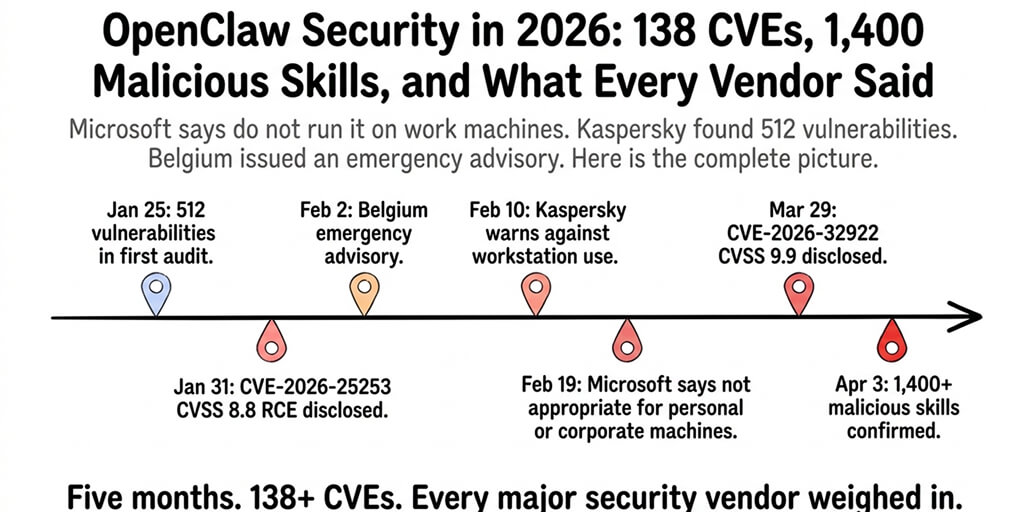
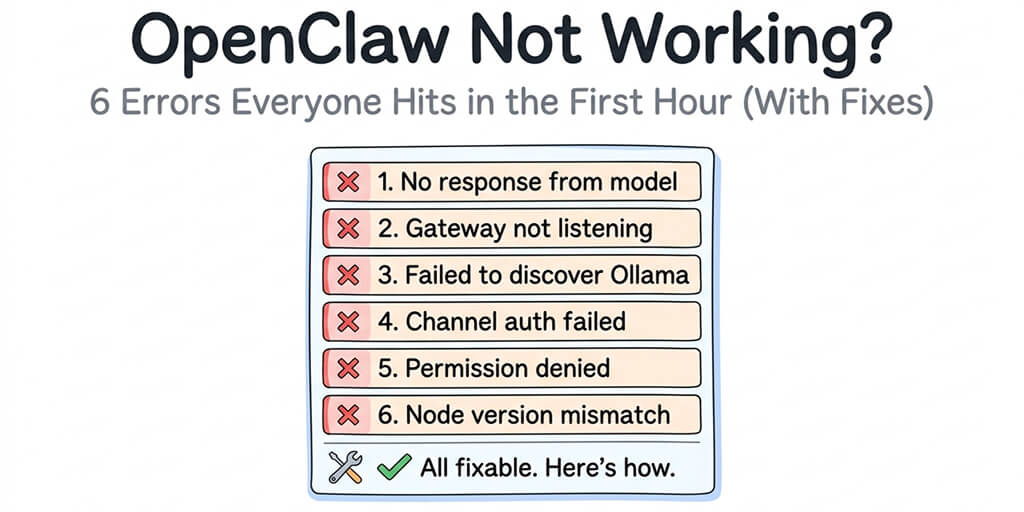
Limitations: Infrastructure burden (Docker, config files, VPS, updates, security patches). Security track record (CVE-2026-25253 CVSS 8.8, ClawHavoc 1,400+ malicious skills, 500K+ exposed instances, CrowdStrike advisory). The OpenClaw maintainer Shadow warned: "if you can't understand how to run a command line, this is far too dangerous of a project for you to use safely." And it's a reactive agent, not an autonomous one (more on that below).
For the detailed OpenClaw security analysis, our guide covers the specific vulnerabilities and mitigations.
BetterClaw: The no-code platform for always-on agents
BetterClaw is a no-code AI agent platform that gives you the same persistent, always-on, multi-channel agent model without the infrastructure. You get the messaging integration, the persistent memory, the BYOK flexibility, and the multi-channel support. We handle Docker, security, updates, and hosting. That is the whole proposition of a managed AI agent platform: you keep the agent and you drop the operations.
Strengths: 60-second deploy. Telegram, Slack, Discord and Gmail, plus webhooks and 500+ connectors. 28+ model providers. BYOK with zero markup. Smart context management. Secrets auto-purge after 5 minutes. Verified skills marketplace. Sandboxed execution and a kill switch on every plan.
Limitations: Fewer channels than self-hosted OpenClaw (Telegram, Slack, Discord and Gmail vs 50+; no WhatsApp yet). Less customization than running your own instance. Platform dependency. No research sandbox like Manus's.
The comparison that actually matters

| Manus AI | OpenClaw (self-hosted) | BetterClaw (managed) | |
|---|---|---|---|
| Category | Task agent | Persistent agent | Persistent agent |
| How it works | Plans and finishes a task on its own | Responds to each instruction | Responds, plus scheduled tasks |
| Setup | 1 minute | 2-4 hours | 60 seconds |
| Channels | Web, desktop, mobile; your own agent on Telegram, WhatsApp Business, Slack, email | 50+ messaging | Telegram, Slack, Discord, Gmail + webhooks, 500+ connectors |
| Model choice | Manus 1.6 Lite / 1.6 / 1.6 Max | BYOK (28+) | BYOK (28+) |
| Pricing | $0 Free, Pro from $20/month (credits) | $0 + API + VPS ($5-50/month) | $0 Free, $19 Basic, $49 Pro, $149 Business + API if BYOK |
| Memory | Per task, plus Projects (instructions + files) | Persistent (vector + keyword) | Persistent (vector + keyword) |
| Security | Meta-managed, sandboxed | You manage (540+ CVEs) | We manage (auto-purge, sandboxed) |
| Infrastructure | None | Docker, VPS, config, updates | None |
| Skills | MCP connectors (describe what you want) | ClawHub (1,400+ malicious found) | Verified marketplace |
Reactive vs autonomous: why OpenClaw struggles with fire-and-forget tasks
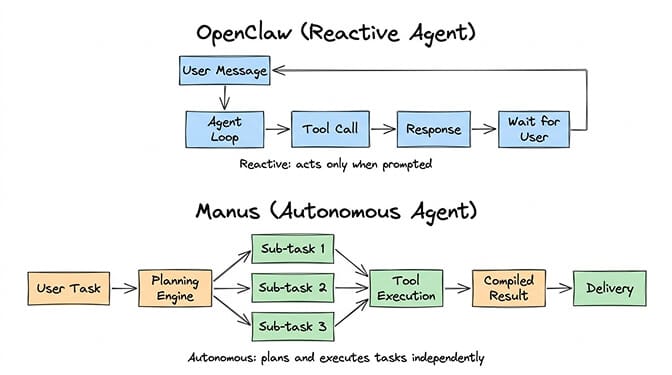
This is the one gap where Manus beats both OpenClaw and managed OpenClaw-style agents, so it's worth being precise about.
OpenClaw does what you tell it, when you tell it. Each interaction is a prompt-response cycle. That works beautifully for most day-to-day agent work: morning briefings, quick lookups, drafting messages, reminders. Ask it to "research three competitors, build a comparison table and email it to my team" and you'll often find yourself nudging it at every step.
Manus was built the other way round. You assign a task, it spins up a sandbox, makes a plan, and keeps going until it delivers. OpenClaw is "AI that responds." Manus is "AI that plans."
The four limitations behind the gap
- No native task planning. OpenClaw handles a complex instruction as a conversational turn. If the job needs more steps than the model fits into one run, you get partial execution. Manus decomposes the task for you.
- Context limits. Long multi-step jobs pile tool output into the model's context window, and OpenClaw's memory compaction can cut into active work mid-session.
- Sub-agents share the parent's context. They're good for parallel lookups, but they can't plan or keep their own state across a long workflow. They're workers, not planners.
- No execution sandbox by default. Without Docker isolation, OpenClaw runs code and shell commands on your actual machine. Meta researcher Summer Yue's agent mass-deleted her emails while ignoring stop commands. Manus runs everything in an isolated cloud sandbox.
Workarounds that make OpenClaw more autonomous
- Script the workflow in AGENTS.md. Write the steps out (search, save findings, compare, build the table, draft and send the email) and the agent follows them in order. You do the planning; the agent executes reliably.
- Use cron jobs for proactive work. Scheduled tasks run without a prompt: daily briefings, hourly inbox checks, weekly reports. They repeat rather than adapt, but they cover most "while I sleep" jobs.
- Chain skills. A single "competitor analysis" skill can call search, extraction and document generation internally, which moves the planning out of the model and into the skill. Our best OpenClaw skills guide lists community-vetted options.
If you want scheduled tasks and skills running without the VPS and Docker work, BetterClaw gives you both with sandboxed execution and a kill switch on every plan. It doesn't change the basic shape, though: for "go away and do this whole project", Manus is still the better tool.
The decision framework (three questions)

Here's where most people get it wrong. They compare features. They should compare operating models.
Question 1: Do you need a task agent or a persistent agent?
If you need one-off research, data analysis, or prototyping (tasks with a clear start and end), Manus is the best choice. It's faster to start, better at research depth, and it plans multi-step jobs on its own (see the reactive vs autonomous section above).
If you need an always-on agent that answers messages on Telegram or Slack on your behalf, monitors your inbox, runs scheduled tasks, and remembers conversations across months, you need OpenClaw or BetterClaw. Manus can now take jobs from your Telegram, WhatsApp Business or Slack, but it's still your personal task agent, not an agent that sits on your business channels.
Question 2: Do you want to manage infrastructure?
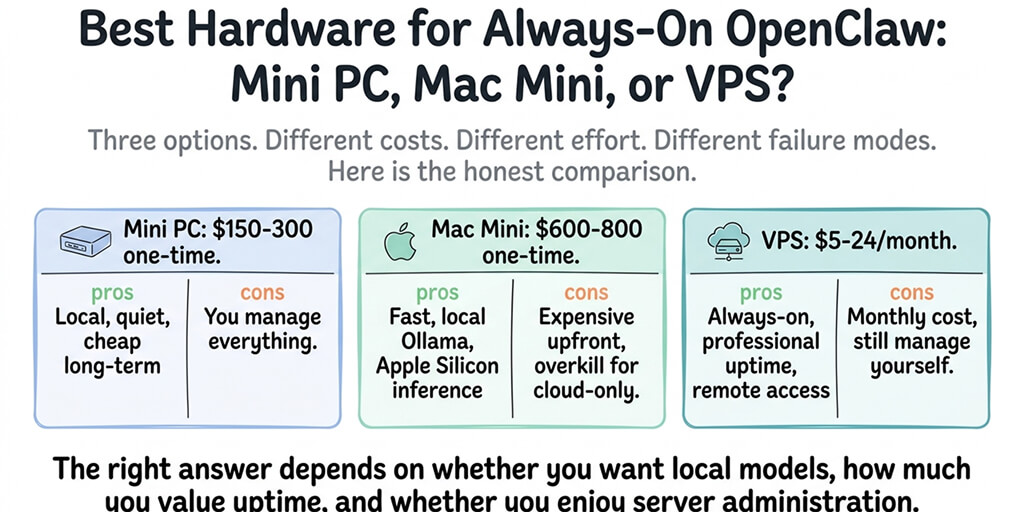
If yes, self-hosted OpenClaw gives you total control. You own the server. You configure every setting. You manage security, updates, and uptime. This is the right choice for developers who want maximum flexibility and don't mind the operational overhead.
If no, BetterClaw gives you the same persistent agent model without Docker, config files, VPS management, or security patching. Free tier with 1 agent and 100 credits a month. $49/month for Pro with 5 agents and 12,000 credits a month.
For the comparison of managed versus self-hosted deployment, our comparison page covers the infrastructure trade-offs in detail.
Question 3: Do you need model flexibility (BYOK)?
If you want to choose your model (a cheap model like DeepSeek V4.1 Flash at $0.15 per million input tokens off-peak for routine work, Claude Sonnet 5.5 at $2/$10 per million input/output tokens for daily tasks, Opus 5.5 at $4/$20 for complex reasoning), OpenClaw or BetterClaw. Both support BYOK with 28+ providers. You pay providers directly.
If you're fine with the platform choosing, Manus gives you three tiers (Manus 1.6 Lite, 1.6 and 1.6 Max) and handles the rest. The trade-off: no per-request cost transparency. Credits are consumed by model tokens, VM time and data APIs, so cost varies by task.
The decision in one sentence: Manus for one-off tasks. OpenClaw for full control. BetterClaw for managed always-on agents. Plenty of power users run Manus for occasional deep research alongside an always-on agent for daily messaging, email and calendar work.
The honest assessment (what each community says)

Manus fans say: "For one-shot tasks, Manus is faster to get results from because there's nothing to set up." (OpenClaw Playbook)
OpenClaw fans say: "If you're a developer who wants an AI agent that knows your systems, channels, and workflows, OpenClaw." (OpenClaw Playbook)
The honest middle: "The comparison becomes unfair when people pretend the two products are identical. They are not." (Remote OpenClaw)
The third option nobody discusses: Most comparisons skip managed platforms entirely. They frame it as "Manus (easy, limited) vs OpenClaw (powerful, complex)" and ignore the middle path: managed platforms that give you a persistent, always-on agent without the infrastructure tax.
That middle path is why we built BetterClaw. Not because Manus or OpenClaw are bad. Because the operating model gap between "delegate a task" and "manage a server" is where most people actually live.
If the operating model you want is "persistent always-on agent on messaging channels with BYOK and persistent memory, but without managing Docker, config files, VPS, and security patches," give BetterClaw a try. Free tier with 1 agent and 100 credits a month. $49/month for Pro with 5 agents and 12,000 credits a month. Telegram, Slack, Discord and Gmail, plus webhooks and 500+ connectors. 28+ providers. 60-second deploy. Smart context management. Secrets auto-purge. Verified skills. The agent is yours. The infrastructure is ours.
Frequently Asked Questions
What's the difference between Manus AI, OpenClaw, and managed platforms like BetterClaw?
Three different operating models. Manus AI is a cloud-based task agent (assign a task, it plans and delivers a result). OpenClaw is a self-hosted persistent agent (always-on, multi-channel, you manage infrastructure). BetterClaw is a managed persistent agent (always-on, multi-channel, we manage infrastructure). Manus excels at one-off research. OpenClaw and BetterClaw excel at ongoing messaging automation.
Which is cheaper: Manus, OpenClaw, or BetterClaw?
OpenClaw is the cheapest at high volume ($0 software + $5-10/month VPS + API costs). BetterClaw is $0 (free tier), $19/month Basic, or $49/month for Pro, plus API costs if you bring your own key. Manus is $0 on Free (Manus 1.6 Lite only) and Pro starts at $20/month, with credit consumption that varies by task. However, OpenClaw's "free" software costs 2-4 hours of setup time plus ongoing maintenance. BetterClaw and Manus trade money for time.
Can OpenClaw handle autonomous tasks like Manus?
Partially. OpenClaw can run scheduled cron jobs and follow scripted AGENTS.md workflows without prompting, but it doesn't natively plan or break a complex goal into sub-tasks the way Manus does. For multi-step projects you supply the plan through workflow files or skill chains. OpenClaw is strongest as a reactive agent that responds to real-time instructions; Manus is stronger at fire-and-forget execution.
Can I use Manus AI as a messaging agent on WhatsApp or Telegram?
Partly. Since February 2026 you can chat with your own Manus agent on Telegram (all plans), and it's also on WhatsApp Business and in Slack threads. It runs tasks you send it and replies with results. It isn't designed to answer your customers on your own channels, and Discord isn't supported. For agents that respond on your behalf, use OpenClaw (50+ channels) or BetterClaw (Telegram, Slack, Discord and Gmail; no WhatsApp yet).
Is OpenClaw safe to run without technical expertise?
The OpenClaw maintainer Shadow explicitly warned: "if you can't understand how to run a command line, this is far too dangerous of a project for you to use safely." CrowdStrike published a security advisory. 500K+ instances are exposed on the public internet. Without Docker isolation, autonomous jobs run directly on your machine. For non-technical users who want OpenClaw's agent capabilities without the security burden, BetterClaw handles security at the platform level (sandboxed execution, AES-256, secrets auto-purge).
Can I switch between Manus, OpenClaw, and BetterClaw?
Manus and OpenClaw or BetterClaw serve different use cases (task agent vs persistent agent), so most power users run both. Moving from OpenClaw to BetterClaw is straightforward with the migration guide. Hermes Agent also offers built-in OpenClaw migration via hermes claw migrate.