Manus is excellent at research and prototyping, and in 2026 it learned to live in your chat apps too. Here's what it actually does well, what it doesn't, what it costs now, and where the gaps are.
Updated September 28, 2026: pricing now reflects Manus's current Free / Pro / Team plans, and we've corrected this post for features Manus shipped after it was first published (Telegram, WhatsApp Business and Slack agents, scheduled tasks, and Projects).
A founder told me last month that Manus planned his entire 3-day Tokyo trip in 4 minutes and 24 seconds. Flights, hotels, transportation routes, day-by-day itinerary, downloadable doc file with prices. 152 credits consumed.
Then he noticed it forgot to include a return flight.
That story captures Manus AI perfectly. Impressively autonomous. Capable. Occasionally misses something critical. And you won't know what it missed until you check the output yourself.
Manus (part of Meta since the deal announced in December 2025, still operating from Singapore) is a general-purpose AI agent that executes multi-step tasks in a cloud sandbox. You describe what you want. It plans, browses the web, writes code, analyzes data, and delivers finished results. Unlike chatbots that wait for your next prompt, Manus works independently until the task is done.
Here's what it's good at, where it falls short, and the use case gap that matters if you need more than project-by-project task execution.
Manus AI use cases at a glance
| Use case | How well Manus does it | Better alternative, if any |
|---|---|---|
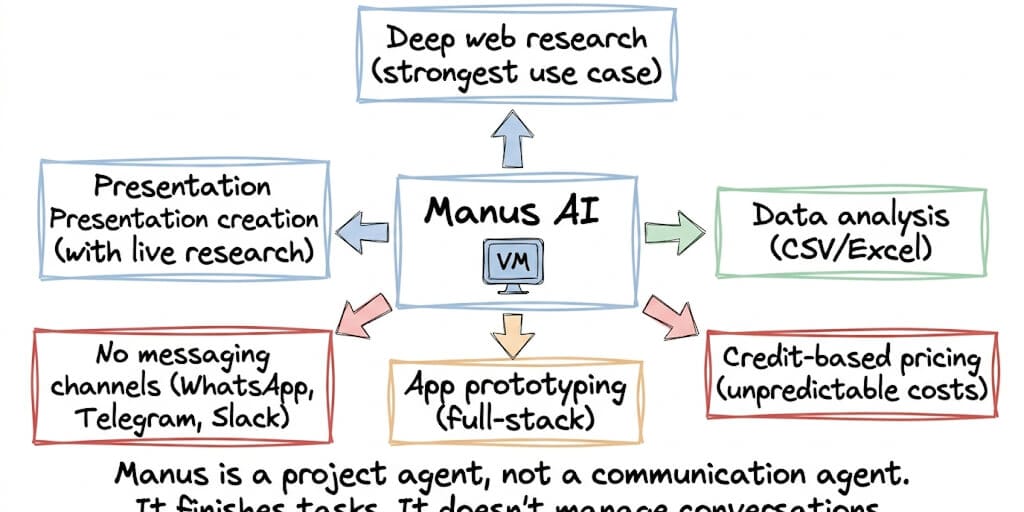
| Deep web research with citations | Its strongest use case: digs past the top links and cites sources. Check the output | None for non-technical users |
| Data analysis and charts from CSV/Excel | Strong: cleaning, charts and written analysis in one run | Code-first AI agent frameworks if you want to build it yourself |
| Competitive analysis with structured output | Strong: visits many sites and returns a table or spreadsheet | None needed |
| Slides and design | Built in: decks with speaker notes and a design view | None needed |
| Prototypes, MVPs, internal tools | Good for demos; reviewers call app building too buggy for production | Don't ship its code to customers |
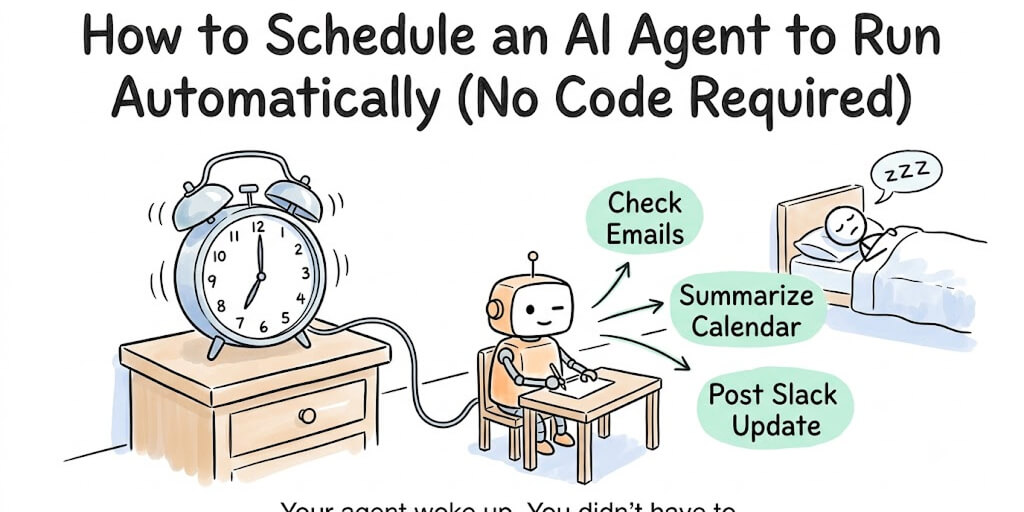
| Recurring reports on a schedule | Improving: scheduled tasks (2 Free, 20 Pro) plus Projects, but credit costs are hard to predict | BetterClaw for always-on scheduled automation |
| Answering customers on Telegram, Slack, Discord | Weak: its chat agents work for you, not your customers; no Discord | BetterClaw or self-hosted OpenClaw |
| Memory that builds up over weeks | Weak: you maintain Projects by hand | BetterClaw (memory across sessions: 7 days Free, 90 days Pro) |
What Manus can do in 2026 (quick overview)
- Agent mode with three model tiers: Manus 1.6 Lite (free), plus Manus 1.6 and 1.6 Max on paid plans. Chat mode for quick questions.
- Wide Research: a parallel multi-agent system for large research and data-processing jobs.
- Slides, design, and web apps: presentation decks with speaker notes, a design view, and a website builder with hosting, databases, payments, and custom domains.
- Data analysis and visualization from uploaded files.
- Scheduled tasks: 2 on Free, 20 on Pro.
- Projects: persistent workspaces with a master instruction and a knowledge base of files that every new task inherits.
- Integrations: MCP connectors (Gmail, Notion, Stripe, HubSpot, Slack, Google Calendar, Google Drive, GitHub and more), custom MCP servers, Zapier, and an API.
- Manus Agents in chat: Telegram (all tiers, since February 2026) and WhatsApp Business, plus
@manusin Slack threads and Mail Manus for email-based tasks. - Browser Operator: a browser extension that lets Manus work inside your own logged-in browser sessions.
Where Manus actually shines (three use cases worth the credits)
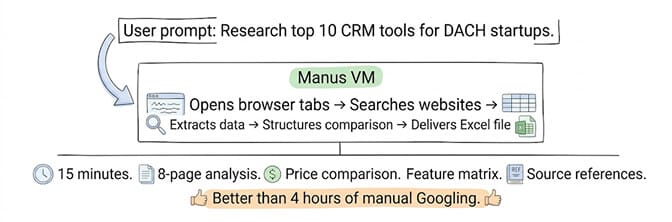
1. Deep web research with citations (the strongest use case)
This is where Manus outperforms everything else. NxCode's review confirmed it: "Research and data analysis are its strongest use cases: Manus excels at deep web research with source citations, outperforming ChatGPT on research depth."
Give Manus a research question. It opens browser tabs. Searches multiple sources. Extracts data. Cross-references findings. Delivers a structured report with citations. One reviewer noted: "It doesn't just look at the top 3 links. It digs deep. The fact that it clearly states the source of information builds trust."
Real example: "Research the top 10 AI agent platforms launched in 2025, compare pricing, and create a spreadsheet." Manus visits 20+ websites, extracts pricing data, creates a comparison table, and delivers a downloadable Excel file. Manual work: 4-6 hours. Manus: 15-20 minutes.
2. Data analysis and visualization (CSV to insight in minutes)
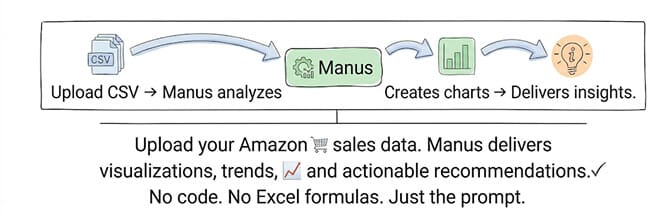
Upload a CSV. Ask a question. Manus analyzes the data, creates visualizations, and delivers insights without you writing a single formula. For solopreneurs and small teams without a data analyst, this replaces hours of manual spreadsheet work.
The strength: Manus handles the entire chain: data cleaning, transformation, visualization, and written analysis in one run. If you'd rather wire this kind of autonomy yourself, our roundup of AI agent frameworks covers the code-first options like CrewAI and LangGraph.
3. Rapid prototyping (apps and websites, not production code)
Manus can build full-stack web apps with authentication, databases, and deployment. One tester built a Flappy Bird game with persistent high scores and user authentication from a single prompt. Another got a complete landing page with animations and responsive design. If what you want is a persistent agent rather than a one-shot build, you can build your own agent without code and keep it running on a schedule instead.
The honest caveat from NxCode: "App building is still too buggy for production. Stick to prototyping and internal tools." The code works. It's not production-ready. Use it for demos, MVPs, and internal tools, not customer-facing products.
For the honest comparison between Manus and OpenClaw-based agents, our comparison page covers the architecture differences in detail. We also dig into Manus vs OpenClaw vs managed agents and how Manus's cloud computer compares to OpenClaw if you want the full picture.
Where Manus falls short (the three limitations that matter)
Limitation 1: Chat access, but it's still a task agent
When we first wrote this post, Manus had no messaging integration at all. That's changed. In February 2026 Manus launched Manus Agents on Telegram for every subscription tier, WhatsApp Business followed, and you can tag @manus in a Slack thread or email tasks to Mail Manus. You can now start a research job from your phone and get the PDF back in the same chat.
What hasn't changed is the shape of the product. Manus in chat is your personal agent: you message it, it runs a task, it replies. It isn't built to sit on your business channels answering other people, and the WhatsApp integration needs a WhatsApp Business account linked to the official Manus agent rather than your own customer-facing number. Discord isn't supported yet.
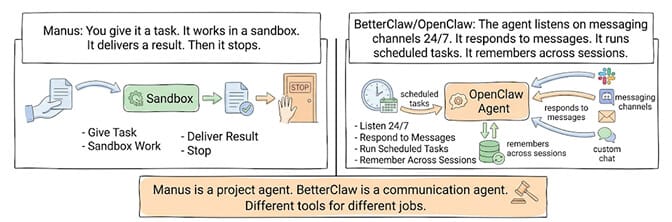
So if what you want is "tell an agent to go do something," Manus now fits wherever you already chat. If what you want is an agent that watches your inbox and channels and responds on your behalf at 3 AM, that's still a different kind of tool.
Limitation 2: Credit-based pricing is unpredictable
Current Manus pricing, per its help center:
| Plan | Price | Credits | Limits |
|---|---|---|---|
| Free | $0 | 300 daily refresh credits (capped at 1,500 a month), usable on Manus 1.6 Lite only | 1 concurrent task, 2 scheduled tasks |
| Pro | From $20/month | 4,000 monthly credits ($40 tier: 8,000; higher tiers available) | 20 concurrent tasks, 20 scheduled tasks, Manus 1.6 / 1.6 Max |
| Team | From $20 per seat/month | Shared team credit pool | Adds SSO and data-training opt-out |
Annual billing takes 17% off. Monthly credits reset each billing cycle; add-on credit packs roll over but only while you have an active paid plan.
Credits are consumed by LLM tokens, virtual machine time, and third-party data APIs, so cost scales with how complex and long a task is. The problem: you don't know exactly how many credits a task will consume until it runs. The Tokyo trip cost 152 credits. A market research task might cost 300. Manus does refund credits for tasks that fail because of a problem on its side, but a task that finishes with the wrong answer still costs you. Multiple reviewers flag this: "Credit usage can feel wasteful, even when tasks fail or require manual fixes."
Compare to BYOK pricing: on BetterClaw, you can bring your own model key and pay the provider directly at published per-token rates (for example, Claude Sonnet 5 at $2 per million input tokens and $10 per million output). You know the per-token cost before you start.
Limitation 3: Context lives in Projects, not in memory
Manus remembers within a task. Across tasks, its answer is Projects: a workspace with a master instruction and a knowledge base of files that every new task inherits. That's useful for repeatable work (a weekly competitor report, a standard research brief). Its chat agents also remember how you like replies formatted.
What we couldn't find documented is an agent that builds up its own long-term memory of your business from conversations over weeks. You maintain the context by editing the project's instructions and files.
If the gap between "task agent you send jobs to" and "always-on agent that manages your messaging, email, and calendar 24/7" is the gap you need filled, BetterClaw handles the always-on communication use case. It's a no-code AI agent platform with Telegram, Slack, Discord and Gmail built in, plus webhooks and 500+ connectors, memory that carries across sessions (7 days on Free, 90 days on Pro), scheduled tasks, and unlimited skills. BYOK, so you can pay model providers directly at published per-token rates. Free plan with 1 agent and 100 credits/month. $49/month for Pro with 5 agents and 12,000 credits/month.
Manus vs BetterClaw: different tools for different jobs
| Manus AI | BetterClaw | |
|---|---|---|
| Category | Task execution agent | Always-on communication agent |
| Best for | Research, data analysis, slides, prototyping | Messaging, email, calendar, 24/7 automation |
| Channels | Web, desktop, mobile, Telegram, WhatsApp Business, Slack, email | Telegram, Slack, Discord, Gmail, plus webhooks and 500+ connectors |
| Memory | Per task, plus Projects (instructions + files) | Carries across sessions (7 days Free, 90 days Pro) |
| Pricing | $0 Free, Pro from $20/month (credit-based) | $0 Free, $19 Starter, $49 Pro (monthly credits, BYOK) |
| Runs when | When you start a task, or on a schedule | 24/7 in the cloud |
| Model choice | Manus 1.6 Lite / 1.6 / 1.6 Max | You choose (28+ providers) |
| BYOK | No | Yes |
Manus isn't the only always-on option any more. Meta and OpenAI shipped their own in September 2026; see Meta Muse vs BetterClaw and OpenAI Dots vs BetterClaw.
The honest recommendation
Here's the take.
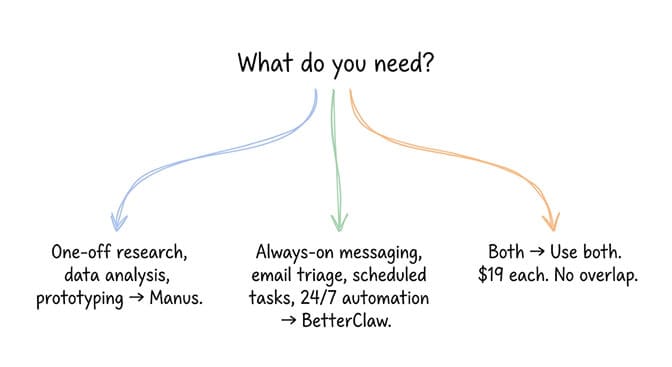
Use Manus for: Research projects that would take you hours of manual Googling. Data analysis on CSVs you don't want to spreadsheet manually. Rapid prototypes and internal tools. Competitive analysis with structured output. These are Manus's genuine strengths and nothing else does them as well for non-technical users.
Don't use Manus for: Production apps (too buggy). Customer-facing communication (its chat agents work for you, not your customers). Long-running context that should build up on its own (Projects need you to maintain them). Anything with unpredictable credit costs you can't afford. For the head-to-head on autonomous task execution, see the reactive vs autonomous section of Manus vs OpenClaw vs managed agents.
Use BetterClaw for: The always-on agent that responds to Telegram messages at 3 AM, triages email in Gmail, posts daily briefings to Slack, and remembers what you told it last month. The communication layer that Manus isn't built for.
The overlap is small. Manus does tasks, now from your chat apps too. BetterClaw does ongoing conversations and automation. You can run both, Manus Pro from $20/month alongside BetterClaw Pro at $49/month, and cover both use cases for about $69 without either tool competing with the other.
If the always-on messaging agent is what you need, give BetterClaw a try. Free tier with 1 agent and 100 credits a month. $49/month for Pro with 5 agents and 12,000 credits a month. Telegram, Slack, Discord and Gmail, plus webhooks and 500+ connectors. Memory across sessions. BYOK inference at your provider's rates. The agent keeps running between tasks.
Frequently Asked Questions
What is Manus AI good for?
Manus AI excels at three things: deep web research with source citations (its strongest use case), data analysis and visualization from CSV/Excel files, and rapid app/website prototyping. It works autonomously in a cloud sandbox, browsing the web, writing code, and delivering finished results. It also builds slides and web apps, runs scheduled tasks, and can be reached from Telegram, WhatsApp Business, and Slack. It's best for discrete tasks you hand off, not for answering your customers or ongoing automation.
How does Manus AI compare to BetterClaw?
Different categories. Manus is a task execution agent (research, data analysis, slides, prototyping) that you use from its apps or from Telegram, WhatsApp Business, and Slack. BetterClaw is a no-code AI agent platform for always-on communication agents (messaging, email, calendar, 24/7 automation) on Telegram, Slack, Discord and Gmail, plus webhooks and 500+ connectors. Manus works for you on request; BetterClaw agents also respond and act on their own. BetterClaw has no research sandbox. Many users run both.
How much does Manus AI cost?
Manus Free is $0 with 300 daily refresh credits (up to 1,500 a month) on Manus 1.6 Lite. Pro starts at $20/month for 4,000 monthly credits, with a $40 tier at 8,000 credits and higher tiers above that. Team starts at $20 per seat per month. Annual billing saves 17%. Credits scale with task complexity, so costs are hard to predict: a trip planning task used 152 credits. BetterClaw has a $0 Free plan (1 agent, 100 credits), Starter at $19/month, and Pro at $49/month (5 agents, 12,000 credits), with BYOK so you can pay model providers directly at known per-token rates.
Can Manus AI respond to WhatsApp or Telegram messages?
Partly. Since February 2026 you can chat with your own Manus agent on Telegram (all plans), and it's also available on WhatsApp Business and in Slack threads. It runs tasks you send it and replies with results. It isn't designed to answer your customers on your own channels, and Discord isn't supported. For always-on agents that respond on your behalf, use BetterClaw (Telegram, Slack, Discord and Gmail; WhatsApp isn't available on BetterClaw yet; $0 free plan) or self-hosted OpenClaw.
Is Manus AI reliable enough for business use?
For research and data analysis: yes, with verification. Multiple reviewers confirm strong research output with citations. For app development: prototyping only, not production. For recurring automation: improving, with scheduled tasks and Projects, but credit costs are hard to predict and context has to be maintained by hand. Till Freitag's assessment: "Not a replacement for well-designed automation workflows."