If the new plan does not fit, these tools do the same job. Every price and licence below was checked on the vendor's own page on 10 November 2026.
| If you want | Use |
|---|---|
| An editor that feels like Cursor | VS Code with Copilot Pro ($10 a month) |
| The strongest Claude agent per dollar | Claude Code on Claude Pro ($20 a month) |
| Free and open source, any model | OpenCode or Cline with your own key |
| Local models only | OpenCode, Cline or Zed pointed at Ollama |
Picture this: you open Cursor on a Monday, pick Claude like you always do, and a notification asks you to top up credit before the agent will run.
Wait. I already pay for this.
You do. But on the new plan, what you pay for is Grok and Composer. Claude is now metered separately, at the same price you'd pay Anthropic directly.
Cursor alternatives at a glance: six that still run Claude and GPT
We checked each tool's pricing page, licence and model list on 10 November 2026. Here are the six we'd shortlist, with the rest covered further down.
| Tool | Type | Claude and GPT | Price | Own key | Best for |
|---|---|---|---|---|---|
| Claude Code | Terminal agent, IDE extension | Claude only | In Claude Pro, $20 a month | Yes, Anthropic key | Long agent runs on Claude |
| Codex CLI | Terminal agent, IDE extension | GPT only, plus local | In ChatGPT Plus, $20 a month | Yes, OpenAI key | GPT-6.1 Sol on a flat plan |
| OpenCode | Terminal agent, MIT | Both | $0 plus your model; Go from $10 | Yes | One tool, any model |
| VS Code + Copilot | Editor and extension | Both | Pro $10 a month | Credits, not keys | Closest to the Cursor feel |
| Zed | Editor, GPL | Both | $0 with your keys; Pro $10 | Yes | A fast editor plus external agents |
| Cline | VS Code extension, Apache-2.0 | Both | $0 plus your model | Yes | An open agent that asks first |
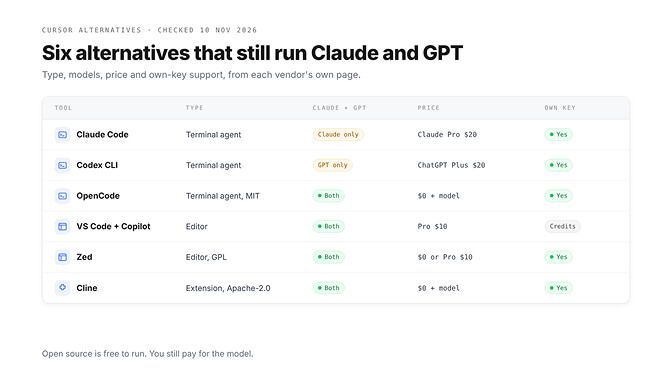
Two things jump out. Four of the six are open source, but that only removes the tool's price, not the model's. And the one flat-rate way to run Claude all day, Claude Code on a Claude plan, isn't an editor at all.
What changed at Cursor, and should you stay?
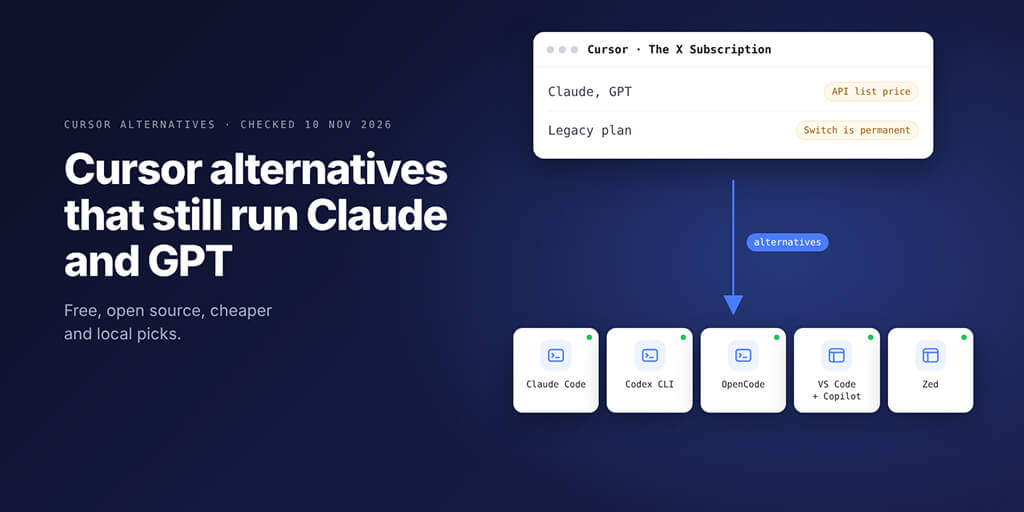
Cursor is now sold as part of The X Subscription, one plan for Grok, Cursor and X. The tiers are Plus at $8, Premium at $30, Super at $100 and Ultra at $200 a month.
Every paid tier gets one weekly pool for Cursor's own models (Grok 4.7, 4.6, 4.5 and Composer 2.5), shared with the Grok apps. Third-party models are not in that pool. On Premium and above, Claude, GPT and Gemini bill at API list price from your prepaid credit, from the first request. Plus is Grok-only: Cursor's own Grok and Composer models, no third-party models and no own API keys.
If you subscribed before the change, you're on a legacy plan, and it keeps working. Cursor's own docs say switching to The X Subscription is optional and permanent, and its help centre adds that Support can't undo it.
Legacy Pro vs X Premium, in published numbers
| Legacy Pro | X Premium | |
|---|---|---|
| Price | $20 a month | $30 a month |
| Usage on Cursor models | Monthly pool | At least 2x legacy Pro, weekly |
| Claude and GPT | Included, through the Other Models pool | Not included; API list price |
| Extra usage | On-demand, billed monthly | Prepaid top-ups |
| Grok and X benefits | No | Yes |
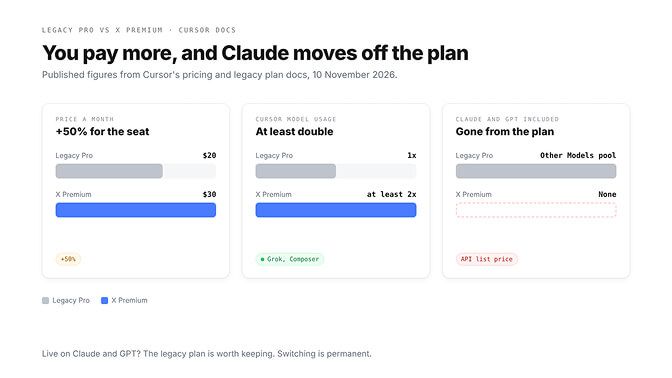
Cursor calls Premium the "comparable" tier for legacy Pro, and says each new tier includes at least twice the usage of Cursor models. That's true, and beside the point if you mostly ran Claude.
One user who ran their normal work on both reported roughly 60% less usage on Premium for the 50% higher price.
So what does Claude cost on Premium now? Here's a calculated example from Anthropic's list prices on 10 November 2026, which Cursor charges with no markup.
| Workload: 40 agent requests a day, 5 days a week; each request 50,000 cached input tokens, 10,000 new input tokens, 2,000 output | Claude Opus 5.5 | Claude Sonnet 5.5 |
|---|---|---|
| Per day | $4.00 | $2.00 |
| Per week | $20 | $10 |
| Per month (4.33 weeks) | about $87 | about $43 |
| Plus the $30 Premium seat | about $117 | about $73 |
The working: new input billed as cache writes ($5 per million on Opus 5.5, $2.50 on Sonnet 5.5), cache reads at $0.20 and $0.10, output at $20 and $10.
If you live on Claude and you're still on legacy Pro, don't click Unify. You can't undo it, and the plan you'd give up is the one that still includes Claude.
There's one more way to stay. On Premium, Super, Ultra and the legacy individual plans, Cursor's help centre says requests on your own Anthropic or OpenAI key don't draw from included usage or prepaid credit. Two catches: Tab completion still runs on Cursor's models, and Cursor's Zero Data Retention policy doesn't cover your own keys.
If something broke after the change, such as the agent defaulting to Grok or Claude missing from the picker, our guide to Cursor AI errors after the plan change covers each fix.
Terminal agents: Claude Code, Codex CLI, OpenCode, Pi and Hermes
These are the Cursor alternatives that skip the editor. You keep your own editor, and the agent works on the repo from a terminal or an IDE panel.
Claude Code
Claude Code is included in every paid Claude plan, starting with Pro at $20 a month ($17 billed annually). It runs in the terminal and as an extension for VS Code, Cursor and JetBrains IDEs, and it shares one usage pool with your Claude chats.
It runs Claude models only. If ANTHROPIC_API_KEY is set in your shell, Claude Code bills that key instead of your plan, which surprises people in both directions.
Codex CLI
Codex CLI is OpenAI's open-source agent (Apache-2.0), at version 0.167.0 on npm. It's included with ChatGPT Plus at $20 a month, in the CLI, the IDE extension, on the web and on iOS, and Pro starts at $100.
OpenAI's estimate for Plus is 15 to 160 local messages per five hours on GPT-6.1 Sol. Codex runs OpenAI models, plus local ones through its built-in ollama and lmstudio providers. For the head-to-head on limits, read our Codex vs Claude Code comparison.
OpenCode
OpenCode is the open-source pick that runs both vendors. It's MIT-licensed, the V2 line is at 2.2.6 on npm, and you pay only your model provider.
Since v2.2.3 you can pick Claude Agent in /connect to use your Claude Code login, and you can sign in with ChatGPT Plus or Pro instead of an OpenAI key. Note that V2 reads AGENTS.md only, not CLAUDE.md.
Pi
Pi is a small, MIT-licensed terminal agent from Earendil, at 1.5.1 on npm. It connects 15+ providers, including Anthropic, OpenAI and Ollama, through API keys or a /login subscription sign-in.
Read the README before you run it. Pi has no built-in permission system and runs with your user's full permissions, so its own docs suggest a container or sandbox.
Hermes Agent
Hermes Agent is a general agent with memory, schedules and a chat-app gateway, not an editor. It's MIT-licensed, v0.23.1 shipped on 9 November, and it connects Anthropic, OpenAI sign-in, OpenRouter and local models.
It can code through its terminal tool, but it does better handing coding to OpenCode through its optional skill. Our Hermes, Pi and OpenCode comparison covers how the three split the work.
Editor Cursor alternatives: Copilot, Cline, Zed, Devin Desktop and Antigravity
If you want an editor with completions in it, these are your options. Two names from older lists have changed, so check before you install.
VS Code with Copilot
Cursor is a fork of VS Code, so going back to VS Code is the shortest move. Copilot Pro is $10 a month, Pro+ $39 and Max $100, and GitHub's model list includes Claude Opus 5.5, Claude Sonnet 5.5 and GPT-6.1 Sol.
Chat and agent work spend GitHub AI Credits. Code completions and next edit suggestions don't, and they're unlimited on every paid plan, which is the nearest thing to Cursor Tab here.
VS Code with Cline (and why not Roo Code)
Cline is an open-source extension (Apache-2.0), free for individuals. You bring keys for Anthropic, OpenAI, OpenRouter and others, or run Ollama and LM Studio locally. Plan mode explores first, Act mode executes, and every edit and command waits for your approval unless you turn on auto-approve.
Skip Roo Code for new setups. Its GitHub repository was archived on 15 May 2026, and the last release is v3.54.0. The team now builds Roomote, a cloud agent.
Zed
Zed is a fast, open-source editor (GPL-3.0-or-later). The Personal plan is $0 with your own keys or external agents, and Claude Agent, Codex and OpenCode install from its agent registry. Pro is $10 a month with $5 of hosted tokens, then API list price plus 10%.
It connects to Anthropic, OpenAI, OpenRouter, Ollama and LM Studio directly. It even ships a Cursor base keymap.
Devin Desktop (formerly Windsurf)
Windsurf is now called Devin Desktop, and windsurf.com redirects to it. Plans and pricing carried over: $0 with a light quota and unlimited Tab, Pro at $20 a month with OpenAI, Claude and Gemini models, and Max at $200.
Antigravity
Google's Antigravity has a $0 individual plan with unlimited Tab completions. But read the model table: Claude Sonnet 5.5 and Opus 5.5 need a paid Google AI Pro plan or higher, the Claude 4.6 models on the $0 plan are due to be removed on 18 November 2026, and the only GPT model is GPT-OSS 120B.
Free and open source Cursor alternatives
Free to run and free as in source are different things. Here's the split.
| Open source (licence) | Free to use, closed source |
|---|---|
| OpenCode (MIT), Pi (MIT), Hermes Agent (MIT) | Antigravity ($0 individual plan) |
| Codex CLI (Apache-2.0), Cline (Apache-2.0) | Copilot Free (2,000 inline suggestions a month) |
| Zed (GPL-3.0-or-later) | Devin Desktop ($0 with a light quota) |
Our pick for free: Cline in VS Code if you want an editor, OpenCode if you live in the terminal. Both cost $0 and both run Claude and GPT on your own key, so the bill is whatever your provider charges.
If what pushed you out was a usage cap rather than a price, our guide to Claude Code and ChatGPT rate limit alternatives covers the other exits.
Cursor alternatives for local LLMs
Five of these tools talk to local models without a plugin:
- OpenCode finds Ollama at
127.0.0.1:11434, plus LM Studio and vLLM, on its own. - Codex CLI has built-in
ollamaandlmstudioproviders. - Cline lists Ollama and LM Studio as providers.
- Zed takes Ollama and LM Studio as providers.
- Pi lists Ollama among its providers.
The catch is the model, not the tool. A coding agent lives on tool calls, and plenty of local models fumble them. Check yours against our list of Ollama models that support tool calling before you blame the agent.
Cheaper Cursor alternatives: the bring-your-own-key route
The cheapest setup depends on whether you want one vendor or many.
One vendor: Claude Pro at $20 includes Claude Code, and ChatGPT Plus at $20 includes Codex. Either costs less than X Premium at $30 before a single Claude token is billed. The trade is limits: both meter you in five-hour windows with weekly limits on top, and neither publishes a token count.
Many vendors: pay per token. OpenCode Go is $10 a month for a set of open coding models plus Claude Haiku 5.5 and GPT-6 Luna, and OpenRouter or direct API keys charge per token with no plan at all. We compare what $10 buys on each in OpenCode Go vs OpenRouter vs the DeepSeek API.
Whichever you pick, set a spending cap on the provider side. A per-token bill has no weekly reset to save you from a looping agent.
The cheapest Cursor alternative is a flat plan for the model you use most, plus a capped key for everything else.
That's also how we price BetterClaw: you bring your own key across 28+ providers, and we add zero markup on the model. Plans start from $19 a month, and your first workspace starts with a 7-day free trial. See BetterClaw plans
Migrating out of Cursor: rules, keybindings and what you lose
Most of a Cursor setup moves in an afternoon. Here's the order we'd do it in.
- Move the
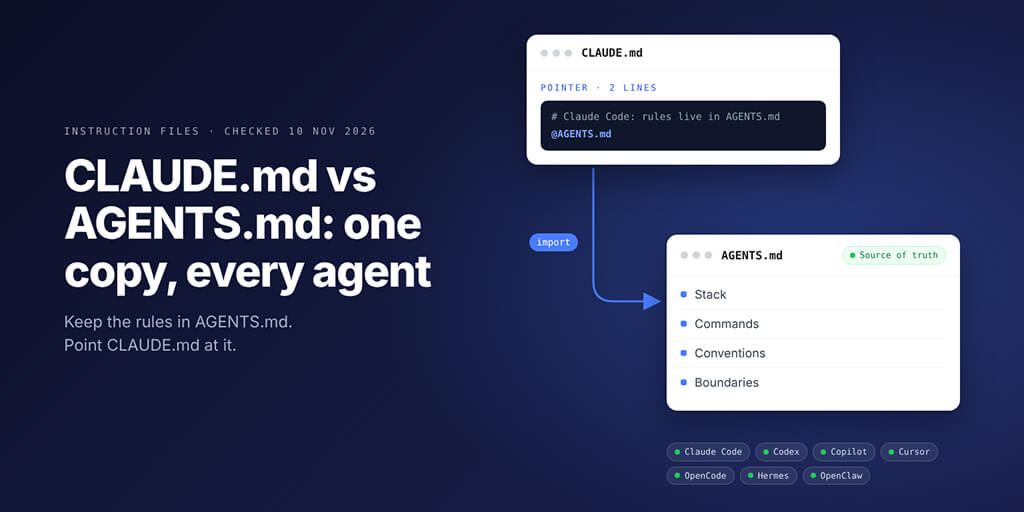
.mdcproject rules from Cursor's rules folder into one AGENTS.md. Cursor's help centre already calls.cursorruleslegacy. - Point CLAUDE.md at AGENTS.md if you'll use Claude Code; our CLAUDE.md vs AGENTS.md guide shows the two-line file.
- Pick your keymap: Zed ships a Cursor base keymap, and VS Code is the editor Cursor was forked from.
- Re-add MCP servers in the new tool's config.
- Cancel billing in the right place: cursor.com/dashboard/billing for legacy plans, grok.com/dashboard/billing for The X Subscription.
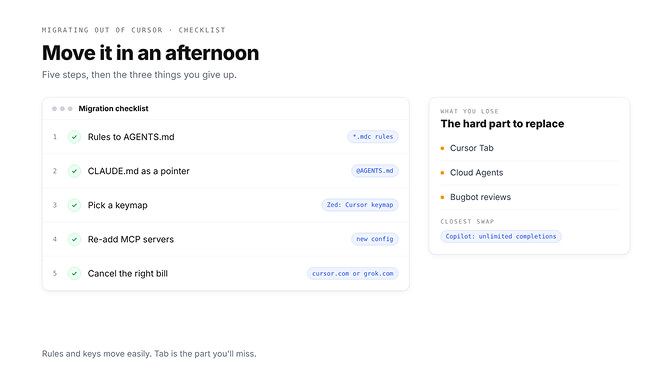
What you lose is real. Cursor Tab is the hardest thing to replace; Copilot's unlimited completions come closest, and the terminal agents have none. You also give up Cursor's Cloud Agents, Automations and Bugbot reviews, which sit on Premium and above anyway.
Always-on agents instead of an editor
Some of what people did in Cursor was never editing. It was "summarise yesterday's PRs", "check the error log at 8" or "draft the release notes". That work doesn't need an editor open.
BetterClaw is one option for that half. It runs managed, always-on agents with 500+ connectors, your own key across 28+ providers at zero markup, and Telegram on Pro and above. It's ISO 27001 certified, with a SOC 2 Type II audit in progress.
Be clear on its limits for coding. BetterClaw is not an IDE and has no tab completion. It doesn't edit your repo in a live loop the way Claude Code or OpenCode do, and it doesn't give each task its own cloud computer. Keep a coding agent for the code, and hand BetterClaw the jobs around it.
The editor was never the point
Most people who search for Cursor alternatives aren't leaving an editor. They're leaving a bill that changed shape.
So pay for the model you use most, keep a capped key for the rest, and put it in whichever window you like. The editor is the cheapest part to replace. Your rules, your keys and your judgement on the diff go wherever you go.
Frequently Asked Questions
What is the best free Cursor alternative?
Cline in VS Code if you want an editor, OpenCode if you work in the terminal. Both are open source, cost $0, and run Claude and GPT on your own API key, so you pay only the model provider. Copilot Free adds 2,000 inline suggestions a month if you miss completions.
Is there an open source Cursor alternative?
Yes. OpenCode, Pi and Hermes Agent are MIT-licensed, Codex CLI and Cline are Apache-2.0, and the Zed editor is GPL-3.0-or-later. Roo Code is also open source, but its repository was archived on 15 May 2026, so we wouldn't start a new setup on it.
Which Cursor alternative works with local LLMs?
OpenCode, Codex CLI, Cline, Zed and Pi all connect to Ollama, and most also support LM Studio. OpenCode even discovers a running Ollama server on its own. Pick a local model that handles tool calls well, because a coding agent depends on them.
Can I keep my Cursor legacy plan?
Yes. Legacy plans keep working at the same price until you change or cancel, and you can still move between legacy plans, such as Pro to Pro+. Switching to The X Subscription is permanent, and Cursor's help centre says Support can't undo it.
Is Codex or Claude Code a Cursor alternative?
Yes, if you're happy to keep your own editor. Claude Code comes with Claude Pro at $20 a month and runs Claude models; Codex CLI comes with ChatGPT Plus at $20 a month and runs OpenAI models. Both work in the terminal and as IDE extensions, but neither offers tab completion.
Can I still use Claude in Cursor?
Yes, on Premium and above, billed at API list price from prepaid credit. On Plus, only Cursor's own Grok and Composer models are available. On Premium and above, and on legacy individual plans, you can also add your own Anthropic key, which doesn't draw on included usage.
What happened to Windsurf and Roo Code?
Windsurf is now Devin Desktop, and existing plans and pricing carried over. Roo Code's GitHub repository was archived on 15 May 2026 after its last release, v3.54.0, and its team now builds a cloud agent called Roomote.