On April 30, Manus launched a persistent cloud VM where your AI agent lives 24/7. It hosts bots, runs scrapers, and keeps databases. This is Manus's direct answer to OpenClaw. Here's how the two compare.
Until two weeks ago, Manus had one fundamental limitation: the agent only existed while a session was open. You gave it a task. It worked in a temporary sandbox. It delivered the result. The sandbox disappeared. Tomorrow, the agent had no memory of today.
That changed on April 30, 2026.
Manus launched Cloud Computer: a persistent Ubuntu VM in the cloud where your AI agent lives full-time. It never shuts down. Your bots stay online. Your databases persist. Your scrapers run on schedule. The files your agent creates today are still there next month.
AI Automation Global called it "the first mainstream consumer product that gives an agent a permanent home." That's not wrong. And it puts Manus in direct competition with OpenClaw for the first time.
Here's what Cloud Computer actually is, how the architecture works, and where each tool wins.
What Manus Cloud Computer actually is (the technical picture)
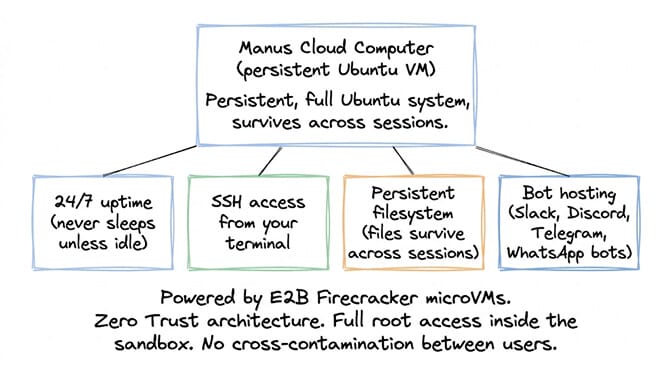
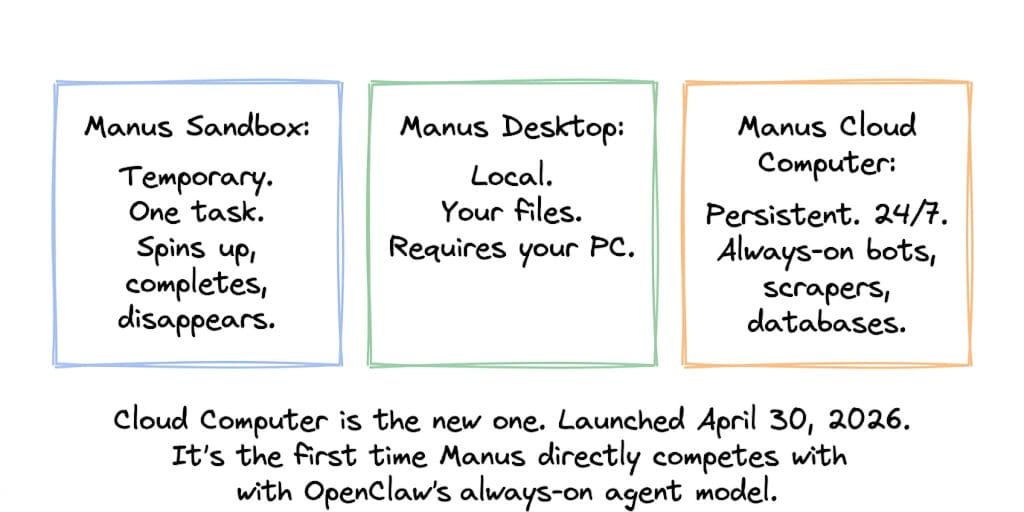
Cloud Computer is a persistent Ubuntu virtual machine that runs in Manus's infrastructure (powered by E2B's Firecracker microVMs, originally developed by AWS). It's the third execution environment in the Manus stack:
Sandbox (original): Temporary. Spins up per task. Disappears when complete. Good for one-off research and prototyping.
Desktop: Controls your local machine. Reads and writes your local files. Requires your PC to be on.
Cloud Computer (new): Persistent. Runs 24/7. Full Ubuntu with networking, filesystem, browser, and software tools. SSH accessible. Three tiers: Basic (simple scripts), Standard (websites and APIs), Advanced (team databases).
The key difference from the sandbox: The sandbox recycles after 7 days (free) or 21 days (Pro) of inactivity. Cloud Computer doesn't. It stays on. Your bot keeps responding to Discord messages while you sleep. Your scraper runs at 4 AM without your laptop being open.
What you can actually do with it (five real use cases)
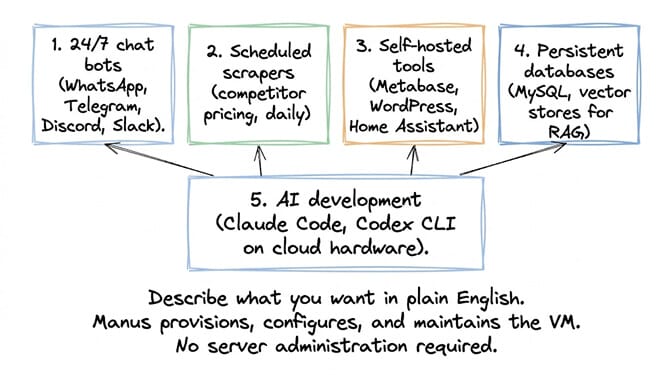
- Always-on chat bots. Host a Telegram or Discord bot that responds to messages around the clock. Manus keeps the websocket connection alive and persists conversation state.
- Scheduled scrapers. "Check competitor website for pricing changes every morning at 4 AM. Save results to a spreadsheet." The scraper runs on Cloud Computer's cron. No laptop needed.
- Self-hosted tools. WordPress for a blog. Metabase for dashboards. Plausible for analytics. Manus installs and configures them. You get a URL.
- Persistent databases. MySQL or vector stores that accumulate data across months. The foundation for any RAG system that needs to grow over time.
- AI development tools. Run Claude Code or Codex CLI on cloud hardware. Code without tying up your local machine.
For more on where the platform shines beyond these, our Manus AI use cases roundup covers the broader task categories Manus handles well.
For the complete comparison between Manus and OpenClaw, our comparison page covers the architectural differences in detail.
How Cloud Computer compares to OpenClaw (the honest assessment)
Here's where it gets interesting.
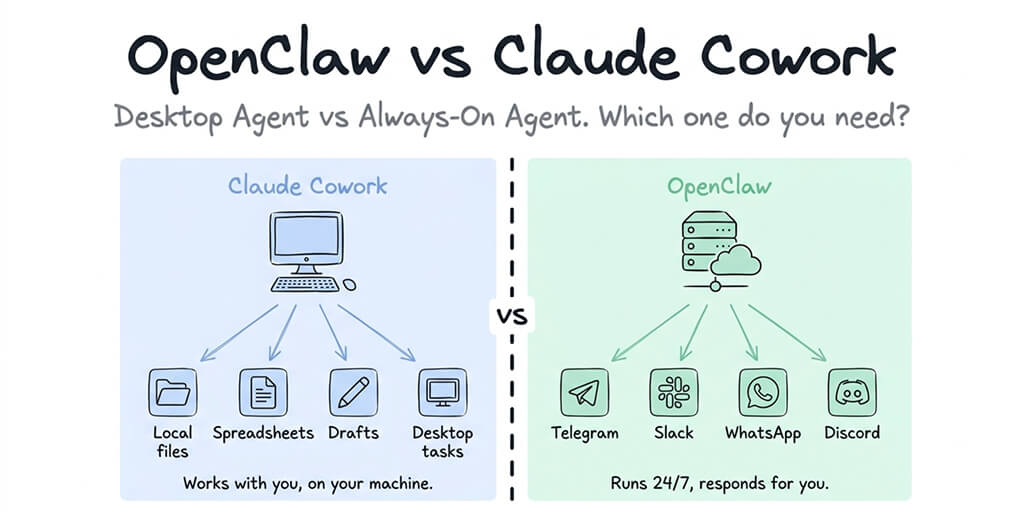
Before Cloud Computer, Manus and OpenClaw weren't competitors. Manus was a project agent (temporary tasks). OpenClaw was an always-on agent (persistent messaging). Different categories.
After Cloud Computer, they overlap significantly. Both can host 24/7 bots. Both can run scheduled tasks. Both persist data across sessions. The category distinction is gone. (For the broader three-way picture, our Manus vs OpenClaw vs managed platforms comparison maps out all three operating models.)
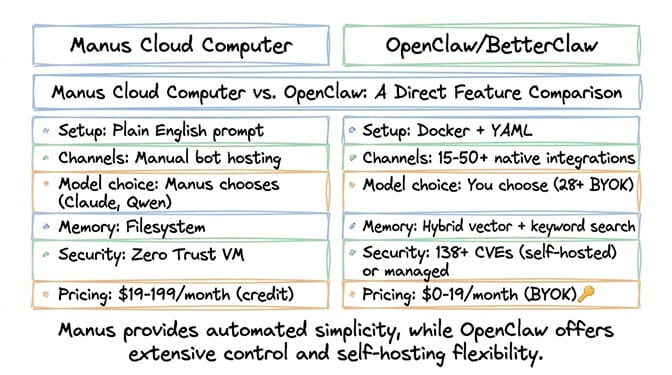
Where Manus Cloud Computer wins:
Zero setup. Describe what you want. Manus provisions the VM. No Docker. No YAML. No SSH (unless you want it). OpenClaw requires Docker, CLI, configuration files. BetterClaw, an AI agent builder with nothing to install, requires an account and 60 seconds.
Full VM access. SSH, root, install anything. OpenClaw runs in a more constrained agent runtime. Cloud Computer is a real Ubuntu machine.
Self-hosting any tool. WordPress, Metabase, custom Python services. OpenClaw is an agent framework, not a general-purpose server.
Where OpenClaw and BetterClaw win:
Native messaging integrations. OpenClaw natively connects to 50+ channels. BetterClaw connects to Telegram, Slack, Discord and Gmail with 1-click setup, plus webhooks and 500+ connectors. Manus Cloud Computer requires you to manually host a bot and manage the websocket connection yourself.
Model choice (BYOK). On OpenClaw or BetterClaw, you choose your model from 28+ providers and pay providers directly. On Manus, you pick a Manus tier (1.6 Lite, 1.6 or 1.6 Max) rather than the underlying model, and you pay via credits. No BYOK.
Persistent agent memory. BetterClaw has hybrid vector + keyword search memory that gets smarter over time. Manus Cloud Computer has filesystem persistence but no dedicated agent memory system with semantic search.
Verified skills marketplace. OpenClaw has ClawHub (1,400+ malicious skills notwithstanding). BetterClaw has a verified marketplace where every skill is tested. Manus has no skill marketplace. You write code or describe what you want.
Cost transparency. BetterClaw: $0 (free tier) or $49/month (Pro) for a fixed monthly credit allowance that resets, plus your model API costs at known per-token rates. Manus: Free, Pro from $20/month or Team from $20 per seat, with credits consumed by model tokens, VM time and data APIs, so you don't know a task's cost until it runs. A task that uses 152 credits one day might use 300 the next.
If you want always-on messaging agents with native channel integrations, BYOK model choice, persistent semantic memory, and verified skills without managing a VM yourself, BetterClaw provides the managed agent platform that Manus Cloud Computer doesn't quite replace. Native Telegram, Slack, Discord and Gmail support, plus webhooks and 500+ connectors. Hybrid memory. 28+ model providers. Free tier with 1 agent and 100 credits a month. $49/month for Pro with 5 agents and 12,000 credits a month.
The bigger picture (what Cloud Computer signals about 2026)
Here's the honest take.
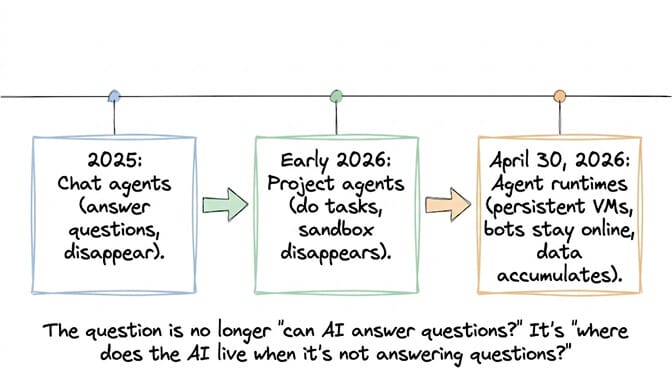
"2025 was the year of the chat agent. 2026 is the year of the agent runtime." AI Automation Global nailed this observation. The question is no longer "can AI answer questions?" It's "where does the AI live when it's not answering questions?"
Manus says: on a persistent VM we manage for you. OpenClaw says: on your infrastructure. BetterClaw says: on our managed cloud.
The convergence is happening. Manus added always-on capability (Cloud Computer). OpenClaw added project execution (TaskFlows). Hermes added durable task completion (Kanban). The tools are growing toward each other. (If your real question is whether OpenClaw can handle fire-and-forget autonomous work the way Manus does, the reactive vs autonomous section of our Manus vs OpenClaw vs managed agents comparison digs into exactly that.) The question is which one does your specific use case best, not which one is "better" in the abstract.
Manus isn't the only one giving agents a permanent home. OpenAI Dots is the same idea, inside ChatGPT. It launched at OpenAI DevDay on 29 September 2026: always-on agents inside ChatGPT, where each Dot gets its own cloud computer and browser (which you can watch at any time), keeps working on goals between conversations, and learns from your feedback. It's the Cloud Computer idea with a ChatGPT front end.
The trade-offs look familiar. OpenAI Dots runs on one model, GPT-6 Astra, with no announced way to pick another. One Dot is included with ChatGPT Pro (from $100 a month) or Business Premium, not with Plus, and Pro users in the UK, EEA and Switzerland are excluded at launch. Our OpenAI Dots vs BetterClaw comparison covers pricing, access and limits in full.
For most people who need always-on messaging agents with model flexibility and native integrations, BetterClaw or OpenClaw is still the better fit. For people who need a full VM with root access to host arbitrary services, Manus Cloud Computer offers something neither OpenClaw nor BetterClaw provides.
If your primary need is an always-on agent on messaging channels with persistent memory and verified skills, give BetterClaw a try. Free tier with 1 agent and 100 credits a month. $49/month for Pro. The agent handles conversations. The infrastructure is managed. No VM required.
Frequently Asked Questions
What is Manus Cloud Computer?
Manus Cloud Computer is a persistent Ubuntu virtual machine launched April 30, 2026 that runs 24/7 on Manus's infrastructure. Unlike the temporary sandbox (which disappears after each task), Cloud Computer stays on permanently. It hosts bots, runs scheduled scrapers, persists databases, and allows SSH access. Powered by E2B Firecracker microVMs. Available in Basic, Standard, and Advanced tiers.
How does Manus Cloud Computer compare to OpenClaw?
Both can run 24/7 agents and scheduled tasks. Key differences: Manus Cloud Computer offers zero-setup VM provisioning and full root access. OpenClaw and BetterClaw offer native messaging integrations (15-50+ channels), BYOK model choice (28+ providers), and semantic agent memory. Manus uses credit-based pricing (Free, Pro from $20/month, Team from $20 per seat). BetterClaw uses flat pricing ($0 free or $49/month Pro) with a fixed monthly credit allowance, plus your API costs.
Can Manus Cloud Computer host bots like OpenClaw does?
Yes, but differently. Manus Cloud Computer can run any bot you deploy on the VM (Telegram, Discord, Slack, WhatsApp). However, you manage the bot code and websocket connections yourself. OpenClaw and BetterClaw provide native messaging integrations where you paste a bot token and the platform handles the connection. Manus gives you a server. BetterClaw gives you a connected agent.
How much does Manus Cloud Computer cost?
Manus's current plans are Free ($0, Manus 1.6 Lite only), Pro from $20/month (4,000 monthly credits) and Team from $20 per seat a month. Usage is billed in credits, which are consumed by model tokens, VM time and data APIs, so costs are hard to predict in advance. For comparison, BetterClaw offers a free tier with 1 agent and 100 credits a month, or $49/month for Pro with 5 agents and 12,000 credits a month. Credits are a fixed monthly allowance that resets rather than a per-action burn, and inference is BYOK, so you pay model providers directly at known per-token rates.
Is Manus Cloud Computer secure for business data?
Manus uses Zero Trust architecture. Each VM is fully isolated. Operations inside one sandbox can't affect others or access user account data. However, Manus is now owned by Meta (acquired December 2025 for $2B+), and Manus is not SOC 2 or GDPR certified. For businesses with strict data governance requirements, BetterClaw's AES-256 encryption, secrets auto-purge, and workspace isolation may be more appropriate.