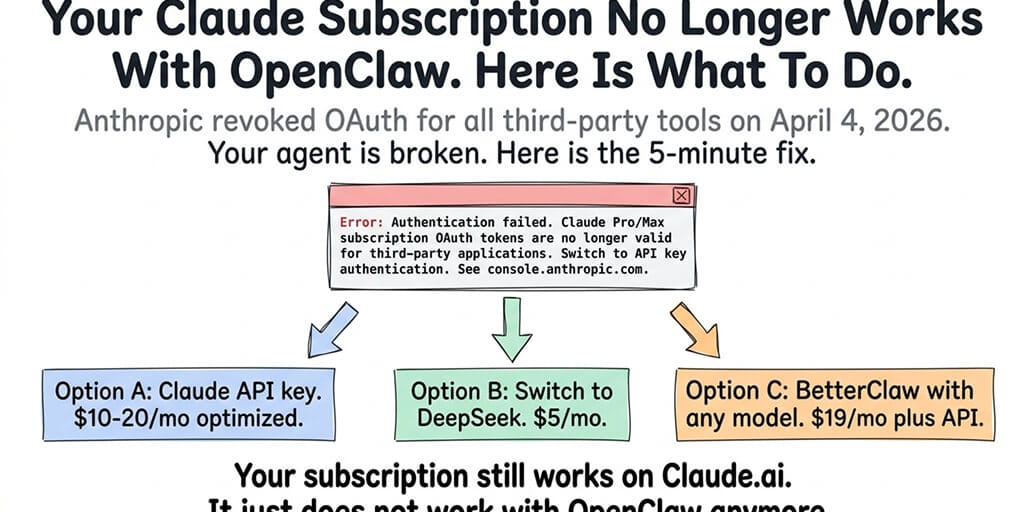
Anthropic revoked OAuth for all third-party tools on April 4, 2026, and a lot of agents broke overnight. Here's the 5-minute fix and three options for what comes next.
If your OpenClaw agent stopped responding that day, you weren't alone. Claude Pro and Max subscriptions stopped working with OpenClaw on April 4, 2026 at 12pm PT.
It wasn't a bug. Anthropic revoked OAuth authentication for every third-party application. OpenClaw, NanoClaw, OpenCode, and every other tool that used your Claude subscription credentials lost access simultaneously, while the subscription kept working on Claude.ai, Claude Code, and Claude Cowork. It also wasn't permanent: Anthropic reversed the ban on May 13 and paused its replacement credit plan on June 15 (see the update above). But subscription terms for third-party tools keep moving, which is why the API key route below is still the one to rely on.
Here's the immediate fix, followed by three options for keeping your agent running long-term.
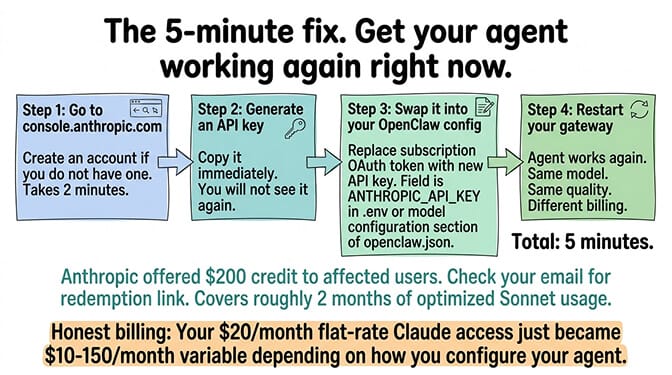
The 5-minute fix (get your agent working again right now)
Step 1: Go to console.anthropic.com. Create an account if you don't have one.
Step 2: Generate an API key. Copy it.
Step 3: Open your OpenClaw config. Replace your subscription OAuth token with the new API key. The field is typically ANTHROPIC_API_KEY in your .env file or the model configuration section of openclaw.json.
Step 4: Restart your gateway.
Your agent works again. Same model. Same quality. Different billing. You're now on per-token API pricing instead of your flat-rate subscription.
Anthropic offered a $200 credit to affected users at the time. That credit covers roughly 2 months of moderate Sonnet usage with optimization, or about 3 weeks without optimization.
The API key fix takes 5 minutes. The billing change takes longer to accept. Your $20/month flat-rate Claude access just became $10-150/month variable depending on how you configure your agent.
What this actually costs you now (the math nobody wants to hear)
Here's what nobody tells you about the subscription-to-API transition.
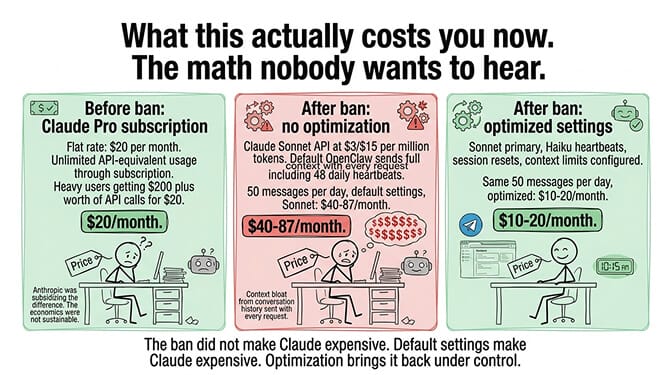
Before the ban: Claude Pro at $20/month covered unlimited API-equivalent usage through your subscription. Heavy users were getting $200+ worth of API calls for $20. Anthropic was subsidizing the difference.
After the ban: Claude Sonnet costs $3 per million input tokens and $15 per million output tokens. Claude Haiku costs $1/$5. Claude Opus (4.6 through Opus 5) costs $5/$25. The newer Sonnet 5 costs $2/$10.
What this means for your agent:
A moderate-usage agent (50 messages/day on Sonnet) with default OpenClaw settings costs approximately $40-87/month in API fees. That's because OpenClaw sends the full conversation context with every request, including 48 daily heartbeats.
With optimization (model routing, session resets, context limits, heartbeat routing to Haiku), the same agent costs $10-20/month.
The difference between $87/month and $10/month is configuration, not usage. For the complete list of cost optimization settings, our API cost reduction guide covers how to configure each one.
Option A: Stay on Claude with API billing ($10-20/month optimized)
Who this is for: Users who prefer Claude's quality and are willing to optimize their configuration to control costs.
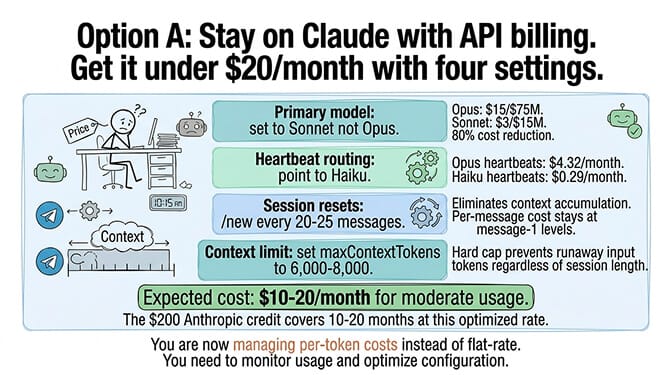
What to do: Use the API key from the 5-minute fix above. Then optimize:
Set your primary model to Sonnet (not Opus). Route heartbeats to Haiku ($0.29/month instead of $1.44/month on Opus). Use /new every 20-25 messages to reset the conversation buffer. Set maxContextTokens to 6,000-8,000.
Expected cost: $10-20/month for moderate usage. The $200 credit covers 10-20 months at this rate.
The trade-off: You're now managing per-token costs instead of paying flat-rate. You need to monitor your usage and optimize your configuration. The $200 credit buys time but eventually runs out.
Option B: Switch to a cheaper model provider ($0-15/month)
Who this is for: Users who care more about cost than sticking with Claude specifically.
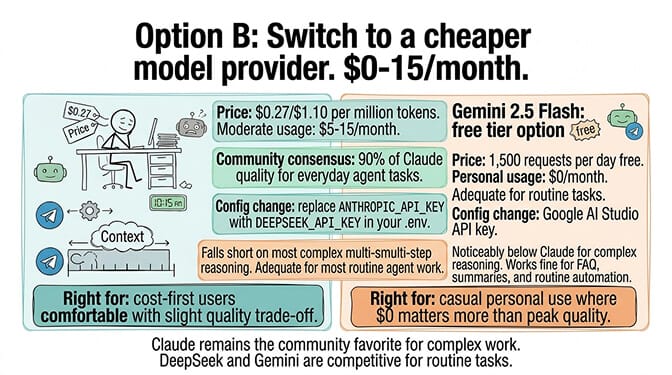
What to do: Replace your Claude API key with a different provider's key in your OpenClaw config.
DeepSeek V3 at $0.27/$1.10 per million tokens. Moderate usage costs $5-15/month. Community consensus: roughly 90% of Claude quality for everyday agent tasks.
Gemini 2.5 Flash with 1,500 free requests/day. Personal usage costs $0/month. Quality is adequate for routine tasks but noticeably below Claude for complex reasoning.
For the ranked comparison of free and budget model alternatives, our cheapest providers guide covers five options with specific quality assessments.
The trade-off: Quality varies by task. Claude remains the community favorite for complex, nuanced work. DeepSeek and Gemini are competitive for routine tasks but fall short on multi-step reasoning and instruction following.
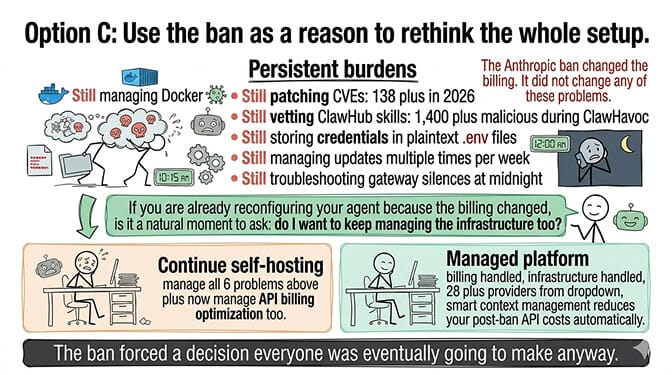
Option C: Use the ban as a reason to rethink the whole setup
Here's where most people get it wrong.
The Anthropic ban changed the billing. It didn't change the other problems. You're still managing Docker. Still patching CVEs (138+ in 2026). Still vetting ClawHub skills (1,400+ malicious during ClawHavoc). Still storing credentials in plaintext .env files.
If you're already reconfiguring your agent because the billing changed, it's a natural moment to ask: do I want to keep managing the infrastructure too?
If managing API keys, model routing, cost optimization, and infrastructure maintenance feels like more reconfiguration than you want, BetterClaw handles all of it. 28+ model providers from a dropdown (Claude API, DeepSeek, Gemini, OpenAI, and more). Smart context management reduces per-request token volume, which directly lowers your post-ban API costs. BYOK with zero inference markup. Free tier with 1 agent. $49/month for Pro. 60-second deploy. The billing change is handled. The infrastructure is handled. You configure the agent, not the server.
Why Anthropic did this (the 30-second version)
Anthropic was losing money. Subscription users were getting API-equivalent workloads at flat-rate pricing. Boris Cherny, Head of Claude Code, explained that subscriptions weren't built for the usage patterns of third-party agent tools. The economics weren't sustainable.
Peter Steinberger (OpenClaw creator, now at OpenAI) was temporarily banned from Claude entirely on April 10. His account was reinstated hours later after the post went viral. He connected the dots publicly: Anthropic copied popular features into their own products (Claude Cowork, Claude Dispatch), then locked out the open-source tools.
The ban didn't last. Anthropic reversed it on May 13, then on June 15 paused the "Agent SDK credit" system it had announced as the replacement. For now, the Agent SDK, claude -p, and third-party tools built on the Agent SDK draw from normal subscription limits, and Anthropic says it is reworking the plan and will give advance notice before a revised version takes effect. The economics that drove the April decision haven't gone away, so plan for the terms to change again.
What to do right now (priority order)
Right now (5 minutes): Get the API key from console.anthropic.com. Swap it into your config. Restart your gateway. Agent works again.
This week: Configure model routing and session management to keep costs under $20/month.
This month: Decide your long-term approach. Stay on Claude API with optimization. Switch to DeepSeek or Gemini for lower costs. Or move to a managed platform that handles the model switching, cost optimization, and infrastructure for you.
The ban forced a decision everyone was eventually going to make anyway. Even with the ban reversed and the credit change paused, Anthropic has said a reworked plan is coming, so flat-rate subscription access for always-on agents isn't something to build on. An API key doesn't depend on how that plays out.
If you want the model decision and the infrastructure decision handled by a platform instead of by your config files, give BetterClaw a try. Free tier with 1 agent and BYOK. $49/month for Pro. For the complete migration guide, our migration page covers what transfers and how. 60-second deploy. 28+ providers. The ban changed the billing. We handle the rest.
Frequently Asked Questions
Why did Anthropic ban Claude subscriptions from OpenClaw?
Anthropic revoked OAuth authentication for all third-party tools on April 4, 2026 because subscription pricing wasn't sustainable for agent-level API workloads. Users paying $20/month were consuming $200+ worth of API calls. Boris Cherny (Head of Claude Code) confirmed subscriptions weren't designed for third-party tool usage patterns. The ban covered OpenClaw, NanoClaw, OpenCode, and every other external application. Anthropic reversed it on May 13, 2026.
Can I still use Claude with OpenClaw after the ban?
Yes. The ban only affected subscription-based OAuth tokens, and Anthropic reversed it on May 13, 2026, then paused its planned "Agent SDK credit" replacement on June 15. The most reliable way to use Claude with OpenClaw is an API key from console.anthropic.com added to your OpenClaw config: per-token pricing ($3/$15 per million tokens for Sonnet), no weekly caps, and no dependence on subscription terms Anthropic says it is still reworking.
How much does OpenClaw cost after the Anthropic ban?
With default settings on Sonnet: $40-87/month in API fees (context bloat from full conversation history sent with every request). With optimization (model routing, session resets, context limits, heartbeat routing to Haiku): $10-20/month. The $200 Anthropic credit covers 10-20 months of optimized usage. The key is optimization, not the model itself.
What's the cheapest way to run OpenClaw after the ban?
Switch to DeepSeek V3 ($0.27/$1.10 per million tokens, roughly $5-15/month for moderate use) or Gemini 2.5 Flash (1,500 free requests/day). Both work with OpenClaw by swapping the API key in your config. Quality is slightly below Claude for complex tasks but adequate for routine agent work. BetterClaw's free tier ($0/month, 1 agent, BYOK with a free model) is the cheapest option with managed hosting.
Is the Anthropic ban permanent?
No. Anthropic updated their terms on February 20, 2026 to explicitly prohibit OAuth in third-party tools, and enforcement followed on April 4. On May 13, Anthropic reversed the ban, announcing that third-party agent use on subscriptions would come back through a separate monthly "Agent SDK credit" (non-rollover, billed at API rates) planned to start June 15. On June 15 it paused that change the day it was due: the Agent SDK, claude -p, and third-party tools built on the Agent SDK continue drawing from normal Pro/Max/Team/Enterprise subscription limits while Anthropic reworks the plan, with advance notice promised before a revised version takes effect. Because the terms may change again, an API key is still the most predictable option for an always-on agent.
Related Reading
- What Is OpenClaw & How Does It Work? — How OpenClaw talks to model providers in the first place
- Is OpenClaw Dead? — Wider context on the project's health
- Cheapest OpenClaw AI Providers — Where to go now, ranked by cost
- OpenClaw Best Free Model — Free options that don't breach anyone's terms
- Model Does Not Support Tools: The Fix — Common snag when switching providers