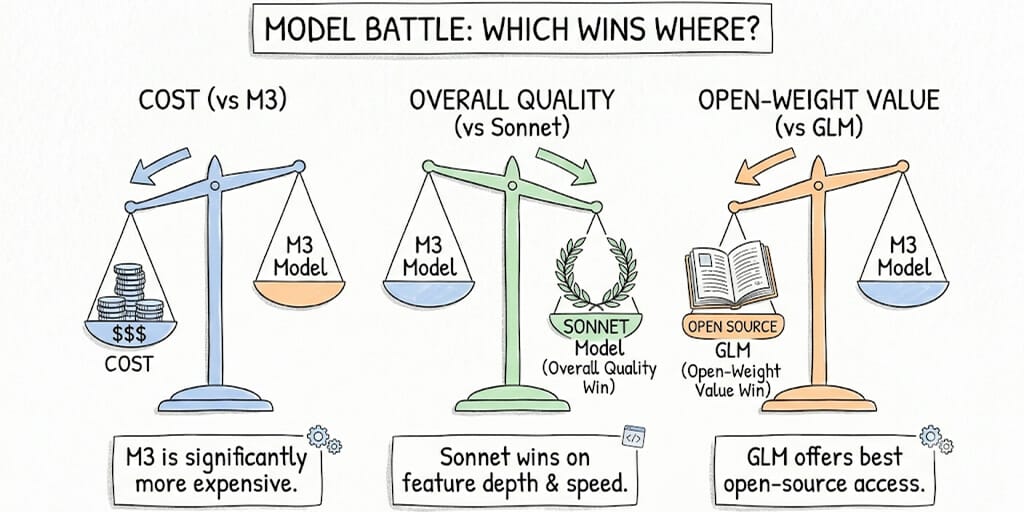
MiniMax M3 wins on cost. GLM 5.2 wins on speed and licence. Sonnet 4.6 wins on reasoning. Here's why, with the prices checked against the labs' own pages.
Three models. Three different labs. Three very different value propositions. GLM 5.2 is the open-weight coding powerhouse. Claude Sonnet 4.6 is the balanced mid-tier workhorse. MiniMax M3 is the budget multimodal challenger. Here is how they actually compare.
Worth clearing up before the numbers: GLM is a model family, not a different architecture from an LLM. GLM vs LLM: the difference explained covers what the name means today.
Test all three on your own workload.
BetterClaw routes GLM 5.2, Claude Sonnet 4.6, and MiniMax M3 through one agent config via BYOK. Switch models with a setting, not a rewrite. Free forever, not a trial. Start free → No credit card · 28+ providers · Zero markup
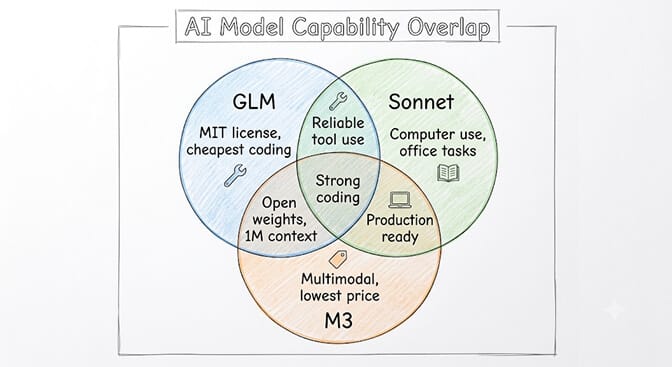
GLM 5.2 from Zhipu AI is the open-weight coding powerhouse with an MIT license and, when it launched, the highest Intelligence Index score of any open model. Claude Sonnet 4.6 from Anthropic is the balanced mid-tier workhorse with near-flagship intelligence at $3/$15 pricing. MiniMax M3 from MiniMax is the budget multimodal challenger that undercuts both on cost while claiming frontier coding performance.
All three launched within weeks of each other in early to mid 2026. All three target agent builders. All three have real strengths and real weaknesses that marketing pages do not mention.
This comparison covers verified benchmarks, actual API pricing, tool calling reliability, agent workflow suitability, and honest assessments of where each model falls short. No affiliate links. No cherry-picked numbers. The right choice depends entirely on what you are building and what you are willing to spend.
This page is the benchmark and capability read. If what you actually need is the bill, our agent cost breakdown runs the per-task and per-day arithmetic instead.
All prices re-verified against first-party pricing pages on 16 September 2026, and all three families have shipped newer siblings since this page first ran. GLM 5.3 and GLM-5.3-Flash landed in August. Claude Sonnet 5 and Opus 5 went GA over the summer. Those are covered in the "What changed since June" section below.
Verdict: MiniMax M3 wins on price at $0.30/$1.20 under 512K input. GLM 5.2 wins on speed, independent benchmark scores and licence freedom. Sonnet 4.6 wins on reasoning depth and tool-chain reliability. If cost decides it: M3. If you need to ship the weights: GLM 5.2. If mistakes cost money: Claude — though Sonnet 5 at $2/$10 has since superseded 4.6 on both price and benchmarks.
The Quick Answer
If you want the summary before the full breakdown:
- Pick GLM 5.2 when you need the strongest open-weight coding model, self-hosting rights under MIT, or the lowest token cost for coding-heavy agent workloads. $1.40/$4.40 per million tokens via API. Open weights on HuggingFace.
- Pick Claude Sonnet 4.6 when you need the best all-around model at mid-tier pricing, computer use for GUI-based tasks, or the most mature tool calling implementation. $3/$15 per million tokens. Best balance of capability, safety, and developer experience.
- Pick MiniMax M3 when cost is the deciding factor, you need multimodal input (images and video), or you need long context at the cheapest price available. $0.30/$1.20 per million tokens on requests up to 512K input, doubling to $0.60/$2.40 above that. Cheapest of the three by a wide margin.
- Pick all three via BetterClaw when you want to route different tasks to different models based on cost and capability, or you are not sure which model fits your workload best and want to test them side by side.
What Each Model Actually Is
GLM 5.2
Developer: Zhipu AI, operating under the Z.ai brand. Beijing-based AI company spun out of Tsinghua University's Knowledge Engineering Group in 2019. Now publicly listed.
Released: June 13 to 16, 2026.
Architecture: 744 billion total parameters, approximately 40 billion active per token. Mixture-of-Experts design. Introduces IndexShare, which reuses a lightweight indexer across every four sparse-attention layers to reduce per-token compute by 2.9x at 1M context. Also ships an improved multi-token prediction (MTP) layer for speculative decoding that increases acceptance length by up to 20%.
Context window: 1 million tokens.
License: MIT. This is the most permissive license available. You can download the weights, run locally, fine-tune on proprietary data, deploy in commercial products, and redistribute without attribution requirements.
Reasoning modes: Two levels called High and Max (xhigh). High gives faster responses with reasonable reasoning depth. Max allocates maximum compute for the hardest problems.
Key benchmark numbers (third-party verified): Intelligence Index v4.1 score of 51 (highest open-weight model at the time of its release). Terminal-Bench 2.1: 81.0. SWE-bench Pro: 62.1. FrontierSWE: leading among open-weight models. BenchLM.ai ranked it #4 out of 124 models with 91/100. Design Arena Code Category: #1 globally for frontend generation from natural language.
Important note: Zhipu published zero benchmark numbers at launch. Every number above comes from third-party evaluations (Artificial Analysis, BenchLM.ai, Design Arena, community testing). This is unusual for a flagship release and worth noting, even though the third-party results have been consistently strong.
Claude Sonnet 4.6
Developer: Anthropic. San Francisco-based AI safety company.
Released: February 17, 2026.
Architecture: Not publicly disclosed. Closed-weight model available only through API (Anthropic, Amazon Bedrock, Google Vertex AI).
Context window: 1 million tokens, and since March 2026 the full window bills at standard rates. Anthropic's own pricing page is explicit that Claude 4.6 and later models "include the full 1M token context window at standard pricing" — a 900K-token request costs the same per token as a 9K one. There is no premium long-context tier to budget for. Prompt cache hits are 0.1x base input, so $0.30 per million tokens, with an optional 1-hour TTL at 2x write.
This is worth flagging because a lot of comparison pages (including an earlier version of this one) still describe Sonnet 4.6 as a 200K model with a paid 1M beta. That stopped being true in March.
Reasoning modes: Four adaptive thinking levels (low, medium, high, max). The model automatically adjusts reasoning depth to task difficulty, spending minimal overhead on simple tasks and full reasoning chains on complex problems.
Key benchmark numbers (Anthropic system card, independently validated): SWE-bench Verified: 79.6%. OSWorld-Verified: 72.5% (computer use). Terminal-Bench 2.0: 59.1%. ARC-AGI-2: 58.3% (a 4.3x improvement over Sonnet 4.5). GDPval-AA: 1633 Elo (best of all models for office productivity). Finance Agent: 63.3% (best-in-class). MCP-Atlas: 61.3%.
Developers preferred Sonnet 4.6 over the previous generation Sonnet 4.5 in 70% of head-to-head comparisons. They preferred it over the older flagship Opus 4.5 in 59% of comparisons. That is a mid-tier model beating the previous generation's premium flagship.
MiniMax M3
Developer: MiniMax. Shanghai-based AI lab founded in 2021. Listed on the Hong Kong Stock Exchange in January 2026.
Released: June 1, 2026.
Architecture: 428 billion total parameters, approximately 23 billion active per token. Mixture-of-Experts. Built on MiniMax Sparse Attention (MSA), which partitions the KV cache into blocks to cut per-token compute at long context to roughly 1/20th of the previous generation, with 9x+ faster prefill and 15x+ faster decoding.
Context window: 1 million tokens, with a guaranteed minimum of 512K and a billing tier change at exactly that line. Independent trackers list M3's usable context as 512K for that reason.
License: MiniMax Community License. Open-weight but with commercial conditions. Not MIT, and not a modified MIT either — MiniMax has said so directly. Commercial use requires displaying "Built with MiniMax M3" on your product or docs, a one-time notice to MiniMax, and prior written authorisation above roughly $20M in yearly revenue from the product. Read the terms before you ship.
Multimodal: Native text, image, and video input. The only model of these three that processes video.
Key benchmark numbers (company-reported, mostly unverified as of mid-June 2026): SWE-Bench Pro: 59.0%. Terminal-Bench 2.1: 66.0%. BrowseComp: 83.5%. SWE-fficiency: 34.8%. KernelBench Hard: 28.8%. MCP-Atlas: 74.2%. MiniMax claims scores surpassing GPT-5.5 and Gemini 3.1 Pro on coding and edging past Claude Opus 4.7 on autonomous browsing.
Important note: Most MiniMax M3 benchmark scores are from MiniMax's own testing infrastructure with their agent scaffolding. Independent verification is still pending as of mid-June 2026. Treat these numbers as indicative rather than confirmed. Artificial Analysis Intelligence Index v4.1 independently scored M3 at 44, which is above average but well below GLM 5.2's 51.
Pricing: The Numbers That Actually Matter
This is where the three models diverge most dramatically, and pricing drives most real-world model selection decisions. Every number below is the first-party rate from the lab's own pricing page, not an aggregator's cheapest reseller.
| GLM 5.2 | Claude Sonnet 4.6 | MiniMax M3 | |
|---|---|---|---|
| Input price (per 1M) | $1.40 | $3.00 | $0.30 (≤512K) / $0.60 (>512K) |
| Output price (per 1M) | $4.40 | $15.00 | $1.20 (≤512K) / $2.40 (>512K) |
| Cache read price (per 1M) | $0.26 | $0.30 | $0.06 (≤512K) / $0.12 (>512K) |
| Batch pricing | Not available | Yes ($1.50/$7.50) | Not available |
| Subscription option | GLM Coding Plan ($18-$80/mo) | Claude Pro ($20/mo), Max ($100-$200/mo) | MiniMax Token Plan (from ~$20/mo) |
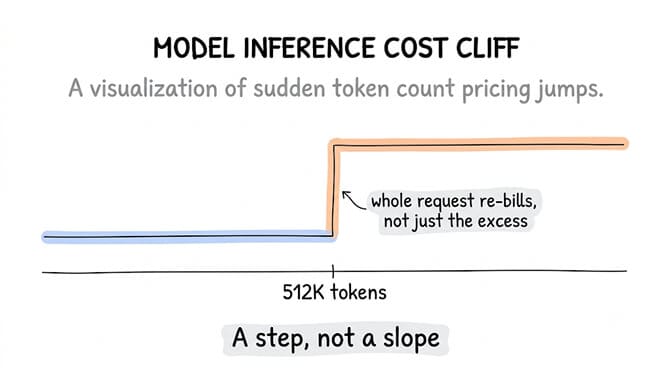
Get the M3 number right, because most pages have it wrong. Comparison articles routinely quote $0.60/$2.40 as M3's standard price with $0.30/$1.20 as a temporary launch promo, then warn you to budget on the higher figure. That is backwards. MiniMax's published standard rate is $0.30/$1.20 for any request with 512K or fewer input tokens. $0.60/$2.40 is not a rate you fall back to when a promo lapses; it is the tier you enter when a single request crosses 512K input tokens. MiniMax does label the displayed rates as a permanent 50% discount against struck-through list prices, but "permanent 50% off" has been the shipping price all year. Cost tables built on the $0.60 assumption are roughly 2x too high.
The 512K cliff is a step, not a slope. When one request crosses 512,000 input tokens, the entire call rebills at the doubled rate. Not the excess portion. A 600K-token call costs more than double a 500K one. Agent loops are exactly the workload that drifts across that line by accident, because every turn appends tool results and reasoning nobody pruned.
What a typical long-context agent cycle costs (1M input + 500K output):
- MiniMax M3, one 1M-token call: $0.60 + $1.20 = $1.80 (over the cliff, doubled tier)
- MiniMax M3, same work split into two sub-512K calls: $0.30 + $0.60 = $0.90
- GLM-5.3-Flash: $0.15 + $0.25 = $0.40
- GLM 5.2: $1.40 + $2.20 = $3.60
- Claude Sonnet 5: $2.00 + $5.00 = $7.00
- Claude Sonnet 4.6: $3.00 + $7.50 = $10.50
- Claude Opus 5: $5.00 + $12.50 = $17.50
Scaled to 100 agent runs per day for a month (3,000 runs):
- GLM-5.3-Flash: ~$1,200/month
- MiniMax M3, pruned under 512K: ~$2,700/month
- MiniMax M3, one call over the cliff: ~$5,400/month
- GLM 5.2: ~$10,800/month
- Claude Sonnet 5: ~$21,000/month
- Claude Sonnet 4.6: ~$31,500/month
- Claude Opus 5: ~$52,500/month
Note what that list actually shows: pruning your context below 512K saves more on M3 than picking M3 over GLM 5.2 saves you in the first place.
The gap is enormous at scale. But pricing without quality context tells you nothing. A model that costs half as much but needs twice as many retries to get a correct answer is not actually cheaper. Keep reading.
Where cost comparison gets nuanced: Sonnet 4.6's prompt caching ($0.30 per million tokens for cache hits, 90% cheaper than fresh input) dramatically changes the economics for workflows with repeated system prompts or shared context. If your agent reuses a long system prompt across many queries, Sonnet 4.6's effective per-query cost drops substantially. GLM 5.2's cache pricing ($0.26/M) is similar but less documented, and M3's cache reads at $0.06/M are the cheapest of the three outright. The cost breakdown linked at the top of this page runs the caching arithmetic at real daily volumes.
Benchmark Comparison
Here are the benchmarks that matter most for agent builders, with verified numbers where available and clear notes where numbers are self-reported.
| Benchmark | What It Measures | GLM 5.2 | Claude Sonnet 4.6 | MiniMax M3 |
|---|---|---|---|---|
| Intelligence Index v4.1 | Overall composite capability | 51 (3rd party) | N/A (Opus 4.6: 56.3) | 44 (3rd party) |
| SWE-bench Verified | Real GitHub issue fixes | ~80% (est.) | 79.6% (verified) | ~80.4% (some reports) |
| SWE-bench Pro | Harder engineering tasks | 62.1% (3rd party) | ~55% (estimated) | 59.0% (self-reported) |
| Terminal-Bench 2.1 | Agent coding tasks | 81.0% (3rd party) | 59.1% (v2.0, verified) | 66.0% (self-reported) |
| OSWorld-Verified | Computer use (GUI) | Not tested | 72.5% (verified) | Not tested |
| BrowseComp | Autonomous web browsing | Not published | ~70% (estimated) | 83.5% (self-reported) |
| MCP-Atlas | Tool use reliability | High (varies) | 61.3% (Opus 4.6 baseline) | 74.2% (self-reported) |
| GPQA Diamond | Science reasoning | Not published | 74.1% (verified) | Not published |
| ARC-AGI-2 | Novel problem solving | Not published | 58.3% (verified) | Not published |
| GDPval-AA | Office productivity | Not tested | 1633 Elo (best of all) | Not tested |
| Finance Agent | Financial tasks | Not tested | 63.3% (best-in-class) | Not tested |
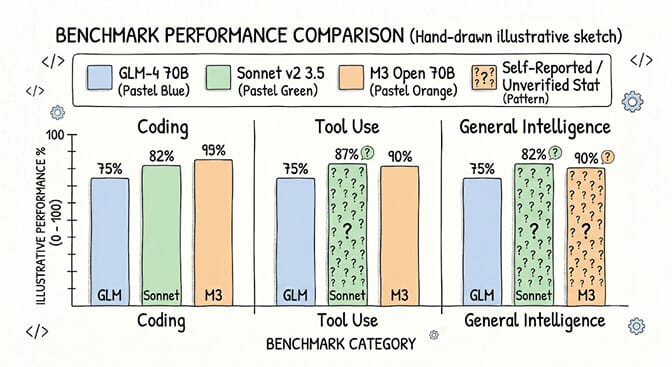
Reading the table honestly: Sonnet 4.6 has the most comprehensive and independently validated benchmark profile of the three. GLM 5.2 has strong third-party numbers on coding benchmarks. MiniMax M3 has impressive self-reported numbers that still have thinner independent confirmation than either of the others.
Two traps in that table are worth naming, because they are the two most common ways model comparisons mislead people.
SWE-bench Pro and SWE-bench Verified are not the same benchmark. You cannot put M3's 59.0% on SWE-bench Pro next to a Claude model's 80-something percent on SWE-bench Verified and conclude anything. The test sets, evaluation criteria and difficulty distributions differ. Any page that lines those two columns up side by side and declares a winner is doing arithmetic on incompatible units.
Intelligence Index scores are version-scoped. Artificial Analysis reweights its suite periodically, and scores from different versions are not comparable. M3 was reported at 55 on the index in early June, then 44 once v4.1 landed on 15 June and shifted the weighting toward newer agentic workloads, then lower again on v4.3. The GLM 5.2 (51) vs M3 (44) comparison in this post is v4.1 against v4.1, which is the only way that comparison means anything. If you see those numbers quoted against a score from a different index version, it is not a like-for-like gap.
Also remember who ran the test. A lab reporting its own benchmark on its own infrastructure with its own agent scaffolding is publishing a ceiling, not a floor. Kili Technology, which runs production AI evaluations, measured a 37% average gap in 2026 between lab benchmark scores and real-world deployment performance for enterprise agentic systems. That gap is a property of the problem, not a flaw in any one model: benchmarks measure capability, production measures reliability.
Tool Calling and Agent Suitability
For anyone building agents, these are the details that benchmarks do not fully capture.
GLM 5.2 Tool Calling
GLM 5.2 supports native function calling, structured JSON output, and extended reasoning with two effort levels. The 1M context window means you can feed an entire codebase into the prompt and maintain conversation history without chunking.
Strengths: Sustains quality over very long coding sessions. The model can chain hundreds of tool calls in coding agent workflows. MIT license means you can deploy it on your own infrastructure with complete control. Design Arena ranked it #1 globally for frontend code generation from natural language, which speaks to practical coding utility beyond benchmark scores.
Weaknesses: Text-only. No image or video input whatsoever. The model tends to be verbose (generating roughly 27% more tokens than average on Intelligence Index evaluation), which can inflate costs on output-priced APIs. The ecosystem around GLM models is smaller than Claude's or OpenAI's, so fewer pre-built integrations exist. Independent benchmark coverage is still catching up since the model is less than two weeks old as of this writing.
Claude Sonnet 4.6 Tool Calling
Sonnet 4.6 has the most mature and battle-tested tool calling implementation of the three. Anthropic has been iterating on tool use since October 2024, and the infrastructure shows.
Strengths: Interleaved tool calls during extended thinking (the model can use tools mid-reasoning without breaking its chain of thought). Strict JSON mode validates outputs server-side against declared schemas. 64% reduction in tool-call latency versus the previous Sonnet 4.5. Best-in-class computer use at 72.5% OSWorld, meaning the model can interact with GUIs, click buttons, fill forms, and navigate web interfaces. Strong prompt injection resistance, performing on par with Opus 4.6. Adaptive thinking automatically adjusts reasoning depth to task difficulty without manual configuration.
Weaknesses: Most expensive of the three at $3/$15 per million tokens, and roughly 10x M3's sub-512K rate. Closed-weight model with no self-hosting option and no way to inspect what you are running. Constitutional AI safety guardrails can occasionally result in refusals on edge-case tasks that other models handle without friction. And since Sonnet 5 shipped at $2/$10, Sonnet 4.6 is now the more expensive Sonnet, which is an odd place for it to sit.
MiniMax M3 Tool Calling
M3 supports function calling and demonstrated autonomous operation in MiniMax's internal showcases: a 12-hour ICLR paper reproduction with 18 commits and 23 experimental figures, and a 24-hour kernel optimization run with 147 benchmark submissions.
Strengths: Native multimodal input (text, image, video) gives it capabilities the other two simply do not have. Long context at $0.30/$1.20 under 512K is the most affordable long-context inference of these three by a wide margin, and cache reads at $0.06/M are the cheapest line item on this page. MiniMax Sparse Attention makes long-context work genuinely cheap. The model supports a thinking on/off toggle per request.
Weaknesses: Community tooling, tutorials, and integration support are still maturing compared to Claude's extensive ecosystem — eight tracked providers against GLM 5.2's seventeen. Benchmark scores are mostly company-reported and thinly verified by independent labs. The commercial license requires review before deployment (not MIT like GLM 5.2), and the attribution plus revenue-threshold clauses are real obligations, not boilerplate. The 512K billing cliff punishes exactly the long-horizon agent loops the model is marketed for. MiniMax is headquartered in Shanghai, which raises data sovereignty considerations under China's 2017 National Intelligence Law for teams processing sensitive data through the MiniMax API.
Speed, and Why Your Provider Matters More Than Your Model
GLM 5.2 wins throughput, and not narrowly.
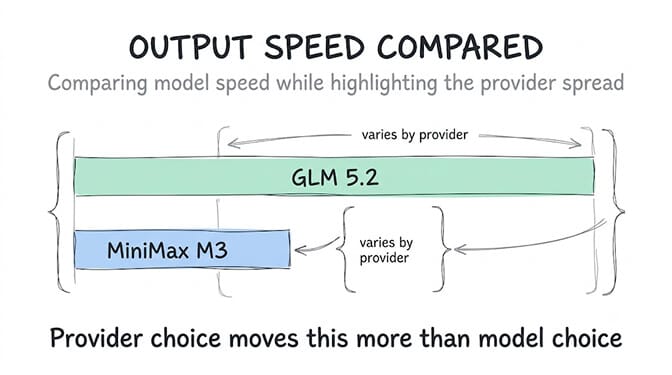
Head to head on Artificial Analysis, GLM 5.2 in max mode generates around 150 output tokens per second against roughly 76 for M3. Time to first token is close, 1.39 seconds versus 1.46, so the gap is throughput rather than responsiveness. Median across all providers puts GLM 5.2 near 213 tokens per second, which is unusually quick for an open-weight model of that size. Sonnet 4.6 sits around 50-80 tokens per second depending on provider and load.
Read the provider column before you trust any single figure, though. GLM 5.2 is served by seventeen tracked providers with a 1,064% spread between fastest and slowest. M3 has eight, with a 296% spread. Your provider choice moves latency more than your model choice does, which is an argument for a platform that lets you swap providers without touching code.
M3 has an architectural advantage these numbers hide. MiniMax Sparse Attention keeps per-token compute at 1M context to roughly a twentieth of the previous generation, with decoding several times faster at the full window. At ordinary context lengths GLM is faster. At extreme ones, M3 degrades better.
Head-to-Head on Real Tasks
Task 1: Multi-File Code Refactoring
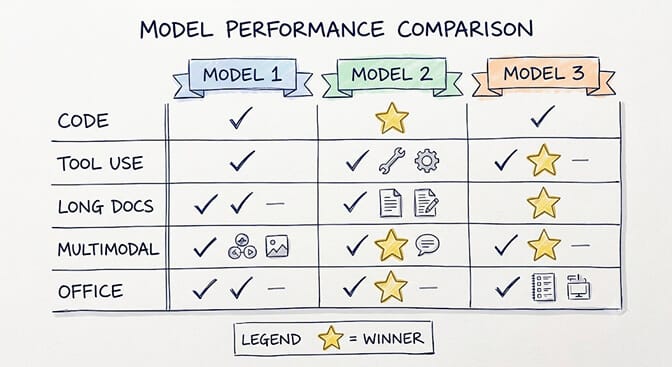
GLM 5.2 wins this category. The combination of 1M context, the strongest open-weight SWE-bench Pro score (62.1%), and sustained quality over long coding sessions makes it the top pick for repository-level work. It can hold a meaningful portion of a large codebase in context and produce consistent edits across multiple files without losing track of earlier changes.
Sonnet 4.6 is very close. 79.6% on SWE-bench Verified is near-flagship performance. For most day-to-day coding tasks, the gap between GLM 5.2 and Sonnet 4.6 is not noticeable in practice. Sonnet 4.6 tends to produce cleaner, more readable code with better variable naming and documentation, and its 1M window at flat pricing covers any real-world refactoring scope.
M3 is solid but needs time. 59% SWE-bench Pro is strong on paper, but without independent verification the actual gap to the other two is unclear. The BrowseComp score suggests strong autonomous capability, but coding refactoring and web browsing test different skills.
Task 2: Tool Use and Agent Workflows
Sonnet 4.6 wins. Most mature implementation, best latency numbers, and the only model with production-proven computer use. If your agent needs to interact with web interfaces, fill forms, navigate applications, or handle multi-step tool sequences with error recovery, Sonnet 4.6 is the clear choice.
GLM 5.2 is strong for coding-specific tool use. File operations, terminal commands, API calls, and test execution work well. The model handles the tool-call-execute-evaluate loop reliably for software engineering tasks.
M3 shows promise on agent benchmarks. The MCP-Atlas and BrowseComp scores suggest strong potential, but the production track record is too thin to recommend for mission-critical agent deployments today.
Task 3: Long Document Processing
All three now offer 1M tokens, and the differences are in the fine print. GLM 5.2 publishes a flat 1M input window with a separate output ceiling of about 131K tokens, which is roughly five times what GLM 5.1 allowed and matters if your agent writes long documents in one pass. Sonnet 4.6 bills its full 1M window at standard rates with no premium tier. M3's 1M is a ceiling over a 512K guaranteed minimum, that maximum counts input and output combined, and crossing 512K doubles the whole request.
So the ranking flips depending on where in the window you live. Under 512K, M3 is the cheapest long-context option available by a factor of four or more. Above it, M3's doubled tier ($0.60/$2.40) still beats GLM 5.2's flat $1.40/$4.40, but the margin narrows and the latency variance widens. Sonnet 4.6 costs the most per token at any length and is the only one of the three whose long-context quality has been independently validated at scale.
The practical move regardless of model: prune between turns. Agent loops fill context without asking permission, and by turn ten or fifteen you are dragging history no single step needed.
Task 4: Multimodal Tasks (Images, Video, Screenshots)
M3 wins by default. It is the only model of the three that accepts image and video input natively. GLM 5.2 is text-only. Sonnet 4.6 accepts images but not video. If your agent needs to understand screenshots, analyze UI designs, interpret charts, or process video frames, M3 is the only option among these three.
Task 5: Office Productivity and Business Tasks
Sonnet 4.6 wins decisively. Best of all models at 1633 Elo on GDPval-AA for office productivity. 63.3% on Finance Agent (also best-in-class). If your agent handles business documents, spreadsheets, email drafting, meeting summaries, or financial analysis, Sonnet 4.6 outperforms both alternatives on these specific tasks.
Open Weights vs Closed: Why It Matters for Agent Builders
This is not an academic distinction. It determines what you can build, where you can deploy, and who controls your infrastructure.
GLM 5.2 (MIT License, Open Weights): Download the weights. Run locally. Fine-tune on your data. Deploy on your infrastructure. Build commercial products. Redistribute modified versions. No attribution required. The practical constraint is hardware: the full model at BF16 is 1.51TB. At 2-bit quantization via Unsloth GGUF, it compresses to roughly 239GB, fitting on a Mac with 256GB unified memory or a workstation with 2+ A100 GPUs.
MiniMax M3 (MiniMax Community License, Open Weights): Open-weight but with commercial conditions. Self-hosting is possible but requires 75 to 150GB of memory at Q4 quantization (Mac Studio 192GB or 2+ A100s). Ollama offers M3 as a cloud-hosted model (minimax-m3:cloud) for zero-setup access. Review the license terms before commercial deployment: attribution is mandatory, and past roughly $20M in annual product revenue you need written authorisation.
The predecessor generation is worth knowing about too. GLM 5.1, the April model that put Z.ai on the map, is MIT with the same $1.40/$4.40 first-party pricing, a 200K context window, and 58.4% on SWE-bench Pro. Its distinctive claim was endurance: Z.ai demonstrated it running autonomously for eight hours on a single coding task, 655 iterations without human intervention. That is a different capability from a big context window, and it is still the reason some teams run GLM for overnight refactors and multi-hour research jobs rather than the model with the larger window. At 754B total and 42B active it is the heaviest of these to self-host; none of these models is practical on consumer hardware, and if you need something that runs on a laptop you are looking at a 30B-class model with 3B active parameters, not any of these.
Claude Sonnet 4.6 (Closed): No weights available. API-only through Anthropic, Amazon Bedrock, or Google Vertex AI. Cannot self-host, fine-tune, or inspect. What you get in exchange: the most thoroughly tested safety layer, the best developer documentation, the most extensive integration ecosystem, and consistent behavior across deployments.
For teams where cost at high volume and infrastructure control matter most, GLM 5.2's MIT license is a genuine competitive advantage. For teams where reliability, safety, and time-to-production matter most, Sonnet 4.6's closed ecosystem is not a limitation. It is the product.
The Complete Comparison Table
| GLM 5.2 | Claude Sonnet 4.6 | MiniMax M3 | |
|---|---|---|---|
| Released | June 13-16, 2026 | February 17, 2026 | June 1, 2026 |
| Developer | Zhipu AI (Z.ai), Beijing | Anthropic, San Francisco | MiniMax, Shanghai |
| Parameters | 744B total / ~40B active (MoE) | Not disclosed | 428B total / ~23B active (MoE) |
| Context window | 1M tokens | 1M tokens (flat pricing) | 1M ceiling / 512K guaranteed |
| Input price per 1M | $1.40 | $3.00 | $0.30 (≤512K) / $0.60 (>512K) |
| Output price per 1M | $4.40 | $15.00 | $1.20 (≤512K) / $2.40 (>512K) |
| Open weights | Yes (MIT) | No | Yes (Community License) |
| Multimodal input | Text only | Text + Image | Text + Image + Video |
| Computer use | No | Yes (72.5% OSWorld) | BrowseComp only |
| Thinking modes | High, Max | Low, Medium, High, Max (adaptive) | On/Off toggle |
| Self-hostable | Yes (2+ A100 or 256GB Mac) | No | Yes (75-150GB memory) |
| Intelligence Index v4.1 | 51 (top open-weight at launch) | N/A (Opus 4.6: 56.3) | 44 |
| SWE-bench Pro | 62.1% | ~55% (estimated) | 59.0% (self-reported) |
| Terminal-Bench 2.1 | 81.0% | 59.1% (v2.0) | 66.0% (self-reported) |
| Best at | Coding, long-horizon agents, cost-efficient inference | General purpose, computer use, office tasks, safety | Budget coding, multimodal, cheap long context |
| Weakest at | Creative writing, multimodal, ecosystem size | Price at high volume | Maturity, independent verification, the 512K cliff, data sovereignty |
What Changed Since June: The Newer Models
All three labs shipped again over the summer. If you are picking a model today rather than reading a historical comparison, these are the ones to weigh.
GLM-5.3-Flash (Z.ai, 26 August 2026). The interesting one. A 320B-total, 18B-active MoE with a 1M context window, native image and video input, and MIT-licensed open weights — which makes it the first GLM that is not text-only, and removes M3's standing "only multimodal open-weight option" advantage. Z.ai lists it at $0.15/$0.50 per million tokens with cached input at $0.03, which undercuts even M3's sub-512K rate by half, with no context cliff attached. Z.ai reports 84.3 on Terminal-Bench 2.1. It is a small model punching at a price nothing else on this page matches.
GLM 5.3 (Z.ai, 18 August 2026). Built on exactly the same base weights as GLM 5.2, with every improvement coming from post-training. 1M context, text-only, roughly 128K max output. Priced identically to 5.1 and 5.2 at $1.40/$4.40, cached input $0.26 — Z.ai has held that line across three generations, which is why quoting GLM at $0.98 or $1.00 from a reseller's page misstates what the lab charges.
Claude Sonnet 5 (Anthropic, GA 30 June 2026). $2/$10 per million tokens, cache hits at $0.20. Anthropic confirmed the $2/$10 launch rate is now the standard price rather than introductory. It scores 85.2% on SWE-bench Verified, 63.2% on SWE-bench Pro and 80.4% on Terminal-Bench 2.1. It is both cheaper and stronger than Sonnet 4.6 on every one of those, which makes Sonnet 4.6 hard to recommend for a new build.
Claude Opus 5 (Anthropic, GA 24 July 2026). $5/$25, cache hits at $0.50, batch at $2.50/$12.50. 89.1% on Terminal-Bench 2.1. Anthropic published Frontier-Bench v0.1 and CursorBench 3.2 at launch rather than a SWE-bench Verified figure. A research-preview Fast mode runs at $10/$50 for latency-sensitive work.
One caution on the Claude 4.7-and-later models: they use a newer tokenizer that produces roughly 30% more tokens for the same text. A per-million-token price cut does not translate one-for-one into a bill cut if the token count moves with it.
The short version if you are starting fresh today: GLM-5.3-Flash is the new cost floor, Sonnet 5 replaces Sonnet 4.6 as the sensible Anthropic default, and M3 keeps its niche on cheap multimodal long context under 512K.
Which One Should You Use?
Use GLM 5.2 if:
- Cost per token is a primary concern and you run high-volume coding agent workloads
- You need MIT-licensed open weights for self-hosting, fine-tuning, or compliance
- Your workload is primarily coding and text processing (no multimodal needs)
- You want the strongest open-weight model available for software engineering tasks
- Infrastructure independence matters (no single API provider dependency)
Use Claude Sonnet 4.6 if:
- You need the best overall model balancing coding, tool use, and general tasks
- Computer use (interacting with GUIs, filling forms, navigating web apps) is part of your workflow
- You want the most mature, battle-tested tool calling with lowest latency
- Safety, prompt injection resistance, and reliable behavior matter for your deployment
- You are already in the Anthropic ecosystem (Claude Code, Bedrock, Cowork)
- Office productivity and business document tasks are core to your use case
Use MiniMax M3 if:
- Budget is the deciding factor and you need frontier-adjacent performance at a fraction of the cost
- Your agent needs to understand images or video (screenshots, charts, visual content, video frames)
- You need long context at the cheapest price available and can keep single requests under 512K
- You are comfortable with a model that has less independent benchmark verification than the other two
- You have evaluated the data sovereignty implications and the Community License terms for your specific use case
If you want a closer two-way read, we also break down GLM 5.2 vs Sonnet 4.6 and, for the Anthropic side specifically, MiniMax M3 vs Claude Sonnet 4.6 — which is where the Opus-tier routing math lives.
Access All Three Through BetterClaw
BetterClaw supports BYOK across 28+ model providers. Connect to GLM 5.2 through OpenRouter or the Z.ai API. Access Claude Sonnet 4.6 through Anthropic directly. Use MiniMax M3 through OpenRouter or the MiniMax API. One agent configuration, multiple model backends, zero infrastructure to manage.
Test each model on your actual workload. See which one produces the best results for your specific use case. Switch between them by changing a setting, not rewriting your agent. If you are routing tasks across models to control spend, our model routing guide walks through the setup.
Get started with BetterClaw for free. Free plan includes 1 agent and 100 credits a month. Free forever, no credit card required.
Frequently Asked Questions
Is GLM 5.2 better than Claude Sonnet 4.6 for coding?
On pure coding benchmarks, GLM 5.2 scores higher. Terminal-Bench 2.1: 81.0% vs 59.1%. SWE-bench Pro: 62.1% vs an estimated 55%. On SWE-bench Verified (real GitHub issue resolution), both models land near 80%, close enough that practical differences depend on your specific codebase and task type. Sonnet 4.6 has the edge on tasks requiring computer use, GUI interaction, or combined coding plus business reasoning. GLM 5.2 wins on raw coding throughput, especially at scale where $1.40/$4.40 against $3/$15 is a 2.1x input and 3.4x output cost advantage. Note that Claude Sonnet 5 has since shipped at $2/$10 with 63.2% on SWE-bench Pro and 80.4% on Terminal-Bench 2.1, which narrows both the price and the benchmark gap considerably.
How much does MiniMax M3 cost compared to Claude Sonnet 4.6?
MiniMax's published standard rate is $0.30 per million input tokens and $1.20 per million output tokens for requests up to 512K input, which is 10x cheaper than Sonnet 4.6 on input and 12.5x cheaper on output. Above 512K input the whole request rebills at $0.60/$2.40, which is still 5x and 6.25x cheaper. Against the newer Claude Sonnet 5 at $2/$10, the sub-512K gap is about 6.7x on input and 8.3x on output. Be careful with pages that describe $0.60/$2.40 as M3's standard price and $0.30/$1.20 as a temporary promo — that has the tiers backwards, and it makes their cost tables roughly twice as expensive as reality.
Can I run GLM 5.2 locally?
Yes, but it requires serious hardware. The full BF16 checkpoint is 1.51TB. At 2-bit quantization (Unsloth Dynamic GGUF), it compresses to approximately 239GB and needs roughly 245GB+ of available memory. This fits on a Mac with 256GB unified memory or a workstation with 2+ NVIDIA A100 GPUs. Ollama lists glm-5.2:cloud for cloud-routed access, but that is not local execution. For actual local inference, use llama.cpp with the Unsloth GGUF files.
Which model has the best tool calling for agent workflows?
Claude Sonnet 4.6. It has the most mature implementation with interleaved tool calls during extended thinking, strict JSON mode for validated outputs, 64% lower tool-call latency compared to the previous generation, and the only production-proven computer use capability of the three. GLM 5.2 is strong for coding-specific tool use (file ops, terminal, APIs). MiniMax M3 supports function calling but has the thinnest production track record among the three.
Is MiniMax M3 safe to use with sensitive or proprietary data?
MiniMax is headquartered in Shanghai and operates under Chinese data governance laws including the 2017 National Intelligence Law. If you process sensitive data through the MiniMax API, data governance rules differ from US or EU-based providers. Self-hosting M3 on your own infrastructure using the open weights eliminates the API-based data sovereignty concern, but requires 75 to 150GB of memory and careful license review for commercial deployment.
Which model should I start with if I am building my first agent?
Claude Sonnet 5 is the safest starting point today at $2/$10 per million tokens. It has the strongest instruction following, the most reliable tool use, the best documentation, and the largest ecosystem of integration examples — and it is both cheaper and stronger than Sonnet 4.6, so there is no reason to start a new build on 4.6. Once your agent is working well, test GLM 5.2 or MiniMax M3 on the same tasks to see whether the cost savings justify switching for your specific workload.
Is GLM-5.3-Flash a better deal than MiniMax M3?
On price and licence, yes. GLM-5.3-Flash is $0.15/$0.50 per million tokens with $0.03 cached input, roughly half M3's sub-512K rate and a quarter of what M3 charges above 512K, with no context cliff. It is MIT licensed rather than commercially restricted, it takes image and video input like M3 does, and it carries the same 1M context window in a much smaller 320B/18B-active package. M3's remaining advantages are its sparse-attention behaviour at the far end of the window and a longer track record in agent tooling. For most new cost-sensitive agents, Flash is the one to test first.
One config, every model.
Connect GLM 5.2, Claude Sonnet 4.6, and MiniMax M3 through BetterClaw with BYOK. Test them side by side on your real workload. Free forever, not a trial. Start free →