Update (September 14, 2026): Klaus (managed OpenClaw hosting) shut down September 1, 2026. An earlier version of this post compared it as a live option; it has been removed. If you were a Klaus customer, see what to do now.
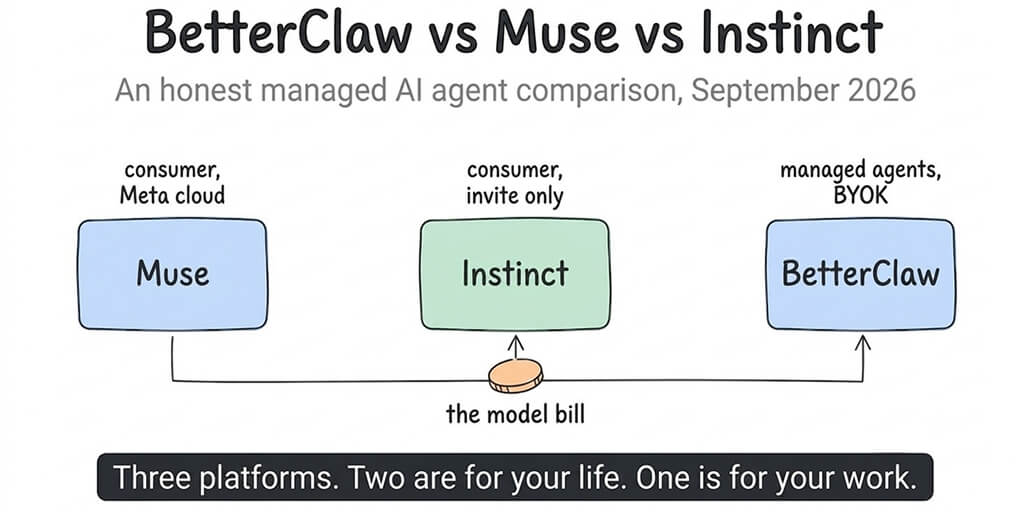
Meta shipped a personal agent on September 8. A 23-year-old's invite-only assistant is worth $2.5 billion without a pricing page. Here's what each one actually is, what it costs once you add the model bill, who owns your data, and who each is really for. Including where we lose.
Tuesday morning, September 8. My phone lit up twice inside ten minutes. A customer asking whether they should move to Muse. An investor friend asking if Instinct was going to eat us.
Fair questions, both. The managed AI agent market had a launch and a valuation in the same fortnight, and our comparison pages didn't mention either. So here is the comparison I'd want if I were choosing, with the numbers checked against each company's own pages and the press that covered them, and with the places we come up short left in.
First, what each of these actually is
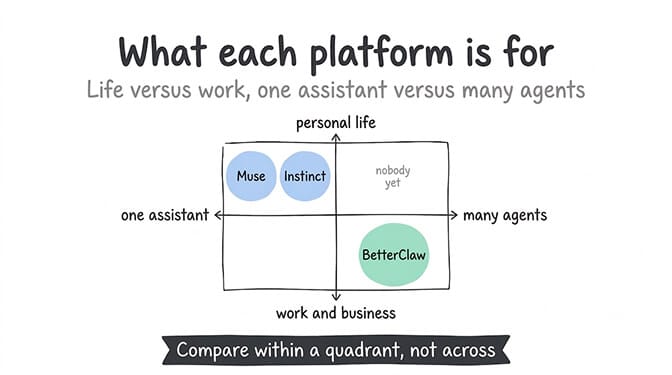
This is where most comparisons go wrong. They line up three logos and pretend they're the same product. They aren't.
Meta Muse is a consumer personal agent. It sends email, books travel, fills forms, and pays for things on your behalf, reachable through its own app, the web, and WhatsApp. It runs on Meta's Muse Spark model family in a dedicated virtual machine per user, with a system called Sentinel that gates sensitive actions behind your approval. US only, adults only, and reportedly built on OpenClaw under the hood.
Instinct is also a consumer personal agent, reachable by text and phone call rather than an app. It's in private beta, invite-only, free for now, with no published pricing. It closed a $250 million Series B at a $2.5 billion valuation on August 26, led by Index Ventures and Benchmark, roughly four months after its parent company was registered.
BetterClaw is a managed platform for building and running multiple AI agents for work, with a visual builder, per-agent isolation, your own model keys, and the security layer we'll get to.
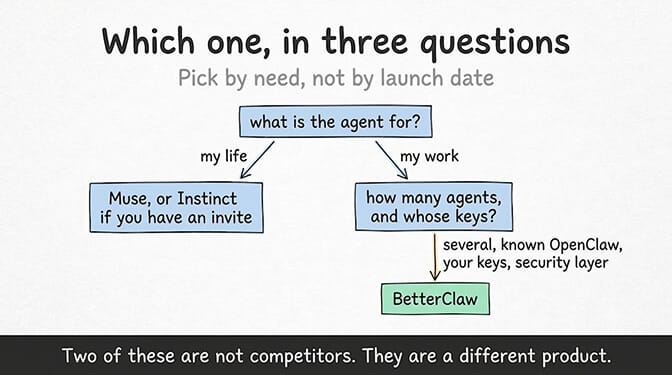
Muse and Instinct want to run your life. BetterClaw wants to run your agents. If you're choosing between the two, you're not really choosing; you're describing two different needs.
The pricing table, and what's missing from it
| Muse | Instinct | BetterClaw | |
|---|---|---|---|
| Free | $0, up to 100M tokens/week (per Zuckerberg), card required | Free during private beta, invite only | $0, 1 agent, 100 credits/mo, no card |
| Entry paid | Power, $20/mo | Not published | Basic, $19/mo (1 agent, 500 credits/mo) |
| Mid | Maximum, $100/mo | Not published | Pro, $49/mo for 5 agents ($39/mo annual) |
| Top | — | — | Business, $149/mo for 25 agents; Enterprise, custom |
| Model bill | Included (Muse Spark only) | Included, provider undisclosed | Your key, zero markup, on every plan; managed keys from Pro |
| Agents per plan | 1 (yours) | 1 (yours) | 1 on Free and Basic, 5 on Pro, 25 on Business |
Prices checked September 14, 2026 against each company's pages and launch coverage.
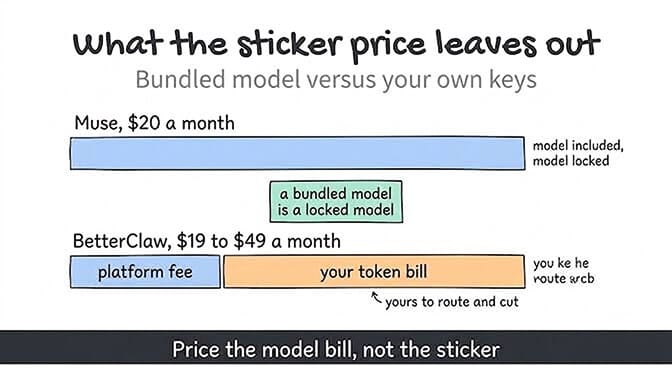
Here's the part the sticker hides. Muse and Instinct bundle the model. BetterClaw doesn't, beyond a credit allowance. So Muse at $20 is genuinely $20, and BetterClaw Basic at $19 is $19 plus whatever your agent spends on tokens through your own key.
That sounds like a point for Muse. It is, for a personal assistant with a fixed job. For work agents it cuts the other way, because a bundled model is a locked model. You run what Meta decided to serve, at the effort level Meta decided on, and when the model changes you find out in the release notes. We tested three frontier models on real agent tasks last week and found them indistinguishable on most daily work, with a 6x cost spread. That spread is only available to you if you hold the keys. We open BYOK on the free plan, because it's the whole point.
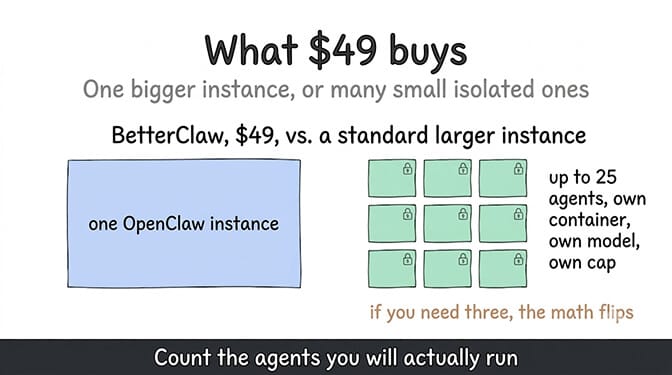
The other line to read twice is agents per plan. Muse and Instinct are one assistant for one person. Our $49 buys five agents, each in its own container, each with its own model. If you only ever need one agent, Basic at $19 is the entry point. If you need three, Pro is where the math starts working.
Security and who owns what
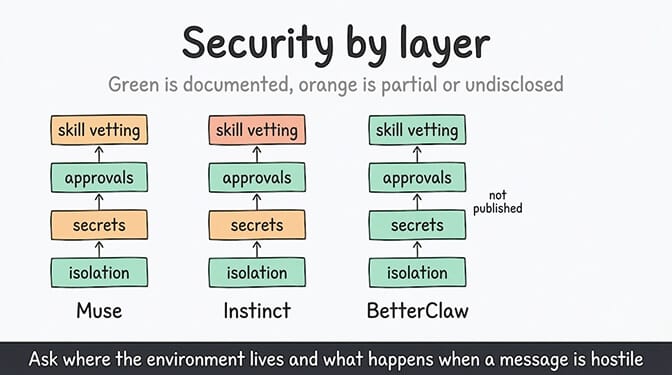
This is the section I'd read first if I were you, and it's the one where the three differ most.
Muse runs each user on a dedicated VM in Meta's cloud, and Sentinel requires your approval before sensitive actions. Both are real safeguards, and better than most self-hosted OpenClaw setups. The trade is that your agent's memory, your connected accounts, and every task it runs live in Meta's infrastructure, and Meta has said it is exploring commissions on purchases the agent makes. The company also acknowledged before launch that internal testing found reliability issues. A card on file is required even for free.
Instinct is the one to read the terms on. Per its own terms, as reported, disconnecting an account does not delete the data already indexed from it, and the service is appointed as your agent to enter agreements that bind you. That is a normal thing for a personal-assistant product to need, and an unusual thing to hand to a four-month-old company that hasn't published a security page. Forbes described the privacy concerns as mounting alongside the valuation.
BetterClaw is where I'll be specific, because it's the reason we exist. Every agent runs in its own isolated container. Secrets auto-purge from agent memory five minutes after use, AES-256 encrypted in between, so an injected instruction finds nothing to exfiltrate. Trust levels (Intern, Specialist, Lead) decide what an agent can do without a human, with action approval and a one-click kill switch on every agent regardless of channel. Skills go through a four-layer audit before they're installable. The security page has the full model.
Why that design: this year OpenClaw, the framework Muse is reportedly built on, shipped a one-click RCE (CVE-2026-25253), saw a 1,400-skill malicious campaign on ClawHub, and was hit by a contact-card prompt injection that Imperva demonstrated in June. Muse and Instinct own the environment your agent lives in. BetterClaw lets you own the environment, and it was built after the ClawHavoc campaign, designed around the assumption that a skill or a message will eventually be hostile.
I'll be equally specific about where we lose here: Muse's Sentinel is a genuinely good approval design for consumer actions like payments, and a dedicated VM per free user is more isolation than most hosted products give paying customers. If you want a personal agent to book flights and you trust Meta with your inbox, that's a defensible choice.
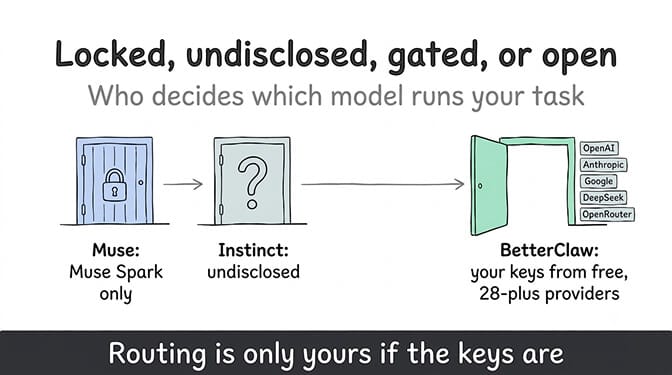
Model flexibility: locked, undisclosed, or open
Muse: Muse Spark only. Instinct: undisclosed. BetterClaw: your keys from free, across 28-plus providers including OpenAI, Anthropic, Google, DeepSeek, Mistral and OpenRouter, with zero markup on inference.
Why this matters more this month than last: Anthropic trimmed Claude Code weekly limits on September 14, OpenAI put the five-hour cap back on Plus in late August, and the cheap open-weight tier (DeepSeek V4 Flash, GLM-5.3-Flash, Kimi) has never been better for triage and drafting. A platform that lets you route per agent, per task, lets you ride that. A platform that bundles one model makes the decision for you, and you pay whatever that model costs whether the task needed it or not. We wrote the routing rules up in the Claude Code and ChatGPT rate limit alternatives post.
If the idea of paying a fixed monthly fee for a model you didn't choose, on tasks that don't need it, sounds like the wrong deal, that's exactly why we made BYOK the default rather than the upgrade. Free plan, no card, one agent, your own keys.
What breaks, and who fixes it
Every one of these products is going to break on you at some point. The question is what happens next.
Muse shipped despite internal reliability concerns, and consumer products from Meta update on Meta's schedule. You'll get what the app store gives you.
Instinct is a beta. Breakage is the deal you accepted with the invite.
BetterClaw stages updates, migrates config before restart, and rolls an agent back if a release breaks it. Real-time health monitoring auto-pauses an agent on anomalies rather than letting it loop. That's the difference between "managed hosting" and "managed agents": one keeps the box up, the other keeps the agent behaving.
If you're running OpenClaw yourself instead, that difference is the whole job. The September 2026.9.2 release was 1,247 pull requests and flipped two defaults (swarm on, cross-agent session visibility on), and you inherit those on upgrade unless you review them. We covered what changed in 2026.9.2 and the nine ways a Gateway fails to start after an update, because we've hit all of them.
Who each one is actually for
Muse if you want a personal assistant for life admin, you're in the US, you're fine with Meta holding the environment, and you want a flat $0 to $100 with no model decisions to make. It's the most polished consumer agent on the market as of this week.
Instinct if you have an invite and you're curious. Not for anything you depend on, not yet, and not before reading the terms.
BetterClaw if the agents are for work, you'll want more than one, you want to hold your own model keys, and you care what happens when a skill or a message turns out to be hostile. Fifty-plus companies including Carelon, Grainger, and Robert Half run on it for that reason. If you're weighing us against self-hosting rather than against these two, the managed vs self-hosting cost breakdown is the more useful page.
If you were on Klaus
Klaus ended service on September 1, 2026. Per its shutdown notice, every subscription was cancelled before the shutdown, the web app and all customer assistants are offline, and a Klaus export includes a recovery prompt you can paste into a new OpenClaw instance to restore your workspace, skills, and chat history.
That leaves two paths. Run OpenClaw yourself and paste the recovery prompt in, which works if you're comfortable owning updates and security. Or move to a managed platform: BetterClaw Basic is $19 a month for one agent, the same price Klaus Starter was, with your own model keys from day one.
What this week actually told me
Meta building on OpenClaw and Instinct raising at $2.5 billion aren't threats to a work-agent platform. They're a verdict on the category: the thing that acts on your behalf is now a product people will pay for, and the biggest companies in the world are shipping it to consumers.
What that leaves open is the harder problem. Not one agent for one person's life, but several agents for a business, on models the business chooses, with a security model that assumes the world is hostile because it is. That quadrant was empty on Monday and it's still mostly empty on Friday. It's where we live, and this week made me more certain, not less, that it's the right place to be.
If any of this resonated, give BetterClaw a try. Free plan with 1 agent and 100 credits a month, bring your own API keys, no inference markup. Pro is $49 a month for 5 agents. Your first deploy takes about 60 seconds. We handle the infrastructure and the security layer. You handle the interesting part. Start free or see full pricing.
Frequently Asked Questions
What is a managed AI agent platform, and how do Muse, Instinct and BetterClaw fit?
A managed AI agent platform hosts and runs an autonomous agent for you so you don't operate servers, updates, or model plumbing. Muse (Meta) and Instinct are consumer personal agents that manage one person's life admin; BetterClaw is a managed platform for building and running multiple work agents with your own model keys and a built-in security layer.
How does BetterClaw compare to Meta Muse for AI agents?
They solve different problems. Muse is a US-only consumer assistant on Meta's Muse Spark model, free up to a weekly token allowance and then $20 or $100 a month, with your data and agent living on a Meta-hosted VM. BetterClaw is for work agents: free for one agent, Pro at $49 a month for 5 agents and Business at $149 for 25, any of 28-plus model providers with zero markup, isolated containers, secrets auto-purge, and trust levels with approval gates.
What happened to Klaus, and what should Klaus users do?
Klaus, a managed OpenClaw hosting service, shut down on September 1, 2026. Subscriptions were cancelled before the shutdown and no further charges are made. A Klaus export includes a recovery prompt that restores your workspace, skills, and chat history into a new OpenClaw instance, so you can self-host OpenClaw or move to a managed platform such as BetterClaw, where Basic is $19 a month for one agent with your own model keys.
Is BetterClaw worth $49 a month when Muse starts free?
It depends on what the money buys. Muse's $0 bundles a locked model for a personal assistant. BetterClaw's $49 buys a Pro plan for 5 agents with your own keys at zero markup, Basic is $19 for one agent, and the free plan covers one agent with 100 credits a month. For one personal assistant, Muse is cheaper; for several work agents, BetterClaw usually is.
Is it safe to give an AI agent platform access to my email, calendar, and payments?
Only with controls in place. Look for isolation per agent, approval gates on sensitive actions, secrets that don't persist in agent memory, and a clear answer on what happens to your data if you disconnect. Muse has a per-user VM and Sentinel approvals; Instinct's reported terms say disconnecting doesn't delete indexed data; BetterClaw adds container isolation, five-minute secrets purge, trust levels, and skill vetting on top of a kill switch.