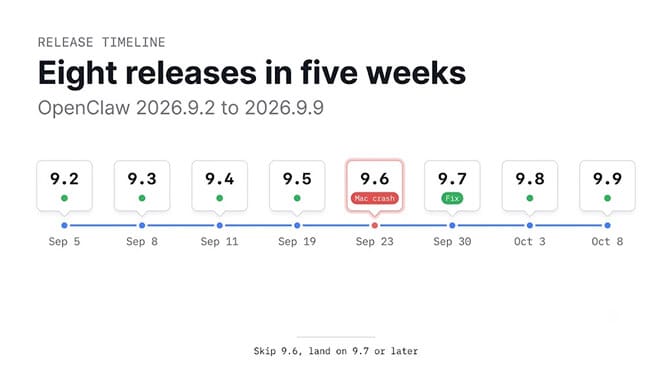
Eight releases in five weeks. Swarm on by default, agents reading each other's sessions, a Mac app that wouldn't open, and a Linux updater that rolled itself back every time. Here's the whole OpenClaw September 2026 update series, ranked by how much it can hurt you.
It's September 24. You click Update on the OpenClaw Mac app, it relaunches, bounces once in the Dock, and macOS tells you OpenClaw quit unexpectedly. You try again. Same thing. Your Gateway on the Linux box is fine. The app that talks to it is dead.
That was OpenClaw 9.6 for a lot of Apple silicon users. It's also the release that pushed this page from a 2026.9.2 breakdown into a full September recap, because the OpenClaw September 2026 update cycle didn't stop at 9.2. It ran all the way to 2026.9.9 on October 8.
I read every changelog in the series so you don't have to. The order below is by blast radius, not by version number.
The OpenClaw September 2026 update series at a glance
| Version | Released | What matters most |
|---|---|---|
| 2026.9.2 | Sept 5 | Swarm and cross-agent session visibility on by default, GPT-6 Astra |
| 2026.9.3 | Sept 8 | Updates rehearsed in isolated candidate state, shareable read-only conversation links |
| 2026.9.4 | Sept 11 | Rollback of compatible failed updates, unified Plugins workspace |
| 2026.9.5 | Sept 19 | Live plugin install and reload without a Gateway restart |
| 2026.9.6 | Sept 23 | Claude Opus 5.5 and GPT-6 Sol/Luna. Mac app crashed at launch |
| 2026.9.7 | Sept 30 | Source fix for the 9.6 Mac crash, fixes for updating from 9.5, verified backups and database rollback for failed updates |
| 2026.9.8 | Oct 3 | Safer update recovery, no two Gateways on the same data in containers |
| 2026.9.9 | Oct 8 | GPT-6.1 Sol in the Codex model list, Claude Haiku 5.5, Windows and Node exit-hang fixes |
Dates are when each version was published to npm. The current stable release, as of October 14, is 2026.10.3, which is outside this series. The OpenClaw latest version page tracks whatever is current.
If you remember one line from September: 9.6 was the release to skip, and 9.7 was the release that cleaned it up.
The OpenClaw 9.6 macOS crash, and how to get out of it
Here's what happened, in order.
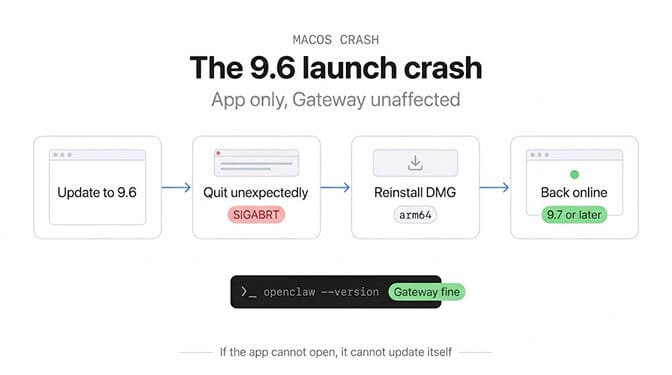
OpenClaw 2026.9.6 was published on September 23. Within hours, Apple silicon Mac users started filing the same report: the app aborted on launch with EXC_CRASH (SIGABRT), abort() called. Reports came in from macOS 26.6.1 and 27.0, on MacBooks, a Mac Studio, and a clean virtual machine.
The crash stacks pointed at Swift concurrency. One trace died in swift_task_dealloc inside CookieSyncManager.scheduleReconcile, another inside ChildProcessExit.wait(timeout:). The main tracking issue is #156861, titled "update to 2026.9.6 leaves OpenClaw completely unlaunchable on both Macs." A maintainer traced it to an async frame for a sleep call being written past its allocation.
Here's the weird part. The fix arrived twice.
- Early September 24: 9.6 was withdrawn from the in-app update feed, with 2026.9.5 named as "the version to run."
- September 24, 09:52 UTC: the release assets were replaced with a rebuilt, notarized 9.6 DMG, and the in-app update feed offered the rebuild from 12:18 UTC. Macs still on 9.5 got it through the normal update. Macs already on the crashing build couldn't self-update and needed the DMG, and the original reporter confirmed it worked.
- September 30: 2026.9.7 shipped the source fix (PR #156881), listed in its changelog as "address async-sleep paths implicated in Mac launch crashes."
The npm package was not affected. The CLI and the Gateway kept running. This was the Mac app only.
If your Mac app still won't open
The app can't update itself if it can't launch, so this is a manual job.
- Quit any half-open OpenClaw process.
- Download the current macOS DMG for your chip from the project's GitHub releases page. Version 9.6 was the first release with architecture-specific Mac builds, so pick the arm64 file on Apple silicon.
- Drag it over the old app and launch.
- Check the Gateway matches. Run
openclaw --versionon the Gateway host. When the Mac app manages a local Gateway, it updates the Gateway after the app relaunches, but it never overrides a remote or externally managed one.
If you want to stay conservative, 2026.9.5 was the maintainers' safe harbour during the outage. There's no reason to stop there now, because 9.7 and later carry the fix.
The other 9.6 trap: updates that always rolled back
The Mac crash got the headlines. The quieter bug hit servers.
Issue #157011, "Managed update 2026.9.5 → 2026.9.6 always rolls back," came from Linux hosts running npm-managed installs under systemd. The update would start, fail in update-history reconciliation, and roll back. The log line looked like this:
Update history reconciliation could not complete: RangeError: Maximum call stack size exceeded
The good news: the rollback worked. Gateways stayed healthy on 9.5. The bad news: doctor --fix didn't clear it, and maintainers warned against pruning update history by hand. Some reporters got through by running the update from an independent shell instead of from chat. Maintainers took it on as a fix the same day, and the 9.7 release notes list fixes for upgrading from 2026.9.5.
This is where most people get it wrong. They see "rolled back" and assume something is broken. On 9.5, a rollback was the safety net doing its job. The answer was to wait for 9.7, not to force it.
What 9.6 actually shipped (besides the crash)
Strip away the incident and 9.6 was a big release: 2,614 pull requests, 178 direct commits and 350 contributors.
- New models: Claude Opus 5.5 with thinking always on, GPT-6 Sol and GPT-6 Luna on the OpenAI API, plus xAI Grok 4.7 and Xiaomi MiMo V2.6.
- Restart recovery: stranded conversations are recovered and active work survives Node restarts.
- A GitHub reader opens public issues, pull requests and diffs beside chat.
- Per-agent decision models through the official TypeSafe plugin.
- A full 30-day usage history, with totals that include sessions beyond the visible list.
Two lines in the 9.6 notes can bite you. If you run an explicit plugin allowlist, add github or you lose the new previews. And remote workspaces need the Gateway and the paired node on the same OpenClaw version, so update both together.
9.7 to 9.9: September's cleanup crew
2026.9.7 (September 30) is the one that matters. 2,818 pull requests. Besides the two fixes above, it added verified backups that check every agent database is included, plus automatic database rollback for eligible updates that fail before the new version starts. Busy chats stall everyone else less, because transcript reads and archived-history preparation moved off the Gateway thread. It also added an OpenAI Agents API plugin and Sign in with ChatGPT as a beta auth option.
2026.9.8 (October 3) is a 43-pull-request safety release: repairing an update keeps the plugins you allowed and enabled, Windows updates retry when files are briefly in use, starting directly or in a container can no longer run two copies on the same data, and Anthropic conversations no longer get stuck waiting on background commands.
2026.9.9 (October 8) is mostly fixes, 112 pull requests. It adds GPT-6.1 Sol to the Codex model list and Claude Haiku 5.5, improves recovery after failed updates, and fixes commands and the Gateway service hanging on Node after printing their output.
Notice the pattern. Every release from 9.3 to 9.9 lists update safety in its highlights. That's a project telling you where it hurt.
9.3 to 9.5: the quiet middle
These three didn't make noise, but each changed how updates behave.
9.3 (September 8) rehearses core and plugin changes in isolated candidate state before activating them. It also added shareable conversations: a revocable, read-only public link to a session's text, current and future. Useful. Also a link anyone can open, so treat it like one.
9.4 (September 11) can restore the previous package and configuration when a compatible update fails, but you still need your own backup before upgrading, because rolling back the app alone can't undo a database format change. It also put bundled and ClawHub plugins into one Plugins workspace and added OPENCLAW_CONFIG_READONLY=1 for deployment-managed config.
9.5 (September 19) installs and reloads supported plugins without restarting the Gateway, and Doctor now preserves session history through upgrades. It's also the release the Mac crash sent everyone back to.
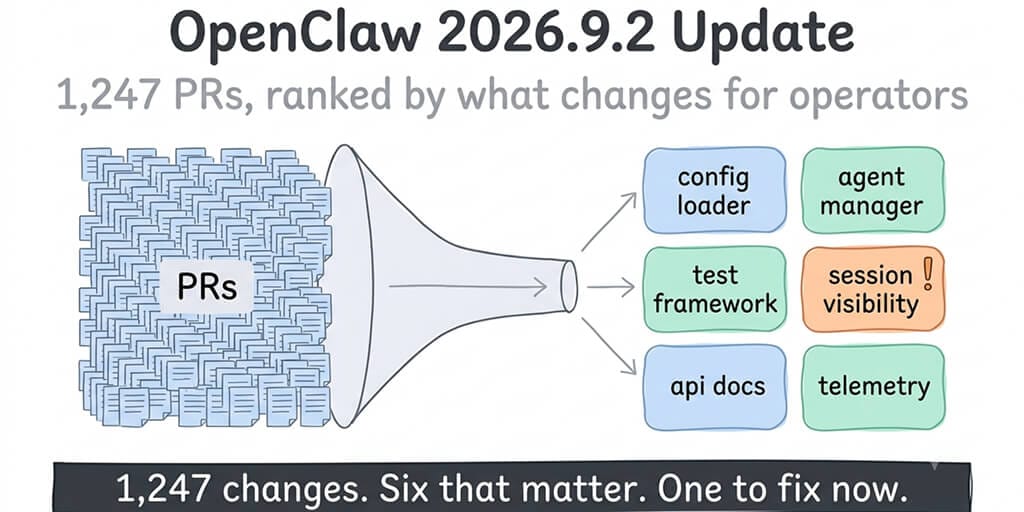
Where it started: 2026.9.2
The tag landed on September 5 at 20:00 UTC, signed by Peter Steinberger, with 1,247 pull requests in range. The line that mattered most wasn't in the Highlights section.
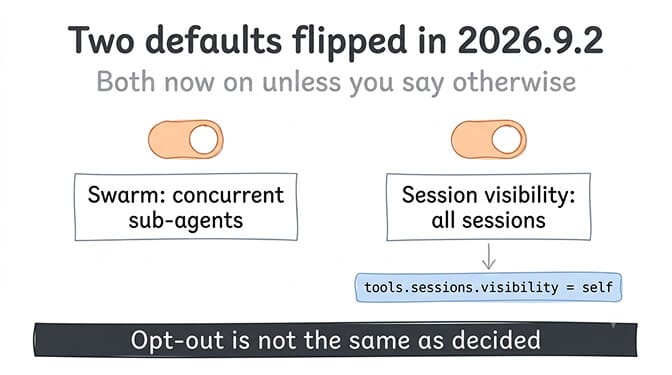
Buried in Changes: "session tools now default to all-session visibility and ordinary agent-to-agent access is enabled." If you run more than one agent on a Gateway, every one of them can now read the others' sessions unless you set tools.sessions.visibility to agent or self. That's a permissions change shipped as a feature. It's the kind of thing you want to know before your Reddit-scraping agent can read your banking agent's transcript.
The defaults that moved
Cross-agent session access is open by default. Set tools.sessions.visibility to self on any agent that handles credentials, money, or private messages. Existing tool and sandbox restrictions still apply, but visibility is now opt-out. The OpenClaw multi-agent setup guide covers why session isolation matters in the first place.
Swarm is enabled by default. Concurrent sub-agents with structured results and live progress, no flag required. Explicit opt-outs, tool restrictions, and the separate Code Mode opt-in are preserved. Tasks that used to run serially can now fan out, which is faster and also means a single bad instruction can be obeyed by several workers at once.
Two defaults flipped in one release: agents can see each other, and agents can spawn each other. Neither is a bug. Both deserve a deliberate yes rather than an accidental one.
GPT-6 Astra is in, with real plumbing
You can select openai/gpt-6-astra with an OpenAI API-key profile or an eligible ChatGPT/Codex account. Text and image input, Responses tool calls, and the supported reasoning controls all work. API-key users on the official Responses endpoint also get asynchronous function tools, steering over cached WebSockets, and a /think ultra orchestration mode.
Before you flip your default model, read the numbers. We ran Astra against Fable 5.1 and Sonnet 5 on real agent tasks and it came out the most expensive per task by a wide margin, largely because reasoning tokens bill as output at $50 per million. The full breakdown is in GPT-6 Astra vs Fable 5.1 vs Sonnet 5 on real agent work.
The reliability fixes that were overdue
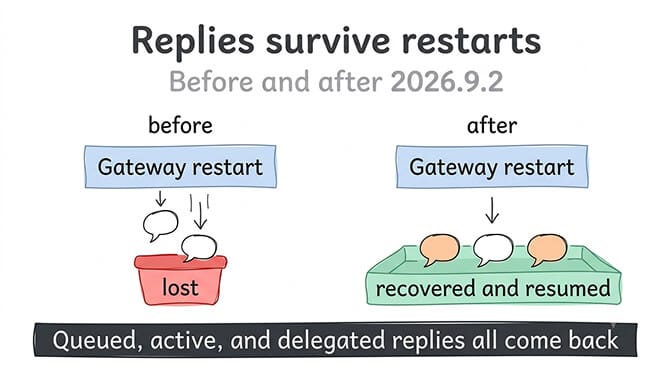
Upgrades keep your settings. Automatic updates retain active settings, enabled skills, and default-agent ownership. Replies survive restarts: active, queued, and delegated replies recover after a Gateway restart. Backups stopped lying: corrupt archive headers are rejected instead of accepted as a partial backup. And more settings now apply live without a restart.
Channel by channel
- Slack gets a native Stop button and no longer duplicates replies after a lost streaming acknowledgment.
- WhatsApp finally tells you why a turn failed, timed out, or was refused.
- Telegram restores media through configured SOCKS and HTTPS proxies.
- Discord adds an opt-in listen-only meeting capture with automatic notes.
- Mattermost recognises mention-prefixed commands like
@bot /new.
If reading eight changelogs in five weeks is starting to feel like a second job, that's the honest reason we built BetterClaw. It runs managed agents where the upgrade, the backup and the session isolation are handled for you, so a launch crash on someone's Mac never becomes your Saturday. Free plan, bring your own keys.
Should you upgrade now?
Yes, but not to 9.6, and not blind.
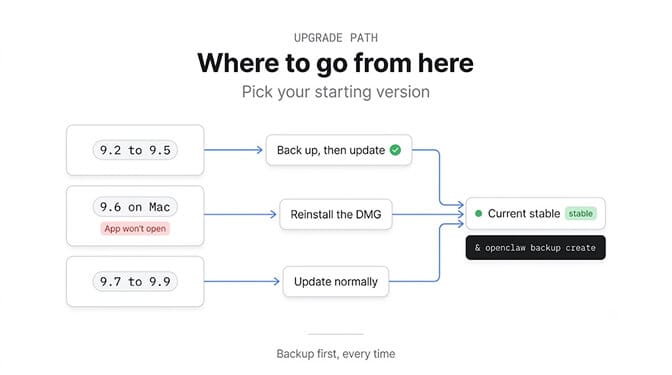
Check what you're actually running first, because automatic updates may have moved you:
openclaw --version
openclaw update status --json
Then match your situation:
- On 9.2 to 9.5: take a backup, then update. Since 9.7, updates make verified database backups of their own, but a backup you made yourself is the one you can trust. Our backup and restore before updating guide walks through it.
- On 9.6 with a Mac app that won't open: reinstall the DMG manually, as above.
- On 9.7 to 9.9: you're past both September landmines. Update normally.
- If you'd rather move slowly: the extended-stable channel (2026.8.35 as of October 12) skips the weekly churn and never auto-applies.
If you need to pin a specific known-good build instead of the newest one, the updater takes a tag: openclaw update --tag <version> --dry-run first, then without --dry-run. The how to update OpenClaw guide covers channels and rollbacks.
And if the Gateway doesn't come back after any of this, the log line tells you which failure you hit. See OpenClaw gateway won't start after updating.
Finally, the two-line check from 9.2 still applies after any upgrade:
# for each agent that handles anything sensitive
tools.sessions.visibility = "self"
# and decide, deliberately, whether swarm stays on
What September was really about
The repo sits at roughly 392,000 stars and 82,400 forks, with more than 6,000 open issues and 3,300 open pull requests. 9.2 alone was 1,247 pull requests. 9.6 was 2,614. 9.7 was 2,818.
That's not a project slowing down. That's a project shipping faster than any single maintainer, or user, can fully test. Two threads ran through the month: "let agents do more, together" and "stop losing people's stuff." The crash and the rollback bug sat right where those threads crossed.
The project is maturing from "a thing that runs" to "a thing that runs unattended," and unattended is where defaults and update safety matter most. The question after every release isn't "what's new." It's "what did I just say yes to, and can I undo it?"
If you'd rather not ask that question every week, you don't have to. Plenty of teams pick a managed platform for exactly this reason, and our guide to AI agent builder platforms compares the options honestly.
If any of this resonated, give BetterClaw a try. The free plan gives you one agent and 100 credits a month, bring your own API keys, no inference markup, and it never asks for a card. Basic is $19 a month, and Pro is $49 a month for five agents, or $39 a month billed annually, with a 7-day money-back guarantee. We handle the infrastructure. You handle the interesting part. Start free or see full pricing.
Frequently Asked Questions
What is the OpenClaw September 2026 update? It's the 2026.9.x release series: eight stable versions from 2026.9.2 on September 5 to 2026.9.9 on October 8. The big changes were Swarm and cross-agent session visibility on by default (9.2), safer updates with rehearsals, rollback and verified backups (9.3 to 9.9), and new models including Claude Opus 5.5, GPT-6 Sol and GPT-6.1 Sol. Version 9.6 also shipped a Mac app that crashed at launch, fixed in 9.7.
How does OpenClaw 9.6 compare to 9.7? 9.6 (September 23) added Claude Opus 5.5, GPT-6 Sol and Luna, restart recovery and a GitHub reader, but its Mac app aborted at launch and managed updates from 9.5 always rolled back on some Linux hosts. 9.7 (September 30) carried fixes for both, and added verified backups and automatic database rollback for eligible failed updates. If you're choosing between them, choose 9.7 or later.
How do I fix the OpenClaw macOS crash at launch? If the app quits unexpectedly on launch after updating to 9.6, it can't update itself. Download the current macOS DMG for your chip from the OpenClaw GitHub releases page, replace the app, and relaunch. A rebuilt 9.6 DMG fixed it on September 24, the source fix shipped in 2026.9.7, and the npm package, CLI and Gateway were never affected.
Is it worth upgrading OpenClaw every week? Not always. The stable channel moved eight times in five weeks, and the jump to 9.6 broke both the Mac app and some Linux updates. If stability matters more than new models, the extended-stable channel (2026.8.35 as of October 12) never auto-applies. If you do follow stable, back up before every update and skip any version with open launch or rollback reports.
Is OpenClaw safe to update without a backup?
It's safer than it was. Since 9.7, updates make verified database backups and can roll the databases back when an eligible update fails before the new version starts. But since 9.4 the release notes have told you to back up before upgrading, because rolling back the app alone can't undo a database format change, so run openclaw backup create first. It takes minutes, and it's the only copy you fully control.