What people actually move to when the learning loop stops being worth the maintenance, plus the cases where staying on Hermes is the right call. Pricing verified August 20, 2026.
The WSL2 install worked on Tuesday. By Friday the context length error was back, the Curator had archived a skill you were still using, and you had spent more time in the Hermes config than the agent had spent doing your actual work.
That is the moment people start searching for a Hermes Agent alternative. Not because Hermes is bad. Because the ratio flipped.
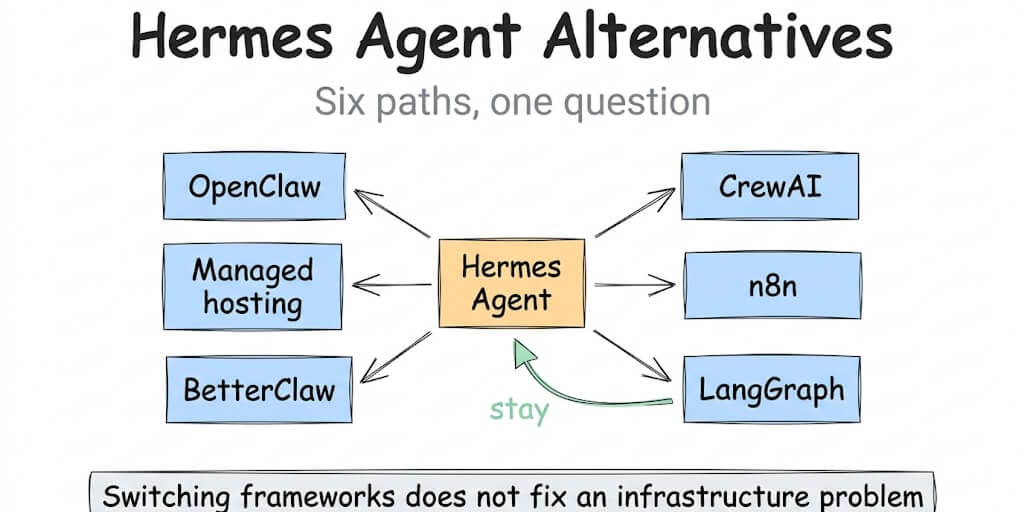
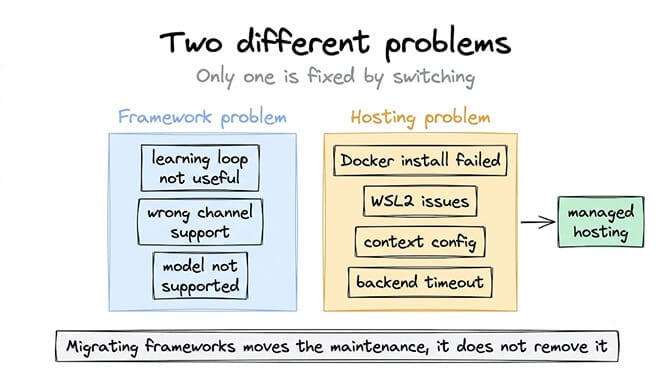
Here's what nobody tells you: most people looking for a Hermes alternative do not have a framework problem. They have a hosting problem wearing a framework costume. Switching from one self-hosted agent to another self-hosted agent moves the maintenance, it does not remove it.
So this roundup covers six real options, ranked by how long each takes to get a working agent, and closes with the case for staying on Hermes. Read that section before you migrate anything.
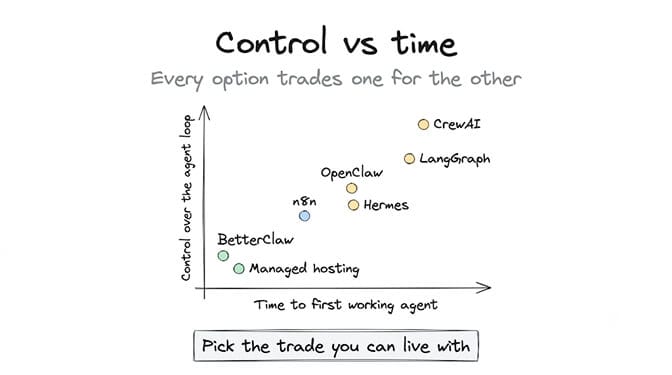
The six alternatives, ranked by time to a working agent
Prices are list prices as of August 20, 2026, before model tokens. Every option here supports bringing your own model keys, so token spend lands on your provider bill either way.
| Option | Entry price | Hosting | Time to first agent | Best for |
|---|---|---|---|---|
| BetterClaw | $0 free plan | Managed | About 60 seconds | Skipping infrastructure entirely |
| Managed OpenClaw hosting | Varies by host | Managed | Minutes | Keeping OpenClaw, dropping the VPS |
| OpenClaw | $0 | Self-hosted | 4 to 8 hours | Maximum ecosystem breadth |
| n8n | €20 / month | Either | An afternoon | Deterministic workflows |
| CrewAI | $0 | Self-hosted | A day, if you write Python | Custom multi-agent orchestration |
| LangGraph | $0 framework, $39 / seat for LangSmith | Self-hosted | Days | Full control of the agent loop |
Why people leave Hermes in the first place
Look at what people actually search for alongside "hermes agent alternative" and the pattern is not subtle.
Docker install failures. Context length below the minimum. Teams integration that will not connect. Auth errors. Backend timeouts at 15,000ms. Our own Hermes Agent error decoder exists because that failure surface is wide enough to need one.
None of those are complaints about the learning loop, which is the thing Hermes is genuinely best at. They are complaints about running software on your own machine.
The feature that made you choose Hermes and the friction that makes you leave it are unrelated. That is worth sitting with before you migrate.
Hermes is a real piece of engineering. Nous Research shipped it in February 2026 and it hit 60,000+ GitHub stars in two months with 295+ contributors, 20 messaging platforms, and 200+ supported models. The Curator reviewing and consolidating skills on a seven day cycle is something no other agent does automatically.
Its weak spots are equally specific. Native Windows support is still early beta with WSL2 as the recommended path. The MCP ecosystem is younger than OpenClaw's 1,000+ servers. And the whole thing assumes you are comfortable owning a runtime.
OpenClaw, if you want the biggest ecosystem
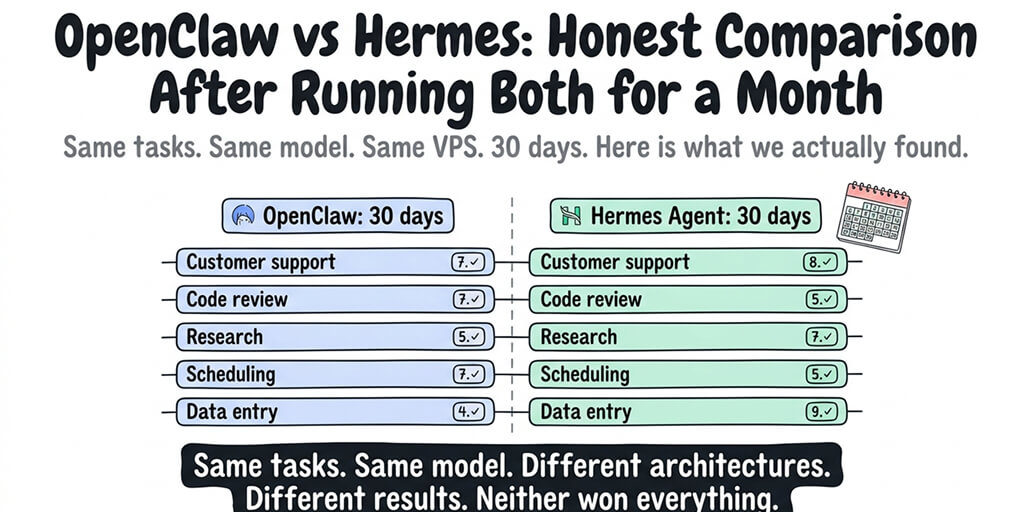
The obvious first stop, and the comparison most people are actually making. We wrote the full head-to-head in OpenClaw versus Hermes, so here is only what matters for the switch decision.
OpenClaw made the opposite bet. Breadth over depth. 230K+ GitHub stars, 1,400+ skills on ClawHub, 50+ messaging channels, 1,000+ MCP servers. If your Hermes complaint is "the integration I need does not exist," OpenClaw probably has it.
The cost of that breadth is a security surface Hermes deliberately kept smaller. The ClawHavoc campaign put 1,400+ malicious skills on ClawHub. CVE-2026-25253 was a one-click remote code execution flaw at CVSS 8.8. Researchers have catalogued 500,000+ instances sitting on the public internet without authentication, and Cisco documented a third-party skill exfiltrating data with no user awareness.
Makes sense when you need an integration or channel Hermes does not have. Does not make sense when you left Hermes because self-hosting was the problem, because OpenClaw self-hosts harder.
Managed OpenClaw hosting, if you like the framework and hate the server
The middle path. Someone else runs the OpenClaw instance, you keep the skills and channels.
This solves the actual complaint for a lot of people: no VPS, no Docker, no WSL2, no 2am restarts. The same holds for any managed agent builder that owns the runtime on your behalf. What it does not solve is the skill supply chain, since a managed host running OpenClaw still pulls from the same ClawHub.
Pricing varies enough between providers that quoting one number here would mislead you. We keep a current comparison in our OpenClaw hosting guide.
Makes sense when your OpenClaw or Hermes setup works and the server is the burden. Does not make sense when you also want verified skills and approval gates, which most hosts do not add.
BetterClaw, if the infrastructure was never the point
We build this, so apply the appropriate discount to what follows.
The pitch is narrow: you were never trying to run a runtime, you were trying to get an agent to do work. Free plan gives you one agent with every feature and no credit card. Pro is $49 per month for 5 agents. You bring your own model keys with zero markup on inference, across 28+ providers.
The parts that matter if you are coming from Hermes specifically: 200+ verified skills behind a four-layer audit that has rejected 824 malicious submissions, 25+ one-click OAuth integrations, 15+ chat platforms, isolated containers per agent, and secrets that auto-purge from agent memory after five minutes. No WSL2, no Docker, no context length config file.
What you give up is real. No learning loop that writes its own skills. No Curator. If those are why you chose Hermes, this is a downgrade on the axis you care about most, and I would rather say that than pretend otherwise. The full comparison, including where Hermes wins, lives on our Hermes Agent vs BetterClaw page, feature by feature.
Makes sense when you want agents running today and never want to see a config file. Does not make sense when self-improving skill generation is the core of your workflow.
If your last three evenings went into Docker and WSL2 rather than into anything your agent produced, that is the entire argument. Free plan, no credit card, and your first agent is live in about sixty seconds.
n8n, if the work was never autonomous
Worth naming honestly: a lot of people running Hermes do not need an agent at all. They need a reliable pipeline.
Starter is €20 a month billed annually for 2,500 workflow executions, Pro is €50 for 10,000, and the self-hosted community edition is free. Over 1,200 integrations, and billing by execution rather than by step means a complex workflow costs the same as a simple one.
Makes sense when the path is fixed. Trigger, transform, send, done. Does not make sense when you need the agent to choose its own next step, because n8n has no persistent agent memory and no trust levels.
CrewAI, if you want to own the orchestration
Open source, 47K+ GitHub stars, used by IBM, PepsiCo, and DocuSign. Role-based multi-agent design that prototypes fast if Python is already in your hands.
The hosted Basic tier is free with 50 workflow executions a month, and Enterprise is quote-only.
Makes sense when you want to define how agents divide work rather than accept a framework's opinion. Does not make sense when you were hoping to spend less time in a terminal, because this is more terminal, not less.
LangGraph, if you want maximum control and will pay for it in time
The developer-first option. The framework is open source, and the paid surface is LangSmith: Developer at $0 per seat with 5,000 base traces a month, Plus at $39 per seat with 10,000, then usage-based at $1.50 per compute unit and $1.00 per storage unit.
That metered model is worth understanding before you commit. It is the same consumption structure the hyperscalers use, which is cheap while you experiment and unforecastable once you scale.
Makes sense when you need graph-level control over agent state and branching. Does not make sense when you have a deadline, because the learning curve is the steepest on this list.
When you should stay on Hermes
This is the section most alternatives roundups skip, which is why most of them are useless.
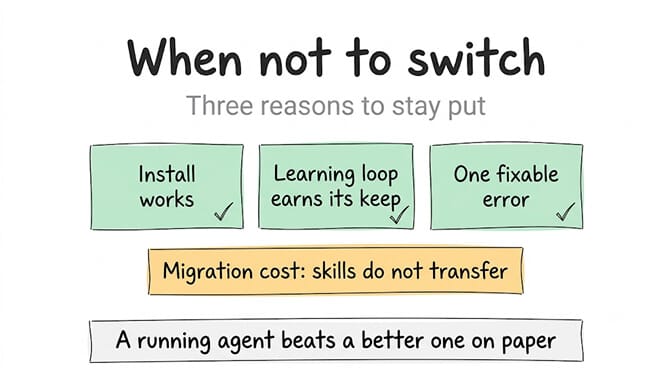
Stay if your install works. A running agent is worth more than a theoretically better one, and migration costs you the accumulated skills the learning loop already built. That library is not portable.
Stay if the learning loop is doing real work for you. Nothing else on this list converts completed tasks into reusable skills automatically. If your agent handles the same category of request weekly and has gotten measurably better at it, you would be trading away the only feature you cannot replace.
Stay if your problem is one fixable error. Context length below the minimum is a config value. A Docker install failure is usually a permissions or compose issue, and if you'd rather keep going, our guide to self-host with Docker covers both. Our Hermes Agent bugs and fixes roundup covers the ten most reported failures, and most of them take ten minutes.
Many people run both. Hermes as the runtime layer for learning and depth, OpenClaw or a managed platform for breadth and channels. These frameworks are not mutually exclusive, and treating the choice as binary is a mistake the comparison-article format encourages.
Verdict by situation
Your install keeps breaking and you have deadlines. Managed, either an OpenClaw host or a managed platform. Stop debugging runtimes on company time.
You need an integration Hermes does not have. OpenClaw, with the security caveats taken seriously. Verify skills before installing them.
Your team is not technical. Managed with a visual builder. Nothing self-hosted survives contact with a team that does not want to own it.
The work is deterministic. n8n, and drop the agent framing.
You want to build something nobody has built. CrewAI or LangGraph. Accept that infrastructure is now part of your job description.
Everything works and you are just browsing. Close the tab. You are fine.
That last one is not a joke. The best outcome of an alternatives article is sometimes that you keep what you have.
The honest closing thought
The agent framework space in 2026 rewards patience in a way nobody advertises. Hermes shipped in February and had 60,000 stars by April. OpenClaw has 230,000 and a CVE history. Both will look different in six months, and the migration you make this week may need making again.
What does not change is the question underneath. Are you building an agent, or are you maintaining a server so that an agent can exist? Those are different jobs, and only one of them shows up in your product.
If it is the second one, start free on BetterClaw. One agent, every feature, no credit card, your own keys with no markup on inference. Pro is $49 per month for 5 agents with full pricing on a single page, and 50+ companies including Carelon, Grainger, and Robert Half run production agents on it. If you would rather compare the whole category first, our best OpenClaw alternatives comparison covers the wider set.
Frequently Asked Questions
What is the best Hermes Agent alternative?
It depends on why you are leaving. If self-hosting is the burden, a managed platform like BetterClaw or a managed OpenClaw host removes it entirely. If you need a bigger ecosystem, OpenClaw has 230K+ stars and 1,400+ skills against Hermes Agent's 60K+ stars. If the work is deterministic rather than autonomous, n8n is a better fit than any agent framework.
How does Hermes Agent compare to OpenClaw?
They made opposite bets. OpenClaw prioritizes breadth with 230K+ stars, 50+ channels, and 1,000+ MCP servers, while Hermes prioritizes runtime depth with a learning loop that converts completed tasks into reusable skills. OpenClaw ships faster with more breaking changes and a documented security history including CVE-2026-25253 and the ClawHavoc skill campaign. Many teams run both.
How do I migrate off Hermes Agent without losing my setup?
Export your model keys and channel configurations first, since those move cleanly to any platform. Your Curator-generated skills do not, because no other framework has an equivalent, so audit which ones you actually depend on before switching. Run both in parallel for a week rather than cutting over, since agent behaviour differences show up in edge cases, not in the first test.
How much does a Hermes Agent alternative cost?
Self-hosted options are free as software and cost you a VPS at roughly $50 to $200 a month once you include storage and your own time. Managed platforms start at $0 on our free plan and $49 per month for Pro (5 agents), with n8n at €20 and LangSmith at $39 per seat. Since every option here supports bringing your own keys, model tokens cost the same regardless.
Is a managed agent platform safe enough to replace a self-hosted one?
It depends on the isolation model rather than on who runs the server. Self-hosting gives you control but also gives you the entire attack surface, which is how 500,000+ unauthenticated instances ended up exposed on the public internet. Look for per-agent sandboxing, verified skills, approval gates before consequential actions, and credential handling that purges secrets from memory rather than storing them indefinitely.