
The DGX Station has no official price. Public OEM listings start at $91,812.55 and sit around $100,000 before storage, add-on GPUs and service push quotes higher. Here is what the price really covers, what else buys you serious local AI capacity, and the uncomfortable reason most of the cheap alternatives got expensive too.
A friend sent me a screenshot on Tuesday. NVIDIA's own marketplace, RTX PRO 6000 Blackwell, 96GB. Sixteen thousand dollars.
He had built his hardware budget in a spreadsheet eleven months earlier, when that same card listed at $8,565. His whole plan, the one where he skipped the DGX Station and bought two workstation cards instead, had quietly doubled in price while he was busy getting approvals.
That is the actual state of this decision in 2026, and it is why most DGX Station alternative comparisons you will find are wrong. They were written against 2025 prices. The memory shortage moved every single number on the board, and it did not move them evenly.
So here is the honest version. What the DGX Station costs, what the six real alternatives cost right now, and the case for not buying any of them.
Stay with me on that last one. It is not the answer you expect from a page like this.
This page covers the DGX Station specifically. If you are still working out which DGX you were pricing in the first place, our NVIDIA DGX alternatives overview compares the whole family — Spark, Station, and the rack tiers — and hands off to the right page from there.
DGX Station price: what each OEM charges (September 2026)
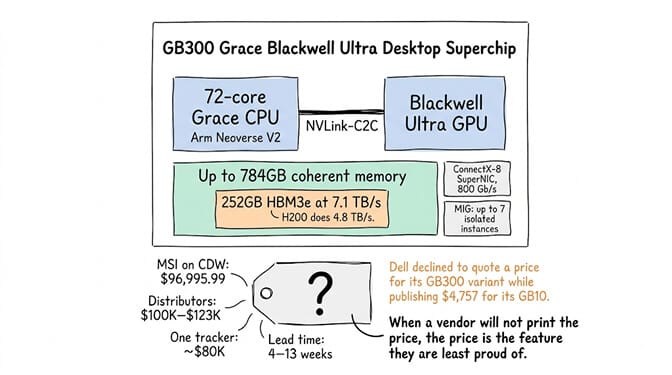
Quick answer: NVIDIA does not publish a DGX Station price and does not sell a Founders Edition. You buy it from an OEM, and the cheapest public US listing on 28 September 2026 was $91,812.55 (Supermicro). Most base configurations list at $96,000 to $100,000, and quotes with extra storage, an add-on GPU and on-site service go well past that.
| DGX Station system | Public US price | Status (28 Sept 2026) |
|---|---|---|
| Supermicro Super AI Station (Gold Series ARS-511GD-NB-LCC-01-G2) | from $91,812.55 | Listed in stock on Supermicro's eStore |
| Exxact Valence VWS-158270643 | $96,250 base | Configure-to-order on Exxact's configurator |
| MSI XpertStation WS300 | $99,999 | Newegg, out of stock |
| ASUS ExpertCenter Pro ET900N G3 | quote | Sold through resellers |
| Dell Pro Max with GB300 | quote | Dell's US store shows it as unavailable |
| HP ZGX Fury G1n AI Station | quote | Sold in fixed SKUs through HP and resellers |
Every one of these carries the same GB300 superchip and the same 748GB of coherent memory. What changes the price is everything around it.
What "DGX Station price" actually means. NVIDIA supplies the GB300 board and partners build the workstation around it, so there are at least six prices, not one. A listed figure is a base configuration. Storage, an optional RTX PRO card for display and graphics work, warranty length and on-site service are all extras. The European distributor pi3g quotes the same family from about $99,000 to $194,500 depending on vendor and configuration, with lead times of two to sixteen weeks as of mid-September.
Costs that are not on the invoice. NVIDIA rates the system at 1,600 W and requires a 20A circuit, so budget for an electrician before the machine arrives. Exxact also offers education and government pricing, which is worth asking every vendor about.
When a vendor will not print the price, the price is the feature they are least proud of. The practical move is to get two or three OEM quotes on an identical configuration, because the spread between them is larger than any discount you will negotiate on one.
What a DGX Station is
The DGX Station is NVIDIA's desktop workstation built around the GB300 Grace Blackwell Ultra Desktop Superchip. A 72-core Grace CPU on Arm Neoverse V2, fused to a Blackwell Ultra GPU over NVLink-C2C.
The number that matters is memory: 748GB of coherent memory, made up of 252GB of HBM3e running at 7.1 TB/s plus 496GB of LPDDR5X on the Grace CPU. For reference, an H200 does 4.8 TB/s. NVIDIA rates it at up to 20 petaFLOPS of FP4. It also carries a ConnectX-8 SuperNIC at up to 800 Gb/s, which lets you link two Stations together, and it supports MIG partitioning into as many as seven isolated instances.
NVIDIA pitches it at the trillion-parameter model class. That is not marketing inflation. It genuinely holds models nothing else on a desk can hold.
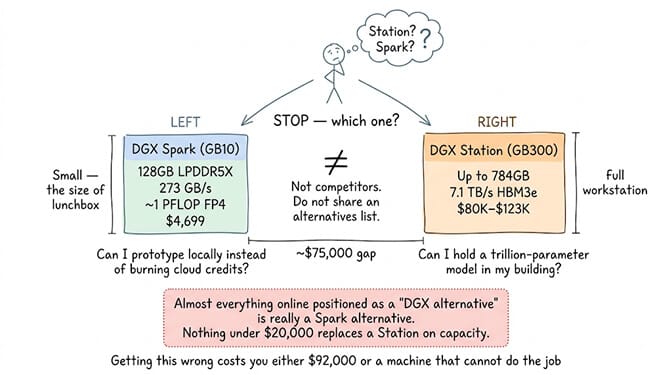
Wait. Do you mean the Station or the Spark?
This trips up a surprising number of people, and getting it wrong costs you either $92,000 or a machine that cannot do the job.
DGX Spark is the small one. GB10 Superchip, 128GB of LPDDR5X unified memory, roughly 273 GB/s of bandwidth, about 1 petaflop of FP4 compute. It launched at $3,999 in October 2025 and was raised to $4,699 in late February 2026, with NVIDIA citing memory supply.
DGX Station is the workstation. GB300, 748GB of coherent memory, HBM3e at 7.1 TB/s, and a price roughly twenty times higher.
They are not competitors and they do not share an alternatives list. A Spark buyer is asking "can I prototype locally instead of burning cloud credits." A Station buyer is asking "can I hold a trillion-parameter model in my building." If you landed here but you actually meant the smaller machine, our DGX Spark alternatives breakdown covers that comparison properly.
Here is where it gets messy. Almost everything positioned as a "DGX alternative" online is really a Spark alternative. Nothing under $20,000 replaces a Station on capacity. What the cheaper options do is let you ask whether you needed that capacity at all.
The DGX Station alternatives worth pricing, ranked by cost
Prices below reflect September 2026 street reality, not launch MSRPs. Verify before you buy, because these have been moving monthly.
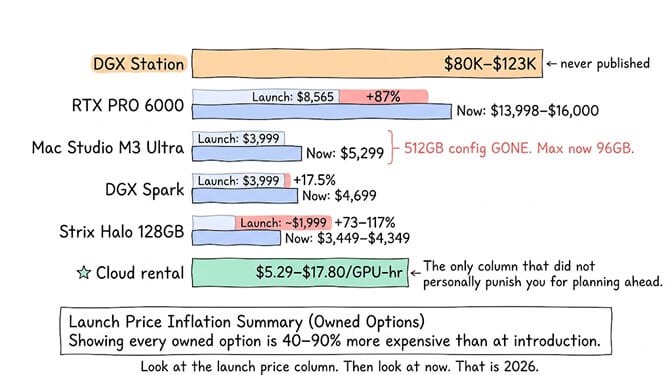
| Option | Memory | Bandwidth | Price (Sept 2026) | Launch price |
|---|---|---|---|---|
| NVIDIA DGX Station (GB300) | 748GB coherent | 7.1 TB/s (HBM3e) | $91,812.55 to $99,999 listed, more as configured | never published |
| RTX PRO 6000 Blackwell 96GB | 96GB GDDR7 | 1.79 TB/s | $13,998 to $16,000 | $8,565 |
| Mac Studio M5 Ultra | up to 512GB | 1.2 TB/s | from $5,499 | from $5,499 |
| NVIDIA DGX Spark | 128GB LPDDR5X | 273 GB/s | $4,699 | $3,999 |
| Strix Halo 128GB mini PC | 128GB unified, ~96GB GPU-addressable | 256 GB/s | $3,099 to $4,349 | ~$1,999 |
| RTX 5090 multi-GPU build | 32GB per card | 1.79 TB/s | roughly $4,600 to $7,000 per card | $1,999 |
| Cloud rental (B200 on demand) | 180GB per GPU | full HBM | $6.69 to $6.99 per GPU-hour at Lambda | n/a |
Look at that "launch price" column for a second. Almost every owned option on this list costs more than it did at introduction, and the RTX 5090 now sells for more than double its launch price. The Mac Studio only escapes because it launched in August at post-shortage prices. The rental column is the only one that did not personally punish you for planning ahead.
RTX PRO 6000 Blackwell 96GB: the alternative that stopped being obvious
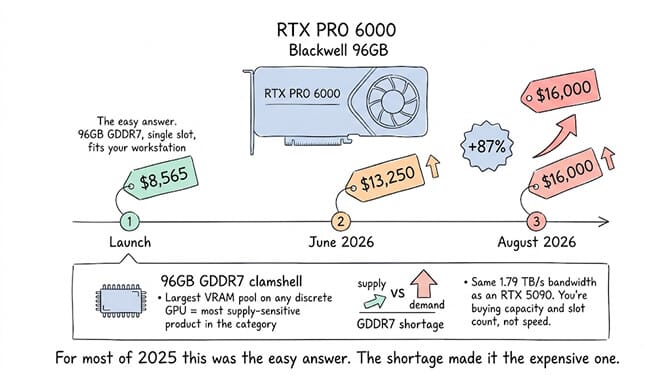
For most of 2025 this was the easy answer. Ninety-six gigabytes of GDDR7 with ECC in a single slot, 24,064 CUDA cores, 1.79 TB/s, and it slotted into a workstation you already owned.
Then it went from $8,565 at launch to $13,250 in June 2026 to $16,000 on NVIDIA's marketplace by August, where it still sits in September. Roughly 87 percent up from launch. Newegg has listed it near $13,998 and B&H around $15,499, so shop around, but the direction is one way.
The cause is the GDDR7 shortage. This card uses a 96GB clamshell design, the largest VRAM pool on any discrete GPU, which makes it the single most supply-sensitive product in the category.
Worth knowing: it shares the exact same 1.79 TB/s bandwidth as an RTX 5090. You are buying capacity and slot count, not speed.
Mac Studio M5 Ultra: the ceiling came back
This section used to be the bleakest one on the page, and it is now the most improved. Update your assumptions if you are working from a comparison table written before September.
Here is what happened. For most of 2026 the Mac Studio was a cautionary tale: Apple pulled the 512GB M3 Ultra configuration in March, the 256GB tier in May, and raised prices in June, all blamed on memory supply. The M3 Ultra ended its life topping out at 96GB for $5,299, up from a $3,999 launch. For a while the highest-capacity desktop outside the data center simply did not exist at any price, and used 512GB units were changing hands above $25,000 on eBay.
Then on August 25, 2026 Apple announced the M5 Max and M5 Ultra Mac Studio and discontinued the M3 Ultra outright. The 512GB ceiling is back, and the bandwidth went up with it: 1.2 TB/s, which Apple puts at 50 percent higher than the previous generation and is roughly four and a half times a DGX Spark's 273 GB/s. Pricing starts at $5,499 for 96GB, and the 256GB configuration is $11,299 on Apple's store. Deliveries began September 22, though the 512GB configuration specifically is not expected until late October. Apple also claims four machines can be clustered over Thunderbolt 5 with RDMA into a single shared memory pool.
That puts the Mac Studio back above the RTX PRO 6000 on capacity rather than level with it, and it is now the cheapest way to hold a very large model in unified memory on a desk. The caveats are the familiar ones: no CUDA, so your local stack does not mirror a cloud deployment, and Apple's memory pricing above the base configuration has never been kind. We compared the two ecosystems in more depth in our piece on Apple Silicon versus NVIDIA for AI workloads if the platform question is the real one for you.
DGX Spark: the CUDA parity play
At $4,699 the Spark is not fast. Its 273 GB/s bus is the bottleneck, and dense 70B decode lands in single digits with common tooling.
What it buys is software. The full CUDA and TensorRT-LLM stack, matching what your cloud instances run, so what works on your desk works in production. NVIDIA's CES 2026 software update delivered up to 2.5x improvement over launch performance through TensorRT-LLM work and speculative decoding, which materially changed its value.
Buy it as a development box. Do not buy it as an inference server.
Strix Halo 128GB mini PCs: the capacity bargain that also inflated
The AMD Ryzen AI Max+ 395 puts 128GB of unified LPDDR5X in a machine the size of a lunchbox, with roughly 96GB addressable as GPU memory on Linux. That is more usable model space than an RTX 5090 at a fraction of the power draw.
Early in 2026 you could get a 128GB Framework Desktop for $1,999. As of late September the 128GB tier runs from $3,099 (Bosgame M5, 2TB) through $3,649.99 (GMKtec EVO-X2, 2TB) to $4,349 (Beelink GTR9 Pro), with Framework's $3,449 build out of stock. The $2,199 EVO-X2 you may have seen quoted is the 64GB model.
Bandwidth is 256 GB/s, so this is a capacity-first box, not a speed box. Run big models slowly and privately, and be comfortable on Linux, because the Windows path costs you 20 to 30 percent throughput.
RTX 5090 multi-GPU: the DIY route
Same 1.79 TB/s as the PRO 6000, 32GB per card, and it launched at $1,999. New cards sold for roughly $4,600 to $7,000 in September 2026 depending on the week and the retailer.
Four of them gets you 128GB of pooled VRAM for a little more than one PRO 6000, plus a power supply problem, a thermal problem, a chassis problem, and tensor parallelism configuration to debug. Genuinely good value if your time is cheap and your electrician is friendly.
Renting DGX-class hardware instead of buying it
Here is the math nobody in a hardware sales conversation wants on the whiteboard.
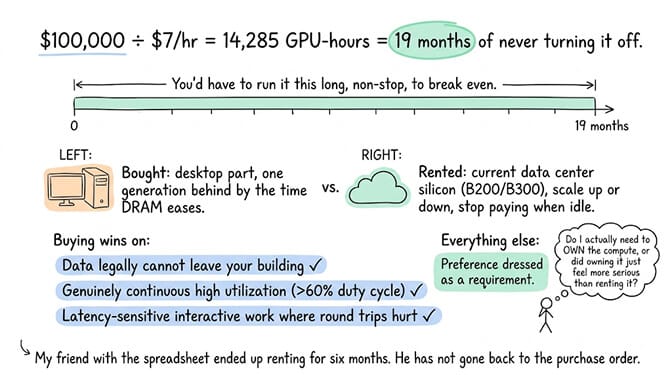
Lambda rents an on-demand B200 (180GB of HBM per GPU) for $6.69 to $6.99 per GPU-hour depending on instance size, and an H100 SXM from $3.99. Other clouds price differently, so shop around, but those are the list rates as of late September.
Take the cheapest DGX Station listing, $91,812.55. At $6.69 an hour on a B200, that is about 13,700 GPU-hours. Nearly nineteen months of literally never turning the thing off. And you are renting current data center silicon rather than owning a desktop part that will be a generation behind by the time the DRAM crunch eases.
Buying wins on three specific things. Data that legally cannot leave your building. Workloads that run genuinely continuously at high utilization. And latency-sensitive interactive work where round trips to a region hurt.
Everything else is a preference dressed as a requirement. We ran the same exercise for the smaller machine in DGX Spark cloud rental versus buying, and the shape of the answer was identical.
Now the part I actually want you to sit with.
A lot of people pricing a DGX Station tell me they need it "for AI agents." Almost none of them do. An autonomous agent spends its life doing orchestration, tool calls, memory lookups, and API round trips. The model inference is usually a hosted API call. The bottleneck is scheduling and context management, not local FLOPs.
Local silicon matters when the weights must stay in the room. It does not matter for most agent work, and conflating the two is how hardware budgets get approved for problems they do not solve.
Picking a DGX Station alternative by what you are actually doing
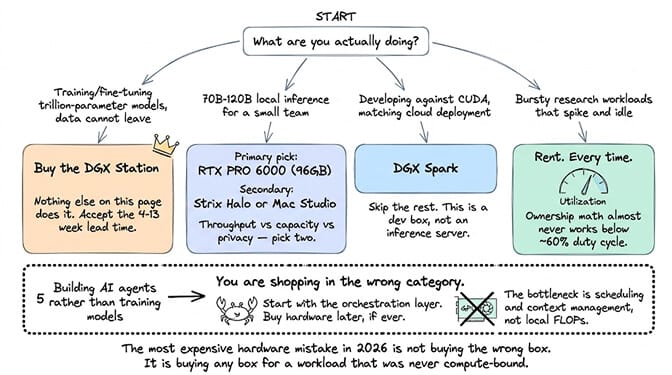
Training or fine-tuning trillion-parameter-class models on premises, with data that cannot leave: buy the Station. Nothing else on this page does it. Get quotes from at least two OEMs and accept a lead time of two to sixteen weeks.
Running 70B to 120B inference locally for a small team: the RTX PRO 6000 at 96GB, or a Strix Halo box if throughput matters less than capacity and privacy. If you need to go materially bigger than 96GB, the M5 Ultra Mac Studio at up to 512GB is now the cheapest route to it.
Developing against CUDA so your local work matches your cloud deployment: DGX Spark, and skip the rest.
Bursty research workloads that spike and idle: rent. Every time. The utilization math almost never favors ownership unless you are above roughly 60 percent duty cycle.
Building AI agents rather than training models: you are shopping in the wrong category. Start with the orchestration layer and buy hardware later, if ever. If you are running open models behind agents specifically, our notes on local model hardware for agent workloads get into what actually gets used versus what gets bought.
The most expensive hardware mistake in 2026 is not buying the wrong box. It is buying any box for a workload that was never compute-bound.
If your work is the agent layer and not the model layer, start free on BetterClaw. The free plan gives you one agent, 100 credits a month, and BYOK, with no credit card. Pro is $49 a month for five agents, unlimited connectors, and 90-day memory, with 20 percent off annually. Full pricing here. Fifty plus companies run agents on it including Carelon, Grainger, KeHE, Premier, and Robert Half, and none of them bought a workstation to do it.
What I would tell a friend with the purchase order open
Do not benchmark this decision against last year's prices. That is the whole lesson of 2026 so far.
The DGX Station is a legitimately remarkable machine and there is a narrow set of teams who should buy one without hesitation. If you hold regulated data and you need a trillion-parameter model in your own building, the alternatives are not alternatives, they are compromises with a different shape.
For everyone else, the shortage has done something useful. It has forced a question that cheap hardware let people avoid for years. Do you actually need to own the compute, or did owning it just feel more serious than renting it?
My friend with the spreadsheet ended up renting for six months while he found out. He has not gone back to the purchase order.
Frequently Asked Questions
What is the best DGX Station alternative?
It depends on what you are replacing. If you need the raw memory capacity, nothing under $20,000 genuinely substitutes for a GB300 Station, and renting B200-class capacity in the cloud is the closer functional match. The M5 Ultra Mac Studio at up to 512GB and 1.2 TB/s, from $5,499, is the closest desktop on capacity, though without CUDA. If you need 70B to 120B local inference rather than trillion-parameter work, the RTX PRO 6000 Blackwell at 96GB or a 128GB Strix Halo mini PC covers it for a small fraction of the price.
How does the DGX Station compare to the DGX Spark?
They are different machine classes despite the shared branding. DGX Spark uses the GB10 Superchip with 128GB of unified memory at roughly 273 GB/s and costs $4,699, while DGX Station uses the GB300 with 748GB of coherent memory including HBM3e at 7.1 TB/s and lists from $91,812.55 through OEMs. Spark is a development box, Station is a workstation-class compute machine.
How much does an NVIDIA DGX Station cost in 2026?
NVIDIA has never published an official price and does not sell a Founders Edition, so pricing comes from OEM partners. As of 28 September 2026 the cheapest public US listing was Supermicro's Super AI Station at $91,812.55, Exxact's Valence configurator started at $96,250, and the MSI XpertStation WS300 was $99,999 at Newegg (out of stock). Dell, ASUS and HP sell by quote. Configured quotes with extra storage, an add-on GPU and on-site service run higher, and lead times range from two to sixteen weeks.
Why is there no official DGX Station price?
Because NVIDIA does not sell the DGX Station itself. It supplies the GB300 board and OEMs such as Supermicro, Exxact, MSI, ASUS, Dell and HP build and price the finished workstation. Each one sets its own base configuration, storage, warranty and service options, which is why the same 748GB machine appears at several different prices.
Is renting DGX-class hardware cheaper than buying?
For most teams, yes, and by a wide margin. At Lambda's $6.69 per GPU-hour for an on-demand B200, the cheapest $91,812.55 DGX Station listing equals about 13,700 GPU-hours, which is more than a year and a half of continuous use before you break even. Ownership wins mainly when data cannot leave your premises or when utilization is genuinely sustained above roughly 60 percent.
Do I need a DGX Station or any local GPU to run AI agents?
Almost certainly not. Agent workloads are dominated by orchestration, tool calls, memory retrieval, and API round trips rather than local model inference, so the bottleneck is scheduling and context management rather than FLOPs. Unless your model weights are legally required to stay in your building, a managed agent platform with your own API keys costs nothing to test and removes the hardware question entirely.