Updated September 18, 2026. Prices checked against vendor and retailer listings on September 17-18, 2026. Specs verified against NVIDIA's product pages.
The short answer: the cheaper option at every budget
| Budget | DGX option | Cheaper alternative | Trade-off |
|---|---|---|---|
| Under $100/month | DGX Cloud ($5.29-$17.80 per GPU-hour) | Hosted model APIs, or a managed agent platform like BetterClaw (free plan, no card) | Nothing runs on your own hardware, so data goes to a provider |
| About $3,000 | Nothing: there is no DGX below the Spark | 128 GB Strix Halo mini PC (Bosgame M5, $3,099), or a Mac Studio M5 Max from $2,499 (the 128 GB build is $5,399) | No CUDA, and about 256 GB/s of bandwidth, similar to the Spark |
| About $5,000 | DGX Spark 64 GB, $4,999 (from 23 Oct; 128 GB is $6,950) | Mac Studio M5 Ultra from $5,499 (96 GB, 1.2 TB/s) | No CUDA, but more than 4x the Spark's 273 GB/s bandwidth for about the same money |
| About $15,000 | Nothing: DGX skips this rung | RTX PRO 6000 Blackwell 96 GB (MSRP $16,000, street $13,998-$15,499) | 96 GB ceiling, and you still need a host PC |
| $95,000+ | DGX Station, $94,930-$175,497 via OEMs | Rent a B200 at $6.69/hour (Lambda, on demand) | A variable bill, and one B200 is not 748 GB of coherent memory |
The rest of this page explains each tier. Every row has a deeper guide, listed in every DGX guide we've written.
You opened a tab to price a DGX and found no price. Not a "contact us" button hiding one, not a configurator. NVIDIA's DGX Spark and DGX Station product pages carry full specifications and zero dollar figures, and that is not an oversight.
Here's what nobody tells you: the absence of a published price is the most useful piece of information on those pages. Hardware that ships with a list price is a product. Hardware that ships with a "contact a partner to order" button is a procurement process, and procurement processes have a minimum viable company size attached.
The DGX family in one table
Street prices as of September 18, 2026. NVIDIA publishes no list price for any tier.
| Product | Silicon | Memory | Street price (Sept 2026) | How it is sold | Realistic buyer |
|---|---|---|---|---|---|
| DGX Spark | GB10 Grace Blackwell Superchip, up to 1 petaFLOP FP4 | 128 GB unified, 273 GB/s | $6,950 (128 GB); $4,999 (64 GB, from 23 Oct) | NVIDIA Marketplace (128 GB); the 64 GB model and OEM GB10 boxes from $5,688 via OEMs | Individual developer or small team |
| DGX Station | GB300 Grace Blackwell Ultra Desktop Superchip, up to 20 petaFLOPS FP4 | 748 GB coherent as shipped (252 GB HBM3e + 496 GB LPDDR5X) | $94,930 to $175,497 | OEMs only (Exxact, MSI, ASUS, Gigabyte, Dell, HP, Supermicro) | Funded team or research group |
| DGX SuperPOD | Rack-scale, built on GB300 NVL72 | Data centre scale | Six to seven figures, quoted | Enterprise procurement | Organisations with a data centre |
| DGX BasePOD | Reference architecture | Depends on build | Depends on build | Enterprise procurement | Teams building their own cluster |
| DGX Cloud | Rented NVIDIA infrastructure | Per instance | $5.29 to $17.80 per GPU-hour | Consumption billing | Anyone avoiding capex |
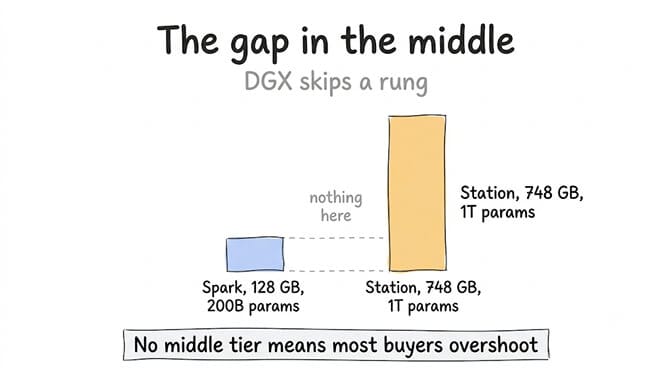
What each tier can hold: the Spark handles 200B-parameter inference and 70B fine-tuning, or 405B with two linked units. The Station holds models up to a trillion parameters and also links in pairs. NVIDIA's spec sheet says "up to 784 GB", which assumes the 288 GB of HBM3e announced at GTC 2025. Shipping units carry 252 GB, which is where the 748 GB figure comes from.
Two things jump out of that table.
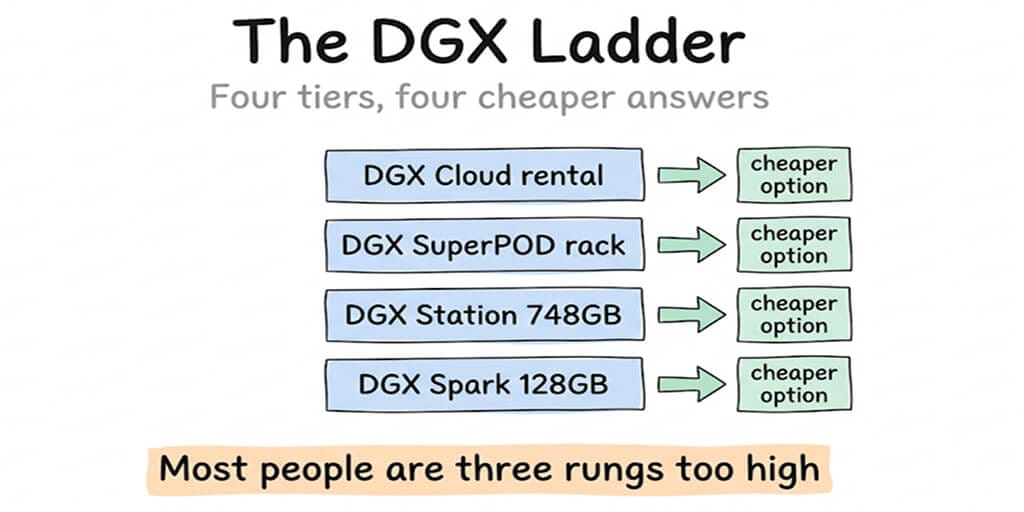
The gap between Spark and Station is not incremental. It is 128 GB against 748 GB, one petaFLOP against twenty, and about $4,700 against about $95,000. There is no middle rung, which is why so many people agonise over the choice: the ladder skips.
The Spark also no longer anchors the price of its own class. NVIDIA's box is the cheapest GB10 you can't currently buy. Every OEM version you can order costs more. Dell's Pro Max with GB10 is the cheapest at $5,688.18, and the range runs up to $7,496.
What each tier is actually for
DGX Spark, the agent box
NVIDIA is unusually direct about this one. The Spark product page describes it as a complete platform for local autonomous agents, built to run always-on agent workloads from the desktop.
128 GB of unified memory runs inference on models up to 200 billion parameters and fine-tunes up to 70 billion. Link two of them over ConnectX networking and you reach 405 billion.
The agent framing is not marketing drift either. NVIDIA ships NemoClaw, an open-source reference stack that adds security and privacy guardrails to OpenClaw, and a recent DGX OS update added streamlined NemoClaw installation. NVIDIA is explicitly courting the self-hosted agent crowd. We compared that stack directly in our NemoClaw comparison.
Buy it if you are running local models continuously and want the token bill to stop. Skip it if your agent workload is bursty, because idle silicon is the most expensive compute there is.
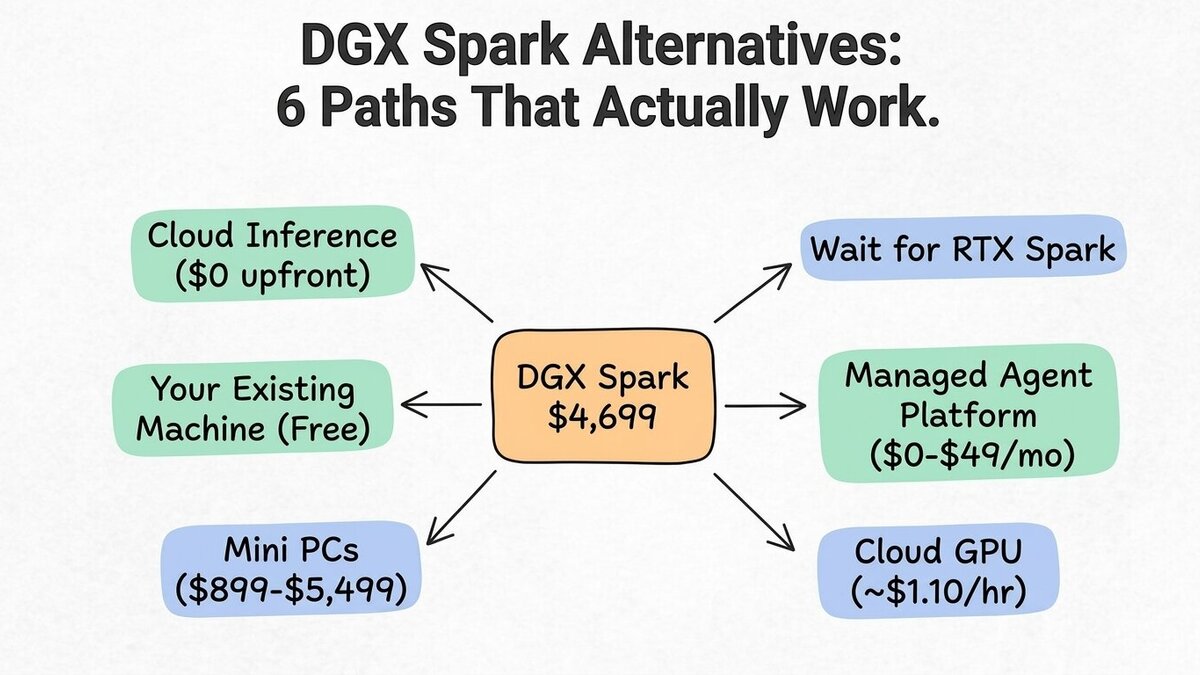
The deeper version of this argument lives in our DGX Spark alternatives breakdown.
DGX Station, the deskside supercomputer
The GB300 Grace Blackwell Ultra Desktop Superchip: a Blackwell Ultra GPU with 252 GB of HBM3e at 7.1 TB/s, and a 72-core Grace CPU with 496 GB of LPDDR5X, giving 748 GB of coherent memory as shipped. Up to 20 petaFLOPS, and support for models up to a trillion parameters. ConnectX-8 SuperNIC at up to 800 Gb/s, and two Stations can be linked.
It also has the features that tell you who it is really for: out-of-band telemetry via BMC, Redfish API support, hardware root of trust, enterprise secure boot. That is a fleet management story, not a hobbyist one. NVIDIA has also announced DGX Station for Windows.
NVIDIA doesn't sell it directly, and there is no Founders Edition. Public OEM listings start at $94,930 (Exxact Valence), sit around $97,000-$100,000 for the MSI XpertStation WS300 and ASUS ExpertCenter Pro ET900N G3, and top out at $175,496.74 for Dell's fixed Pro Max with GB300 configuration. Buy it if you are training or fine-tuning at a scale where cloud GPU bills have become a line item someone asks about. Skip it if you are inferencing, because you are buying training capacity to run a workload that does not need it.
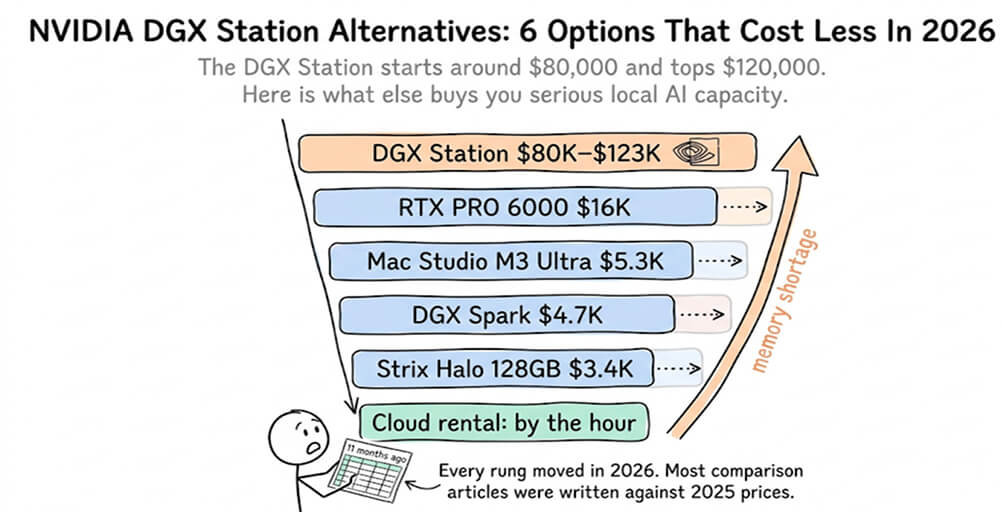
This page is the family overview and stops here on Station. For the full six-option comparison — RTX PRO 6000, Mac Studio, Strix Halo, multi-GPU builds and cloud rental, each priced against the Station with current street figures and lead times, see our DGX Station price guide.
The rack tiers, which you are not buying
SuperPOD is a full-stack blueprint for gigascale AI infrastructure built on GB300 NVL72. BasePOD is a reference architecture for building your own.
If you arrived here by searching "nvidia dgx alternative", you are not procuring a rack. Nobody types that query on the way to a data centre buildout.
I am naming these for completeness and moving on, because padding this section would waste your time and neither of us is here for that.
DGX Cloud, the tier that undercuts the rest
Rent the same silicon instead of owning it. No capex, no depreciation, no power draw in your office, and no eighteen month bet on which architecture wins.
The trade is that you are back to a variable bill, which is the exact thing most DGX shoppers are trying to escape. Our rent vs buy break-even analysis runs the arithmetic properly.
The question behind the question
Nobody wants a DGX. I have never met a person whose actual goal was to own a Grace Blackwell superchip.
What people want is for the token bill to stop, or for their data to stay on-premises, or for an agent to keep running without a rate limit. The DGX is one answer to those, and it is a capital-intensive answer to what is usually an operating problem.
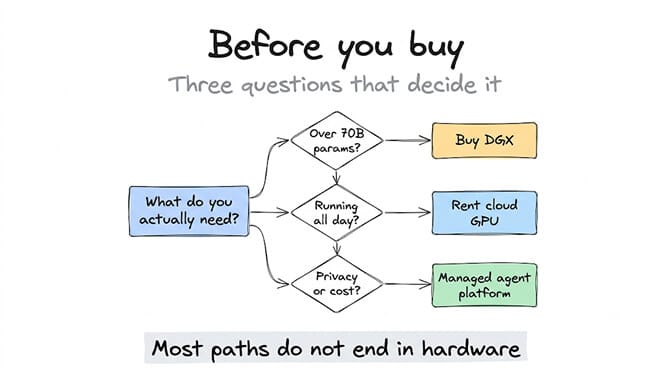
So before you price anything, answer three questions honestly. How many parameters does your workload genuinely need? How many hours a day will the hardware be doing work rather than idling? And is the constraint actually cost, or is it privacy?
If the honest answers are "under 70B", "a few hours", and "cost", buying hardware is the wrong instrument. You will spend thousands to idle expensive silicon while a rented equivalent would have cost less than the electricity.
That is the calculation almost nobody publishes, and it is why DGX Spark memory bandwidth matters more than the headline petaFLOP number. Bandwidth, not compute, is what limits agent workloads in practice.
If your goal was simply agents that run continuously without you owning infrastructure, that is the thing we built. BetterClaw runs managed agents with 200+ verified skills, 25+ one-click integrations, and 28+ model providers on a free plan with no credit card, and you bring your own keys so inference costs provider rates with no markup. Cheaper than a power supply, and available this afternoon.
Alternatives by budget band
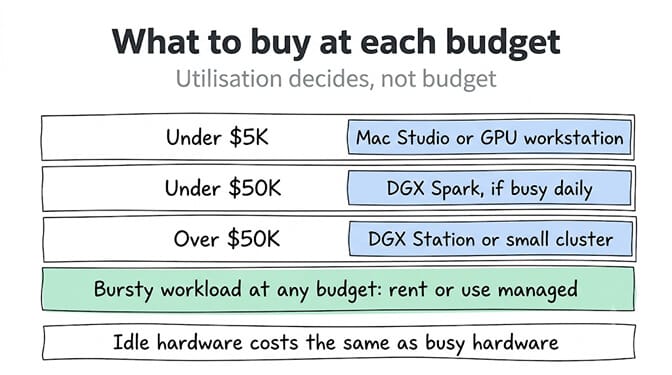
Under $5,000
- A 128 GB Strix Halo mini PC (from $3,099) or a Mac Studio M5 Max covers inference on mid-sized models.
- You give up CUDA and NVIDIA's software stack, and you keep the difference.
- Where that trade breaks down: DGX Spark vs a local GPU.
$5,000 to $20,000
- DGX Spark ($6,950, or $4,999 for 64 GB), a GB10 clone ($5,688+), a Mac Studio M5 Ultra ($5,499+), or an RTX PRO 6000 96 GB ($13,998+).
- The real question is not which box. It's whether the machine will be busy enough to beat renting.
- The full comparison: DGX Spark alternatives.
$95,000 and up
- DGX Station from an OEM, or a small multi-GPU cluster.
- By now you have a procurement process and a finance conversation, and one blog post shouldn't decide it.
- Six cheaper routes first: DGX Station alternatives.
Any budget, if the workload is bursty or the goal is agents
- Rent. Cloud GPU hours, DGX Cloud, or a managed platform.
- Utilisation is what makes owned hardware cheap, and bursty workloads never reach it.
- If the goal was agents rather than models, you are shopping in the wrong category entirely.
What's coming next (RTX Spark N1X in October, AMD Gorgon Halo)
If you are wondering whether to wait for a DGX Spark successor: NVIDIA has not announced a second-generation Spark. Two products are close enough to change the maths, though.
- NVIDIA RTX Spark (N1X). A GB10-class chip for Windows laptops and compact desktops, shipping from October 2026 through Lenovo, Dell, HP, ASUS, Acer and Microsoft. The top configuration pairs a 20-core Grace CPU with a 6,144-core Blackwell GPU and up to 128 GB of unified memory. No prices had been published as of September 18.
- AMD Gorgon Halo (Ryzen AI Max 400). The Strix Halo refresh, with up to 192 GB of unified memory, of which up to 160 GB can go to the GPU. OEM systems are due from Q3 2026.
Don't expect either to pull prices down soon. DRAM and NAND costs have pushed unified-memory boxes up all year, which is why NVIDIA raised the Spark itself to $6,950 in October.
Where DGX genuinely wins
An honest hub has to include this section or the rest of it reads as a pitch.
Buy when your data cannot leave the building. Regulatory or contractual constraints make cloud inference a non-starter for some teams, and no amount of arithmetic changes that.
Buy when utilisation is genuinely high. A Spark running agent workloads sixteen hours a day pays for itself against cloud token costs faster than most spreadsheets predict, which is exactly the case NVIDIA built it for.
Buy when latency to the model matters more than anything else. Local inference has no network hop, and for interactive workloads that difference is felt rather than measured.
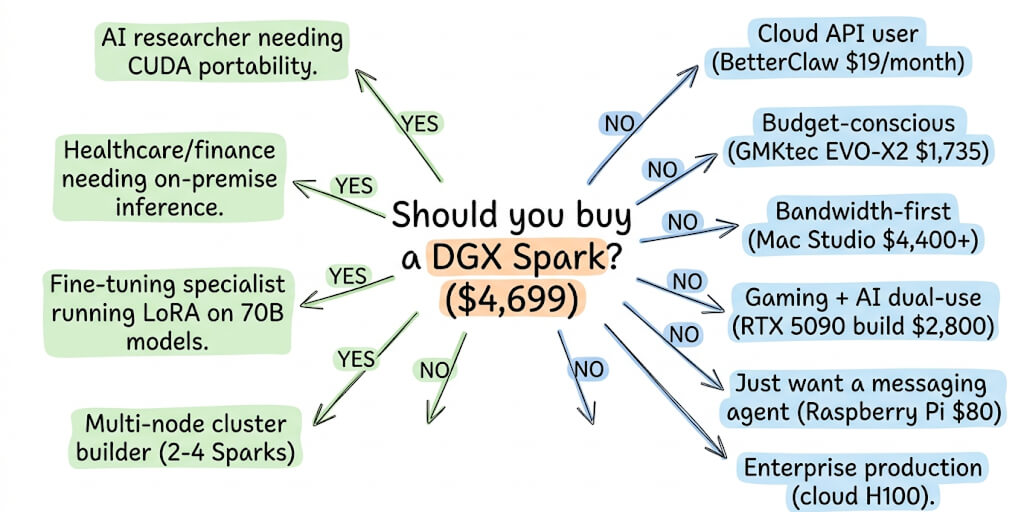
Our breakdown of who actually needs a DGX Spark works through those cases in detail rather than asserting them.
Every DGX guide we've written
This page is the hub. Each guide below goes deep on one question:
- DGX Spark alternatives: every box that competes with the Spark, priced for September 2026.
- DGX Station alternatives: six cheaper routes to Station-class work, from the RTX PRO 6000 to renting.
- DGX Spark memory bandwidth: what 273 GB/s means for tokens per second.
- Rent vs buy break-even: the hour count at which owning beats renting.
- Who actually needs a DGX Spark: the workloads that justify one, and the ones that don't.
- DGX Spark vs a local GPU: when a consumer GPU plus the cloud beats unified memory.
- Spark alternatives (non-NVIDIA 'Spark'): if you meant Google's Gemini Spark rather than the NVIDIA box.
The last thing worth saying
Hardware cycles are eighteen months and agent frameworks change monthly. Whatever you buy today will be mid-tier by the time your procurement finishes, and the workload you bought it for will have shifted twice.
That is not an argument against buying. It is an argument for buying late, when the workload is proven, rather than early, when the spreadsheet is optimistic. The people I have watched regret a DGX purchase all bought it to enable a workload they had not yet run.
Run the workload first. Rent while you learn what it needs. Buy the tier your measured usage justifies, not the tier your ambitions do.
If what you actually needed was agents running reliably rather than silicon on your desk, start free on BetterClaw. One agent, 100 credits a month, no credit card, your own model keys with no markup on inference. Pro is $49 a month for five agents, full pricing fits on one page, and 50+ companies including Carelon, Grainger, and Robert Half run production agents on it. If you are weighing self-hosted stacks instead, our best OpenClaw alternatives comparison covers that side.
Frequently Asked Questions
Is there a cheaper alternative to NVIDIA DGX?
Yes, at every tier. A 128 GB Strix Halo mini PC costs about $3,000 against the DGX Spark's $6,950. A Mac Studio M5 Ultra from $5,499 has more than four times the Spark's memory bandwidth. Against the DGX Station ($94,930+), renting a B200 at $6.69 an hour avoids a six-figure purchase. If the goal is running AI agents, a managed platform removes the hardware cost entirely.
How much does an NVIDIA DGX Spark cost in 2026?
The 128 GB DGX Spark Founders Edition costs $6,950 since 2 October 2026. It launched at $3,999 and went to $4,699 in February 2026, and NVIDIA attributed both increases to memory supply. A 64 GB model costs $4,999 from 23 October 2026, sold only through OEM partners. At September prices, OEM boxes with the same GB10 chip now undercut the Founders Edition: the cheapest orderable one was the Dell Pro Max with GB10 at $5,688.18. Expect OEM prices to rise after NVIDIA's increase.
How much does a DGX Station cost?
NVIDIA doesn't sell the DGX Station directly or publish a price. It ships through OEMs. Public listings as of September 2026 start at $94,930 (Exxact Valence), run to about $100,000 for the MSI XpertStation WS300 and ASUS ExpertCenter Pro ET900N G3, and reach $175,496.74 for Dell's fixed Pro Max with GB300 configuration. Lead times run from 2 to 16 weeks.
Is a Mac Studio a good DGX alternative?
For inference, often yes. The Mac Studio M5 Ultra starts at $5,499, has 1.2 TB/s of memory bandwidth against the DGX Spark's 273 GB/s, and goes up to 512 GB (that configuration ships in late October). What you give up is CUDA, so your local stack won't match a cloud NVIDIA deployment, and fine-tuning tooling is thinner.
Should I rent GPUs instead of buying a DGX?
Rent unless the machine will be busy most of the day. A DGX Station at $94,930 equals about 14,190 hours of an on-demand B200 at $6.69 an hour: roughly 19 months running 24/7. One B200 isn't a like-for-like match for 748 GB of coherent memory, but for bursty workloads renting almost always wins. Idle hardware costs the same as busy hardware.
How does DGX Spark compare to DGX Station?
The gap is much larger than the naming suggests. The Spark uses the GB10 Superchip with 128 GB of unified memory at 273 GB/s and handles inference up to 200 billion parameters. The Station uses the GB300 with 748 GB of coherent memory as shipped, up to 20 petaFLOPS, and supports models up to a trillion parameters. There is no middle tier between them.
Is a managed platform reliable enough to replace local hardware for agents?
For most agent workloads, yes, and the failure modes are different rather than worse. Local hardware fails through driver updates, thermal issues, and power events, none of which have an SLA. What matters more is isolation: look for per-agent sandboxing, encrypted credentials, approval gates before consequential actions, and a kill switch. The exception is genuine data residency requirements, where local hardware remains the only answer.