GLM and LLM sound like rival architectures. They aren't. Here's what each one actually means, including the statistics meaning that sends half the searches here by accident.
This question shows up on Reddit, Stack Overflow, and our own Discord almost daily: "Is GLM 5.3 an LLM or something different? What does the G stand for?"
The confusion is understandable. Google "GLM" and you get results about generalized linear models (statistics), the General Language Model architecture (a 2021 AI paper), and the GLM-5 series (a specific family of Chinese models). Three different things sharing the same acronym, and only two of them are even about language models.
Here's the short answer for agent builders: GLM today is a brand, not an architecture. All GLMs are LLMs. The thing that once made the GLM architecture distinct has been quietly retired.
The longer answer matters if you're choosing between GLM-5.3 ($1.40/M) and Claude Sonnet 5 ($2/M, proprietary), because the reasons to pick one are all about price, licence and benchmark scores - and the architecture story people repeat about GLM is several years out of date.
What does GLM stand for in AI?
GLM stands for General Language Model. It is the model family built by Z.ai (formerly Zhipu AI), a Chinese AI lab spun out of Tsinghua University. The current generation is GLM-5.3 (August 2026), with GLM-5.3-Flash available as open weights under the MIT licence.
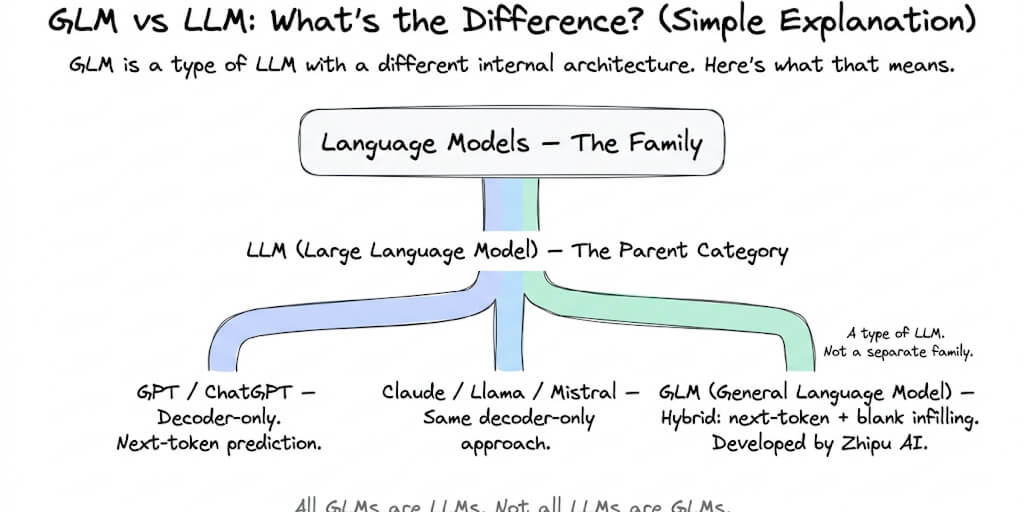
GLM is not a different type of AI from LLMs. GLM models are large language models. The name is a brand, not an architecture.
Three things people mix up:
- GLM, the Z.ai model family (GLM-4.5, GLM-5.2, GLM-5.3, GLM-5.3-Flash). This is what most people mean in 2026, and what this page covers.
- GLM, the generalized linear model. A statistics term (logistic regression, Poisson regression). Unrelated to AI.
- GLM, the 2021 General Language Model paper. The Tsinghua research paper that gave Z.ai's models their name, built on autoregressive blank infilling. Current GLM-5.x models no longer use that architecture.
Looking for GLM in statistics? In statistics, GLM stands for generalized linear model: logistic regression, Poisson regression and friends. That's a different topic. Our quick statistics primer below tells the two apart, and Wikipedia's generalized linear model article is the place to go deeper.
GLM models vs other LLMs: side by side
Checked 22 September 2026 against each lab's published pricing and model cards. Prices are per million tokens, input/output.
| Model | Developer | Parameters | Price (input/output per MTok) | Context | Open weights | Tool calling |
|---|---|---|---|---|---|---|
| GLM-5.3 | Z.ai | 744B MoE (40B active) | $1.40 / $4.40 | 1M | Yes (custom glm-5.3 licence) | Yes |
| GLM-5.3-Flash | Z.ai | 320B MoE (18B active) | $0.15 / $0.50 | 1M | Yes (MIT) | Yes |
| GLM-4.7-Flash | Z.ai | 30B MoE (3B active) | Free API | 200K | Yes | Yes |
| Claude Sonnet 5 | Anthropic | Not disclosed | $2 / $10 | 1M | No | Yes |
| Claude Opus 5 | Anthropic | Not disclosed | $5 / $25 | 1M | No | Yes |
| GPT-5.5 | OpenAI | Not disclosed | $5 / $30 | 1.05M | No | Yes |
| MiniMax M3 | MiniMax | 428B MoE (23B active) | $0.30 / $1.20 (up to 512K input) | 1M | Yes (custom community licence) | Yes |
| Qwen3.8-27B | Alibaba | 27B dense | Free (local) | 256K | Yes (Apache 2.0) | Yes |
Parameter counts for the GLM-5 series follow Z.ai's GLM-5 repository, which lists the family at 744B total and 40B active. Hugging Face's weight listing shows 753B for the GLM-5.3 checkpoint, and some GLM-5.1 coverage quotes 754B, which is why you will see all three numbers quoted. MiniMax M3 bills the whole request at double rate ($0.60/$2.40) once input goes past 512K tokens.
The table makes the point this whole page is about: GLM sits in the same columns as Claude, GPT and MiniMax because it is the same kind of thing. What separates them is price, licence and context, not category.
What LLM means (the standard architecture)
LLM stands for Large Language Model. It's the umbrella term for any large neural network trained on text. GPT-5.5, Claude Sonnet 5, Llama 3.3, Gemini, Mistral... these are all LLMs.
Most modern LLMs use a decoder-only transformer architecture. This means they predict the next token in a sequence, one at a time, left to right. You give them a prompt. They generate the next word. Then the next. Then the next. Until they hit a stop condition.
This is how ChatGPT works. This is how Claude works. This is how most models you interact with daily work.
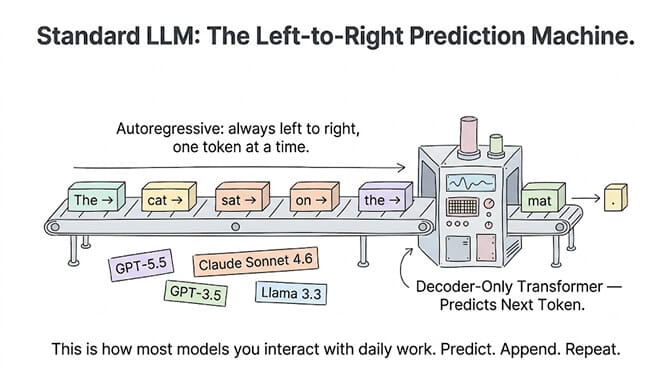
Key properties of standard LLMs:
- Generate text left-to-right (autoregressive).
- Trained on "predict the next token."
- Strong at open-ended generation, conversation, creative writing, and instruction following.
- The architecture is simple, well-understood, and scales efficiently.
What GLM means (and what it used to mean)
GLM stands for General Language Model. The name comes from a 2021 Tsinghua University paper, GLM: General Language Model Pretraining with Autoregressive Blank Infilling (Du et al., ACL 2022), and the work was commercialised by Zhipu AI, now trading as Z.ai.
That original architecture genuinely was a hybrid. Standard LLMs predict the next token, autoregressive and left to right. The 2021 GLM was trained to fill in missing spans of text as well - closer to how BERT fills in masked words, but over longer spans and combined with autoregressive generation. The prefix attended to itself bidirectionally while the generated part attended causally. GLM-130B, the 2022 open bilingual model, was built on that objective and made a point of it: while GPT-3, PaLM, OPT and BLOOM were all GPT-style decoder-only stacks, GLM-130B deliberately explored a bidirectional backbone instead.
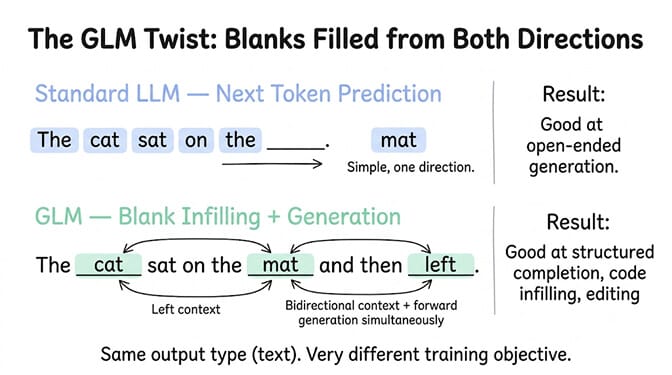
That is no longer how GLM models are built. Somewhere between GLM-130B and GLM-4, the family moved to the same decoder-only transformer everyone else uses, and the blank-infilling objective went with it. The current generation is explicit about this. GLM-4.5's technical report (arXiv:2508.06471) describes a plain Mixture-of-Experts decoder with grouped-query attention, partial RoPE and QK-Norm. The GLM-5 report (arXiv:2602.15763) describes a 744B-parameter, 40B-active decoder-only MoE with 256 experts, DeepSeek Sparse Attention and multi-token prediction. The GLM-5.3 model card on Hugging Face lists the task as causal language modelling. No blank infilling anywhere.
So when someone tells you GLM is architecturally different from an LLM, they are describing a 2021 paper, not the model you are about to put a credit card behind. The interesting differences in 2026 are sparsity, licence and price.
GLM version history
The version numbers are the other thing people get lost in, so here is the whole line in one place. There is no GLM-4.3 or GLM-3.5 in Z.ai's release history. If you see those names, they are almost always typos for GLM-4.5 or ChatGLM3.
| Model | Released | Key change |
|---|---|---|
| GLM (paper) | March 2021 | Autoregressive blank-infilling pre-training (research paper) |
| GLM-130B | September 2022 | 130B open bilingual model, still on the blank-infilling objective |
| ChatGLM-6B | March 2023 | First chat-tuned release, open weights |
| ChatGLM2-6B / ChatGLM3-6B | June / October 2023 | Iterations on the open 6B chat model |
| GLM-4 | January 2024 | Proprietary flagship aimed at GPT-4-era models |
| GLM-4.5 | July 2025 | Decoder-only MoE with grouped-query attention, built for agentic work |
| GLM-4.6 | September 2025 | Coding improvements |
| GLM-4.7 | December 2025 | Stronger coding and agent performance |
| GLM-4.7-Flash | January 2026 | 30B MoE (3B active), free API tier |
| GLM-5 | February 2026 | 744B MoE (40B active), DeepSeek Sparse Attention |
| GLM-5.1 | April 2026 | Long-running autonomous agent work, MIT |
| GLM-5.2 | June 2026 | Terminal-Bench 2.1 81.0, MIT |
| GLM-5.3 | 18 August 2026 | Same base as 5.2, heavier post-training, custom glm-5.3 licence. Current flagship |
| GLM-5.3-Flash | 26 August 2026 | 320B MoE (18B active), natively multimodal, MIT, $0.15 input |
| GLM-5.5 | Not released | No model card or API endpoint as of September 2026 |
GLM-5.3 was announced to Z.ai Coding Plan subscribers on 14 August, reached the public API on 18 August, and its weights followed on Hugging Face on 28 August. That is why you'll see all three dates quoted.
The other GLM: generalized linear models in statistics
A large share of people searching "GLM vs LLM" are not looking for a Chinese model at all. They are in a stats, econometrics or epidemiology course, and GLM there means something completely unrelated.
A generalized linear model is a statistical regression framework introduced by Nelder and Wedderburn in 1972. Ordinary linear regression assumes your outcome is continuous and normally distributed. A GLM relaxes that with two pieces: a distribution from the exponential family (normal, binomial, Poisson, gamma) and a link function that connects the linear predictor to the mean of that distribution. Pick a binomial family with a logit link and you have logistic regression. Pick Poisson with a log link and you have Poisson regression for count data. Both are GLMs.
If your question came with words like glm(), R, statsmodels, family=binomial, odds ratios, deviance or residuals, that is the GLM you want, and it has no relationship to language models beyond three letters.
Watch out for a third one too: the general linear model (no "-ized") is a different object again - the ANOVA/regression framework behind SPSS's GLM procedure, which assumes normal errors and an identity link. General, generalized, and General Language Model are three distinct things.
A quick way to tell which GLM you have landed on:
| If you see... | You mean |
|---|---|
glm(), link function, binomial, Poisson, deviance | Generalized linear model (statistics) |
| ANOVA, SPSS, between-subjects factors, identity link | General linear model (statistics) |
| Blank infilling, GLM-130B, ChatGLM, the 2021 Tsinghua paper | General Language Model (the original AI architecture) |
| GLM-4.5, GLM-5.2, GLM-5.3, Z.ai, Zhipu, MoE, tokens per million | The GLM model family (what people usually mean in 2026) |
The rest of this post is about the last two.
Why this matters for agents (the practical part)
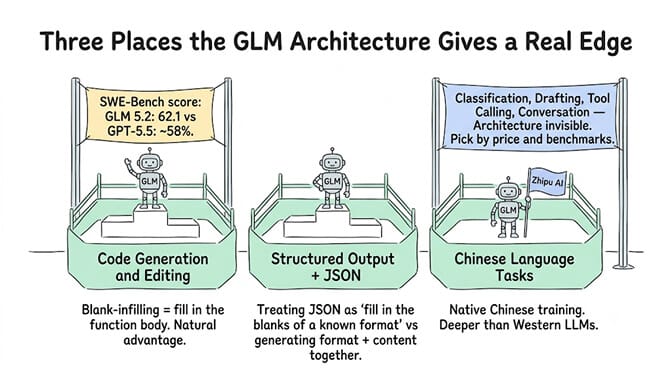
For most agent tasks, the difference between a GLM-branded model and any other frontier LLM is invisible. Both generate text. Both follow instructions. Both call tools. There is no architectural tell to notice when your agent classifies emails or drafts responses, because there is no longer an architectural difference to notice.
But there are three areas where the GLM models do behave differently from their Western counterparts - for reasons of training and economics rather than architecture:
Code generation and editing
The GLM-5 series is post-trained hard on agentic coding, and it shows: Z.ai's release notes for GLM-5.3 claim a 50% improvement over GLM-5.2 on their internal code benchmark, and the model card reports 66.9 on DeepSWE v1.1. What makes that interesting is where the gain came from. GLM-5.3 carries the same parameter count as 5.2, and analysts who have looked at it read it as the same base model with far more post-training rather than a new pretrain. That is the opposite of the architecture story: what makes these models good at code is the training recipe, not the letters in the name.
If your agent writes or edits code, GLM models compete with Claude Sonnet 5 for less: GLM-5.3 is $1.40/$4.40 per million tokens against Sonnet 5's $2/$10, so under half the output price. Our model cost comparison covers the daily numbers.
Structured output
Tasks where the model needs to produce JSON, fill in form fields, or complete structured templates are where these models earn their keep relative to price. That is a post-training and tool-calling result, not an architectural one - the same discipline that produces the MCP-Atlas and Terminal-Bench numbers. Treat it as an empirical claim to test on your own schemas rather than something guaranteed by how the model is built.
Multilingual (especially Chinese)
GLM comes out of Tsinghua and Z.ai in Beijing, with native Chinese training data that is deeper than most Western LLMs have. For agents serving Chinese-speaking users or processing Chinese documents, GLM models typically outperform Claude and GPT on Chinese tasks specifically. This one is genuinely a data difference, and it is the most durable of the three.
The models you'll actually encounter
GLM family (Zhipu AI / Z.ai)
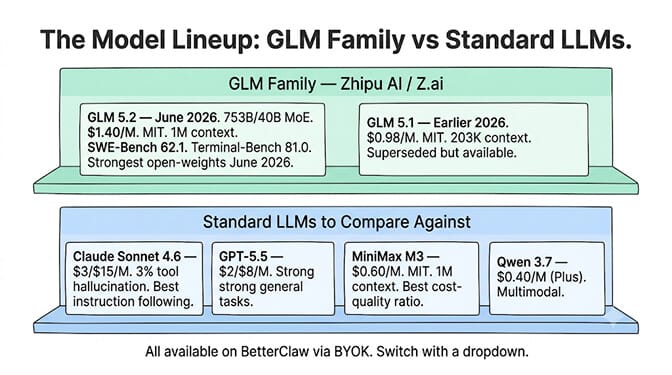
- GLM-5.3 (18 August 2026): 744B MoE, 40B active, decoder-only with DeepSeek Sparse Attention. $1.40/$4.40/M. 1M context, 128K max output. Model card reports DeepSWE v1.1 66.9 and Terminal-Bench 2.1 88.2. Not MIT. The weights are on Hugging Face under a bespoke
glm-5.3licence with a revenue-threshold clause aimed at the largest cloud providers. Same parameter count as 5.2, with the gains coming from post-training rather than a new pretrain. - GLM-5.3-Flash (26 August 2026): 320B MoE, 18B active. $0.15/$0.50/M. MIT. 1M context. Natively multimodal (image and video in), with a hybrid attention stack. Roughly a tenth of 5.3's price and still ahead of GLM 5.2 on most rows. The cheap workhorse of the family.
- GLM 5.2 (June 2026): 744B MoE, 40B active. $1.40/$4.40/M. MIT license. 1M context. SWE-Bench Pro 62.1. Terminal-Bench 2.1 81.0. Superseded by 5.3, but still the newest full-size GLM you can use under a plain MIT licence.
- GLM 5.1 (April 2026): 744B MoE, 40B active. $1.40/$4.40/M on Z.ai's own API (the $0.98 figure you'll see is a reseller rate). MIT. 203K context. Superseded but still available.
The licence change at 5.3 is the detail worth carrying away. "GLM is MIT" was true for a long run of releases and stopped being true in August 2026. If your reason for choosing GLM was the licence rather than the price, check the terms on the specific version you are pulling, and note that GLM-5.3-Flash kept MIT while the flagship did not.
Standard LLMs you compare GLM against
- Claude Sonnet 5: $2/$10/M. 1M context. Anthropic's current mid-tier model, strong on instruction following and multi-step tool use.
- Claude Opus 5: $5/$25/M. 1M context. Anthropic's flagship for the hardest reasoning and agent work.
- GPT-5.5: $5/$30/M. 1.05M context. Strong on general tasks.
- MiniMax M3: $0.30/$1.20/M up to 512K input (the whole request doubles above that). Open weights under a custom community licence. 1M context. Best cost-to-quality ratio.
- Qwen 3.7: $0.40/$1.60/M (Plus tier). API-only. Multimodal.
All of these are available on BetterClaw via BYOK with zero inference markup. 28+ providers supported. Switch between GLM and standard LLMs with a dropdown. Free plan with 1 agent and 100 credits a month. $49/month on Pro.
The honest take: does the architecture matter in practice?
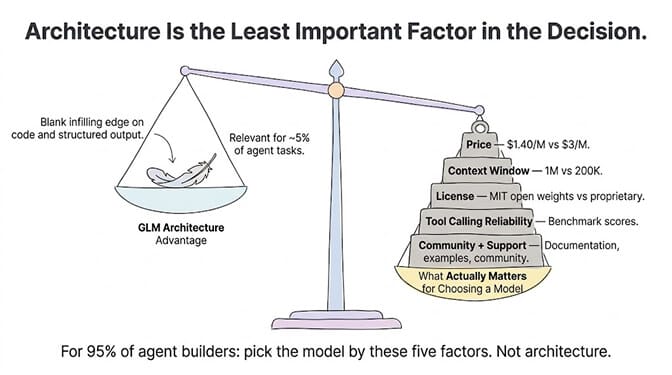
For 95% of agent builders: no. And in 2026 the question barely parses, because there is no distinct GLM architecture left to matter. Pick the model based on benchmarks, price, licence and capabilities.
GLM-5.3 is a great model. Not because it's a GLM. Because it scores well on agent benchmarks, costs $1.40/M, and has a 1M context window. You'd use it for the same reasons you'd use any other strong, cheap, open-weights model.
Where you do see a real architectural difference inside the family, it's about sparsity rather than heritage: GLM-5.3 activates 40B of 744B parameters, GLM-5.3-Flash activates 18B of 320B. That is what makes the Flash variant cost a tenth as much, and it's a trade you can measure on your own tasks in an afternoon.
If you're choosing between GLM-5.3 and Claude Sonnet for your agent, the question isn't "GLM architecture vs LLM architecture." It's "$1.40/$4.40 vs $2/$10, open-weights vs proprietary, and what does the licence actually permit." Architecture is the least important factor in the decision. Our GLM 5.2 vs Sonnet 4.6 breakdown covers the full comparison.
The agent building space in 2026 is model-agnostic. The best platforms (BetterClaw, CrewAI, LangGraph) let you switch models without rewriting your agent. Use GLM-5.3 this month. Switch to Sonnet 5 next month. Try M3 the month after. The architecture is abstracted away. What matters is whether the model does the job at a price you can sustain.
Want to test whether GLM-5.3 or Sonnet 5 works better for your specific agent tasks? On BetterClaw, connect both Z.ai and Anthropic keys and switch between them with a dropdown. Same agent, different model, instant comparison. Free plan for testing. $49/month for Pro when you've picked your model.
Frequently Asked Questions
What is the difference between GLM and LLM?
LLM (Large Language Model) is the umbrella term for any large AI model trained on text. GPT, Claude, Llama, and GLM are all LLMs. GLM (General Language Model) was originally a distinct architecture from Tsinghua University that trained on autoregressive blank infilling rather than plain next-token prediction, and GLM-130B was built that way. The models shipping under the name today, GLM-4.5 through GLM-5.3, are conventional decoder-only Mixture-of-Experts transformers trained on causal language modelling. So GLM is a family of LLMs, not a separate category, and the architectural difference people cite is historical.
Does GLM stand for generalized linear model?
In statistics, yes. A generalized linear model (Nelder and Wedderburn, 1972) is a regression framework that extends linear regression with an exponential-family distribution and a link function; logistic and Poisson regression are both GLMs. That meaning has nothing to do with AI. In AI, GLM stands for General Language Model and refers to Z.ai's model family. There is also a third, separate thing called the general linear model, the ANOVA-style framework used in SPSS. If your question involves glm(), R, link functions or deviance, you want the statistics one.
Does GLM still use autoregressive blank infilling?
No. Blank infilling was the objective in the original 2021 GLM paper and in GLM-130B. The GLM-4.5 technical report describes a Mixture-of-Experts decoder with grouped-query attention, partial RoPE and QK-Norm, and the GLM-5 report describes a 744B-parameter decoder-only MoE with DeepSeek Sparse Attention and multi-token prediction. The GLM-5.3 model card lists causal language modelling. The family moved to a standard decoder-only stack and did not go back.
What is GLM-5.3, and how is it different from GLM 5.2?
GLM-5.3 shipped on 18 August 2026. It is the same 744B-parameter, 40B-active base as GLM 5.2 with substantially more post-training, which is where its gains come from: 66.9 on DeepSWE v1.1 and 88.2 on Terminal-Bench 2.1, with a claimed 50% improvement over 5.2 on Z.ai's internal code benchmark. Pricing matches 5.2 at $1.40/$4.40 per million tokens with a 1M context window. The one thing that did change is the licence: GLM 5.2 was MIT, and GLM-5.3's weights ship under a bespoke glm-5.3 licence instead. A smaller sibling, GLM-5.3-Flash (320B total, 18B active, natively multimodal, $0.15/$0.50 per million), followed on 26 August 2026 and kept MIT.
Is GLM better than Claude Sonnet?
It depends on the task. The current matchup is GLM-5.3 against Claude Sonnet 5: GLM-5.3 costs $1.40/$4.40 per million tokens against Sonnet 5's $2/$10, and both have a 1M context window. In the previous generation, GLM 5.2 beat Claude Sonnet 4.6 on SWE-Bench Pro (62.1 vs ~58%) and scored 81.0 on Terminal-Bench 2.1, while Sonnet had lower tool-call hallucination (3% vs ~8-12%), better instruction following and stronger customer-facing output quality. The pattern holds: GLM is the value pick for coding and structured tasks, Sonnet the safer pick for multi-step agent workflows and customer-facing output. Our GLM 5.2 vs Sonnet 4.6 breakdown has the full numbers.
Is there a free GLM model?
Yes. GLM-4.7-Flash (a 30B MoE with 3B active) is free on Z.ai's API, with open weights on Hugging Face, a 200K context window and tool calling. GLM-5.3-Flash is also open weights under the MIT licence, but at 320B total parameters it isn't a realistic local model for most people. Use it through the paid API at $0.15/$0.50 per million tokens, and note that it can get stuck in repetition loops under heavy multi-tool agent prompts. For every free option ranked on real agent work, see our best free models for OpenClaw guide.
Is GLM-5.5 released?
No. As of September 2026, the latest GLM models are GLM-5.3 (API launch 18 August 2026) and GLM-5.3-Flash (26 August 2026). There is no GLM-5.5 model card, Hugging Face repo or API endpoint. The GLM-5.5 release dates you may have seen come from leaks and analyst forecasts that pointed to August 2026, and August ended without one. Z.ai announced roughly $5 billion in new financing in mid-September 2026 for compute and next-generation GLM work, but it has not announced a release date for any new model.
Can I use GLM models for AI agents?
Yes. GLM models (GLM-5.3, GLM-5.3-Flash, GLM 5.2, GLM 5.1) work with any agent framework that supports the OpenAI-compatible API format. On BetterClaw, connect your Z.ai API key via BYOK. On OpenClaw or Hermes, configure the provider with the Z.ai base URL. GLM 5.2 supports tool calling (MCP-Atlas 77.0), and both 5.2 and 5.3 have a 1M context window at $1.40/M input.
Why is GLM so much cheaper than Claude?
Sparsity and licensing, not a different architecture. GLM-5.3 is a Mixture-of-Experts model: 744B total parameters but only 40B active per inference pass, so it needs far less compute per token than a dense model of equivalent quality. GLM-5.3-Flash pushes that further at 18B active out of 320B, which is why it lands near $0.15/M. Z.ai also publishes weights and competes on price rather than exclusivity, while Anthropic's Claude models are proprietary with premium pricing.
Does the GLM architecture affect agent performance?
Not in any way you'd notice, because it is the same decoder-only transformer architecture as everything else at the frontier. For 95% of agent tasks (classification, extraction, drafting, tool calling), GLM models behave like any other strong LLM. What does move the needle is the post-training recipe, the sparsity ratio, and the price per million tokens. Benchmarks, context window, licence and tool-calling reliability are the things to compare.
One dashboard. Every model.
Connect GLM, Claude, MiniMax, and 25+ more providers via BYOK and switch with a dropdown - zero markup, 200+ verified skills. Free forever, not a trial. Start free →