NVIDIA's personal AI supercomputer is impressive. It's also $4,699 and Linux-only. Here are six paths to local AI that cost less, do more, or eliminate the hardware question entirely.
I was genuinely excited when NVIDIA announced DGX Spark. A personal AI supercomputer on your desk. 128 GB unified memory. Run 200-billion-parameter models locally. The dream machine for anyone building AI agents.
Then I saw the price. $3,999 at launch. Raised to $4,699 in February 2026 because of LPDDR5x memory supply constraints. Linux only. No Windows support.
And here's what nobody mentions in the launch videos: DGX Spark can't outperform an RTX 5090 on LLM inference. The GB10 chip's 1 PFLOP is FP4 sparse compute. Actual token generation speed is bottlenecked by the same 273 GB/s memory bandwidth you get on several cheaper systems.
Don't misunderstand. DGX Spark is a real product for a real audience. If you need CUDA 13 compatibility, unified memory for 200B-parameter models, and NVIDIA's full software stack with Ollama pre-installed, it's the only desktop option with all three. AI researchers, ML engineers prototyping before datacenter deployment, and teams deep in the NVIDIA ecosystem have legitimate reasons to buy one.
But if you're building AI agents, running local inference for cost or privacy, or just want a model running on hardware you control... there's a good chance you're paying for things you don't need.
Best DGX Spark Alternatives in 2026, Ranked by Price
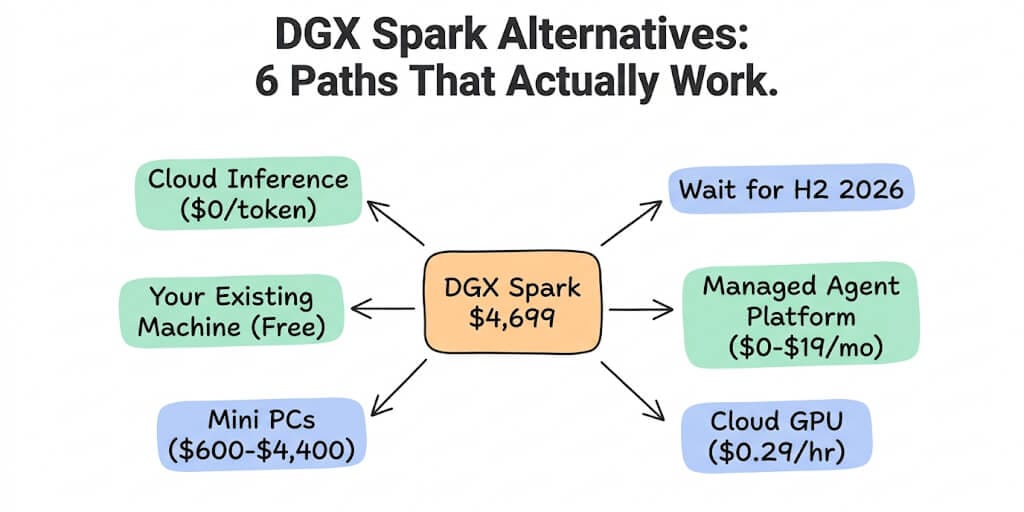
If price is the deciding factor, here is the whole field in one table, cheapest first. DGX Spark is at the bottom for reference.
Prices last verified 8 September 2026. Read them as a snapshot, not a constant. The 2026 DRAM and NAND shortage that pushed the Spark itself from $3,999 to $4,699 has moved every unified-memory box on this list, in most cases upward, and several configurations are on backorder rather than in stock.
| Option | Price | Memory | What you give up vs. DGX Spark |
|---|---|---|---|
| Ollama on hardware you already own | $0 | Whatever you have | Capacity. Realistically caps out around 30B models on 32 GB |
| Cloud inference (OpenRouter, Groq, Together) | $0 upfront, ~$10-50/mo typical | Unlimited | Data sovereignty and offline use |
| Managed agent platform (BetterClaw) | $0 free, $49/mo Pro | N/A - BYOK | Direct GPU access. You don't host the model at all |
| Cloud GPU rental (Vast.ai, RunPod) | From $0.29/hr (~$46/mo at 8 hrs × 20 days) | 80 GB A100 and up | Data sovereignty, consistent latency, 24/7 economics |
| Mac Mini M4 | From $799 | 16-32 GB | 128 GB capacity. Fine for models under 30B |
| GMKtec EVO-X2 | $2,199 | 128 GB | CUDA. ROCm and Ollama work, NIM and TensorRT-LLM don't |
| Mac Studio M5 Max | From $2,499 | 36-128 GB | CUDA. Gains up to 614 GB/s bandwidth |
| HP Z2 Mini G1a | From ~$2,888 | 128 GB | CUDA. Gains an enterprise warranty |
| Framework Desktop (Strix Halo) | $3,449 (backordered) | 128 GB | CUDA. Gains modularity and repairability |
| AMD Ryzen AI Halo Developer Platform | $3,999 | 128 GB | CUDA. Gains Windows support |
| ASUS Ascent GX10 | $3,999-$6,999 (1 TB), varies by retailer | 128 GB | Nothing architecturally - same GB10 chip, but no longer reliably cheaper |
| Mac Studio M5 Ultra | From $5,499 | Up to 512 GB | CUDA. Gains 1.2 TB/s - roughly 4× the bandwidth |
| NVIDIA DGX Spark (reference) | $4,699 | 128 GB | - |
Four things worth pulling out of that table:
The cheapest way to get 128 GB is $2,199, not $4,699. The GMKtec EVO-X2 matches the Spark's memory capacity and its 273 GB/s bandwidth for less than half the price. You lose CUDA, which matters only if you need NVIDIA's software stack specifically.
The same chip in an ASUS box has stopped being the bargain it was. The ASUS Ascent GX10 runs identical GB10 silicon, and for much of 2026 it sold for roughly $1,600 less than the Spark. That gap has closed and in places inverted. Checked 8 September 2026: ASUS's own eShop lists it at $6,999 and out of stock, Amazon at $5,999 and out of stock, Walmart at $3,999.99. Only the Walmart listing still undercuts the $4,699 Spark. Treat the GX10 as an availability play now rather than a price play, and price all three retailers before assuming it saves you anything.
The cheapest option that actually ships agents is $0. If the goal is working agents rather than owned hardware, nothing in the hardware column is on the critical path. Start with cloud inference or a managed platform and buy hardware later if the economics turn.
The AMD price advantage narrowed in 2026, and it is worth knowing why. The EVO-X2 launched near $1,500 and the Framework Desktop's 128 GB build launched at $1,999. Both are now materially more expensive, because the same LPDDR5x shortage that pushed the Spark from $3,999 to $4,699 hit every Strix Halo box using the same memory. In relative terms the EVO-X2 has gone from roughly 37% of the Spark's price to roughly 47%, and the Framework Desktop from half the Spark's price to about three-quarters of it. AMD still wins - a 128 GB EVO-X2 is still $2,500 less than a Spark - but "half the price" is now the honest ceiling for the claim, not "a third," and the Framework configuration in particular is frequently out of stock. Check live pricing before you plan a build around any number on this page.
"Spark Alternative" - Which Spark Do You Mean?
Four different products get called "Spark," and the alternatives are completely different for each. If you arrived from a search that just said "Spark," start here.
NVIDIA DGX Spark - the $4,699 desktop AI computer with the GB10 Grace Blackwell superchip and 128 GB unified memory. This is what the price table above covers, and what the rest of this page is about.
NVIDIA RTX Spark - a different product line entirely: consumer Windows PCs and laptops built on the RTX Spark superchip (the N1/N1X), announced at Computex 2026. It pairs a 20-core Grace CPU with a Blackwell RTX GPU and up to 128 GB unified memory. These have not shipped yet. NVIDIA has confirmed a fall 2026 launch, with the first systems from ASUS, Dell, HP, Lenovo, Microsoft Surface and MSI expected in October 2026. NVIDIA has published no official pricing; reported estimates run $2,000-$2,500 for N1 configurations and $2,500-$2,900 for the flagship N1X.
If you are shopping for an RTX Spark equivalent rather than waiting, the machines that already ship with comparable unified memory in a portable form factor are:
| Machine | Unified memory | Memory bandwidth | Notes |
|---|---|---|---|
| MacBook Pro M5 Max | Up to 128 GB | 460 GB/s (32-core GPU), 614 GB/s (40-core) | Ships today. The bandwidth leader in a laptop, and priced accordingly |
| Strix Halo laptops and tablets (Ryzen AI Max+ 395) | Up to 128 GB | ~256 GB/s | Ships today. Roughly the same bandwidth class as DGX Spark, ROCm rather than CUDA |
| RTX 5090 laptop GPU systems | 24 GB GDDR7 (dedicated) | Much higher, far less capacity | Faster per token, but 24 GB caps you well below 70B models |
The honest summary: nothing shipping today matches the RTX Spark's specific combination of CUDA plus 128 GB unified memory in a laptop. The M5 Max gets you the memory and more bandwidth without CUDA; Strix Halo gets you the memory cheaply without CUDA; a 5090 laptop gets you CUDA without the memory. If you need all three, October is the wait.
Gemini Spark - Google's $100/month AI agent product, US-only and still in beta. Different category entirely; see Gemini Spark alternatives.
Apache Spark - the distributed data processing framework. Nothing to do with any NVIDIA hardware; its alternatives are engines like Flink, Dask, and Ray.
If you landed here looking for a cheaper machine to run local models, you're in the right place. If you wanted an agent platform rather than hardware, the Gemini Spark page is the closer match.
Below, the same options grouped by approach rather than price, with the reasoning for each.
Alternative 1: Cloud inference (skip the hardware entirely)
Cost: $0 upfront. Pay per token.
If your goal is running AI agents, not running local hardware, cloud inference gives you access to every model without buying anything. OpenRouter ($0.60/M for MiniMax M3, $0.98/M for GLM 5.1, $3/M for Claude Sonnet), Groq (fast Llama inference), and Together.ai (open-source model hosting) all offer BYOK-compatible endpoints.
When this makes sense: Your agent runs fewer than 5,000 tasks per day. Your data sensitivity allows API calls. You want access to frontier models (Opus 4.8, GPT-5.5) that no local hardware can run.
When it doesn't: You need data sovereignty. Your volume is high enough that API costs exceed hardware amortization. You need offline capability.
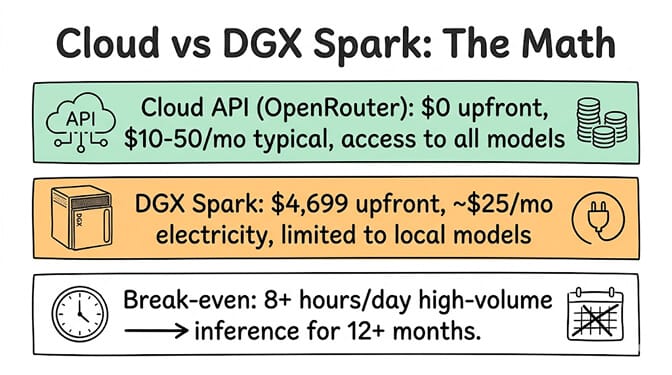
The math: DGX Spark at $4,699 amortizes to ~$131/month over three years. At typical API rates, most agent workloads cost $10-50/month. You'd need to run inference 8+ hours daily at high volume before local hardware breaks even. We ran the full DGX Spark vs local GPU vs cloud API cost comparison over 12 months if you want the numbers.
Alternative 2: Ollama on your existing machine (free)
Cost: $0.
Before spending $4,699, check what you already own. Ollama runs on Mac, Windows, and Linux. If your machine has 16 GB of RAM, you can run Gemma 4 12B, Qwen 3.6 35B-A3B (only 3B active params), or Llama 3.3 8B at usable speeds.
With 32 GB (any M2/M3/M4 Mac, or a desktop with 32 GB RAM), you can run Qwen 3.6 27B and most open-source models that matter for agent work.
One command:
brew install ollama && ollama run gemma4:12b
That's it. No $4,699. No Linux requirement. The model runs on your existing hardware.
When this makes sense: You want to test local AI. You have a Mac with Apple Silicon or a gaming PC with a decent GPU. Your models are under 30B parameters.
When it doesn't: You need to run 70B+ parameter models. Your machine has less than 16 GB RAM. You need dedicated hardware that stays running 24/7 while you use your main machine for other work.
Alternative 3: Mini PCs built for local AI ($799 to $5,499)
This is where DGX Spark has the most competition, and where the field changed most over the summer of 2026.
Apple: Mac Mini M4 ($799+) and Mac Studio M5 ($2,499+)
Apple Silicon's unified memory and Metal GPU acceleration make these the easiest local AI machines. If you're weighing the two ecosystems, our Apple Silicon vs NVIDIA breakdown for AI agents covers the capacity-vs-speed tradeoff in detail.
The Mac Mini M4 starts at $799 with 16 GB and runs Gemma 4 12B at 30-50 tok/s. Note that Apple repriced the Mini upward in May 2026 during the DRAM shortage; the old $599 entry price is gone.
The Mac Studio was refreshed on 25 August 2026 and now runs M5 Max and M5 Ultra, with deliveries from 22 September. Be careful with older comparisons that quote an "M4 Ultra" Mac Studio: that configuration never shipped. The previous generation was M4 Max and M3 Ultra. The current lineup:
- M5 Max, from $2,499. 36 GB base, configurable to 128 GB. 460 GB/s on the 32-core GPU, 614 GB/s on the 40-core. At 128 GB it matches the Spark's capacity with roughly 2.25× the bandwidth, and it costs less than the Spark at the base configuration - though the jump to 128 GB is a paid upgrade that closes much of that gap.
- M5 Ultra, from $5,499. 1.2 TB/s of memory bandwidth, roughly 4× the Spark's 273 GB/s, and up to 512 GB of unified memory (the 512 GB option is not available until late October; 256 GB is the current ceiling). This is the fastest way to generate tokens from a large local model that you can put on a desk, and it is priced like it.
ASUS Ascent GX10 ($3,999-$6,999, and volatile)
The same GB10 Grace Blackwell superchip as the DGX Spark - the silicon is NVIDIA's, the box is ASUS's - with 128 GB of unified LPDDR5x, a 1 TB NVMe SSD, ConnectX-7 networking and NVIDIA DGX OS. It is sold through ASUS's own eShop plus Amazon, Walmart, Micro Center and Central Computer. US retail pricing sat near $3,099 for the 1 TB configuration for much of 2026 and has since blown out: ASUS eShop $6,999 (out of stock), Amazon $5,999 (out of stock), Walmart $3,999.99, all checked 8 September 2026. The spread between retailers on an identical SKU is now wider than the discount this machine used to offer.
You get the NVIDIA software stack and CUDA compatibility for roughly $1,600 less than the Founders Edition Spark. The trade-offs are support and supply: your support path runs through ASUS rather than NVIDIA, and pricing on this box has been volatile - ASUS's own eShop has listed higher-capacity configurations dramatically above the retail price of the base unit during the memory shortage. Confirm the exact configuration and price at checkout rather than trusting any published figure, including this one.
If you want DGX Spark specifically, and not a DGX Spark alternative, this is the cheapest route to the same chip.
Framework Desktop with Strix Halo ($3,449, backordered)
The Framework Desktop with AMD Ryzen AI Max+ 395 is the repairable, upgradeable option in this class. 128 GB of unified memory, modular components, and a design meant to be opened rather than replaced - which matters if you plan to keep the machine for three or more years rather than treating it as a two-year depreciating asset.
It is also the clearest illustration of what the memory shortage did to this category. The 128 GB DIY configuration launched at $1,999. As of September 2026 the same build is listed at $3,449 and is out of stock on Framework's own store. It remains cheaper than the Spark and cheaper than AMD's own developer platform, but the "half the price of a DGX Spark" framing that was true at launch no longer holds.
The community has validated it for local LLM inference. Strix Halo's ~256 GB/s of bandwidth puts it in the same performance class as the Spark, and 128 GB is enough for 70B-class models at Q4. What you give up is CUDA.
| DGX Spark | Framework Desktop | |
|---|---|---|
| Price | $4,699 | $3,449 (128 GB DIY, backordered) |
| Launch price | $3,999 | $1,999 |
| Memory | 128 GB unified | 128 GB unified |
| Bandwidth | 273 GB/s | ~256 GB/s |
| Upgradeable | No | Yes - modular, repairable |
| Software stack | CUDA, NIM, TensorRT-LLM | ROCm, Ollama, llama.cpp, vLLM |
| OS | Linux only (DGX OS) | Linux or Windows |
| Support | NVIDIA | Framework plus a strong open-source community |
The rest of the Strix Halo field
The Ryzen AI Max+ 395 is no longer an EVO-X2-or-nothing decision. Multiple vendors now ship the same chip with the same 128 GB ceiling:
- GMKtec EVO-X2 ($2,199 for 128 GB / 2 TB) - still the value pick, and covered in detail below.
- HP Z2 Mini G1a (from ~$2,888 at B&H, up to ~$4,586 direct from HP for a 128 GB / 2 TB build) - the same silicon in an enterprise workstation with an HP warranty and a Ryzen AI Max+ PRO 395. This is the one that clears enterprise procurement, and it ships now.
- AMD Ryzen AI Halo Developer Platform ($3,999) - AMD's sanctioned developer box, Micro Center exclusive, in stores since 10 July 2026. Linux and Windows 11 Pro options at the same price.
- Beelink GTR9 Pro, Minisforum MS-S1 Max ($1,500-$2,500) - the rest of the budget tier, in 64-128 GB configurations.
If you don't specifically need NVIDIA's CUDA stack, a Strix Halo box gets you the same memory capacity for $700 to $2,500 less than the Spark, depending on which one you pick and what is in stock that week.
Alternative 4: Cloud GPU rental ($0.29/hr and up)
Cost: Pay by the hour. No upfront hardware.
RunPod, Vast.ai, and Lambda Labs rent GPU instances by the hour. An A100 80 GB on Vast.ai costs approximately $0.29/hr. Run it 8 hours a day, 20 days a month: $46/month. That's less than 1% of the DGX Spark price, with more compute power.
When this makes sense: Burst workloads. Training or fine-tuning (where DGX Spark is too weak anyway). Short-term projects. Teams that need GPU power for weeks, not years.
When it doesn't: You need data sovereignty (your data goes to the cloud provider's servers). You need consistent latency (cloud GPU availability varies). You run inference 24/7 (dedicated hardware becomes cheaper).
For teams running local models for privacy-sensitive agent workloads, cloud GPU is a middle ground: more power than a mini PC, less commitment than dedicated hardware, but your data still leaves your network.
Where the break-even sits: owning a DGX Spark works out to roughly $156/month over three years once you include electricity. At $0.29/hour, that buys 536 rented GPU-hours a month - about 17.6 hours a day, every day. Below that, renting is cheaper. We ran the full math, including residual value and the factors the hourly rate hides, in DGX Spark: rent cloud GPUs or buy the hardware?
Alternative 5: A managed agent platform (skip the model hosting entirely)
Here's the question most people searching for a DGX Spark alternative don't ask: do you actually need to run models locally?
If your goal is building AI agents that automate your work, the model is a component, not the product. You don't need to host it. You need it to work.
BetterClaw connects to 28+ model providers via BYOK. You bring an API key from OpenRouter (any open-source model), Anthropic (Claude), OpenAI (GPT), Google (Gemini), MiniMax (M3), or any other provider. You can even point it at your own Ollama instance running on your existing hardware.
The platform handles agent logic, integrations, scheduling, memory, and security. The model backend is your choice.
Cost: Free plan ($0/month, 1 agent, 100 credits/month, Basic skills). Pro: $49/month. Plus whatever your model provider charges.
When this makes sense: You want agents running, not GPUs running. You want to switch between cloud and local models without changing your agent configuration. You don't want to manage infrastructure.
When it doesn't: You're doing ML research that requires direct GPU access. You're fine-tuning models (agents use inference, not training). You want to build your own model serving stack.
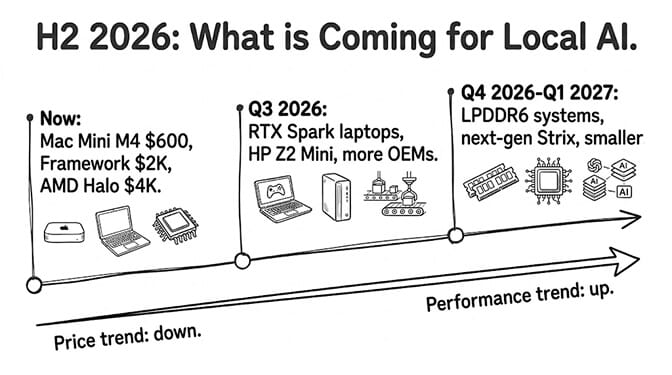
Alternative 6: Wait for the next hardware wave
The local AI hardware space is moving fast. This section was written as a forecast in mid-2026, so here it is re-scored as of 8 September 2026: what has actually arrived, and what is still ahead.
Already shipped
Mac Studio M5 Max and M5 Ultra. Announced 25 August 2026, deliveries from 22 September. The M5 Ultra's 1.2 TB/s of memory bandwidth is the single biggest change to this comparison all year - it is roughly 4× the Spark's 273 GB/s, which is the constraint that actually governs token generation speed. Covered in Alternative 3 above.
HP Z2 Mini G1a. Same AMD Strix Halo silicon as the Framework Desktop, in an enterprise workstation with an HP warranty. Now orderable, from roughly $2,888. Important for procurement that requires a recognised vendor.
AMD Ryzen AI Halo Developer Platform. Went from pre-order to shelves at Micro Center on 10 July 2026, at $3,999, with Linux and Windows 11 Pro options.
Framework Desktop 128 GB. Shipping, but at $3,449 rather than its $1,999 launch price, and frequently out of stock.
Perplexity Portable Computer - the first real software reason to prefer a Spark. Launched 25 August 2026 with NVIDIA, it runs the entire agent stack - orchestrator, models, harness and sandbox - on your own machine, with no per-token cost for local steps and an explicit permission prompt before any step escalates to one of 15+ cloud models. It ships with Qwen 3.8 27B and PPLX 27B plus Google Drive, Gmail and GitHub connectors, for Perplexity Pro, Max and Enterprise subscribers. It targets DGX Spark and Linux boxes with RTX GPUs of 24 GB or more; Windows was slated for September, and Apple silicon is not on the roadmap. Worth knowing because it cuts against the rest of this page: the developer reaction was mostly puzzlement at why a local agent app needs to be tied to one specific $4,699 box. If you were buying a Spark anyway, this is the first software that makes the lock-in pay for itself. If you were not, it is not a reason to start.
Still ahead
RTX Spark PCs - October 2026. NVIDIA unveiled the RTX Spark Superchip at Computex 2026 and has confirmed a fall 2026 launch, with the first Windows systems from ASUS, Dell, HP, Lenovo, Microsoft Surface and MSI expected in October, and Acer and GIGABYTE following. The silicon pairs a 20-core Grace CPU with a Blackwell RTX GPU and up to 128 GB unified memory. NVIDIA has still published no official pricing; reported estimates run $2,000-$2,900 depending on configuration, which would undercut the $4,699 desktop DGX Spark while keeping the same 128 GB capacity. This is the closest thing to a reason to wait right now - it is roughly a month out, and it is the only announced machine that pairs CUDA with 128 GB of unified memory below the Spark's price.
LPDDR6 systems - late 2026 into 2027. Samsung and SK hynix both demonstrated working LPDDR6 silicon at ISSCC in early 2026, with mass production in the back half of the year. LPDDR6 runs up to 14.4 Gbps on a wider 24-bit channel, roughly 2.25× the per-die bandwidth of LPDDR5X. First devices are expected in Q3-Q4 2026 with wide adoption through 2027, and mobile is the priority - desktops and workstations wait. When it lands, the 273 GB/s ceiling that limits DGX Spark and every current Strix Halo box moves substantially.
Falling model sizes. Gemma 4 12B already runs on 16 GB hardware. Qwen 3.6 35B-A3B activates only 3B parameters. As model architectures get more efficient, the hardware bar for local inference keeps dropping. The $4,699 machine you buy today may be overkill for the models you run in 12 months.
One caveat that cuts against waiting: the DRAM shortage is not obviously improving. Every unified-memory machine in the table above got more expensive in 2026, not less. Patience saved money in most previous hardware cycles; in this one, the price you are quoted today may be the cheapest you see for a while. Wait for the October RTX Spark launch if you want to see the full field before committing. Do not wait indefinitely expecting prices to fall.
The AMD DGX Spark Competitor
AMD is the only vendor shipping a direct architectural answer to DGX Spark, and it does it at two price points.
GMKtec EVO-X2 ($2,199) is the value play. AMD Ryzen AI Max+ 395, 128 GB unified memory, 273 GB/s bandwidth - identical capacity and bandwidth to the Spark for less than half the price. TechRadar's benchmarks show it generating tokens faster than the Spark on medium-to-large models including GPT-OSS 20B and Llama 3.3 70B, with lower first-token latency. It launched nearer $1,500 and has climbed through 2026 on memory pricing; some 128 GB listings have appeared as high as $3,499, so compare configurations carefully - the $2,199 figure is the 128 GB / 2 TB build.
AMD Ryzen AI Halo Developer Platform ($3,999) is the sanctioned developer box: same 128 GB, same 273 GB/s, official AMD support, and Windows - which DGX Spark still does not offer. It moved from pre-order to general availability at Micro Center on 10 July 2026, as a Micro Center exclusive, with Linux and Windows 11 Pro builds at the same price.
The tradeoff in both cases is the same and it is not about performance: you get ROCm instead of CUDA. Ollama, llama.cpp, and vLLM all run fine on ROCm. NVIDIA NIM, TensorRT-LLM, and NemoClaw do not run at all. If your work depends on the NVIDIA software stack, no AMD box substitutes regardless of the spec sheet. If it doesn't, AMD wins on price, and on Windows support.
Is there an AMD equivalent to DGX Spark? Yes - the GMKtec EVO-X2 at $2,199 for the budget route, or AMD's own Ryzen AI Halo Developer Platform at $3,999 for official support and Windows. Both match the Spark's 128 GB and 273 GB/s. Neither supports CUDA.
Best Models to Run on a DGX Spark
If you already own a Spark - or you are trying to work out whether 128 GB is enough before you buy one - here is the practical breakdown against that memory ceiling. Budget roughly 10-15 GB of headroom above the weights for the KV cache and the OS; a model that fits on paper at 120 GB does not fit in practice.
Runs comfortably, with room for a long context window:
- Gemma 4 31B - around 17.5 GB at 4-bit (Google's figure; there is no Gemma 4 27B). Plenty of headroom, and a sensible default for agent work.
- Qwen 3.6 35B-A3B - MoE with only 3B active parameters. The fastest thing in this class on a bandwidth-limited machine, because bandwidth cost scales with active parameters, not total ones.
- GPT-OSS 20B - OpenAI's open-weight 21B MoE at MXFP4, roughly 13 GB. Runs almost anywhere, including hardware far below a Spark.
- Llama 3.3 70B at Q4_K_M - roughly 43-49 GB. NVIDIA and third-party benchmarks put the Spark at approximately 35-45 tokens/second here. This is the headline "70B model on your desk" use case and it works.
Fits, but tight:
- GPT-OSS 120B at MXFP4 - around 60 GB. NVIDIA measured roughly 1,725 tok/s prefill and 55 tok/s decode on the Spark. Comfortably the best capability-per-gigabyte on this list.
- Llama 3.3 70B at Q8_0 - roughly 70 GB of weights. It loads, but once a real context window fills the KV cache you are close to the ceiling. Q4_K_M is the better trade for almost everyone.
Does not fit:
- DeepSeek V4 and other 671B-class MoE models - several hundred gigabytes even at Q4. Cloud or a multi-GPU server, not a desktop.
- Llama 3.1 405B - needs 800+ GB at full precision. It technically loads at Q2/Q3, and you should not: quality degrades far enough that a well-quantised 70B beats it.
- GPT-6 Astra, Claude Fable 5.1, Opus 4.8 - no open weights at all. API only, regardless of your hardware.
The constraint to understand is bandwidth, not capacity. The Spark's 128 GB will hold a 70B model, but its 273 GB/s decides how fast the tokens come out. For dense models above 30B, a Mac Studio M5 Ultra at 1.2 TB/s generates tokens several times faster from the same weights - which is why the memory bandwidth breakdown matters more than the capacity spec when you are choosing hardware. The practical workaround on a Spark is to prefer MoE architectures: Qwen 3.6 35B-A3B moves 3B parameters per token instead of 35B, and feels dramatically faster than its parameter count suggests.
One more thing worth checking before you commit to a model: most Spark owners run inference through Ollama, and not every model there supports tool calling - which an agent needs. Our reference on which Ollama models actually support tools has the full table.
The verdict by use case
"I build AI agents and want the lowest cost." Cloud inference via OpenRouter + BetterClaw. $0-50/month. No hardware.
"I want local AI for privacy but can't spend $4,699." Ollama on your existing Mac or PC. Free. Or a GMKtec EVO-X2 ($2,199) for a dedicated 128 GB machine - the cheapest route to the Spark's capacity.
"I need 128 GB unified memory and Windows support." AMD Ryzen AI Halo ($3,999). Same memory, $700 less than DGX Spark, runs Windows.
"I need NVIDIA's CUDA ecosystem specifically." DGX Spark ($4,699). Nothing else gives you CUDA + 128 GB unified memory on a desktop. It's expensive because it's the only option.
"I want the best Mac experience for local AI." Mac Studio M5 Max ($2,499+) for value, or M5 Ultra ($5,499+) if you want the fastest local token generation available on a desk - 1.2 TB/s, roughly 4× the Spark's bandwidth. Superior out-of-box experience either way, and Metal acceleration is mature.
"I want the same chip as a DGX Spark for less." The ASUS Ascent GX10 - but price it before you commit. Identical GB10 silicon, same 128 GB, same CUDA stack, support through ASUS instead of NVIDIA, and as of September 2026 cheaper than a Spark only at Walmart ($3,999.99). The ASUS and Amazon listings both sit above the Spark and are out of stock.
"I already have a Spark and want to know what to run on it." Llama 3.3 70B at Q4_K_M for general work, GPT-OSS 120B at MXFP4 for the most capability that fits, Qwen 3.6 35B-A3B when you want speed. See the model breakdown above.
"I don't know yet and don't want to commit." Start with cloud inference. Use an API. Build your agent first. Optimize the model backend later. The model is replaceable. The agent logic is what matters.
Gartner projects 40% of enterprise applications will embed AI agents by end of 2026. Most of those agents will run on cloud APIs, not on $4,699 desktop hardware. DGX Spark is for a specific audience. Our breakdown of who actually needs a DGX Spark covers the four buyer profiles that justify it. Make sure you're that audience before buying.
Give BetterClaw a look if you want your agent running before the hardware ships. Works with every option on this list: cloud APIs, local Ollama, or your own GPU. Free plan with 1 agent and 100 credits a month. $49/month for Pro. BYOK with zero markup. We handle the agent. You pick the backend.
Frequently Asked Questions
What is the best DGX Spark alternative in 2026?
It depends on your use case. For most AI agent builders, cloud inference ($0-50/month via OpenRouter or similar) eliminates the hardware question entirely. For local AI on a budget, the GMKtec EVO-X2 ($2,199, 128 GB) gives you the same memory and bandwidth as DGX Spark for less than half the price. For the same GB10 chip and the CUDA stack, the ASUS Ascent GX10 is the Spark in an ASUS box, though it only undercuts a Spark at some retailers now ($3,999.99 at Walmart against $5,999-$6,999 elsewhere, and out of stock at both of those). For Windows support with 128 GB, AMD's Ryzen AI Halo ($3,999) undercuts DGX Spark by $700. For the Mac ecosystem, the Mac Studio M5 Ultra ($5,499+) is the premium option, with 1.2 TB/s of memory bandwidth against the Spark's 273 GB/s. Prices verified 8 September 2026.
How much does the DGX Spark cost in 2026?
NVIDIA DGX Spark launched at $3,999 but was raised to $4,699 in February 2026 due to LPDDR5x memory supply constraints. OEM variants from ASUS, Dell, HP, Lenovo, and Acer may carry different pricing. The DGX Spark amortizes to approximately $131/month over three years, plus ~$25/month in electricity at 240W continuous operation.
Can I run the same AI models as DGX Spark on cheaper hardware?
For most models up to 30B parameters, yes. Ollama on a Mac with 16-32 GB Apple Silicon runs Gemma 4 12B, Qwen 3.6, and Llama models at usable speeds for free. For 70B+ parameter models, you need 64-128 GB of unified memory. The GMKtec EVO-X2 ($2,199, 128 GB), the Framework Desktop ($3,449, 128 GB), and the rest of the Strix Halo field handle these at the same 273 GB/s class of bandwidth as the Spark. DGX Spark's unique advantage is CUDA compatibility, not raw model capacity.
Do I need local hardware to run AI agents?
No. Most AI agents run on cloud APIs (Claude, GPT, DeepSeek, MiniMax M3) and never touch local hardware. Platforms like BetterClaw connect to 28+ model providers via BYOK. Your agent's logic, integrations, memory, and scheduling run on managed infrastructure. The model backend is interchangeable. Local hardware only makes sense when data sovereignty, offline capability, or extremely high-volume inference justifies the investment.
What is the RTX Spark equivalent GPU?
There isn't an exact one. The RTX Spark superchip pairs a 20-core Grace CPU with a Blackwell RTX GPU and up to 128 GB of unified memory, and no shipping laptop combines all three properties. The closest comparisons are the MacBook Pro M5 Max (up to 128 GB unified memory at 460-614 GB/s, more bandwidth but no CUDA), AMD Strix Halo laptops with the Ryzen AI Max+ 395 (up to 128 GB at roughly 256 GB/s, ROCm instead of CUDA), and RTX 5090 laptop GPUs (CUDA and much higher bandwidth, but capped at 24 GB of dedicated VRAM). RTX Spark systems are expected to ship in October 2026. Note that RTX Spark and DGX Spark are different products: the DGX Spark is the $4,699 desktop this page covers.
What is the best model to run on a DGX Spark?
For general agent work, Llama 3.3 70B at Q4_K_M - roughly 43-49 GB, leaving room for context, and about 35-45 tokens/second on the Spark. For the most capability that fits in 128 GB, GPT-OSS 120B at MXFP4 (around 60 GB, roughly 55 tok/s decode). For speed, prefer a MoE model such as Qwen 3.6 35B-A3B, which activates only 3B parameters per token and therefore is far less constrained by the Spark's 273 GB/s bandwidth. Models in the 671B class such as DeepSeek V4, and Llama 3.1 405B at full precision, do not fit.
Should I wait to buy a DGX Spark or alternative?
There is one specific reason to wait right now: NVIDIA's RTX Spark PCs are expected in October 2026 from ASUS, Dell, HP, Lenovo, Microsoft Surface and MSI, with reported estimates around $2,000-$2,900 for up to 128 GB of unified memory and a CUDA-capable Blackwell GPU. That is roughly a month out and would be the cheapest CUDA-plus-128 GB machine available. Beyond that, be careful with the general "prices always fall" assumption - the 2026 DRAM shortage pushed every unified-memory machine in this category up during 2026, including the Spark itself. LPDDR6 will lift the 273 GB/s bandwidth ceiling, but consumer availability is Q3-Q4 2026 for mobile with desktops and workstations later. Buy when you have a specific need, not on speculation.