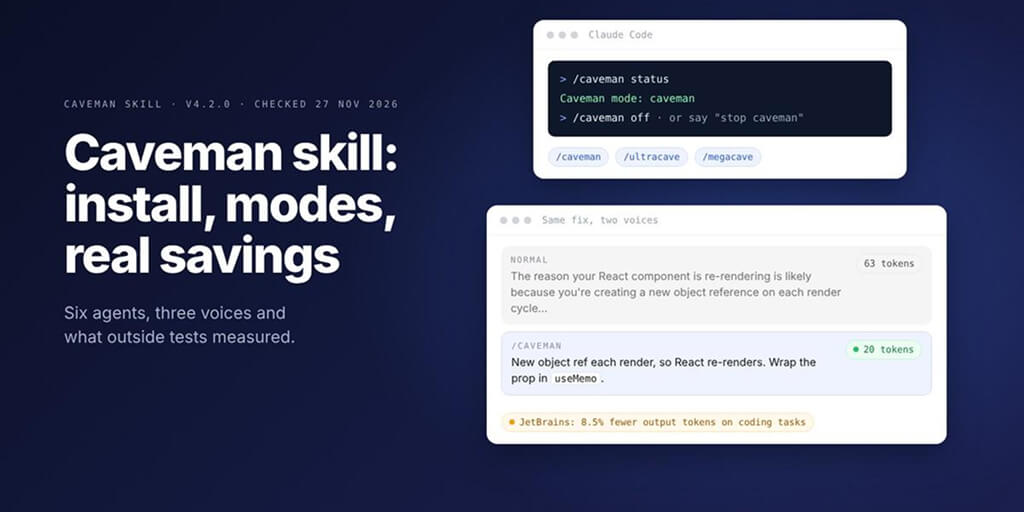
The Caveman skill (JuliusBrussee/caveman, Apache-2.0, about 123k GitHub stars, v4.2.0 from 22 November 2026) makes a coding agent answer in terse prose while code, commands, paths and errors stay exact. Independent tests found 8.5% fewer output tokens on real coding tasks (JetBrains), not the 65% once advertised, and a plain "be brief." matched it in one benchmark.
Install it in Claude Code with claude plugin marketplace add JuliusBrussee/caveman && claude plugin install caveman@caveman, switch voices with /caveman, /ultracave or /megacave, and stop it with /caveman off.
| If you want to | Do this |
|---|---|
| Check it's on | /caveman status, or cat ~/.claude/.caveman-active (prints caveman) |
| Turn it off | /caveman off, or say "stop caveman" |
| Update it | claude plugin update caveman@caveman, then restart Claude Code |
| Know what to expect | About 8.5% fewer output tokens on agent work; roughly a third fewer on short Q&A, the same as "be brief." |
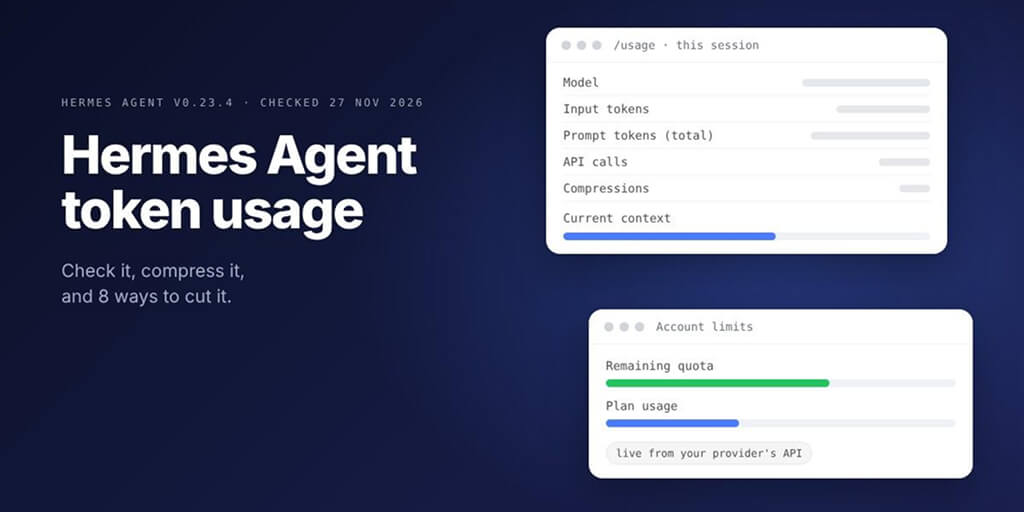
Checked: 27 November 2026. Versions: Caveman v4.2.0, RTK v1.2.1, Ponytail v5.3.3, Claude Code 2.1.332, Codex CLI 0.172.0, Cursor CLI 2026.11.22, Hermes Agent v0.23.4, OpenClaw 2026.11.10, Gemini CLI 0.71.1, Copilot CLI 1.0.116.
Picture this: you install Caveman on Monday, and by lunch Claude answers in seven words. On Friday your usage page has barely moved.
So what did the install actually buy you?
This is the deep dive behind the Caveman row in our guide to skills and plugins that reduce token usage.
What the Caveman skill does (and doesn't)
Caveman's skill file opens with its core rules: answer first, kill ceremony, use the short word, and keep the payload verbatim. Articles can go, but "not", "never", "no" and "only" never do, and numbers and units stay exact.
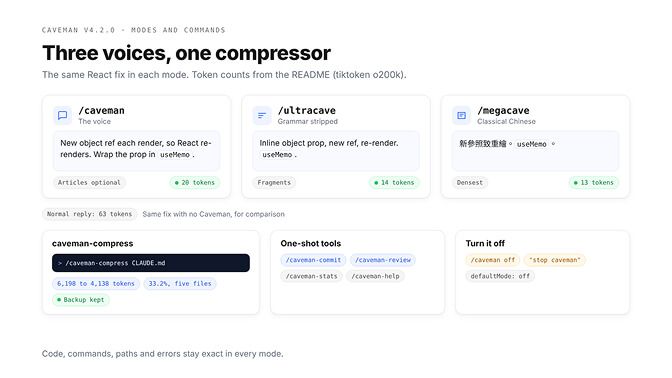
The README's own example shows the effect. A 63-token explanation of a React re-render becomes "New object ref each render, so React re-renders. Wrap the prop in useMemo.", which is 20 tokens on the tiktoken o200k count.
What it never touches matters as much. Code, commands, file paths and error text stay character for character, and commits, docs, pull requests and memory files are written in normal prose. Security warnings, irreversible actions and confused users get full sentences, and Caveman never rewrites your own prompt.
Two layers: the skill and the CLI
The skill shortens replies, and the @caveman-ai/cli runs a local proxy that has shipped since 2.0.0 (August 2026). Version 4.0 (October 2026) split it into six modules the README calls rocks (output, input, waste-fixes, routing, scripts, browse), each switched with caveman on or caveman off.
That proxy is where the input-side work happens: caveman shrink -- pnpm test compresses noisy command output, caveman trial -- claude runs an A/B on your own work, and caveman doctor prints one problem per line with its fix. Waste-fixes also keeps Anthropic's prompt cache warm while you pause, and whether that pays depends on how cache reads are priced, which our prompt caching guide covers.
One naming warning: skill directories list several other skills called "caveman" by other authors. This post covers JuliusBrussee/caveman only.
Caveman shortens the part of a session you read. In an agent session, most of what you pay for is the part you don't.
Modes: /caveman, /ultracave, /megacave (and the old lite/full/ultra names)
Caveman 3.1.0 (October 2026) replaced six intensity levels with three self-contained voices. The old names still work as aliases: lite and full mean /caveman, ultra means /ultracave, and the wenyan levels mean /megacave.
| Mode | What it does | When to use it | Author-measured output tokens (10 questions, claude-opus-5-5) |
|---|---|---|---|
| No instruction | Normal replies | Baseline | 6,983 |
| "Answer concisely." | One line in your prompt | When short replies are all you want | 4,334 |
/caveman | The voice: answer first, no ceremony, articles optional | Everyday coding chat | 4,119 (3% below "Answer concisely." at the median) |
/ultracave | Grammar stripped: fragments, each fact once | When you only skim replies | 2,693 (35% below it at the median) |
/megacave | Classical Chinese (wenyan), the densest form | Curiosity, mostly | 9% below "Answer concisely." at the median |
Checked: 27 November 2026. Author-measured on the 3.1.0 rules, n = 10, not yet re-run.
/caveman status shows the current mode without changing it. To pick the mode new sessions start in, put {"defaultMode": "ultracave"} (or "caveman", "megacave", "off", "manual") in ~/.config/caveman/config.json or a project's .caveman.json, or set CAVEMAN_DEFAULT_MODE; "manual" starts every session off until you type /caveman.
Caveman also adds a one-line reminder to every prompt so the style holds. Since v4.1.0 you can drop it with "reinforce": false or CAVEMAN_REINFORCE=0, and the full rules still load when a session starts.
caveman-compress for memory files
/caveman-compress CLAUDE.md rewrites a memory file in Caveman style and keeps the original as a backup. Claude Code loads CLAUDE.md at every session start, so a smaller file pays off every time; our AGENTS.md best practices cover keeping these files small by hand.
The author-measured result: five test files went from 6,198 to 4,138 counted tokens, 22.8% to 49.1% each. That measures file size, not session cost. It sends the file to your model provider, refuses files holding a key or token, and needs Python 3.10 or newer, so read the diff before you keep it.
/caveman-stats
/caveman-stats reports "real token usage for this Claude Code session": recorded output and cache-read counts, with which mode produced them. It reports savings as unknown, because a session log holds no run without Caveman to compare against.
How to install the Caveman skill (Claude Code, Codex, Cursor, Hermes, OpenClaw, Gemini CLI)
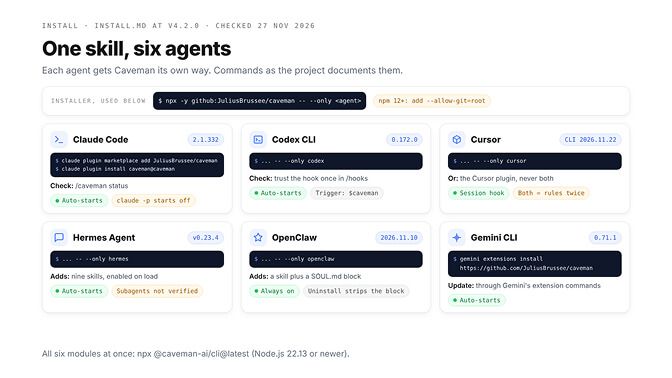
Every command here comes from the project's README and INSTALL.md at v4.2.0. On npm 12 or newer, a bare npx -y github:... command stops with EALLOWGIT, so use npx --allow-git=root -y github:JuliusBrussee/caveman -- --only <agent>.
Claude Code
claude plugin marketplace add JuliusBrussee/caveman
claude plugin install caveman@caveman
Inside a session, type /plugin marketplace add JuliusBrussee/caveman and then /plugin install caveman@caveman. It auto-starts in every interactive session and in subagents, while claude -p and Agent SDK runs start off on purpose.
To check it's on, run cat ~/.claude/.caveman-active, which should print caveman. To update, use the full name, claude plugin update caveman@caveman, because the short name fails with "Plugin "caveman" not found"; then restart, since hooks load only at session start.
Auto-start needs Node.js 18 or newer on your PATH. Want the voice with no hooks? npx skills add JuliusBrussee/caveman -g installs the skill alone.
Everything at once
npx @caveman-ai/cli@latest
The CLI (Node.js 22.13 or newer) finds your agents and logins, shows what it will change and applies it when you press Enter; the install.sh and install.ps1 one-liners pinned to v4.2.0 end in the same setup. It sends usage stats by default (never prompts or code), and caveman telemetry off stops that.
While the CLI routes Claude Code through its proxy, Claude Code's Remote Control can't start: launch with caveman claude --remote-control when you need it.
Codex
npx -y github:JuliusBrussee/caveman -- --only codex
Open /hooks in Codex once and trust the Caveman entry; if codex features list shows hooks off, add [features] hooks = true to ~/.codex/config.toml. Codex calls skills with a dollar sign, so the toggle is $caveman, not /caveman.
To update, re-run the installer. If you're still choosing between the two agents, our Codex vs Claude Code comparison covers the bigger differences.
Cursor
npx -y github:JuliusBrussee/caveman -- --only cursor
This adds the skills and a session hook in ~/.cursor/hooks.json, read by the editor, the Agents window and the Cursor CLI. The alternative is the Cursor plugin, cursor-agent --plugin-dir ~/.cursor/plugins/local/caveman, but pick one: with both, every chat gets the rules twice.
An August 2026 fix moved Cursor skills into the global folder, so an older install that dropped them into your project folder needs a re-run.
Hermes Agent
npx -y github:JuliusBrussee/caveman -- --only hermes
The installer copies nine Caveman skills into ~/.hermes/skills/productivity/, and Hermes enables them on load. caveman hermes runs Hermes through the CLI's proxy instead.
The project marks Hermes subagents as not verified, so if a delegated task comes back wordy, ask for the caveman skill in that task. Re-run the installer to update, and if you're still deciding where Hermes should live, our guide to Hermes Agent hosting compares the options.
OpenClaw
npx -y github:JuliusBrussee/caveman -- --only openclaw
This drops the skill into ~/.openclaw/workspace/skills/caveman/ and appends a small marker-fenced block to the workspace SOUL.md, which OpenClaw injects on every turn. Uninstalling removes the skill and that block and leaves the rest of SOUL.md alone.
Caveman v4.2.0 was last checked against Hermes 0.23.0 and OpenClaw 2026.11.1, a few releases behind today's, and only for whether each agent launches, with no live model request. For other skills worth adding, see our ranking of the best OpenClaw skills.
Gemini CLI and Copilot CLI
gemini extensions install https://github.com/JuliusBrussee/caveman
npx -y github:JuliusBrussee/caveman -- --only copilot --with-init
Gemini CLI owns its extensions, so update through its own extension commands. For GitHub Copilot, the Copilot CLI gets a session hook, while VS Code gets repo-wide instructions from --with-init and no auto-start.
Claude.ai, the desktop app and Cowork
Add the marketplace JuliusBrussee/caveman under Customize > Plugins, add Caveman, and turn on Settings > Capabilities > Code execution and file creation. Chat has no startup hook, so start with /caveman; in Cowork, start a new task first.
The README says this route is "not tested end to end yet". A plugin installed from the Claude Code command line stays on that machine and never reaches your Claude account.
How to turn Caveman off or uninstall it
| To stop it | Do this |
|---|---|
| In this window | /caveman off, or say "stop caveman" or "normal mode" |
| In new sessions | {"defaultMode": "off"} in ~/.config/caveman/config.json, or "manual" to start off until you type /caveman |
| One CLI module | caveman off input (modules: output, input, waste-fixes, routing, scripts, browse) |
| The Claude Code plugin | claude plugin disable caveman@caveman, or claude plugin uninstall caveman@caveman |
| A skills-only install | npx skills remove JuliusBrussee/caveman -g |
| Everything the installer wrote | npx -y github:JuliusBrussee/caveman -- --uninstall, then npm uninstall -g @caveman-ai/cli |
Checked: 27 November 2026
/caveman off stops the voice; the CLI's modules are switched separately with caveman off <module>. Order matters on the last row: remove the CLI first and ANTHROPIC_BASE_URL stays in ~/.claude/settings.json, which you then clear with caveman disable --all after reinstalling the CLI.
What the independent tests show
Three outside tests and the author's own numbers are public and checkable. Read them together and the picture is consistent: big cuts on short, chatty answers, small ones on agent work.
| Who | Date | Setup | Result | Quality |
|---|---|---|---|---|
| JetBrains | July 2026 | Claude Code 2.1.200, Claude Sonnet 5 at low effort, 86 SkillsBench tasks (82 clean pairs), Caveman forced on | 8.5% fewer output tokens (592k to 542k); about 10% cheaper per task at best | No measurable loss (p = 0.82) |
| Max Taylor | 29 April 2026 | 24 prompts, 5 arms, 120 responses on Claude Opus 4.7, single-shot | "be brief." 419 tokens against a 636 baseline (34% fewer); Caveman lite 401, full 404, ultra 449 | Every arm within 1.5% |
| mikeruhl/rtk-vs-caveman | 16 April 2026 | 270 direct API calls, 9 conditions, Claude Sonnet 4.6, RTK simulated in code | Caveman output 39% to 43% lower but total tokens about 10% higher; cost 23% to 27% lower; "Answer concisely." output 29% lower, cost 25% lower | Caveman full 4.00 vs 3.98 baseline (of 5) |
| Caveman README (author-measured) | October 2026 | 10 dev questions, claude-opus-5-5, n = 10, 3.1.0 rules, not re-run | /caveman 3% below "Answer concisely." at the median, /ultracave 35% below | Not measured |
Checked: 27 November 2026
JetBrains forced Caveman on in every reply and called the result "the ceiling, not the usual-case result." Its first 10-task run showed 29.5% fewer output tokens, which shrank to 8.5% at full scale, and one task crossing the 200k long-context pricing tier flipped the raw cost totals: small samples flatter it.
Max Taylor's prompts were short Q&A, not agent sessions, and two words matched the plugin on tokens and quality. The mikeruhl study explains why total tokens can rise: the skill added about 1,033 input tokens per request, which the study itself says overstates the cost in long Claude Code sessions, where the rules load once. Its own summary is that RTK and Caveman "operate on different token streams."
The README has caught up with all of this. It stopped claiming 65% in v2.0.0 (August 2026), and since October it says /caveman is 3% shorter than "Answer concisely.", that the rules cost about 1,160 input tokens, and that "if you pay per request (GitHub Copilot), shorter answers save nothing."
Two more studies test the caveman style rather than this skill. Elastic's elastic-caveman, a separate skill for Elasticsearch replies, cut response tokens 63.6% across eight MCP scenarios (1,284 tokens down to 467), and the CAVEWOMAN paper (arXiv 2606.24083, credited to Adobe Research in Caveman's README) found that compressing the output cut realized cost 1.4 to 2.4 times on most API models, while compressing the input raised the net cost.
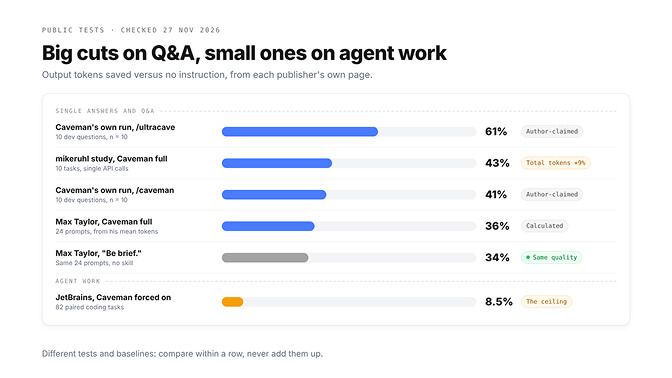
The savings are real but they sit on output tokens, a minority of an agent session's bill. Expect single digits on agent work and 30% to 45% on short, chatty Q&A, most of which a plain "be brief." also gets.
Caveman vs RTK vs Ponytail vs "be brief."
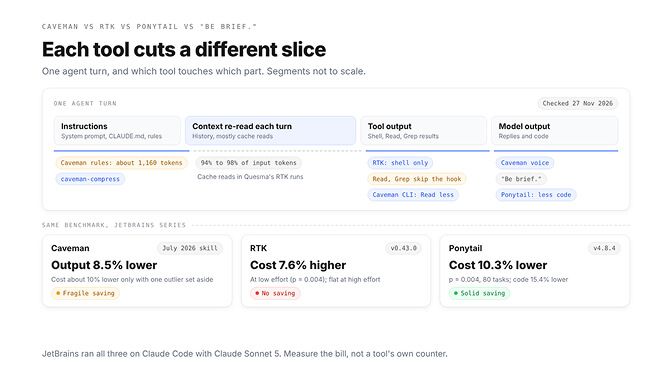
These four get compared as if they did one job. They work on different layers, and only one of them has a solid independent cost saving.
| Tool | Layer it works on | Install | Author's claim | Independent result | Lossy? |
|---|---|---|---|---|---|
| Caveman v4.2.0 (123k stars) | Reply prose; tool output too through the CLI's proxy | claude plugin marketplace add JuliusBrussee/caveman, then claude plugin install caveman@caveman | /caveman 3% below "Answer concisely." | JetBrains: 8.5% fewer output tokens | Prose only; proxy keeps originals on disk |
| RTK v1.2.1 (88k stars) | Shell command output, before the agent reads it | brew install rtk, then rtk init -g | Up to 90% less command output, counted as bytes divided by 4 | JetBrains (v0.43.0): cost 7.6% higher at low effort, flat at high. Quesma (0.45.0): total bill 5% lower with Claude Code on Fable 5.0, 5% higher with OpenCode 1.18.25 on DeepSeek V4 Pro | Yes; rtk bypass runs a command unfiltered |
| Ponytail v5.3.3 (200k stars) | How much code the agent writes | /plugin marketplace add DietrichGebert/ponytail, then /plugin install ponytail@ponytail | 45% fewer output tokens, 26% lower cost (39 tasks, 5 runs each, Opus 5.5) | JetBrains (v4.8.4): cost 10.3% lower (p = 0.004), code 15.4% lower | No: validation and security stay |
| "be brief." | Reply prose | Two words in your prompt or CLAUDE.md | None | Max Taylor: 34% fewer tokens, same quality. mikeruhl ("Answer concisely."): cost 25% lower | No |
Checked: 27 November 2026. Stars rounded from GitHub; every independent test ran an older version than today's.
RTK's own README says "a 90% cut in command output is not a 90% cut in cost," and the tests show why. In JetBrains' replay of 83 sessions, only about a fifth of tool output came from commands RTK can rewrite, partly because Claude Code reads files with built-in tools that skip its hook; JetBrains' bill went up while rtk gain reported 96.2 million tokens saved.
Ponytail is a write-less-code skill, not a prose compressor: it makes the agent check whether code needs to exist before writing it. It was the only tool in JetBrains' series with a statistically solid cost saving, but installed as a bare skill it self-activated zero times in ten sessions, so use the plugin. Caveman's install guide says the two stack: "Ponytail decides how much code gets written; caveman decides how the reply reads."
"be brief." costs two words of input, against about 1,160 tokens for Caveman's rules. Stacking doesn't add up either: in the mikeruhl study, which simulated RTK's filtering in code, RTK ultra plus Caveman ultra cut cost 42% but scored the lowest quality of all nine setups.
Which to try first:
- Chat-heavy sessions full of explanations: "be brief." first, then Caveman if you want the same shape every time.
- Test and build output filling the context: RTK, or a hook that trims that output, which our guide to reducing Claude Code token usage without plugins shows.
- An agent that over-builds: Ponytail.
- Per-request billing, such as GitHub Copilot's premium requests: Caveman's own docs say shorter answers save nothing there.
Caveman skill not working? Fixes by symptom
Most failures come down to when hooks fire and which copy of Caveman loaded. The fixes below come from the project's INSTALL.md and its maintainer's own fixes.
| Symptom | Fix |
|---|---|
/caveman isn't recognised or the skill isn't listed | Restart the session, since the start hook only fires then, and type / to check the list. If another skill owns the name, use /caveman:caveman. For installer setups, check ~/.claude/settings.json for caveman-activate.js and caveman-mode-tracker.js and re-run with --force |
| No Node.js on the machine | Auto-start needs Node.js 18 or newer on your PATH; until then, type /caveman yourself |
| The mode doesn't stick, or comes back after "stop caveman" | Set defaultMode in the config or the repo's .caveman.json. The compaction re-arm bug is fixed, and /clear is a deliberate reset |
| It drifts back to long prose mid-session | Keep the per-prompt reminder on (don't set reinforce to false). Opus 5.5 ignoring /ultracave is an open issue (#1318, October 2026) |
Codex rejects /caveman | Type $caveman, trust the hook in /hooks, and check that Codex hooks are on |
| Cursor shows no Caveman, or the rules twice | Re-run --only cursor (an August fix moved the skills to the global folder), and use either the installer or the plugin, not both |
| Windows installer or hook errors | Use install.ps1 in PowerShell 5.1 or newer, allow it for the session with Set-ExecutionPolicy -Scope Process -ExecutionPolicy Bypass, and add --allow-git=root if npm 12 says EALLOWGIT |
| You can't tell whether it's on | /caveman status, ~/.claude/.caveman-active and /caveman-stats; for CLI installs, caveman status and caveman doctor |
Checked: 27 November 2026
Still stuck? The README's own advice is to open your agent in the Caveman repo and say "Read INSTALL.md, install caveman for me."
When Caveman is worth it, and when it isn't
Worth it:
- Long conversational or debugging sessions where you read a lot of agent prose.
- A subscription close to its limits, where trimming replies stretches it a little.
- A team that wants the same terse reply shape from every agent.
Not worth it:
- Short tasks: in the mikeruhl study, total tokens rose 20% to 51% on four small-input tasks, because the rules outweighed the savings.
- Per-request billing, where a shorter answer costs the same.
- Work where the prose is the deliverable, such as explanations a teammate has to follow. Caveman already writes docs and PR descriptions in normal prose.
On privacy, the skill sends nothing except files you run through caveman-compress, which go to your model provider. The CLI sends usage stats until you run caveman telemetry off or set DO_NOT_TRACK=1, and Auto, its model router, sends your recent asks, with whatever your agent attaches, to Caveman Cloud only after you sign in and pick it.
Our order of operations: try "be brief." for a week, install the plugin if replies still sprawl, and add the CLI's proxy only after an A/B on your own tasks. Caveman's best feature isn't the grunt; it's a README honest enough to tell you when to switch it off.
Want an always-on agent that runs on your own key?
Caveman is for the coding agent on your laptop. If the agents you care about run all day, BetterClaw is a managed agent platform: they run on our infrastructure on a schedule, on your own model key from 28+ providers, and you pay the provider's price for every token with no markup from us.
BetterClaw Free, as its page describes it today, gives you 1 agent, 100 credits a month and 3 connectors on your own key, with no card and no expiry. Start free
Need more credits, more agents or team seats? Paid plans start at $19 a month. See plans and pricing
Frequently Asked Questions
Is the Caveman skill useful?
Yes, if you read a lot of agent prose: it shortens replies reliably and JetBrains found no measurable quality loss. On real coding tasks the saving is small, 8.5% fewer output tokens, because code and tool calls dominate those sessions. Try "be brief." first and keep Caveman if you want the same terse shape every time.
Does the Caveman skill really save 65% of tokens?
No. The 65% figure came from early versions of the README, measured on 10 chat-style prompts against default verbose replies, and the README dropped it in v2.0.0 in August 2026. Today it says /caveman is 3% shorter than "Answer concisely." at the median, and JetBrains measured 8.5% fewer output tokens on 82 paired coding tasks.
Is Caveman better than just telling Claude to be brief?
For short answers alone, not by much: in Max Taylor's test, "be brief." cut tokens 34%, close to Caveman's lite and full levels at the same quality. In the mikeruhl study, Caveman cut more output than "Answer concisely." but saved about the same on cost, 23% to 27% against 25%. Caveman's edge is consistency: hooks keep it on across sessions and subagents, and it drops back to full sentences for warnings and irreversible steps.
How do I turn Caveman off?
Type /caveman off or say "stop caveman" for the current window, or set "defaultMode": "off" in ~/.config/caveman/config.json for new sessions. Run claude plugin disable caveman@caveman to switch the plugin off, and npx -y github:JuliusBrussee/caveman -- --uninstall to remove everything the installer wrote, before uninstalling the CLI.
Does Caveman work with Codex, Cursor, Hermes and OpenClaw?
Yes: run npx -y github:JuliusBrussee/caveman -- --only followed by codex, cursor, hermes or openclaw. Codex also needs its hook trusted once in /hooks and uses $caveman instead of /caveman. Hermes subagents are not verified, and Caveman's last checks, on Hermes 0.23.0 and OpenClaw 2026.11.1, only confirmed that each agent launches.
Caveman or RTK: which should I install first?
Check where your tokens go first: /context and /usage in Claude Code show it. If long explanations dominate, try "be brief." or Caveman; if test and build output dominates, RTK targets that, though JetBrains and Quesma found no reliable cost saving from it. Install one at a time and compare billed usage on the same task.