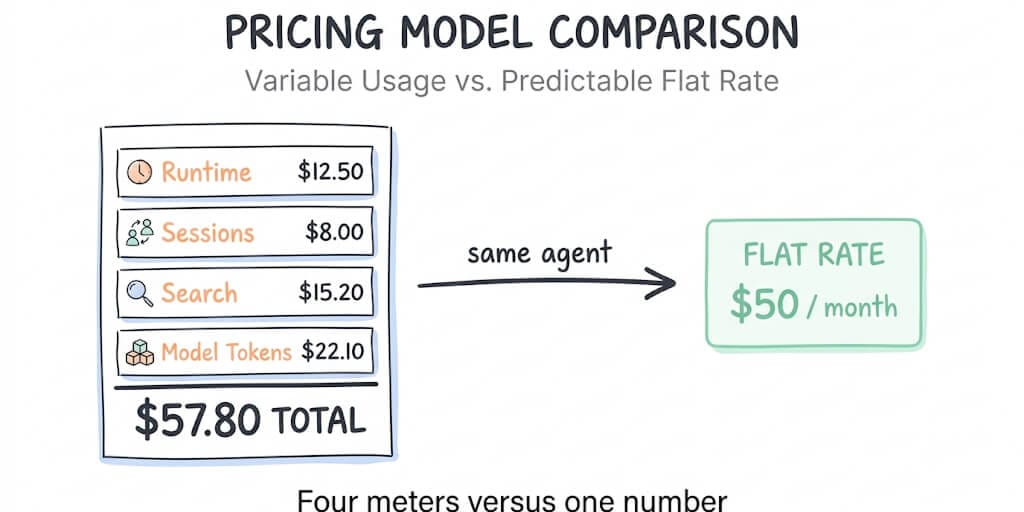
Google charges you across four separate meters. Here is what that actually costs, and which platforms hand you one number instead.
The invoice came in on a Tuesday. Four line items, none of which anyone recognized on its own, adding up to just over $1,800 for one support agent that had been live six weeks.
Nobody had done anything wrong. That is the part worth sitting with.
Vertex AI Agent Builder pricing: the four meters, in one table
Google rebranded Vertex AI Agent Builder as the Gemini Enterprise Agent Platform at Cloud Next 2026 and folded Agentspace into it. Same services, new name, same billing model.
| Meter | Rate (2026) |
|---|---|
| Agent Engine runtime (vCPU) | $0.0864 per vCPU-hour |
| Agent Engine runtime (memory) | $0.0090 per GB-hour |
| Sessions and Memory Bank | $0.25 per 1,000 events |
| Vertex AI Search | $1.50 to $6.00 per 1,000 queries by tier |
| Data indexing storage | around $1.00 per GB per month |
| Foundation model tokens | billed separately by model |
| Flat monthly platform fee | none |
Free allowances soften the start: 50 vCPU-hours and 100 GB-hours of runtime a month, 10,000 free Vertex AI Search queries a month, and $300 in credits for 90 days on a new Google Cloud account.
No flat fee is not the same as cheap. It means the ceiling is set by your traffic, not by your plan.
What you actually pay for, and the line items that catch people out
Walk through one interaction. A user asks your agent a question.
The agent retrieves documents through Vertex AI Search. That is meter one. It generates an answer with Gemini. That is model tokens, meter two. It writes the exchange to session state so the next message has context. Meter three. All of that runs on Agent Engine. Meter four.
One question, four SKUs on your invoice. At a hundred thousand daily queries the arithmetic stops being academic.
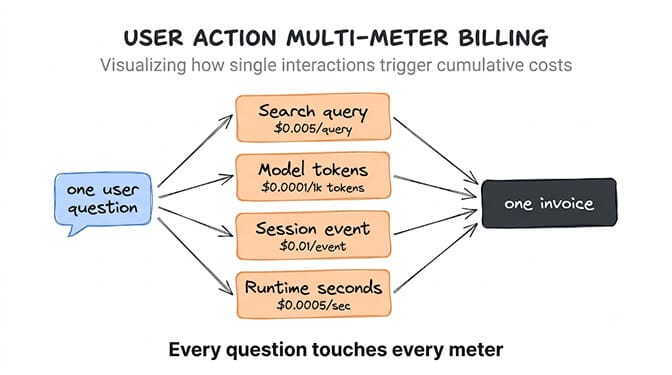
Three things reliably surprise people.
First, sessions and memory became billable in early 2026. Budgets built on 2025 numbers are now low by design, not by mistake.
Second, code execution bills at runtime rates. If your agent uses a code interpreter tool, that is compute you are paying for by the vCPU-hour.
Third, model tokens are almost always the largest line, and agent workflows amplify them. A single user turn can trigger several internal calls for planning, retrieval, tool use, and summarizing. You pay for every hop.
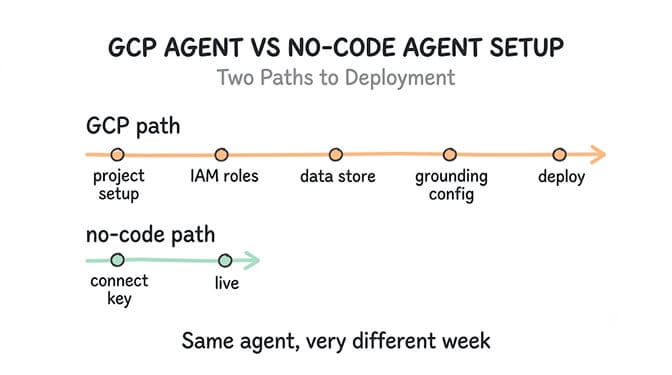
Then there is the cost that never appears on the invoice. Getting a governed agent live on GCP means IAM, service accounts, a data store, grounding configuration, and someone who genuinely knows the platform. If that person is not already on your team, the setup tax is the real price. Our full Vertex AI Agent Builder pricing breakdown walks the meters line by line.
The cheapest Vertex AI Agent Builder alternatives, ranked by what you actually pay
Ranked by predictable entry cost, not by feature count.
| Platform | Entry price | Bill at production scale | Code needed |
|---|---|---|---|
| BetterClaw | $0 free plan, forever | $49/mo Pro, $149/mo Business, flat | No |
| n8n | Free self-hosted, plus $5 to $20 server | $24/mo Cloud Starter, $60/mo Pro | Some |
| Gumloop | Free, 2,000 credits | $37/mo, $244/mo for teams | No |
| CrewAI | Free, open source | Your own infra, plus tokens | Python |
| Lindy | No free plan, 7-day trial | $49.99 to $199.99/mo, plus overages | No |
| AWS Bedrock AgentCore | Usage-based, no free plan | $0.0895/vCPU-hour across 12 components | Yes |
Now the honest version of each.
BetterClaw: flat pricing, no inference markup
I will declare the bias up front. We build this one.
BetterClaw is a no-code AI agent builder. You sign up, connect a model key, pick your integrations, and the agent is live. Most people get there in about sixty seconds, which is roughly the length of the GCP IAM screen you would otherwise be staring at.
The pricing is deliberately boring. Free is $0 forever with one agent and 500 credits a month, no card. Pro is $49 a month for five agents and 12,000 credits, or $39 on annual billing. Business is $149 for twenty-five agents. Full detail lives on the BetterClaw pricing page.
The part that matters against Vertex: you bring your own key and pay OpenAI, Anthropic, or Google directly at their published rates. We take zero markup on inference. Twenty-eight-plus providers are supported, so if Gemini 3 gets expensive you switch models in a dropdown instead of a migration.
When it makes sense: you want one predictable number, you are not already deep in Google Cloud, and you would rather ship an agent than configure a platform.
When it does not: you need native BigQuery grounding across petabytes of first-party data, or your procurement team will only sign a hyperscaler contract. Vertex wins both of those on the merits. Our head-to-head comparison covers that tradeoff in detail.
n8n: cheapest per run if you like wiring things
n8n bills per execution, and one execution is one full workflow run no matter how many nodes it contains. Cloud starts around $24 a month for 2,500 executions and $60 for 10,000. Community Edition is free software on a server you rent for five or ten dollars.
That per-execution model is genuinely the cheapest way to run high-volume, predictable automation with 1,200-plus connectors.
When it makes sense: your work is triggered workflows, not autonomous decisions, and someone on the team enjoys building the graph.
When it does not: you want an agent with persistent memory that decides what to do next. n8n runs workflows brilliantly and remembers almost nothing between them. We wrote about that gap in more detail in our n8n alternative for managed AI agents breakdown.
Gumloop: visual pipelines, credit math
Free tier gives you 2,000 credits. Paid starts near $37 a month for 10,000, and team plans jump to $244.
The builder is genuinely pleasant and enterprise names like Shopify and Instacart use it. The catch is the same catch every credit platform has: heavy AI steps and scraping burn allowance faster than the pricing page implies, so your effective cost per task is discovered rather than chosen.
When it makes sense: document and data pipelines where you want to see every step.
When it does not: you need a stable monthly number to put in a budget.
CrewAI: free until you count your own time
Open source, 47,000-plus GitHub stars, used at IBM and PepsiCo, excellent role-based multi-agent design. Zero license cost.
Then you provide the Python environment, the server, the monitoring, the credential handling, and the person who gets paged. Self-hosting an agent stack realistically lands at $200 to $500 a month once you price engineering time honestly, which we broke down in our self-hosting versus managed comparison.
When it makes sense: you have Python engineers and want maximum control over orchestration logic.
When it does not: the person who wants the agent is not the person who can deploy it.
If you have read this far mostly hoping someone will tell you the flat-rate option exists: it does. BetterClaw has a free plan with every core feature, $49 a month when you outgrow it, and your model bill stays with your provider. No card to look around.
Lindy: polished, until the credit meter moves
Lindy dropped its free tier in early 2026. It is now a 7-day trial, then $49.99 for Plus, $99.99 for Pro, and $199.99 for Max, monthly only.
Credits scale with complexity rather than count, so a workflow that includes a phone call can consume more than a hundred times what a knowledge-base lookup costs. Phone numbers add $10 each per month on top.
When it makes sense: outbound sales and inbox automation, where the prebuilt agents save you real setup time.
When it does not: anything voice-heavy, or any month where you need the bill to be the same as last month's.
AWS Bedrock AgentCore: Vertex's pricing problem, in a different accent
If your objection to Vertex is complexity rather than Google specifically, AgentCore will disappoint you. Runtime bills at $0.0895 per vCPU-hour and $0.00945 per GB-hour, Gateway adds $0.005 per 1,000 tool invocations, and there are twelve independently billable components in total.
Credit where due: CPU is charged on active use, so the seconds your agent spends waiting on a model are not billed at the CPU rate. That is a real improvement.
When it makes sense: you are already an AWS shop with the IAM discipline to match.
When it does not: you were hoping for fewer SKUs. Our AgentCore pricing alternative guide has the full component list.
Picking a Vertex AI Agent Builder alternative by use case
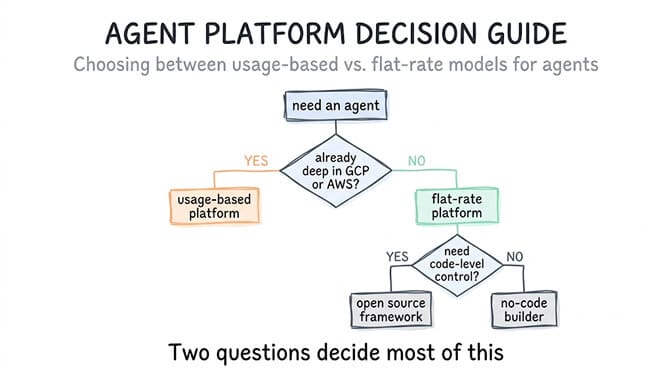
If your data already lives in BigQuery and Workspace, stay on Vertex. The grounding quality is worth the four meters and nothing on this list matches it.
If you are a founder or a small team who needs a working agent this week, take a flat-rate no-code builder. The setup tax on a hyperscaler will cost you more than the subscription ever would.
If you are running high-volume triggered automation with clear inputs and outputs, n8n's per-execution billing is the cheapest honest answer on this page.
If you have Python engineers and strong opinions about orchestration, use CrewAI and accept that you are now also the platform team.
And if you are enterprise but not committed to a cloud, look hard at whether you need governance features or just a governed vendor. Gartner expects 40% of enterprise applications to embed AI agents by the end of 2026, which means most of these decisions are being made this year by people who have never priced a vCPU-hour. If you would rather compare the whole field first, our roundup of the best AI agent builders covers the platforms this article skipped.
If any of this resonated, give BetterClaw a try. Free plan, one agent, every core security feature, no credit card. $49 a month for Pro when you outgrow it, $39 on annual, and your model bill stays with your provider at zero markup. First deploy takes about a minute. We handle the infrastructure. You handle the part that is actually interesting.
One number instead of four meters
No GCP account, no IAM roles, no four-SKU invoice. Paste a key from any of 28+ providers and go. Start free → No credit card · Free plan with 1 agent and 500 credits/mo · $49/mo for Pro, $39 on annual · Zero inference markup
The thing about four-meter pricing is that it is not a trick. It is an honest reflection of a platform built for people whose job is capacity planning.
Most of us do not have that job. We just want the agent to answer the ticket.
Frequently Asked Questions
What is Vertex AI Agent Builder pricing based on?
There is no flat subscription. You pay across four meters: Agent Engine runtime at $0.0864 per vCPU-hour plus $0.0090 per GB-hour, session and memory events at $0.25 per 1,000, Vertex AI Search from $1.50 to $6.00 per 1,000 queries, and foundation model tokens billed separately. New Google Cloud accounts get $300 in credits valid for 90 days.
How do Vertex AI Agent Builder alternatives compare on cost?
Flat-rate platforms give you one number: BetterClaw is $0 free or $49 a month, n8n Cloud starts near $24, Gumloop near $37, Lindy at $49.99. Usage-based rivals like AWS Bedrock AgentCore have the same multi-meter problem as Vertex. The gap widens at scale, because usage pricing tracks your traffic while flat pricing does not.
How long does it take to move an agent off Vertex AI Agent Builder?
For a straightforward support or ops agent, an afternoon. The prompt, the knowledge sources, and the tool list transfer conceptually to any platform. What takes longer is anything relying on native BigQuery grounding or GCP-specific IAM, which usually has to be rebuilt rather than ported.
How much does a production AI agent actually cost per month?
On Vertex, a real support agent commonly lands between $500 and $2,000 a month once all four meters run together, and teams have reported five-figure surprises from services left running. On a flat-rate platform the platform fee is fixed, so your variable cost is only model tokens, which for a moderate-volume agent typically runs $5 to $30 a month.
Is a no-code agent platform secure enough for business use?
It depends entirely on what the platform does by default. The questions worth asking: does every agent run in an isolated container, are credentials encrypted at rest, can you approve actions before they execute, and is there a kill switch. BetterClaw ships all four on every plan including Free, with 200-plus security-audited skills rather than an open marketplace.