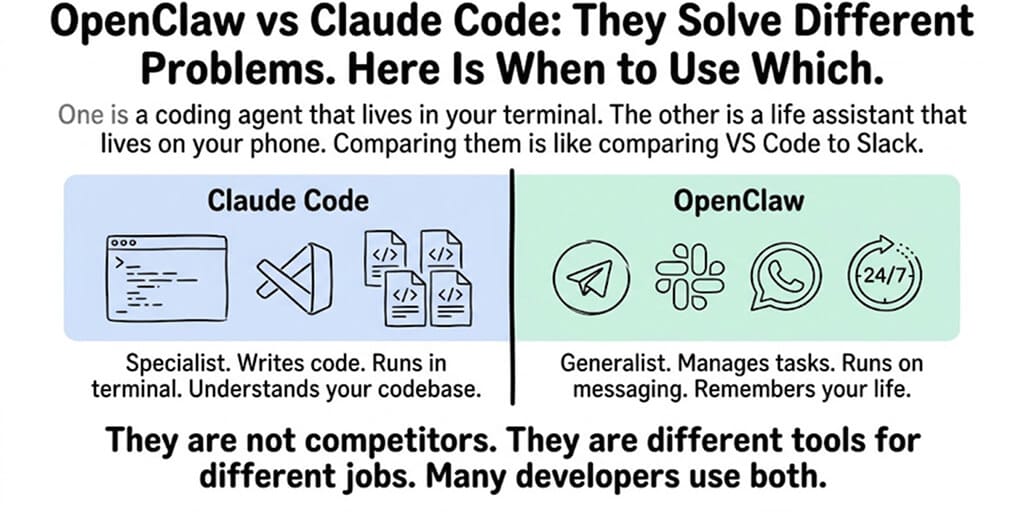
One is a coding agent that lives in your terminal. The other is a life assistant that lives on your phone. Comparing them is like comparing VS Code to Slack. Here's the honest breakdown.
A developer in the OpenClaw Discord asked last week: "Should I cancel my Claude Code subscription and just use OpenClaw for everything?"
Fourteen replies. All of them said the same thing in different ways: They do completely different things.
He was using Claude Code to refactor a React codebase. He was using OpenClaw to manage his calendar, draft emails, and answer customer questions on Telegram. He thought one could replace the other because both "use Claude." That's like saying Photoshop and Gmail are the same because both run on a MacBook.
Here's the honest comparison between OpenClaw and Claude Code, when to use which, and why many developers run both.
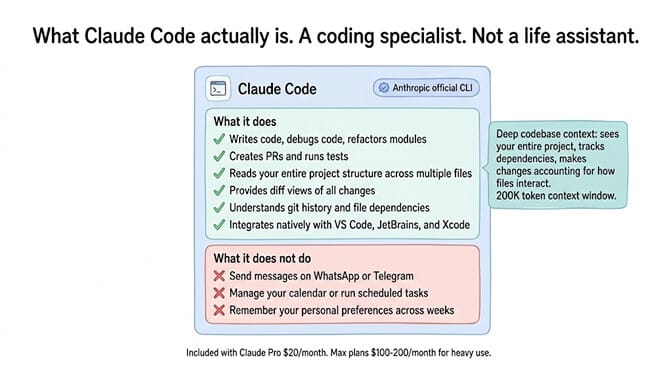
What Claude Code Actually Is (a Coding Specialist)
Claude Code is Anthropic's official CLI for agentic software development. It lives in your terminal. It reads your files, understands your git history, and operates within your codebase with a 200K-token context window.
What it does: Writes code. Debugs code. Refactors code. Creates PRs. Runs tests. Understands your project structure across multiple files. Provides diff views of changes. Integrates with VS Code, JetBrains, and Xcode.
What it doesn't do: Send messages on WhatsApp. Manage your calendar. Answer customer questions on Telegram. Remember what you told it last week about your preferences. Run scheduled tasks at 6 AM. Connect to Slack, Discord, or any messaging platform.
Pricing: Included with Claude Pro ($20/month). Max plans ($100-200/month) for 5-20x usage with Opus access. Or use BYOK through the API.
The key differentiator: Deep codebase context. Claude Code doesn't just run code. It understands code. It sees your entire project, tracks dependencies, and makes changes that account for how different files interact. No other tool does this as well in May 2026.
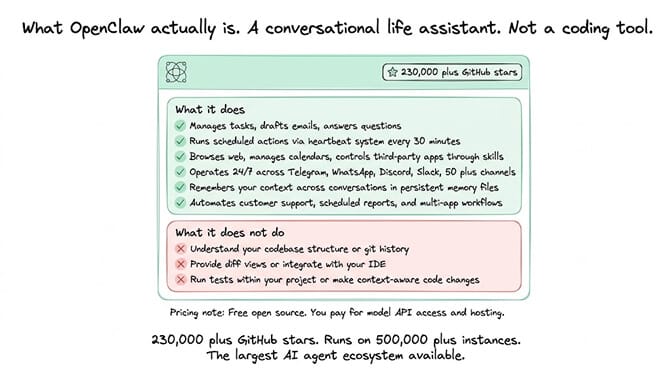
What OpenClaw Actually Is (a Life Assistant)
OpenClaw is a general-purpose AI agent that runs on messaging platforms. 230,000+ GitHub stars. It lives on Telegram, WhatsApp, Discord, Slack, and 50+ other channels. It remembers your context across conversations in persistent memory files.
What it does: Manages tasks. Drafts emails. Answers questions. Runs scheduled actions (heartbeat system, every 30 minutes). Browses the web. Manages calendars. Controls third-party apps through skills. Operates 24/7.
What it doesn't do: Understand your codebase structure. Provide diff views of changes. Integrate with your IDE. Read your git history. Run tests within your project. Any deep software engineering work.
Pricing: Free (open source). You pay for model API access and hosting.
For the detailed OpenClaw alternative comparison, our comparison page covers how BetterClaw fits into the ecosystem alongside both tools.
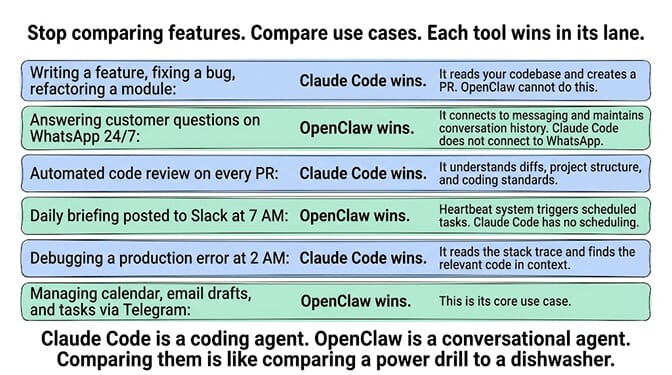
The Comparison That Matters (Stop Comparing Features, Compare Use Cases)
Here's where most people get it wrong.
Feature comparison tables between OpenClaw and Claude Code are misleading because they imply the tools compete. They don't. Here's the use case comparison instead:
- Writing a feature, fixing a bug, refactoring a module: Claude Code. It reads your codebase, suggests changes in context, and creates a PR. OpenClaw can't do this because it doesn't have codebase context.
- Answering customer questions on WhatsApp 24/7: OpenClaw. It connects to messaging platforms, maintains conversation history, and uses persistent memory. Claude Code doesn't connect to WhatsApp at all.
- Automated code review on every PR: Claude Code. It understands diffs, project structure, and can approve/reject based on coding standards. OpenClaw doesn't integrate with GitHub workflows at this level.
- Daily briefing posted to Slack at 7 AM: OpenClaw. Its heartbeat system triggers scheduled tasks and posts to messaging channels. Claude Code has no scheduling or messaging capability.
- Debugging a production error at 2 AM: Claude Code. It reads the stack trace, finds the relevant code, and suggests a fix in context. OpenClaw would need to be told what to do step by step.
- Managing your personal calendar, email drafts, and task list via Telegram: OpenClaw. This is its core use case. Claude Code is a terminal tool with no messaging integration.
The category distinction: Claude Code is a coding agent. OpenClaw is a conversational agent. Comparing them is like comparing a power drill to a dishwasher. Both are useful. Neither replaces the other.
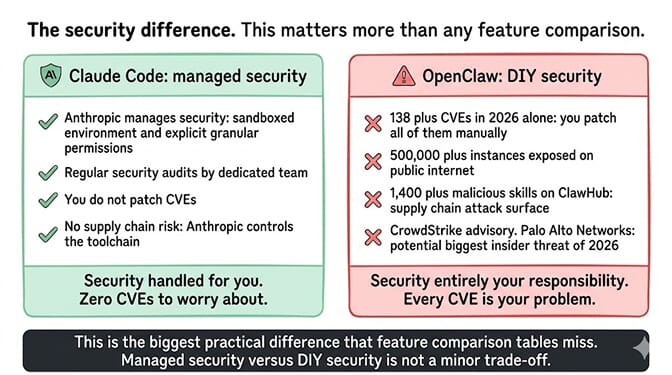
The Security Difference (This Matters More Than You Think)
Claude Code: Anthropic manages the security. Sandboxed environment. Explicit, granular permissions. Regular audits. Dedicated security team. You don't patch CVEs.
OpenClaw: You manage the security. 540+ CVEs in 2026. 500K+ exposed instances. 1,400+ malicious skills on ClawHub. CrowdStrike published a full security advisory. Palo Alto Networks described it as "the potential biggest insider threat of 2026." You patch everything yourself.
This is the biggest practical difference that feature comparisons miss. Claude Code is managed security. OpenClaw is DIY security. For the complete OpenClaw security analysis, our security risks deep dive covers the full picture.
The "Use Both" Strategy (What Most Developers Actually Do)
Here's what nobody tells you about choosing between these tools.
Most developers who've tried both end up using both. DataCamp's comparison concluded the same: "Many people find that having both covers almost everything they need from AI agents in 2026."
Claude Code handles the coding workflow. You open the terminal, describe what you need built or fixed, and Claude Code handles it with full codebase context.
OpenClaw (or BetterClaw) handles everything else. Calendar management, email drafts, customer support on messaging channels, scheduled reports, web research, task delegation.
If the "everything else" part sounds like what you need and you don't want to manage OpenClaw's Docker setup, security patches, and infrastructure, BetterClaw handles the non-coding agent. Same conversational agent capabilities. Managed security (no 540+ CVEs to worry about). Smart context management (lower API costs). Verified skills (no ClawHub supply chain risk). Free tier with 1 agent and BYOK. $49/month for Pro. 60-second deploy.
When to Choose One Over the Other (Decision Framework)
Choose Claude Code if: Your primary need is coding assistance. You work in a terminal. You want IDE integration. You don't need messaging platform integration or 24/7 autonomous operation.
Choose OpenClaw (or BetterClaw) if: Your primary need is a conversational agent on messaging platforms. You want scheduled tasks, persistent memory, and multi-channel support. You don't need deep codebase context. (If you're still picking a conversational-agent platform, our best OpenClaw alternatives guide sorts the options by category.)
Choose both if: You write code AND manage tasks/communications through messaging. Claude Code for the coding. A conversational agent for everything else. (If the Anthropic ban has you rethinking which model powers that conversational agent, our Claude alternatives for OpenClaw ranks seven models by quality and cost.)
The "OpenClaw vs Claude Code" debate is a false choice because they're not in the same category. The real question is whether you need a coding agent, a conversational agent, or both. Most people building things in 2026 need both.
If you want the conversational agent without the infrastructure management, give BetterClaw a try. Free tier with 1 agent and BYOK. $49/month for Pro. Pair it with Claude Code for the coding. The two tools complement each other because they solve completely different problems.
Frequently Asked Questions
What is the difference between OpenClaw and Claude Code?
OpenClaw is a general-purpose AI agent that runs on messaging platforms (Telegram, WhatsApp, Slack) with persistent memory, scheduled tasks, and 200+ skills. Claude Code is Anthropic's terminal-based coding agent with deep codebase context, IDE integration, and PR creation. They solve different problems: OpenClaw for life/task management, Claude Code for software development.
Can OpenClaw replace Claude Code for coding?
Not effectively. OpenClaw can run code through skills, but it lacks Claude Code's deep codebase context (200K-token project awareness), IDE integration (VS Code, JetBrains), diff views, and git history understanding. For real software engineering, Claude Code is purpose-built. OpenClaw is better for everything outside of coding.
Can Claude Code replace OpenClaw for daily tasks?
No. Claude Code has no messaging platform integration (no WhatsApp, Telegram, Slack), no persistent memory across sessions, no scheduled task system, and no skill marketplace. It's a terminal tool for coding. For calendar management, email drafts, customer support, and automated workflows, you need a conversational agent like OpenClaw or BetterClaw.
How much do OpenClaw and Claude Code cost together?
Claude Code: $20/month (Pro) for included access, or $100-200/month (Max) for heavy use. OpenClaw: $0 (free, open source) + $6-24/month VPS + $10-40/month model API costs. BetterClaw as the managed alternative: $0 (free tier) or $49/month (Pro). Total for both: $20/month for light use (Claude Pro + BetterClaw free tier), or $69/month if you need BetterClaw Pro.
Is BetterClaw a better alternative to OpenClaw for use alongside Claude Code?
For non-coding tasks, yes. BetterClaw provides the same conversational agent capabilities (messaging channels, persistent memory, scheduled tasks, skills) without the security risks (540+ CVEs), infrastructure management (Docker, VPS), and skill supply chain risk (1,400+ malicious skills on ClawHub). Free tier with 1 agent and BYOK. $49/month for Pro.