Updated September 28, 2026. Fees and routing re-checked against OpenRouter, and every cost example redone with current models (Claude Opus 5.5, Sonnet 5, GPT-6 Astra and Sol) at today's Anthropic, OpenAI and DeepSeek rates.
500+ models, one API key, and a 5.5% fee you might not know about. Here's the real cost math for agent workloads.
I found the bug in our billing spreadsheet on a Wednesday.
Our agent was running Claude Sonnet through OpenRouter for support ticket classification. Simple task. 2 million input tokens, 500K output tokens per day. The per-token rates on OpenRouter matched Anthropic's published pricing exactly. No markup. That's what the docs said.
But when I compared our actual OpenRouter spend against what we'd have paid going direct to Anthropic's API, we were 5.5% higher. Not per-token. Per-dollar.
That's when I learned how OpenRouter actually charges.
The token rates are the same. But when you buy credits with a card, OpenRouter charges a 5.5% fee on the purchase ($0.80 minimum). On $100 of credits that's about $5.50. At our spend level, that 5.5% added up to a meaningful number.
Was OpenRouter still worth it? That depends entirely on what you're using it for. And most comparisons online get this wrong because they only look at per-token pricing without factoring in the credit purchase fee, the BYOK allowance, the free model tier, or the operational value of having 500+ models behind a single API key.
Let me break down the actual OpenRouter cost comparison for AI agent workloads. With real numbers.
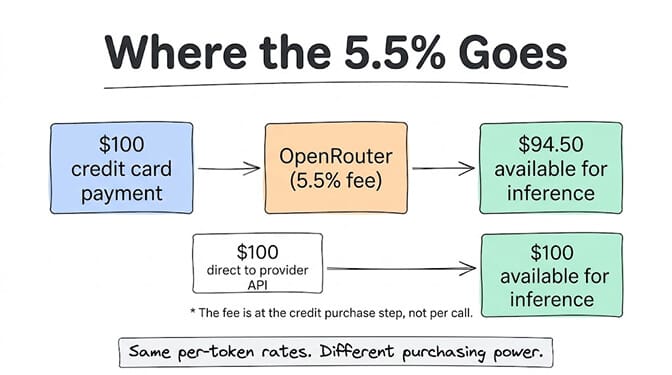
OpenRouter pricing at a glance (September 2026)
| What you pay for | OpenRouter cost |
|---|---|
| Per-token model pricing | Same as the provider's rate (no inference markup) |
| Buying credits by card | 5.5% fee, $0.80 minimum |
| Buying credits with crypto | 5% fee |
| BYOK (your own provider keys) | Free up to $25,000 of list-price inference/month, then 5% |
| Free models | $0, 50 requests/day (1,000/day once you've bought $10+ in credits) |
OpenRouter also has four plans, and the fee depends on which one you're on:
| Plan | Fee on credit purchases | BYOK allowance | What's different |
|---|---|---|---|
| Free | None (free models only) | None | 25+ free models, 50 requests/day, community support |
| Standard (pay-as-you-go) | 5.5% | $25,000/month, then 5% | Most users. Email support |
| Business (pay-as-you-go) | 8% | $25,000/month, then 5% | EU and US in-region routing, up to 1,000 workspaces, signed DPA on request |
| Enterprise | Contract (fee discounts available) | $200,000/month, then 5% | SSO/SAML, contractual SLAs, invoicing, dedicated support |
If your team is on Business, every "credits" figure in this article is 8% over list, not 5.5%. The $1,800 Opus 5.5 example below becomes $1,944 through Business credits (+$144).
Two details matter for the math. The BYOK allowance is measured in dollars of list-price inference, not requests. OpenRouter used to offer 1 million free BYOK requests a month, and a lot of older guides still quote that. And the 5% BYOK fee, once you pass the allowance, is deducted from your OpenRouter credits, so you still keep a small credit balance.
What OpenRouter actually is (30-second version)
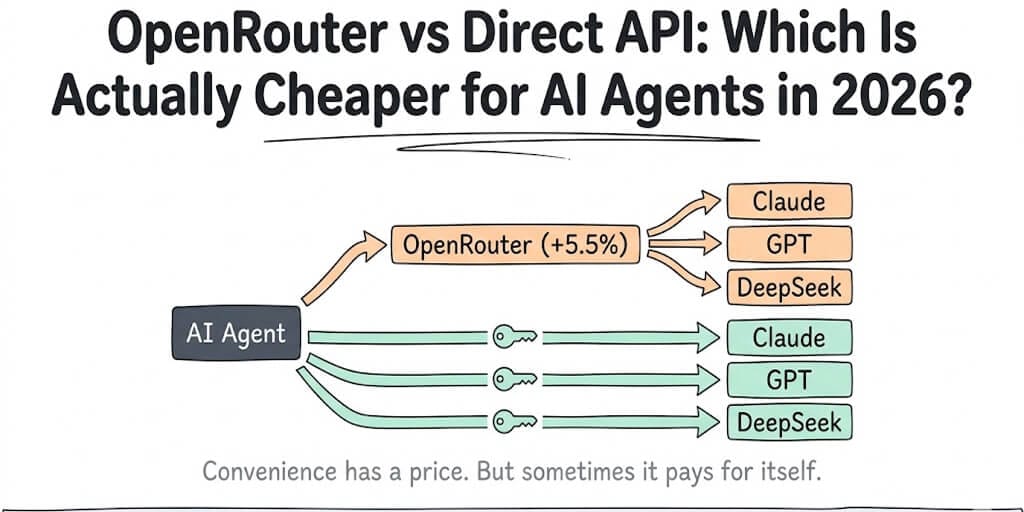
OpenRouter is an API aggregator. Instead of managing separate API keys for OpenAI, Anthropic, Google, DeepSeek, Mistral, and dozens of others, you get one API key that routes to 500+ models from 80+ providers.
You add credits to your OpenRouter account. You make API calls. Credits are deducted per-token at the model's published rate. The 5.5% fee happens at the credit purchase step, not per-call.
The value proposition is: one API key, unified billing, automatic failover (if Claude goes down, route to GPT automatically), and access to models you might not have individual API keys for.
For someone making one-off API calls, this is a nice convenience. For someone running AI agents that consume millions of tokens per day across multiple models, the cost and operational implications are different.
The OpenRouter cost comparison nobody does properly
Here's the real math. I'll use current models at their September 28, 2026 prices and calculate monthly cost (30 days) for a typical agent workload: 5 million input tokens + 2 million output tokens per day. No caching, so these are worst-case numbers.
Claude Opus 5.5
Direct from Anthropic: $4/MTok input, $20/MTok output. Daily cost: (5 x $4) + (2 x $20) = $20 + $40 = $60/day = $1,800/month.
Through OpenRouter credits: Per-token rates match the provider's published rate (OpenRouter lists Opus 5.5 at the same $4/$20), but you need $1,800 in credits. At a 5.5% fee, you pay $1,899 for them. Effective monthly cost: $1,899 (extra $99).
Through OpenRouter BYOK: $1,800 is well under the $25,000 allowance. Effective monthly cost: $1,800 (extra $0).
Claude Sonnet 5
Direct from Anthropic: $2/MTok input, $10/MTok output. Daily cost: (5 x $2) + (2 x $10) = $10 + $20 = $30/day = $900/month.
Through OpenRouter credits: $949.50 (extra $49.50). Through BYOK: $900.
DeepSeek direct vs OpenRouter
DeepSeek is the model people ask about most when comparing OpenRouter to going direct, because the per-token price is so low that the 5.5% fee looks like nothing. It is small in dollars. It is not zero, and there is one detail that matters more than the fee.
Direct from DeepSeek at off-peak rates: $0.66/MTok input (cache miss), $1.98/MTok output. Daily cost: (5 x $0.66) + (2 x $1.98) = $3.30 + $3.96 = $7.26/day = $217.80/month. DeepSeek now charges double during weekday peak hours (01:00-04:00 and 06:00-10:00 UTC), so an all-peak workload would be $435.60/month.
Through OpenRouter credits: You pay $229.78 to get $217.80 in purchasing power. Effective monthly cost: $229.78 (extra $11.98).
The detail: OpenRouter routes DeepSeek requests to whichever provider is serving the model, and that is not always DeepSeek itself. Third-party hosts of DeepSeek weights set their own prices and do not follow DeepSeek's off-peak discount. The DeepSeek section below shows what that costs and how to avoid it.
GPT-6 Astra and GPT-6 Sol
Direct from OpenAI, GPT-6 Astra (the flagship): $10/MTok input, $50/MTok output. Daily cost: (5 x $10) + (2 x $50) = $50 + $100 = $150/day = $4,500/month.
Through OpenRouter credits: You pay $4,747.50 to get $4,500. Effective monthly cost: $4,747.50 (extra $247.50).
GPT-6 Sol, the mid tier, costs exactly what Sonnet 5 does: $2/$10, so $900/month direct and $949.50 through credits. One OpenAI-specific catch: any GPT-6 prompt over 272K input tokens is billed at 2x input and 1.5x output for the whole request. Claude has no long-context surcharge, on OpenRouter or direct.
All five side by side
| Model (5M in + 2M out/day) | Direct API | OpenRouter credits (+5.5%) | OpenRouter BYOK |
|---|---|---|---|
| GPT-6 Astra ($10/$50) | $4,500.00 | $4,747.50 (+$247.50) | $4,500.00 |
| Claude Opus 5.5 ($4/$20) | $1,800.00 | $1,899.00 (+$99.00) | $1,800.00 |
| Claude Sonnet 5 ($2/$10) | $900.00 | $949.50 (+$49.50) | $900.00 |
| GPT-6 Sol ($2/$10) | $900.00 | $949.50 (+$49.50) | $900.00 |
| DeepSeek V4 Pro, off-peak ($0.66/$1.98) | $217.80 | $229.78 (+$11.98) | $217.80 |
Prices verified 28 September 2026 against the Anthropic, OpenAI and DeepSeek pricing pages, OpenRouter's pricing page and FAQ, and OpenRouter's live model list. If you are reading this later, check the provider pages first; per-token rates move more often than OpenRouter's fee does.
The pattern is clear: the 5.5% fee scales with your spend. On cheap models (DeepSeek), the extra cost is small. On mid-tier models (Sonnet 5, GPT-6 Sol) it's about $50/month at this volume. On the expensive ones (Opus 5.5, GPT-6 Astra), it's $99-248/month. The same question applies to whatever AI agent builder you run on top: ask what it adds to your inference bill before you connect a key.
For the full picture of what these models cost across different agent workload scenarios, we published a detailed breakdown with five real use cases.
The 5.5% fee is invisible at low volume. At $2,000+/month in LLM spend, it starts to matter. At $10,000+/month, it's a line item worth eliminating, and BYOK is how you eliminate it without leaving OpenRouter.
The BYOK escape hatch (and why it changes everything)
Here's the part most people miss.
OpenRouter supports BYOK (Bring Your Own Key). You add your own Anthropic, OpenAI, or DeepSeek API keys in OpenRouter's settings. The provider bills you directly for the inference, and OpenRouter acts purely as a routing layer, which sidesteps the 5.5% credit purchase fee on that traffic.
The pricing is set in dollars, not requests. On pay-as-you-go, the first $25,000 of list-price inference per month through your own keys carries no OpenRouter fee. Past that, OpenRouter charges 5% of what the same model and provider would normally cost on OpenRouter, deducted from your credits. (Older guides, including an earlier version of this one, quoted "1 million free BYOK requests a month." That's no longer how it works.)
What that means in practice:
- $1,800/month of Opus 5.5 via BYOK: $0 in OpenRouter fees. Same cost as going direct.
- $25,000/month via BYOK: still $0 in fees.
- $30,000/month via BYOK: 5% on the $5,000 above the allowance = $250/month. Through credits, the same $30,000 would cost $1,650 in fees.
For almost every agent team, that's the best of both worlds. You get OpenRouter's unified API, automatic failover, and model switching at the same price as going direct.
The catch: you need to manage those API keys. If you have keys for three providers, you're back to managing three billing relationships. OpenRouter handles the routing, but the payment goes direct.
This is similar to the model we use at BetterClaw, though we take it a step further. BYOK with zero inference markup across 28+ model providers. You connect your own API keys. We route your requests. You pay providers directly. We charge a flat platform fee ($0 on Free, $19/month on Basic, $49/month on Pro for 5 agents) and never touch your inference costs, with no usage fee on top at any volume. For a detailed comparison of how different platforms handle LLM pricing, the differences between BYOK, markup, and bundled credits are significant.
OpenRouter vs DeepSeek pricing: direct API vs OpenRouter (the off-peak catch)
DeepSeek is the one provider where going direct can beat OpenRouter by much more than the 5.5% fee. DeepSeek's own API charges half price off-peak. Peak hours are 01:00-04:00 and 06:00-10:00 UTC, Monday to Friday. Everything else is off-peak, including weekends.
Most OpenRouter hosts of DeepSeek's weights don't do that. They charge one price around the clock, and for most of them that price is DeepSeek's peak rate. Here is DeepSeek V4 Pro, per million tokens, checked on OpenRouter's live endpoints on 22 September 2026:
| Route | Input | Output | Notes |
|---|---|---|---|
| DeepSeek direct, off-peak | $0.66 | $1.98 | Nights, weekends and most of the working day in the Americas |
| DeepSeek direct, peak | $1.32 | $3.96 | Weekday 01:00-04:00 and 06:00-10:00 UTC |
| OpenRouter, DeepSeek's own endpoint | $0.66 | $1.98 | Listed at the off-peak rate when we checked (an off-peak hour), plus 5.5% on credits |
| OpenRouter, most third-party hosts | $1.32 | $3.96 | Together, Fireworks, Parasail and others. Peak rate all day, plus 5.5% |
| OpenRouter, cheapest discounted host | $0.60 | $1.80 | A temporary 55% discount on one host. Promotions like this come and go |
For the 5M-input, 2M-output workload above, run entirely off-peak, that's $217.80/month direct against $459.56/month on a typical third-party host through OpenRouter credits. Default routing gives most traffic to the cheapest hosts, so you won't always pay the worst case, but you can't count on the off-peak rate either.
The fix: pin DeepSeek's own endpoint. Use the current model ID (deepseek/deepseek-v4-pro-0813, which is what DeepSeek's API serves today). The older deepseek/deepseek-v4-pro listing on OpenRouter isn't served by DeepSeek at all. Then pin the provider so OpenRouter can't fall back to another host:
{
  "model": "deepseek/deepseek-v4-pro-0813",
  "provider": {
    "order": ["deepseek"],
    "allow_fallbacks": false
  },
  "messages": [{"role": "user", "content": "..."}]
}
You still pay the 5.5% credit fee, or nothing extra through BYOK with your own DeepSeek key. V4.1 Flash (deepseek-flash on DeepSeek's API, deepseek/deepseek-v4.1-flash on OpenRouter) is different. DeepSeek charges $0.15/$0.60 off-peak and $0.30/$1.20 peak, but OpenRouter's Flash hosts range widely: on 28 September, Together charged $0.30/$1.20, Fireworks $0.22/$0.66 and DeepInfra $0.14/$0.42 (an fp8 quantization). For Flash, a third-party host can undercut DeepSeek's own peak price. Check the quantization before you pin it.
How OpenRouter provider routing works (cheapest vs fastest)
By default OpenRouter load-balances each request across the providers serving that model. It first drops any provider that has had a significant outage in the last 30 seconds. Among the rest, it picks by price, weighted by the inverse square of the price. A $1 provider is 9 times more likely to get the request than a $3 one. The others become fallbacks. So the default leans cheap, but it does not always pick the cheapest provider.
To choose the trade-off yourself:
| You want | Set | What it does |
|---|---|---|
| Cheapest | "provider": {"sort": "price"}, or add :floor to the model ID | Tries providers from lowest price up. :floor also unlocks flex-tier endpoints |
| Fastest output | "provider": {"sort": "throughput"}, or add :nitro to the model ID | Tries the highest tokens-per-second providers first. :nitro also unlocks priority-tier endpoints |
| Lowest latency | "provider": {"sort": "latency"} | Tries the fastest time-to-first-token providers first |
| One specific provider | "provider": {"order": ["deepseek"], "allow_fallbacks": false} | Pins the provider, as in the DeepSeek example above |
Setting sort or order turns off the default load balancing, so providers are tried strictly in that sequence. Every option is in OpenRouter's provider routing docs.
Is OpenRouter worth it?
Yes, if you use several models or want automatic failover and spend under about $2,000 a month. No, if you run one model at scale. Credits cost 5.5% more than going direct at every spend level. BYOK removes the fee for the first $25,000 of inference a month. The crossover is around $2,000 a month through credits, where the fee passes $110 a month and BYOK or a direct key wins.
"Is it cheaper?" and "is it worth it?" are different questions. It's never cheaper than going direct on credits, but it's often worth the 5.5%. The short version:
Worth it if you:
- switch between models often (500+ models behind one API key)
- want automatic fallback when a provider goes down
- are prototyping and testing providers before you commit
- spend under about $500 a month, where the fee is under $27.50
Not worth it if you:
- use one model almost exclusively (direct saves 5.5% on every dollar, 8% on Business)
- need guaranteed rate limits and SLAs from the model provider
- spend $2,000+ a month through credits (the fee passes $110 a month; switch to BYOK or go direct)
- care a lot about vendor support (see the note below)
A note on support. OpenRouter's Trustpilot score sits below 2 out of 5, from a small number of reviews. Most complaints are about support response times, account issues and credit refunds. Unused credits can only be refunded within 24 hours of purchase, and the platform fee is never refunded. The complaints are rarely about routing or model quality.
When OpenRouter is worth it
Let me be fair. OpenRouter isn't a bad deal for everyone. There are specific scenarios where it's clearly the better choice:
You're testing multiple models. If you're evaluating 10 different models for your agent workflow, setting up 10 different API accounts with 10 different billing setups is a waste of time. OpenRouter lets you test all of them with one key. The 5.5% fee on a $50 testing budget is $2.75. That's nothing compared to the hours you'd spend managing accounts.
You need failover. If your production agent can't tolerate downtime when Claude's API has an outage (and they do happen), OpenRouter's automatic failover routes to a backup model. Building this yourself requires a routing layer, health checks, and fallback logic. OpenRouter gives it to you for the 5.5%, or for free under the BYOK allowance.
You want access to niche models. OpenRouter hosts models you can't easily access through direct APIs. Smaller open-weight models, regional providers, and experimental models that don't have their own API infrastructure. If your agent needs one of these, OpenRouter might be the only option. (If self-hosting is on the table too, our OpenRouter vs direct API vs local Ollama comparison adds the third path.)
Your spend is under $500/month. At $500/month, the 5.5% fee is $27.50. That's less than the cost of one hour of engineering time spent managing multiple API integrations. The convenience is worth it.
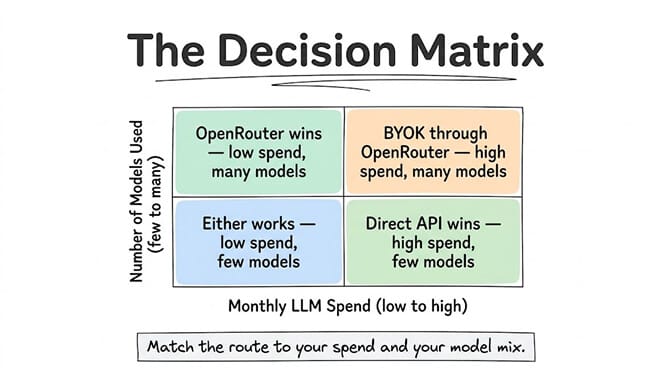
When direct API is the better deal
Your spend exceeds $1,000/month on a single provider and you'd pay by credits. If 80% of your inference goes through Anthropic, the math is simple. The 5.5% on $1,000 is $55/month. Over a year, that's $660. You could use that to pay for an agent platform subscription and still come out ahead. (Or keep OpenRouter and switch that provider to BYOK. Under $25,000/month, it costs the same as direct.)
Your BYOK traffic is above $25,000/month. Past the allowance, BYOK adds 5% on the excess. At that scale, going direct (or negotiating OpenRouter Enterprise, where the allowance is $200,000/month) is the cheaper route.
You need guaranteed rate limits and SLAs. Direct API accounts with providers like Anthropic and OpenAI come with documented rate limits, priority tiers, and support. OpenRouter routes through providers but doesn't guarantee their rate limits apply to your traffic specifically. (For raw inference speed specifically, our Groq vs OpenAI API comparison covers the fastest direct route.) For production agents where throughput predictability matters, direct relationships give you more control.
You're already managing the keys anyway. If your agent platform handles multi-provider routing for you (connecting your own keys and routing between them based on task type), you don't need OpenRouter as a middleware layer. You already have the routing. Adding OpenRouter credits would just add the 5.5% for no benefit.
Data sensitivity. Every API call through OpenRouter passes through their infrastructure. For regulated industries (healthcare, finance, government), adding a third-party intermediary in the data flow creates compliance questions. Direct API calls go from your system to the provider. One hop instead of two.
OpenRouter vs a $20 AI subscription: when each makes sense
A lot of people comparing OpenRouter prices are really asking something else. Should I pay $20 a month for Claude Pro or ChatGPT Plus, or pay per token through OpenRouter?
| Claude Pro | ChatGPT Plus | OpenRouter (pay per token) | |
|---|---|---|---|
| Price | $20/month ($17/month billed annually) | $20/month | No fee, pay for tokens plus 5.5% on credits |
| What you get | Claude apps, Claude Code and Cowork | ChatGPT's paid tier, including Codex | 500+ models through one API |
| Usage limit | Usage limits apply, with weekly caps | Usage limits apply | None beyond provider rate limits. You pay for what you use |
| Light use: 50 messages/day on Claude Sonnet 5 | $20 flat | $20 flat (OpenAI models) | About $14/month |
| Heavy use: 500 messages/day on Claude Sonnet 5 | $20 flat, if you stay under the limits | $20 flat, if you stay under the limits | About $142/month |
| API access for your own app or agent | Not included. The API is billed separately ($2/$10 per 1M tokens for Sonnet 5) | Not included. The API is billed separately | Included. That's what it is |
The OpenRouter figures assume 2,000 input and 500 output tokens per message at Sonnet 5's $2/$10 rate, bought through credits. Longer conversations resend more context each turn, so treat them as a floor.
The rule of thumb: for chatting with one assistant every day, a subscription wins, because $20 buys far more usage than $20 of tokens. A subscription can't power your own app or agent, though. Once you're calling a model from code, OpenRouter (or a direct API key) is the only option of the three, and at light volume it costs less than $20 a month.
The free model tier is genuinely useful
Here's the part of OpenRouter that doesn't get enough attention.
OpenRouter offers 25+ free models with zero per-token cost. No credit card required. Rate-limited (50 requests per day on the basic tier, up to 1,000 per day once you've bought $10+ in credits), but free.
For testing agent workflows, prototyping new skills, or running low-volume internal agents, free models on OpenRouter are a real option. You won't get Claude or GPT-6 quality, but for tasks like simple classification, text formatting, or basic summarization, free models from Google, Meta, Mistral, and others can handle the workload.
This is particularly valuable if you're building on BetterClaw with BYOK. Use your paid API keys for production agents. Use an OpenRouter free-tier key for development and testing. Zero cost for prototyping. Full quality for production. The platform handles both through the same visual agent builder.
The hidden cost most people forget: platform markup
Here's where this comparison gets relevant for anyone building AI agents (not just making API calls).
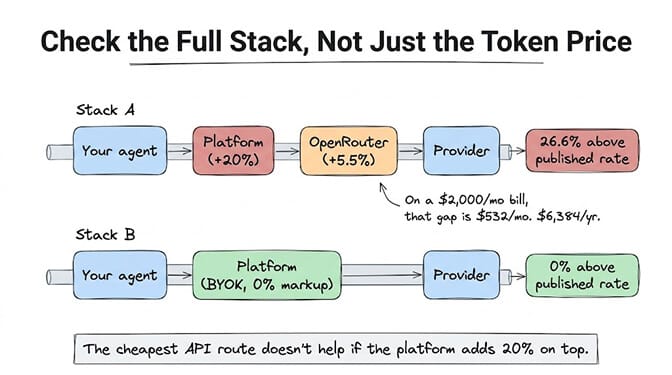
OpenRouter's 5.5% credit fee is one type of markup. But many AI agent platforms add their own markup on top of whatever you're paying for inference. Some charge 20-40% on top of the model's published rate. Some bundle LLM costs into their subscription and don't tell you what you're actually paying per token.
The question isn't just "OpenRouter vs direct API." It's "what's the total cost stack between my request and the model?"
Stack A: Your agent -> Platform (20% markup) -> OpenRouter credits (5.5% fee) -> Provider = 26.6% above published rate.
Stack B: Your agent -> Platform (BYOK, zero markup) -> Provider = 0% above published rate.
That 26.6% difference on a $2,000/month LLM bill is $532/month. $6,384/year. That's real money.
This is why we're opinionated about BYOK at BetterClaw. You connect your own API keys. We charge $0 on the Free plan, $19/month on Basic and $49/month on Pro (5 agents). Zero inference markup. Your tokens, your provider, your rate. The platform fee is flat and predictable. The LLM cost is whatever you negotiate directly with your provider.
The cheapest API route in the world doesn't help if your agent platform adds 20% on top. Check the full stack, not just the token price.
The actual decision framework
Here's how I'd decide (or plug your own token volumes into the OpenRouter fee calculator):
Monthly LLM spend under $500, testing multiple models: Use OpenRouter credits. The convenience and model variety are worth the 5.5%.
Monthly LLM spend $500-25,000, settling on 2-3 models: Use OpenRouter with BYOK for your primary models. Under the $25,000/month allowance, that traffic costs exactly what direct would. Use a small credit balance for niche models and testing.
Monthly LLM spend over $25,000, production agents: Go direct for your primary providers, or talk to OpenRouter about Enterprise ($200,000/month BYOK allowance). Past the allowance, BYOK adds 5% on the excess, and credits add 5.5% on everything. Use a BYOK agent platform that handles multi-provider routing natively.
Running AI agents specifically: Use a platform that supports BYOK across multiple providers and handles the routing for you. Whether you feed it an OpenRouter key or direct provider keys is your choice. The platform shouldn't care and shouldn't charge you for the privilege.
For a broader look at how to choose the right LLM for each agent task, the routing strategy matters as much as the pricing strategy.
If OpenRouter isn't the right fit, we compared nine OpenRouter alternatives on real fees, verified on each gateway's own pricing page.
What this looks like in twelve months
LLM pricing keeps moving, and not always downward. DeepSeek now splits V4 Pro pricing into peak and off-peak hours. At the top end it moved down: Opus 5.5 costs $4/$20, against the $5/$25 Opus 4.8 still charges, and Sonnet 5 is $2/$10. OpenAI's GPT-6 Luna runs $0.10/$0.50. Cheap capable models keep getting cheaper.
As model prices drop, the percentage-based fee model (OpenRouter's 5.5%) becomes a smaller absolute number. On a $100/month bill, the 5.5% is $5.50. That's trivially cheap for the convenience.
But for the frontier models that still cost $4-50 per million tokens, the fee remains meaningful, which is exactly why the BYOK allowance matters.
The strategic question isn't whether to use OpenRouter today. It's whether your agent infrastructure is flexible enough to route through whatever makes sense tomorrow. Direct API when it's cheapest. OpenRouter when you need variety. BYOK when you want control. The infrastructure should be model-agnostic and routing-agnostic.
If any of this resonated, give BetterClaw a look. The free plan comes with 1 agent and 100 credits a month, and Pro is $49/month. Connect OpenRouter, connect direct API keys, or both. Zero inference markup regardless. Deploy in 60 seconds. We handle the routing. You keep the savings.
Frequently Asked Questions
What is OpenRouter and how does it work for AI agents?
OpenRouter is an API aggregation platform that provides access to 500+ AI models from 80+ providers through a single API key. For AI agents, this means you can route requests to Claude, GPT, DeepSeek, Gemini, and hundreds of other models without managing separate API accounts for each. OpenRouter passes through provider token pricing with no markup and charges a 5.5% fee ($0.80 minimum) when you purchase credits by card.
Is OpenRouter worth it?
Yes if you spend under about $500 a month, test several models, or want automatic failover without building it. It's not worth it if you use one model almost exclusively, need provider SLAs, or put $2,000+ a month through credits. The 5.5% fee on $500 is $27.50, less than an hour of engineering time. Between $500 and $25,000 a month it is still worth it if you switch your main providers to BYOK, because that traffic then costs the same as going direct. Above $25,000 a month of BYOK inference, or if you need guaranteed rate limits from a single provider, direct API is the better deal.
How much does OpenRouter charge?
Per-token rates on OpenRouter match direct API pricing from providers like Anthropic and OpenAI. The cost difference comes from the 5.5% fee applied when purchasing credits by card (5% with crypto). On $100 of credits, the extra cost is $5.50. On $2,000, it's $110. With BYOK (adding your own API keys in OpenRouter settings), the first $25,000 of list-price inference per month is free, and a 5% fee applies to usage beyond that. Enterprise plans raise the BYOK allowance to $200,000 per month.
Does OpenRouter have a subscription?
No. OpenRouter is pay-as-you-go. You buy credits (5.5% fee by card, 5% by crypto) and they are deducted per token at the provider's rate, or you bring your own provider keys and pay the provider directly. There is no monthly plan, no seat pricing and no minimum spend beyond the $0.80 minimum fee on a credit purchase. The Business plan is also pay-as-you-go, with an 8% fee instead of 5.5%, and Enterprise is a negotiated contract. If you're weighing OpenRouter against a $20 Claude Pro or ChatGPT Plus subscription, a subscription is cheaper for daily chatting, and OpenRouter is the one that works for your own apps and agents.
How does OpenRouter make money?
Three ways. The fee when you buy credits: 5.5% by card on the Standard plan (5% by crypto), 8% on Business. A 5% fee on BYOK usage above the free allowance of $25,000 a month in list-price inference ($200,000 on Enterprise). And enterprise contracts. There is no markup on per-token prices; OpenRouter passes through each provider's published rate.
When is the direct API cheaper than OpenRouter?
Direct API is always 5.5% cheaper than paying for the same tokens with OpenRouter credits: $1,800/month of Claude Opus 5.5 costs $1,899 through credits. Against OpenRouter BYOK, direct costs the same until your BYOK inference passes $25,000/month, after which BYOK adds 5% on the excess. If you're spending over $25,000/month or need guaranteed rate limits, go direct. A BYOK agent platform like BetterClaw handles multi-provider routing without either fee.
Is OpenRouter free to use?
OpenRouter offers 25+ free models at zero per-token cost. No credit card required. The free tier has rate limits (50 requests/day, rising to 1,000/day once you've bought $10+ in credits). For testing, prototyping, and low-volume agent workloads, the free tier is genuinely useful. Paid models use the credit system with the 5.5% purchase fee, or BYOK.
Is OpenRouter reliable enough for production AI agents?
OpenRouter includes automatic failover (routing to backup models if your primary goes down), which actually improves reliability versus a single direct API connection. The main production consideration is data flow: every API call passes through OpenRouter's infrastructure, which may create compliance concerns for regulated industries. For most production workloads, OpenRouter's reliability is solid and the failover feature adds genuine uptime value.