Three months ago, a developer on our team spent two weeks building a customer support agent on LangChain. Chains, tools, memory, retrievers. The whole architecture. It worked, technically. Customers could ask questions, the agent would search the knowledge base, and it would respond.
Then we tried LlamaIndex for the same project. The retrieval quality was noticeably better. Fewer wrong answers. More precise document chunking. Less context wasted on irrelevant results.
But the agent couldn't do anything beyond retrieving documents. No sending emails. No creating tickets. No calling external APIs.
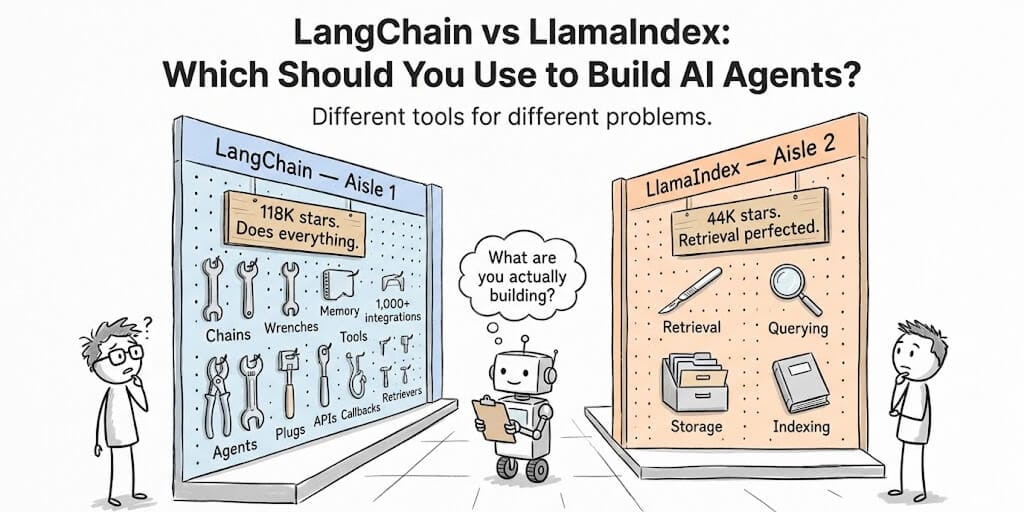
That's the LangChain vs LlamaIndex dilemma in a nutshell. LangChain does everything, but nothing is optimized out of the box. LlamaIndex does retrieval brilliantly, but struggles when your agent needs to act, not just answer.
Here's how to pick the right one. Or decide you don't need either.
What LangChain actually is (and isn't)
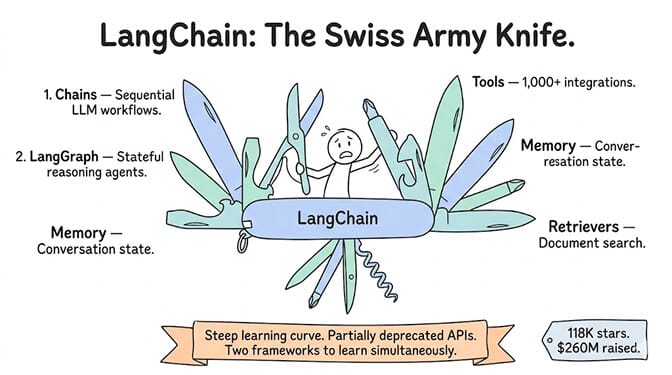
LangChain is a general-purpose framework for building LLM-powered applications. It started in late 2022 as a way to wire language models to external tools, APIs, and databases. It exploded to 118,000+ GitHub stars, 5 million+ weekly PyPI downloads, $260M in funding, and a $1.25B valuation.
Its core abstraction is the "chain." A composable sequence of steps: format a prompt, call an LLM, invoke a tool, parse the output, store it in memory. Chains can branch, loop, and call other chains.
With LangGraph (LangChain's newer agent framework), you get stateful multi-actor workflows where agents can reason, act, and iterate. 1,000+ integrations cover everything from vector databases to third-party APIs to custom tools.
Here's the honest assessment:
LangChain's breadth is both its greatest strength and its worst problem. The API surface is massive. Abstractions can feel leaky. Breaking changes across versions have burned a lot of developers. The learning curve is steep even for experienced Python programmers.
And parts of the original LangChain are now partially deprecated, with the team pushing users toward LangGraph for agent workloads. So if you're just starting, you're actually learning two frameworks.
What LlamaIndex actually is (and isn't)
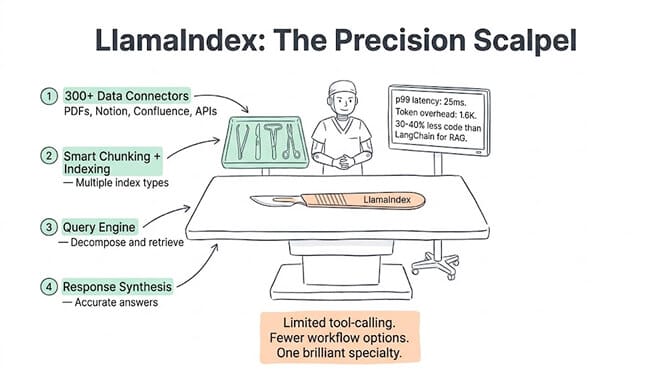
LlamaIndex (formerly GPT Index) is a data framework built specifically for connecting LLMs with private or domain-specific data. It has 44,000+ GitHub stars and 300+ data connectors through LlamaHub.
Where LangChain thinks in terms of "chains and tools," LlamaIndex thinks in terms of "data connectors, indices, and query engines." You point it at your data sources (PDFs, databases, Notion, Confluence, APIs), it ingests and indexes them, and then you query against them with natural language.
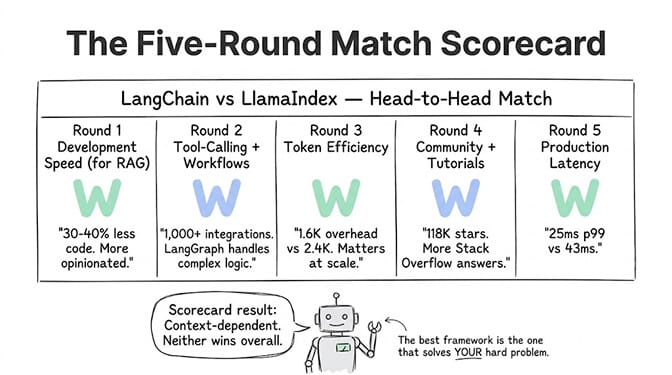
For RAG (Retrieval-Augmented Generation), LlamaIndex is significantly more capable out of the box. Independent benchmarks show that LlamaIndex-based RAG pipelines require 30-40% less code than equivalent LangChain implementations. Framework overhead is approximately 6ms versus LangGraph's 14ms. And LlamaIndex uses roughly 1.6K tokens of framework overhead per query versus 2.4K for LangChain.
The p99 latency difference matters for production: LlamaIndex hits about 25ms versus LangChain at 43ms.
But here's the tradeoff. LlamaIndex is optimized for one thing: getting accurate answers out of your data. When you need your agent to do things (send an email, create a Jira ticket, call a webhook, interact with a CRM), LlamaIndex's tool-calling and workflow capabilities are more limited than LangChain's.
The real question: what are you building?
Every "LangChain vs LlamaIndex" article hedges with "it depends." Here's a more specific answer.
Use LangChain/LangGraph when your agent needs to act.
If your agent reads emails, classifies them, looks up customer data in a CRM, drafts a response, and sends it... that's a tool-heavy, multi-step workflow. LangChain's agent abstractions (especially LangGraph) handle this well. You define tools, the agent reasons about which to use, and the framework handles execution, memory, and state.
LangChain is also better when you need to coordinate multiple LLMs, switch between providers, or build complex conditional logic. Its 1,000+ integrations mean you'll rarely need to build a custom connector.
Use LlamaIndex when your agent needs to know.
If your agent's primary job is answering questions from a large document corpus (internal wikis, product docs, legal contracts, research papers), LlamaIndex gives you better retrieval quality with less engineering effort. Its chunking strategies, query decomposition, and response synthesis are genuinely more sophisticated than LangChain's equivalents.
If retrieval accuracy is the difference between a useful agent and a useless one, LlamaIndex's specialization matters.
Use both together when you need both.
The pattern that's emerged in 2026: LlamaIndex for ingestion and retrieval, LangChain for orchestration. Use LlamaIndex's superior document processing to build your knowledge base, then LangChain's agents to orchestrate how that knowledge is accessed alongside other tools.
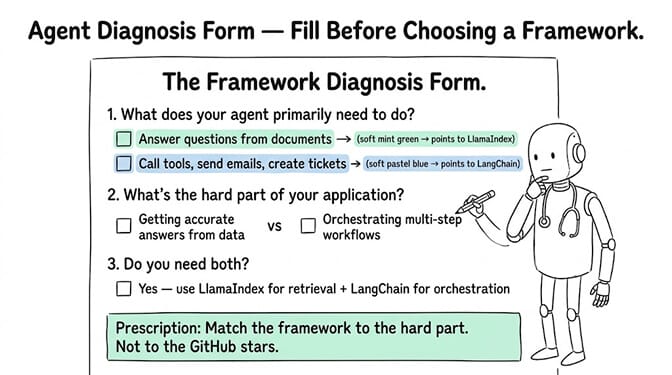
The best framework question isn't "which is better?" It's "what's the hard part of my application?" If the hard part is connecting an LLM to tools and APIs, use LangChain. If the hard part is getting accurate answers from documents, use LlamaIndex.
The part nobody tells you about either framework
Both LangChain and LlamaIndex require Python, a development environment, and meaningful engineering time. Neither hosts your agent. Neither manages your infrastructure. Neither handles security, secrets management, or trust levels. If that list reads like work you would rather not own, a visual AI agent builder covers it as platform behaviour instead of application code you write and maintain.
Here's what building an agent on either framework actually looks like:
Week 1: Set up Python environment. Install dependencies. Read documentation. Build a prototype that works in a notebook.
Week 2: Add real integrations (Gmail, Slack, CRM). Debug authentication. Handle edge cases. Write error handling.
Week 3: Deploy somewhere. Docker, VPS, or cloud function. Set up monitoring. Handle secrets securely. Add logging.
Week 4: Production issues. Context window overflow. Token costs spiraling. Agent hallucinating tool calls. Memory not persisting between sessions.
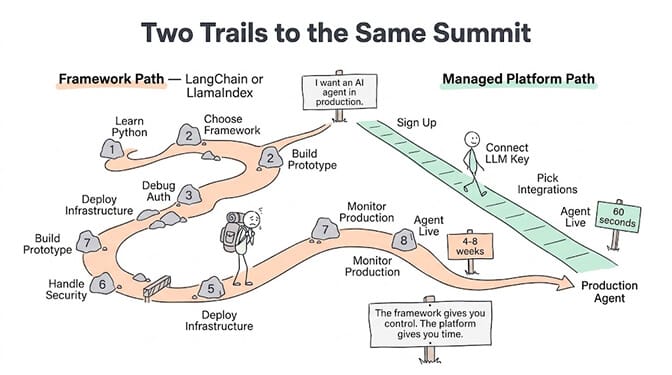
McKinsey estimates AI agents represent a $2.6-4.4 trillion addressable market. But the bottleneck isn't the framework. It's everything around it. Infrastructure, security, monitoring, cost management. (We mapped the full landscape of AI agent frameworks if you want to see where each one fits.)
This is exactly why we built BetterClaw as a no-code AI agent platform. Not to replace LangChain or LlamaIndex for developers who want maximum control. But for everyone who wants agents in production without spending a month on infrastructure. Visual builder. Unlimited skills. Persistent memory with hybrid vector plus keyword search. Trust levels. Secrets auto-purge. Deploy in 60 seconds. Free plan with 1 agent and 100 credits a month. $49/month on Pro. BYOK with zero markup.
LangChain vs LlamaIndex: head-to-head on what matters
Let me break down the comparison on the specific dimensions that matter for agent builders.
Development speed
LangChain's breadth means more options but also more decisions. Which chain type? Which agent executor? Which memory class? For experienced developers who've built on LangChain before, development is fast. For newcomers, expect a steep ramp-up.
LlamaIndex gets you to a working RAG prototype faster. The framework makes more opinionated choices for you, which speeds up initial development. But if your needs extend beyond retrieval, you'll hit walls sooner.
Production readiness
Both frameworks have matured significantly. LangSmith (LangChain's commercial observability platform, $12-16M ARR) provides tracing, evaluation, and monitoring for LangChain applications. LlamaIndex offers LlamaTrace for similar observability.
Neither framework handles deployment, hosting, or scaling for you. That's your infrastructure team's problem.
Cost at scale
LlamaIndex's lower token overhead (1.6K vs 2.4K per query) adds up at scale. If your agent handles thousands of queries daily, those extra 800 tokens per query translate directly into higher API bills.
LangChain's broader integration surface can reduce custom development costs, though. Fewer bespoke connectors to build and maintain.
Community and support
LangChain has the larger community, more tutorials, more Stack Overflow answers, and more third-party integrations. If you get stuck, you're more likely to find someone who's solved your specific problem.
LlamaIndex's community is smaller but more focused. The documentation is generally considered clearer and more coherent.
When the framework isn't the right question
Here's an honest take from building agents for 50+ companies.
Most teams evaluating LangChain vs LlamaIndex don't actually need either framework. They need an agent that works in production. The framework is a means to that end, not the end itself.
If you're a developer who wants maximum control over every component, who enjoys (or at least tolerates) infrastructure management, and who has the time to build and maintain a custom stack... LangChain or LlamaIndex are excellent choices. Our guide to building an AI agent walks through what that path involves.
If you're a startup founder, an ops lead, or a technical team that would rather spend engineering hours on product differentiation instead of agent infrastructure... the framework path is a significant time and cost investment for capabilities that managed platforms include by default.
Gartner projects 40% of enterprise applications will embed AI agents by end of 2026. The question isn't whether agents will be everywhere. It's whether you'll build the plumbing or focus on what makes your agent actually useful.
If you'd rather skip the framework decision entirely, give BetterClaw a look. Free plan with 1 agent and 100 credits a month. $49/month for Pro for Pro. 28+ model providers supported (including every model LangChain and LlamaIndex support). Your first agent deploys in 60 seconds. We handle the infrastructure. You handle the interesting part.
Frequently Asked Questions
What is the difference between LangChain and LlamaIndex?
LangChain is a general-purpose framework for building LLM applications with tools, agents, and workflows. It has 118K+ GitHub stars and 1,000+ integrations. LlamaIndex is a data framework specifically designed for connecting LLMs with private data through optimized retrieval (RAG). LangChain is better for tool-heavy agent workflows. LlamaIndex is better when accurate document retrieval is the primary challenge.
How does LangChain compare to LlamaIndex for building AI agents?
LangChain (especially LangGraph) is stronger for agents that need to call tools, interact with APIs, and execute multi-step workflows. LlamaIndex is stronger for agents whose primary function is answering questions from a document corpus. In production, many teams use both: LlamaIndex for ingestion and retrieval, LangChain for orchestration and tool calling.
How long does it take to build an AI agent with LangChain or LlamaIndex?
A working prototype in a Jupyter notebook takes a few hours to a few days for an experienced Python developer. Getting that prototype to production (with proper deployment, security, monitoring, and error handling) typically takes 2-4 weeks. Both frameworks require Python proficiency, and LangChain's learning curve is notably steeper due to its larger API surface and the transition from legacy LangChain to LangGraph.
Is LangChain or LlamaIndex more cost-effective at scale?
LlamaIndex has lower per-query overhead (approximately 1.6K tokens vs 2.4K tokens framework overhead, and 6ms vs 14ms latency). For high-volume RAG applications, this translates to meaningful cost savings. LangChain's broader integration library can reduce custom development costs. The total cost comparison depends on whether your bottleneck is API bills (LlamaIndex wins) or engineering time building custom connectors (LangChain wins).
Can I build production AI agents without LangChain or LlamaIndex?
Yes. No-code AI agent platforms like BetterClaw let you deploy production agents without writing code or managing infrastructure. You get persistent memory, tool integrations, trust levels, and security features included. The tradeoff is less granular control compared to a custom framework build. For teams that prioritize speed to production over architectural customization, managed platforms eliminate weeks of infrastructure work.
Related Reading
- AI Agent Frameworks in 2026 — The full category overview these two sit inside
- LangGraph vs CrewAI vs AutoGen — Once you've picked an orchestration layer, this is the next decision
- Pydantic AI vs LangChain — The type-safe alternative to LangChain specifically
- BetterClaw vs CrewAI — The managed option, if you'd rather not assemble a stack