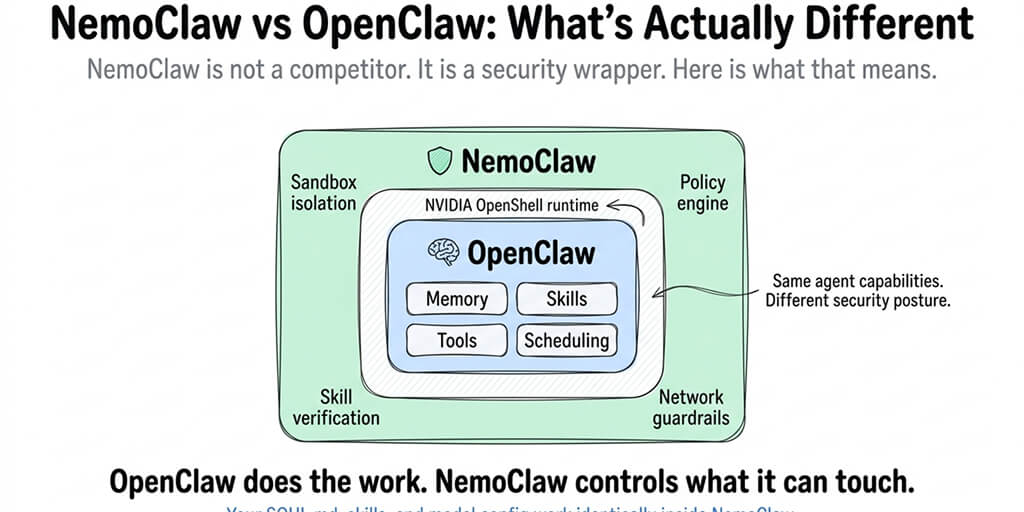
NemoClaw isn't a competitor to OpenClaw. It's a security wrapper around it. Here's what that means for you and whether it changes anything about your setup.
Jensen Huang got on stage at GTC and said every company on Earth needs an OpenClaw strategy. Then NVIDIA launched NemoClaw. And suddenly everyone running OpenClaw started asking: do I need to switch?
The short answer is no. NemoClaw is not a replacement for OpenClaw. It's not a fork. It's not a competing project. NemoClaw is OpenClaw running inside NVIDIA's OpenShell security runtime. Same agent architecture. Same memory system. Same skills. Different security posture.
But the long answer has nuance. Here's the honest NemoClaw vs OpenClaw breakdown.
What NemoClaw actually is
NVIDIA announced NemoClaw at GTC 2026 on March 16. Jensen Huang, Peter Steinberger (OpenClaw's creator, now at OpenAI), and Kari Briski (NVIDIA's VP of generative AI software) collaborated on it.
NemoClaw is an open-source reference stack that installs OpenClaw inside NVIDIA's OpenShell runtime with a single command. OpenShell provides the security layer that OpenClaw itself doesn't have: sandboxed execution, policy-based access controls, network guardrails, skill verification, and a privacy router for model inference.
The New Stack described it well: "an enterprise-grade distribution of OpenClaw." TechCrunch called it "OpenClaw with enterprise-grade security and privacy features baked in." The Register was more direct: NVIDIA wrapping security around OpenClaw's free rein.
NemoClaw is in early alpha. NVIDIA's own documentation says "this software is not production-ready. Interfaces, APIs, and behavior may change without notice." It launched March 16, 2026. As of now, it's experimental software.
What they share (almost everything)
This is the critical point most coverage misses: NemoClaw runs OpenClaw. The agent inside NemoClaw is OpenClaw. The same architecture. The same memory system (daily logs and MEMORY.md). The same skill format. The same scheduling. The same multi-platform messaging.
Skills you've written for OpenClaw work in NemoClaw. Your SOUL.md transfers. Your config structure is similar. If you know OpenClaw, you know 90% of what's inside NemoClaw.
The underlying agent is identical because NVIDIA didn't rebuild the core. They built a security and privacy layer on top of it.
For the complete guide to how OpenClaw's architecture works, our explainer covers the memory system, skill format, and agent lifecycle that both OpenClaw and NemoClaw share.
Where they actually differ
The differences are in the security layer, the inference routing, and the target user.
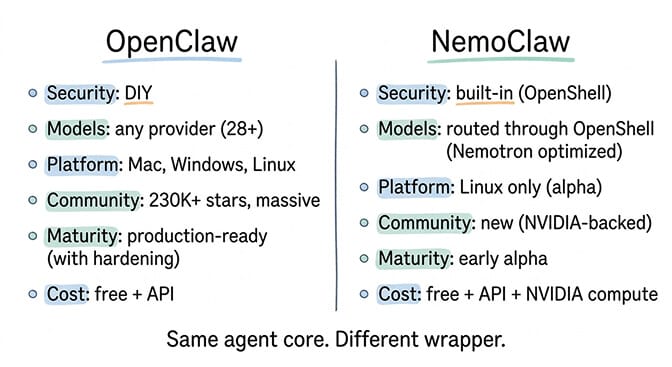
Security model
OpenClaw runs with whatever permissions you give it. By default, it has access to your file system, your network, your installed applications. The security responsibility falls entirely on you: firewall configuration, gateway binding, skill vetting, credential management. CrowdStrike's security advisory flagged this as the core enterprise risk. The ClawHavoc campaign (824+ malicious skills on ClawHub) demonstrated the real-world consequences.
NemoClaw adds NVIDIA's OpenShell runtime, which enforces security by default. The agent can only write to two directories (/sandbox and /tmp) unless explicitly given additional access. A policy engine (YAML-based) defines what actions the agent can take, what network calls are allowed, and what requests need human approval. Skill verification adds a vetting layer that checks skills before installation.
For enterprise deployments where an autonomous agent touches production systems, customer data, or regulated environments, this is a significant difference.
Inference routing
OpenClaw is model-agnostic. You plug in Claude, GPT-4o, DeepSeek, Gemini, a local Ollama model, or any OpenAI-compatible API. You choose. You control costs.
NemoClaw routes all inference through OpenShell's privacy router. It's optimized for NVIDIA's Nemotron models (specifically Nemotron 3 Super 120B: 120 billion parameters, 12 billion active, 442 tokens per second). You can use other models, but the routing adds a layer between your agent and the model provider.
For users who want total model flexibility and direct API control, this is a friction point.
Platform support
OpenClaw runs on Mac, Windows (via WSL2), and Linux. It's hardware-agnostic.
NemoClaw currently requires Linux. It's optimized for NVIDIA GPUs (RTX PCs, DGX Spark, DGX Station) but is technically hardware-agnostic. Mac and Windows support isn't available in the alpha.
Community and maturity
OpenClaw: 230,000+ GitHub stars. 44,000+ forks. 850+ contributors. 1.27 million weekly npm downloads. Thousands of community tutorials, Reddit threads, Discord channels, and managed hosting providers. A massive, active ecosystem.
NemoClaw: launched March 16, 2026. Early alpha. Growing documentation. NVIDIA backing but a new community forming. No third-party managed hosting yet.
Which one should you start with?
Here's the clear recommendation based on your situation.
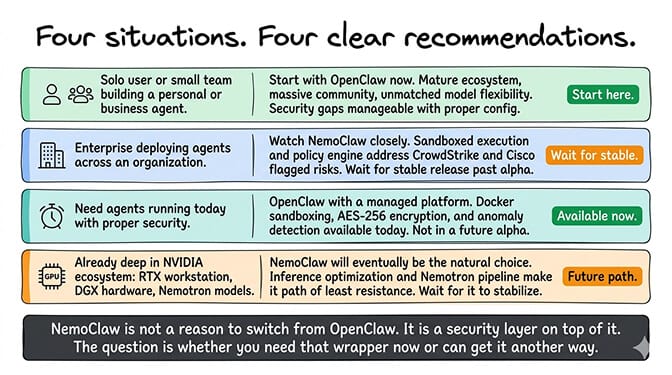
If you're a solo user or small team building a personal/business agent: Start with OpenClaw. The ecosystem is mature, the community support is massive, the model flexibility is unmatched, and it runs on whatever hardware you have. The security gaps are manageable with proper configuration (gateway binding, skill vetting, spending caps). For the complete security checklist, our guide covers the specific protections you need.
If you're an enterprise deploying agents across an organization: Watch NemoClaw closely. The sandboxed execution, policy engine, and skill verification address the exact security concerns that CrowdStrike and Cisco flagged. But wait for it to mature past alpha. "Not production-ready" means not production-ready. Run a test environment. Don't deploy to production until NVIDIA ships a stable release.
If you need agents running today with proper security: Use a managed platform that includes security protections. NemoClaw's security features (sandboxing, encrypted credentials, skill isolation) are genuinely important, but they're also available from managed platforms like Better Claw that include Docker-sandboxed execution, AES-256 encryption, and anomaly detection today, not in a future alpha release. $49/month for Pro, BYOK with 28+ providers.
If you're already deep in the NVIDIA ecosystem (RTX workstation, DGX hardware, Nemotron models): NemoClaw will eventually be the natural choice. The inference optimization for NVIDIA hardware and the integrated Nemotron model pipeline make it the path of least resistance for NVIDIA-first environments. (If you haven't bought the hardware yet, weigh the DGX Spark alternatives first.) Just wait for it to stabilize.
NemoClaw isn't a reason to switch away from OpenClaw. It's a security layer on top of OpenClaw. The question isn't "which one" but "do you need the security wrapper right now or can you get it from another source?"
What about managed hosting?
OpenClaw has multiple managed hosting options: xCloud ($24/month), ClawHosted ($49/month, Telegram only), DigitalOcean 1-Click ($24/month, requires SSH), and several others. If you'd rather skip hosting OpenClaw altogether, BetterClaw is a no-code AI agent platform (free plan, or $49/month for Pro, Docker-sandboxed execution, AES-256 encryption, 15+ channels). The NemoClaw vs BetterClaw page compares the two directly.
NemoClaw has no managed hosting options yet. It's self-hosted only, Linux only, alpha only. If managed hosting for NemoClaw launches from NVIDIA or third parties, we'll update this section.
For users who want the security benefits NemoClaw promises (sandboxed execution, encrypted credentials, policy controls) without waiting for NemoClaw to mature, the managed vs self-hosted comparison covers which platforms include these protections today.
The honest bottom line
NemoClaw is important. NVIDIA bringing enterprise security to the OpenClaw ecosystem validates that AI agents are moving from hobbyist experiments to production infrastructure. The involvement of Jensen Huang, Peter Steinberger, CrowdStrike, Cisco, and Google in the security partnership signals serious intent.
But right now, it's alpha software. Linux only. Nemotron-optimized with friction for other models. No production deployments. No managed hosting.
OpenClaw is production software. Cross-platform. Model-agnostic. Massive community. Multiple managed hosting options. The security gaps are real but addressable with proper configuration or a managed platform.
Start with OpenClaw. Keep an eye on NemoClaw. When it reaches stable release, reassess. That's the honest advice from a team that watches the OpenClaw ecosystem every day.
If you want an AI agent with enterprise security protections today, give Better Claw a try. $49/month for Pro, BYOK with 28+ providers. Docker-sandboxed execution. AES-256 encryption. Health monitoring with auto-pause. The security layer NemoClaw promises, available right now, on an agent that works on any OS from any browser.
Frequently Asked Questions
What is the difference between NemoClaw and OpenClaw?
NemoClaw is NVIDIA's open-source security wrapper built on top of OpenClaw. It installs OpenClaw inside the NVIDIA OpenShell runtime, adding sandboxed execution, policy-based access controls, skill verification, and a privacy router for model inference. The underlying agent (memory, skills, scheduling, messaging) is identical. NemoClaw adds enterprise security. OpenClaw provides the core agent.
Is NemoClaw better than OpenClaw?
For enterprise security, NemoClaw is stronger because it enforces sandboxing, network guardrails, and skill verification by default. For model flexibility, platform support, and ecosystem maturity, OpenClaw is better because it runs on Mac/Windows/Linux, supports 28+ model providers, and has a massive community. NemoClaw is also early alpha software (not production-ready), while OpenClaw is actively used in production by thousands of users.
Can I switch from OpenClaw to NemoClaw?
Yes, because NemoClaw runs OpenClaw inside it. Your SOUL.md, skills, and memory files transfer. However, NemoClaw currently requires Linux, routes inference through OpenShell (which adds friction for non-Nemotron models), and is in early alpha. Most users should wait until NemoClaw reaches a stable release before switching. Your OpenClaw configuration work isn't wasted since the core architecture is shared.
Does NemoClaw cost money?
NemoClaw itself is free and open-source. You still pay for AI model API costs (same as OpenClaw). NemoClaw is optimized for NVIDIA's Nemotron models, which run locally on NVIDIA hardware (RTX PCs, DGX Spark, DGX Station). Running Nemotron locally eliminates API costs but requires NVIDIA hardware. Using cloud models through NemoClaw's privacy router has standard API pricing. There's no managed hosting for NemoClaw yet, so you self-host everything.
Should I wait for NemoClaw before starting with OpenClaw?
No. NemoClaw is early alpha software that NVIDIA explicitly says is not production-ready. If you want to start building with an AI agent today, start with OpenClaw. Everything you build (SOUL.md, skills, memory, workflows) will transfer to NemoClaw when it matures because NemoClaw runs the same OpenClaw core. Don't delay productive work for alpha software. Start now, migrate later if it makes sense.
Related Reading
- How Does OpenClaw Work? — The core architecture both NemoClaw and OpenClaw share
- OpenClaw Security Checklist — Get NemoClaw-level security on plain OpenClaw today
- OpenClaw Security Risks Explained — Why NVIDIA built NemoClaw in the first place
- BetterClaw vs Self-Hosted OpenClaw — A managed alternative with the security layer baked in
- Best OpenClaw Use Cases — Workflows that work on both NemoClaw and OpenClaw