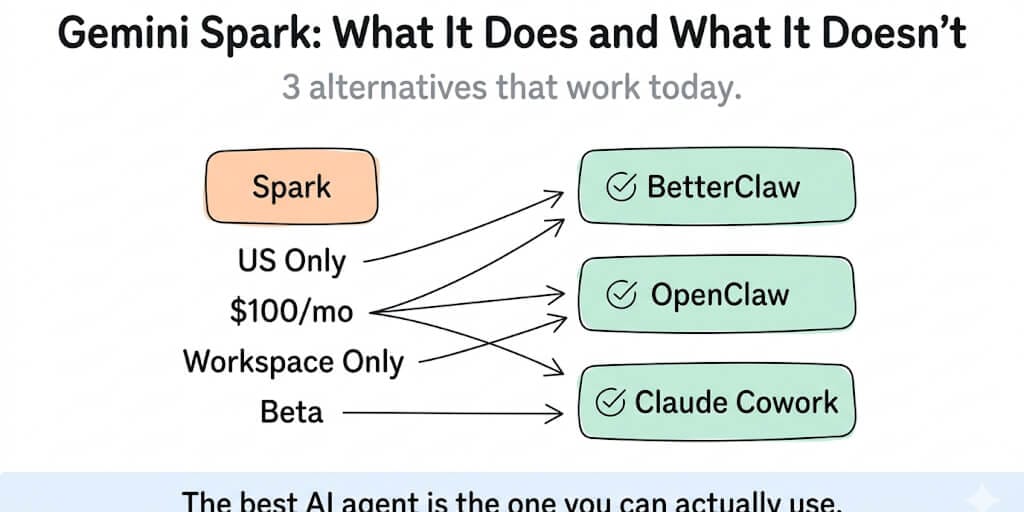
Google's new 24/7 AI agent is impressive. It's also $100/month, US-only, and locked to Google Workspace. Here's what Spark actually does, where it falls short, and three alternatives that work right now.
Google I/O 2026 happened on May 19. Sundar Pichai walked on stage and introduced Gemini Spark: a 24/7 AI agent that runs on dedicated cloud servers, persists after you close your laptop, and handles tasks autonomously in the background.
The internet lost its mind.
"AI agents are finally here." "Google just killed every startup in the space." "This changes everything."
Here's the thing. I've spent the last week reading every piece of documentation, every reviewer's hands-on report, and every spec sheet about Gemini Spark. And while the product is genuinely impressive, the gap between the I/O keynote and what you can actually use today is significant.
If you searched for a Gemini Spark alternative because you're excited about the concept but blocked by the pricing, the waitlist, or the limitations, this article is for you. If you meant NVIDIA's DGX Spark desktop instead, you want our guide to all NVIDIA DGX alternatives.
What Gemini Spark actually is (the honest version)
Gemini Spark is Google's first persistent AI agent. Unlike the standard Gemini chatbot (which ends when you close the tab), Spark runs on dedicated Google Cloud virtual machines 24/7. It keeps working when your phone is locked and your laptop is shut.
It's powered by Gemini 3.5 Flash and built on Google's Antigravity 2.0 agent platform. Sundar Pichai described it as "your personal AI agent that helps you navigate your digital life, taking action on your behalf and under your direction."
What it can do (based on confirmed documentation):
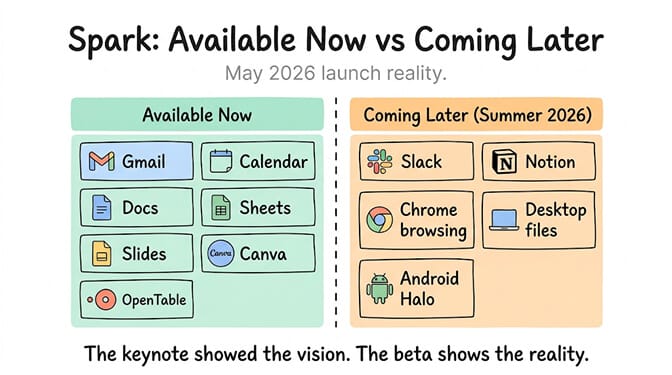
Monitor your Gmail inbox and surface important emails. Track emailed updates (school notifications, subscription charges). Pull together project notes from Gmail, Docs, Sheets, and Slides into a single summary. Draft emails using context from your Google Workspace. Ask for confirmation before taking major actions (sending emails, making purchases, editing calendar). Integrate with third-party apps via MCP (Canva, OpenTable, Instacart announced so far).
That last point is important. Spark is designed to expand beyond Google Workspace through MCP (Model Context Protocol) integrations. But at launch, the third-party options are limited to a handful of partners.
The 5 limitations nobody mentioned in the keynote
Here's what Gemini Spark can't do right now, or what requires significant caveats.
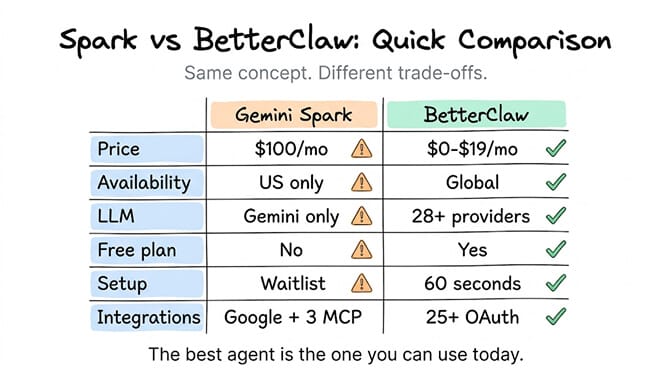
1. It costs $100/month minimum. Spark requires Google AI Ultra, which Google repriced from $249.99 to $99.99/month at I/O. That's the cheapest path to Spark. The lighter "Daily Brief" feature reaches cheaper tiers ($7.99 AI Plus, $19.99 AI Pro), but full Spark agent functionality is Ultra-only. For context, that's $1,200/year for one agent.
2. US-only at launch. Spark is rolling out to US Google AI Ultra subscribers first. EU and UK availability depends on compliance filings (the EU AI Act's Article 50 transparency obligations take effect August 2, 2026). If you're outside the US, there's no timeline for when you'll get access.
3. Google Workspace ecosystem lock-in. Spark's deepest integrations are with Gmail, Calendar, Docs, Sheets, and Slides. Third-party MCP integrations are starting with Canva, OpenTable, and Instacart, with Slack and Notion coming "over the summer." If your workflow runs on HubSpot, GitHub, Jira, or non-Google tools, Spark's utility is limited at launch.
4. No free tier. No free plan. The free Gemini tier gets zero agent access. Even the $7.99/month AI Plus plan only gets the lighter Daily Brief, not full Spark. There's no way to test the actual agent without committing to $100/month.
5. Still in beta. Trusted testers got access the week of May 19. US Ultra subscribers started getting access the following week. This is a beta product with limited integrations, limited geography, and no privacy policy specific to Spark's data handling (a gap Google will need to address before EU compliance deadlines).
Gemini Spark is a genuinely impressive product. It's also a $100/month beta that only works for US-based Google Workspace power users. If that describes you, it might be worth the wait. If it doesn't, keep reading.
Gemini Spark alternative #1: BetterClaw (no-code, works with everything, free plan)
This is us. I'll be upfront about that. But the comparison is relevant because BetterClaw solves the exact problems Spark's limitations create.
Works globally. No geographic restrictions. Available everywhere, today.
Free plan available. $0/month, 1 agent, 100 credits/month. Free forever, not a trial, and it never asks for a credit card. BetterClaw Pro is $49/month ($39/month billed annually) if you need 5 agents and 12,000 credits.
28+ LLM providers. Not locked to Gemini. Use OpenAI, Anthropic Claude, Google Gemini, Mistral, Cohere, DeepSeek, or any of 28+ providers. BYOK with zero inference markup. You pay your provider directly.
25+ integrations beyond Google Workspace. Gmail, Calendar, and Docs, yes. But also HubSpot, GitHub, Slack, Jira, LinkedIn, Telegram, WhatsApp, Discord, and more. 200+ verified skills with a 4-layer security audit. 15+ chat platform connections.
No-code setup in 60 seconds. No Python. No Docker. No terminal. Sign up, connect your LLM key, pick your integrations, write instructions in plain English. Deploy.
The practical difference: Spark monitors your Gmail and drafts responses within Google Workspace. BetterClaw does the same thing, plus connects to your CRM, your project management tool, your messaging channels, and your calendar. All on the same agent. At about half the price. With a free plan to start.
We wrote a full breakdown of how AI agent workflow patterns actually work in practice, including the morning briefing pattern that Spark's Daily Brief feature mirrors.
If you specifically want Google's enterprise agent stack instead of the consumer Spark product, our BetterClaw vs Vertex AI Agent Builder comparison covers that GCP-native path in detail.
Where Spark wins over BetterClaw: If you live entirely inside Google Workspace and want zero-configuration Gmail integration without BYOK, Spark's native Google access is deeper. Google processes 19 billion AI tokens per minute across its products. That infrastructure advantage is real. Once Spark matures and expands its integrations, the comparison will shift.
Where BetterClaw wins: Price ($0-$49 vs $100), integrations (25+ vs Google Workspace + handful of MCP partners), LLM flexibility (28+ providers vs Gemini 3.5 only), availability (global vs US-only), and security features (secrets auto-purge, isolated Docker containers, trust levels with kill switch).
If you're the kind of person who watched the Spark keynote and thought "I want that, but I don't want to pay $100/month and I use more than just Gmail," BetterClaw is the no-code AI agent builder that fits that description. Free plan, no credit card. $49/month for Pro. Your agent runs in 60 seconds. Start here.
Gemini Spark alternative #2: OpenClaw (self-hosted, maximum control)
OpenClaw is the open-source AI agent framework with 230K+ GitHub stars. It's the opposite end of the spectrum from Spark: instead of a managed Google product, you get full control over every aspect of the agent's behavior, hosting, and data.
What it does well: Maximum customization. 44,000+ community skills. Works with any LLM provider. Self-hosted means your data stays on your servers. Massive community (850+ contributors, 44K+ forks).
The trade-offs: Requires Docker, Postgres, Redis, Nginx, and ongoing infrastructure management. Setup takes 4-8 hours. Ongoing ops time: 5-20 hours per month. Security is your responsibility (the ClawHavoc campaign planted 1,400+ malicious skills on ClawHub, and CrowdStrike published a formal enterprise security advisory about deployment risks).
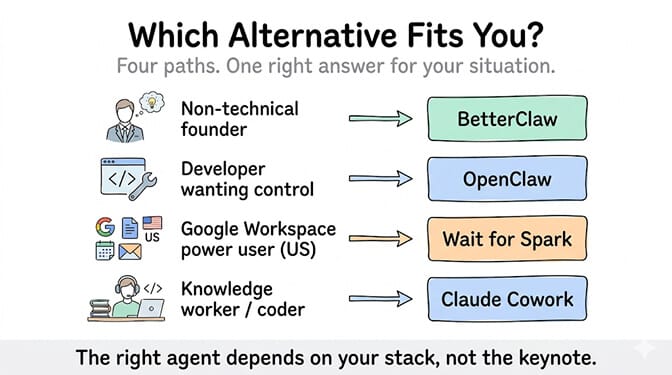
Who it's for: Developers who want complete control and are willing to maintain infrastructure. If you're a non-technical founder, OpenClaw is not the right starting point.
Price: The framework is free. Hosting costs $5-29/month for a VPS. But the real cost is ops time. Our managed vs self-hosting TCO analysis found the true 30-day cost is $651-1,256/month when you count engineering hours.
BetterClaw, by contrast, ships with 200+ verified skills. If OpenClaw itself is what you're shopping to replace, our guide to the best OpenClaw alternatives sorts every option by what it actually does.
Gemini Spark alternative #3: Claude Cowork (Anthropic's agent)
Claude Cowork is Anthropic's entry into the persistent agent space. It runs inside the Claude desktop environment and can automate file management, research, and coding tasks.
What it does well: Strong reasoning (Claude is consistently rated among the best models for complex tasks). Good for developer workflows and file-based tasks. Desktop integration for Mac users.
The trade-offs: Focused on Claude's model ecosystem (no multi-provider support). Narrower integration set compared to BetterClaw or even Spark. More oriented toward knowledge work and coding than operational automation (email triage, lead qualification, support).
Who it's for: Knowledge workers and developers who already use Claude and want agent capabilities within that ecosystem.
Price: Included with Claude Pro/Max subscriptions ($20-$100/month depending on tier).
The comparison that actually matters
Here's the honest summary.
| Feature | Gemini Spark | BetterClaw | OpenClaw | Claude Cowork |
|---|---|---|---|---|
| Price | $100/mo (Ultra) | $0 free, $49/mo Pro | Free + $5-29 hosting | $20-100/mo |
| Setup time | Waitlist (beta) | 60 seconds | 4-8 hours | Minutes |
| LLM providers | Gemini only | 28+ (BYOK) | Any (self-configured) | Claude only |
| Integrations | Google Workspace + 3 MCP | 25+ OAuth, 200+ skills | 44,000+ community | Desktop, files |
| Free plan | No | Yes (1 agent, 100 credits) | Framework free | No |
| Availability | US only | Global | Self-hosted anywhere | Global |
| Technical skill needed | None | None | Docker, Python, DevOps | Minimal |
| Best for | Google Workspace users | Non-technical teams, startups | Developers wanting control | Knowledge workers |
Gartner predicts 40% of enterprise applications will embed AI agents by end of 2026. The question isn't whether AI agents are coming. It's which one fits your specific situation right now, not six months from now when Spark exits beta.
What happens next
Gemini Spark will get better. Over the summer, Google plans to expand MCP integrations to Slack, Notion, and more. Chrome-based browsing is coming. Android Halo will show live agent progress on mobile. And Gemini 3.5 Pro (the heavier model) is expected to reach wider distribution within weeks, which could significantly improve Spark's reasoning.
The question is whether you want to wait for all of that. Or start building today with something that works right now.
Every week you spend evaluating is a week your competitor's agent is handling their support tickets, qualifying their leads, and sending their follow-ups. The technology is ready. The platforms exist. The only barrier is starting.
Give BetterClaw a shot. Free plan with 1 agent and 100 credits a month. $49/month for Pro. 28+ LLM providers including Gemini. 25+ integrations. Deploy in 60 seconds. We're not trying to be Spark. We're trying to be the agent platform you can actually use today. Start here.
Frequently Asked Questions
What is Gemini Spark and why are people looking for alternatives?
Gemini Spark is Google's 24/7 persistent AI agent, announced at I/O 2026 on May 19. It runs on dedicated Google Cloud servers and can monitor Gmail, manage Google Workspace tasks, and connect to some third-party apps via MCP. People look for Gemini Spark alternatives because it requires Google AI Ultra ($100/month minimum), is US-only at launch, is still in beta, and works primarily within the Google Workspace ecosystem.
How does BetterClaw compare to Gemini Spark as an AI agent?
BetterClaw costs $0-$49/month vs Spark's $100/month. BetterClaw supports 28+ LLM providers (including Gemini) vs Spark's Gemini-only model. BetterClaw has 25+ OAuth integrations and 200+ verified skills vs Spark's Google Workspace focus with limited third-party MCP partners. BetterClaw is available globally with a free plan and deploys in 60 seconds. Spark is stronger in native Google Workspace depth and Google's infrastructure scale.
Is there a free alternative to Gemini Spark?
Yes. BetterClaw offers a free plan ($0/month, no credit card) with 1 agent and 100 credits/month. It is free forever rather than a trial, though it is a narrow plan: 3 connectors on a single account, 7-day memory, basic skills, and no webhooks. You can run a morning briefing agent, email triage, or competitor monitoring for free using BetterClaw's free plan paired with Google Gemini's free API tier via BYOK. OpenClaw is also free as an open-source framework, but requires self-hosting and technical setup (Docker, Postgres, command line).
How much does Gemini Spark cost compared to other AI agents?
Gemini Spark requires Google AI Ultra at $100/month (reduced from $249.99 at I/O 2026) or $200/month for the higher Ultra tier. BetterClaw starts at $0/month (free plan) with Pro at $49/month. Claude Cowork is included with Claude Pro at $20/month. OpenClaw is free to run but self-hosting costs $5-29/month for infrastructure plus 5-20 hours of monthly ops time.
Can Gemini Spark work with non-Google tools?
Limited, and growing. At launch (May 2026), Spark works primarily with Google Workspace (Gmail, Calendar, Docs, Sheets, Slides) and a handful of MCP partners (Canva, OpenTable, Instacart). Google has announced plans to expand third-party integrations via MCP over the summer, including Slack and Notion. If you need integrations with HubSpot, GitHub, Jira, LinkedIn, or messaging platforms today, BetterClaw supports 25+ OAuth integrations and 200+ verified skills across these services.