Three workflow tools. Three pricing models. One question nobody asks until the bill arrives.
A founder I know built a 10-step lead qualification workflow. It pulls new leads from a form, enriches them with an AI call, scores them, routes high-intent leads to Slack, low-intent to a nurture sequence, and logs everything to a Google Sheet. Ten steps. Fires about 1,000 times a month.
On Zapier, every single step counts as a task. That's 10,000 tasks a month. Her Professional plan covered 750. She blew through her tier in three days and got an upgrade prompt she wasn't expecting.
On n8n, the entire 10-step workflow counts as one execution. That same 1,000 runs would cost her 1,000 executions. Or, self-hosted, literally zero dollars.
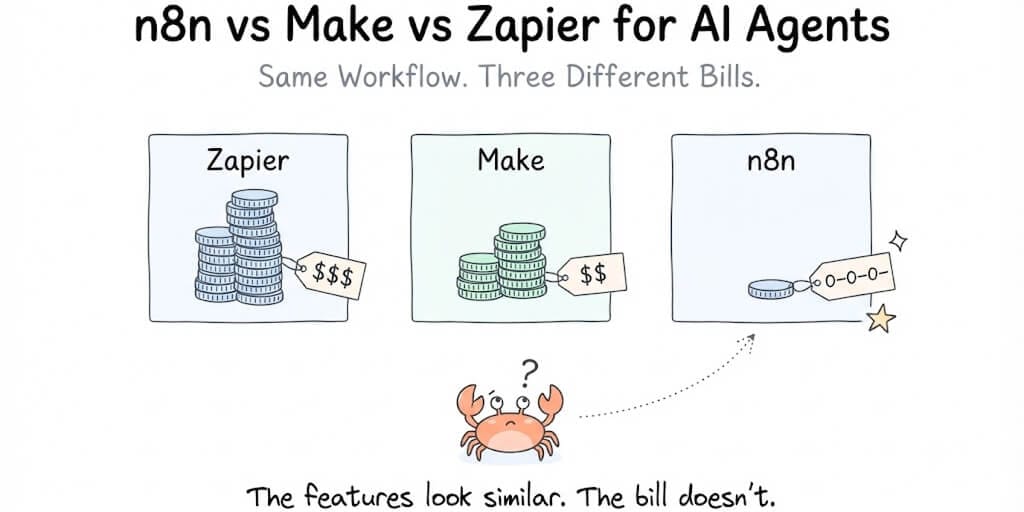
That pricing gap is the first thing you need to understand before you read another word of this comparison. Because the features look similar across all three platforms until you run them at any kind of volume, and then the pricing model decides the rest.
Built for agents, not workflows pretending to be agents.
Persistent memory, trust levels, cost caps, and 120+ connectors. Free forever, not a trial. Start free → No credit card · No Docker · No config files
The pricing math that actually matters for AI agent workflows
This is the part most comparison posts bury at the bottom. I'm putting it first because it changes everything that follows.
For a 10-step workflow running 10,000 times a month, n8n can cut costs by 80 to 90 percent versus Zapier. Not because n8n's per-unit price is lower. Because the units are different.
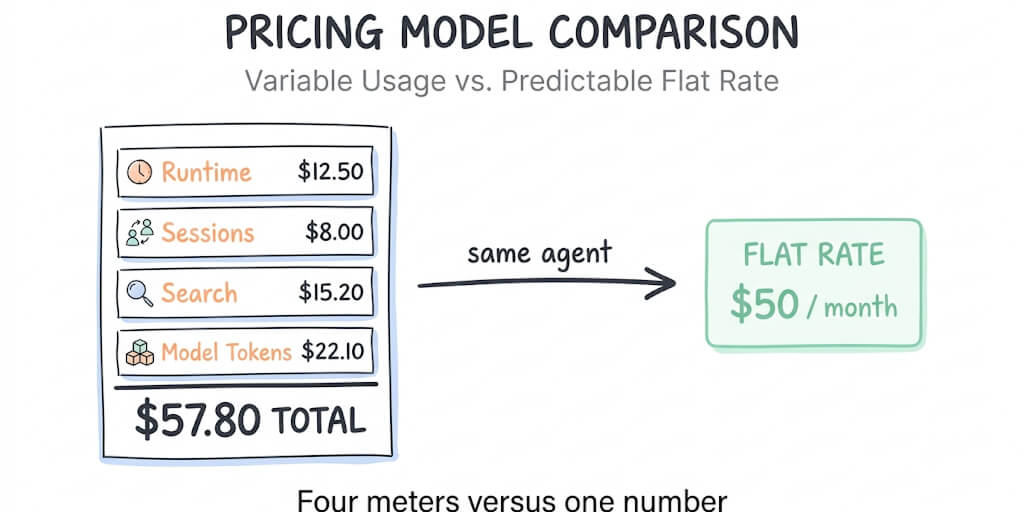
Zapier bills per task. Every action inside a workflow counts. A 10-step workflow that fires 1,000 times is 10,000 tasks. Professional tier starts at $19.99 a month for 750 tasks. To hit 10,000 you're on a significantly higher tier.
Make bills per operation. Similar to Zapier's per-task model, but cheaper per unit. Starts at $9 a month for 10,000 operations.
n8n bills per execution. The entire workflow is one execution, regardless of how many steps it has. Cloud starts at $20 a month. Self-hosted n8n eliminates per-execution pricing entirely. It's free with unlimited executions on your own infrastructure.
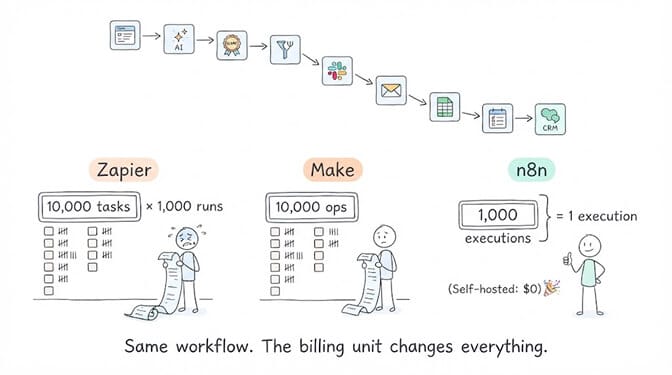
For AI agent workflows, where a single run might involve 15 to 20 steps (LLM call, tool use, decision branch, another LLM call, action, logging), per-task billing punishes complexity. Per-execution billing does not.
Here's what nobody tells you about the AI-specific cost: Zapier shipped native AI Actions for the top 30 integrations, but the AI features have their own credit system layered on top of the existing per-task billing, which means your bill can jump even if your task count stays the same. If your Zapier bill jumped this year without your usage changing, AI credits and agent features are probably the cause.
Where each one actually excels for AI workflows
Zapier: the fastest way to get AI into a simple workflow
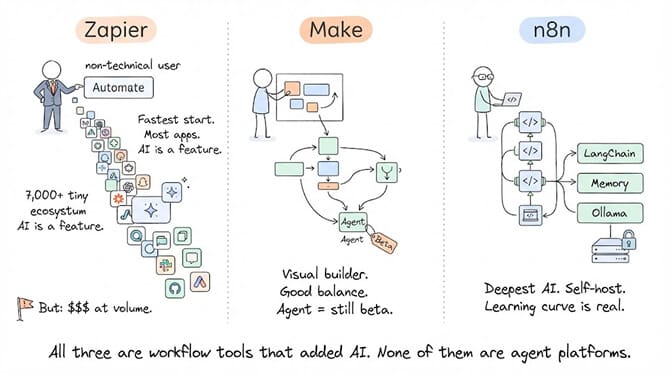
Zapier has the largest app ecosystem at over 7,000 integrations. If the tool you need to connect exists, Zapier almost certainly has a connector for it.
Zapier Agents is a real product now. You describe a goal in natural language, and it drafts a workflow for you. For non-technical users who need AI-augmented automation and don't want to think about infrastructure, this is genuinely the fastest path from "I want this" to "it's running." We compare it with an agent platform in Zapier AI Agents vs BetterClaw.
Where Zapier struggles with AI agents: you can call AI APIs in Zapier, but you can't build stateful agents with memory and context awareness the way you can in n8n. Zapier treats AI as a feature inside a workflow, not as an architecture. A no-code AI agent platform inverts that: the agent is the architecture, and the workflow is something it decides on at runtime. There's no persistent memory across runs. No trust levels. No way to have the agent make branching decisions based on accumulated context from previous sessions.
And the per-task billing makes it the most expensive option the moment your AI workflow gets complex. A single AI-augmented workflow with 15 steps at moderate volume can exceed Zapier's mid-tier pricing fast.
Make: the visual builder that balances cost and power
Make sits in the middle on almost every dimension. More powerful than Zapier's builder, more accessible than n8n's. 3,000+ integrations. Visual workflow design that handles complex branching better than Zapier's more linear approach.
Make introduced Maia, an AI assistant that builds scenarios from natural language, and has an agent builder still flagged as beta. It's further behind on AI-native features than either n8n or Zapier, but it's cheaper than Zapier at equivalent volumes and doesn't require the technical investment that n8n does.
Where Make struggles with AI agents: the agent builder is still beta, which means it's not production-ready for autonomous workflows. Make is excellent for workflows with AI steps in them. It's not yet a platform for building agents that act on their own.
n8n: the developer's choice, and the only one built for real AI agents
n8n 2.0, launched in January 2026, introduced native LangChain integration with 70-plus AI nodes, persistent memory, and the deepest AI agent capabilities of the three.
This is the platform where you can build a genuine AI agent with memory across sessions, tool calling through LangChain nodes, branching decisions based on LLM reasoning, and connection to local models through Ollama without paying per-call cloud fees. n8n treats AI as an architecture, not a feature.
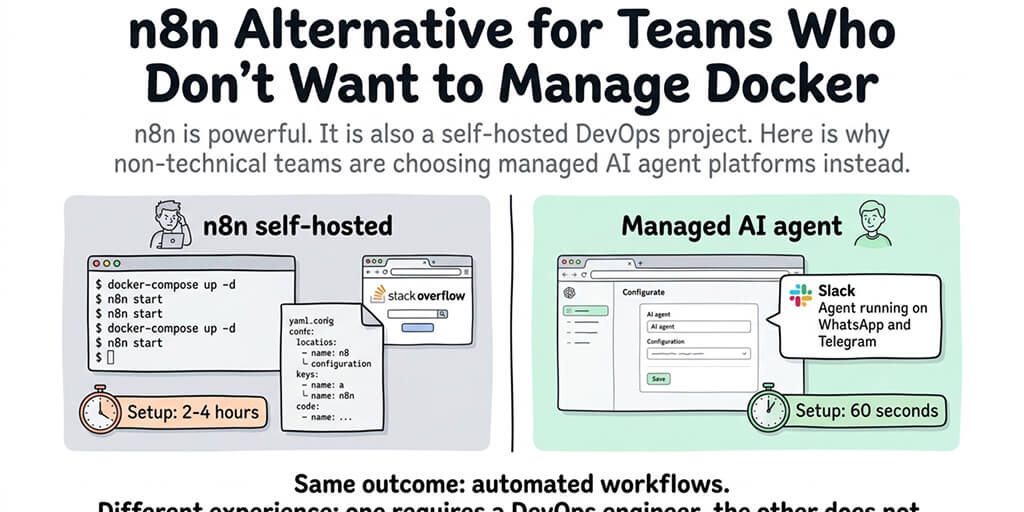
Where n8n struggles: the learning curve is real. If nobody on your team is comfortable with node-based workflow design and the occasional JavaScript expression, n8n's power becomes a liability rather than an asset. And self-hosting means you're maintaining the infrastructure yourself, which is free on the compute bill but not free on engineering time.
The privacy question only one of them can answer
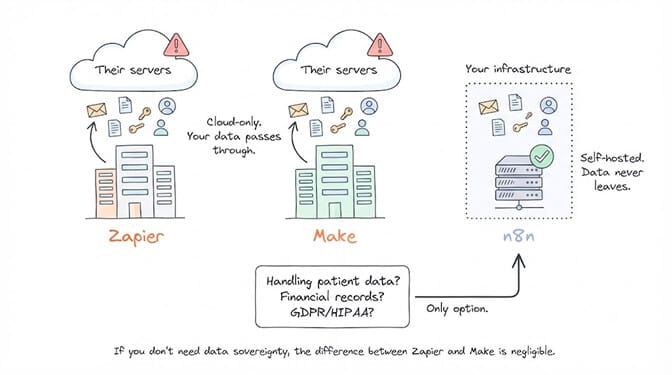
n8n is the only self-hostable option among the three. For regulated industries like healthcare and finance, or teams deploying custom AI agents, n8n's open-source architecture means data never leaves your servers.
Zapier and Make are cloud-only. Your workflow data, your API keys, your customer information, all of it passes through their servers. For most use cases, that's fine. For teams handling patient data, financial records, or anything under GDPR/HIPAA compliance, it's a genuine constraint.
Here's the honest version of this comparison: if you need data sovereignty, n8n is your only option among these three. If you don't, the privacy difference between Zapier and Make is negligible, and neither gives you the ability to keep sensitive data entirely in-house.
If self-hosting n8n for data sovereignty sounds right but maintaining the infrastructure doesn't, that tension is exactly the space where managed AI agent platforms live.
The question nobody asks: is any of these actually an agent platform?
Stay with me here, because this is the part that matters most and that most comparison posts skip entirely.
All three of these tools are workflow automation platforms that added AI capabilities. They're excellent at what they do: trigger, process, transform, route, output. With AI nodes, they can classify, summarize, extract, and generate along the way.
But none of them are autonomous agent platforms in the way that term is used in the agent-building space. Here's what's missing from all three:
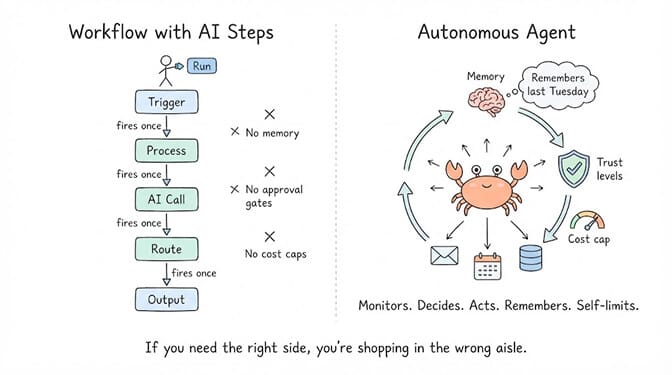
No persistent agent memory across sessions. n8n gets closest with its 2.0 memory features, but Zapier and Make have no concept of an agent that remembers your preferences from last Tuesday and applies them to today's work.
No trust levels or approval gates. None of the three have built-in mechanisms for saying "this agent can classify emails on its own but needs my approval before sending one." That's a guardrail that matters for production agent safety.
No autonomous scheduling with cost caps. An agent that checks your inbox every 15 minutes, stays within a daily cost budget, and auto-pauses when something looks wrong is a different category from a workflow that fires on a trigger.
If the idea of building and maintaining agent memory, approval gates, and cost monitoring as custom n8n nodes sounds like the wrong use of your engineering time, that's exactly the gap BetterClaw fills (our BetterClaw vs n8n comparison covers where each one fits). We built a visual agent builder specifically for autonomous agents with 120+ connectors, trust levels, persistent memory, and BYOK with zero inference markup. Free plan, no credit card, 60-second deploy.
If what you want is the finished job rather than a template to wire up, browse BetterClaw's ready-made AI agent workflows: email triage, lead scoring, competitor monitoring, receipts to Google Sheets and more, each one already built.
The verdict, depending on who you are
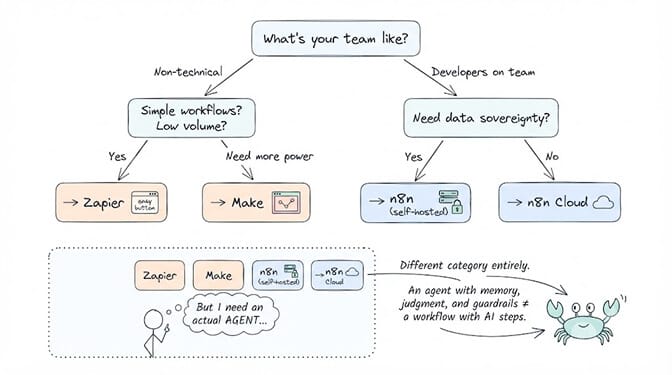
Choose Zapier if you're non-technical, your workflows are simple (under 5 steps), your volume is low, and you value having the largest app ecosystem. The AI features are real but they're features, not an agent architecture. Be aware that per-task billing punishes complexity.
Choose Make if you want a visual builder that handles moderate complexity at a lower price point than Zapier, and you don't need full AI agent capabilities yet. Best middle ground between cost and usability.
Choose n8n if you have developers on the team, you need data sovereignty, you want to build actual AI agent workflows with LangChain integration and persistent memory, and you're willing to manage infrastructure (or pay for n8n's managed cloud). Best AI capabilities of the three, best pricing at volume.
Choose none of them if what you actually need is an autonomous agent, not a workflow with AI steps. An agent that monitors, decides, acts, remembers, and self-limits is architecturally different from a workflow that fires on a trigger. Many teams use a hybrid approach: platform-based automation for simple, high-volume tasks combined with purpose-built AI agents for complex processes that require intelligence, context, and flexibility. Expense routing is a typical example: an AI operations agent checks each expense against your policy, routes it to the right approver and puts anything over the limit into an exception report for a person to decide.
For more context on the token-cost implications of running AI workflows at scale, regardless of which platform you choose, our guide to cutting agent token costs covers the specific techniques (model routing, prompt caching, context compression) that reduce your LLM bill by 40 to 70 percent.
The takeaway worth keeping
The n8n vs Make vs Zapier question is the wrong question for about half the people asking it. If you need workflow automation with AI features, all three work and the decision comes down to your team's technical ability and your tolerance for per-task pricing.
If you need an autonomous agent with memory, judgment, and guardrails, you're shopping in the wrong aisle. The tools are fine. They're just not agent platforms, and treating them as such is how teams end up with a 47-node n8n workflow that does what a properly configured agent does in three settings.
If you'd rather skip the workflow-as-agent workaround entirely, give BetterClaw a try. Free plan with one agent, every feature, and 100 credits a month. $49 a month for Pro when you need 5 agents and 12,000 credits. 28+ model providers, zero inference markup, bring your own API keys, and your first deploy takes about 60 seconds. We built it for autonomous agents, not workflows pretending to be agents.
Frequently Asked Questions
What is the best workflow tool for AI agents in 2026?
n8n is the strongest of the three for AI agent workflows, with native LangChain integration, 70-plus AI nodes, persistent memory, and the only self-hosting option for data sovereignty. However, all three (n8n, Make, Zapier) are workflow automation tools, not autonomous agent platforms. For true AI agents with memory, trust levels, and approval gates, purpose-built agent platforms are the better fit.
How does n8n compare to Zapier for AI agent costs?
n8n bills per workflow execution (the whole workflow is one unit), while Zapier bills per task (each step counts separately). For a 10-step workflow running 10,000 times a month, n8n can cost 80 to 90 percent less than Zapier. Self-hosted n8n eliminates per-execution costs entirely. Zapier's newer AI features add their own credit costs on top of the existing per-task billing.
Can I build a real AI agent in Zapier or Make?
You can build workflows with AI steps in both, but neither supports persistent memory across sessions, trust levels, approval gates, or autonomous scheduling with cost caps. Zapier Agents lets you describe goals in natural language and drafts workflows, which is useful but architecturally different from an autonomous agent. n8n comes closest to real agent architecture with its LangChain integration and memory features.
How much does n8n cost compared to Make and Zapier?
n8n cloud starts at $20 per month, self-hosted is free with unlimited executions. Make starts at $9 per month for 10,000 operations. Zapier starts at $19.99 per month for 750 tasks. At high volumes with complex workflows, n8n is typically 5 to 8 times cheaper than Zapier because of the per-execution versus per-task billing difference.
Is n8n private enough for handling sensitive business data?
n8n is the only one of the three that offers self-hosting, which means your data never leaves your servers. For teams under GDPR, HIPAA, or other compliance frameworks, this is a structural advantage. Zapier and Make are cloud-only, so all workflow data passes through their infrastructure. Self-hosted n8n requires you to manage the infrastructure yourself.