n8n is one of the best workflow automation tools available. BetterClaw is a no-code AI agent builder. They look similar in screenshots. They solve fundamentally different problems. Here's how to tell which one you actually need.
An ops lead in our community spent two weeks building an n8n workflow for customer support email triage. It was beautiful. 47 nodes. Branching logic for 12 ticket categories. Webhook triggers. Slack notifications. Gmail integration.
It worked perfectly for the tickets it was designed for.
Then a customer sent an email in Spanish. The workflow didn't have a language detection node. It classified the email as "other" and dropped it into a catch-all queue where it sat for three days.
Another customer sent a complaint disguised as a compliment: "I absolutely love how your product crashes every Tuesday." The sentiment node flagged it as positive. No escalation.
The workflow followed the rules perfectly. The rules just couldn't handle reality.
She rebuilt the same triage on BetterClaw in about 15 minutes. No nodes. No branches. She told the agent: "Classify incoming support emails by urgency and category. Respond to routine queries from the knowledge base. Escalate complaints, complex questions, and anything you're unsure about to Slack."
The Spanish email? The agent read it, understood it, responded in Spanish, and classified it correctly. The sarcastic complaint? The agent caught the underlying frustration and escalated it.
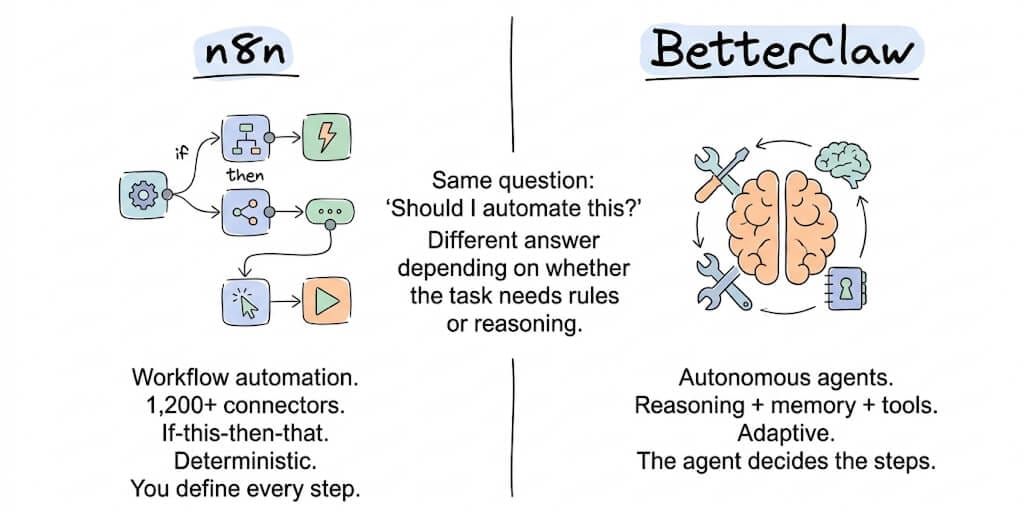
That's the difference between workflow automation and an autonomous agent. A workflow follows the rules you define. An agent reasons about what to do.
Both are valuable. Both have their place. But they're not interchangeable. Here's the honest comparison.
The quick comparison (for people who just want the answer)
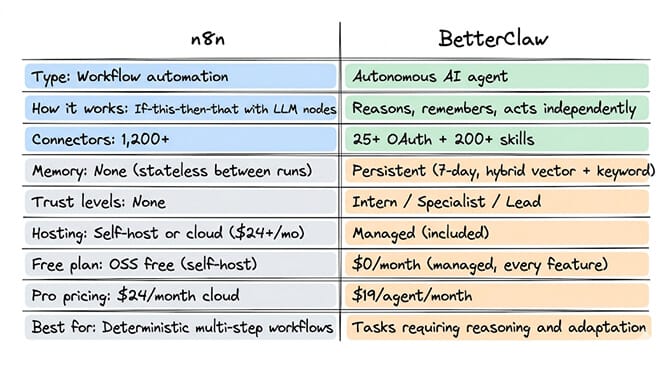
| n8n | BetterClaw | |
|---|---|---|
| Type | Workflow automation | Autonomous AI agent |
| How it works | If-this-then-that with LLM nodes | Reasons, remembers, acts independently |
| Connectors | 1,200+ | 25+ OAuth + 200+ verified skills |
| Memory | Stateless between runs | Persistent (7-day Free / 90-day Pro, vector + keyword) |
| Trust levels | None | Intern / Specialist / Lead |
| Hosting | Self-host or cloud ($24+/mo) | Managed (included) |
| Free plan | OSS free (self-host required) | $0/month (managed, 1 agent, 100 credits) |
| Pro pricing | $24/month (cloud) | $49/month |
| Best for | Deterministic multi-step workflows | Tasks needing reasoning and adaptation |
What n8n does well (the honest assessment)
Let's be clear. n8n is excellent at what it does.
1,200+ connectors. That's not a typo. n8n integrates with more apps than any other workflow platform. If it has an API, n8n probably has a connector for it.
Open-source and self-hostable. Full control over your data, your infrastructure, and your workflows. Active community. Regular updates. The self-hosted version is genuinely free.
Visual workflow builder. Drag nodes. Connect them. Define triggers, conditions, and actions. The canvas is intuitive for anyone who's seen a flowchart.
Deterministic execution. The same input produces the same output every time. No variation. No "reasoning." No surprises. For workflows that must be predictable (data pipelines, ETL processes, notification routing), this is a strength.
AI nodes available. n8n added LLM nodes (OpenAI, Anthropic, etc.) that let you include AI processing as a step in your workflow. This is powerful for workflows like "receive email → run through GPT → post summary to Slack." (For inspiration on what those workflows can do, our n8n workflow ideas with AI agents post collects practical patterns.)
Our comparison of the 12 best AI agent builders covers n8n alongside agent-first platforms.
The distinction that matters (workflows vs agents)
Here's where most people get it wrong. They see n8n's AI nodes and the BetterClaw visual builder and think they're the same category.
They're not. And confusing them leads to picking the wrong tool. (For the broader primer on what makes an autonomous agent different from automation, see our what is an AI agent guide.)
Workflows follow rules. Agents reason about goals.
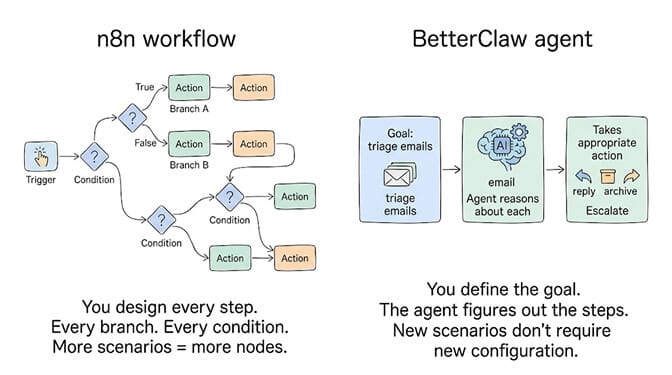
n8n workflow for email triage: "When email arrives → check if sender is in VIP list → if yes, flag as urgent → if no, check subject for keywords → if 'invoice,' route to billing → if 'support,' route to support → else, route to general."
You defined every branch. Every condition. Every outcome. If a new category of email appears that doesn't match any rule, it falls through to "else." You need to add a new node.
BetterClaw agent for email triage: "Classify incoming support emails. Respond to routine queries from the knowledge base. Escalate complex issues to Slack with a summary."
The agent reads the email, understands the context, and makes a decision. A new category of email? The agent reasons about it and classifies it based on the goal, not a pre-defined rule. (Our AI agent for email automation post walks through this email-triage example end to end.)
Workflows are stateless. Agents remember.
n8n has no persistent memory between workflow runs. Each execution starts fresh. The workflow that processed your email at 9 AM has no knowledge that it processed a different email from the same person at 8 AM.
BetterClaw agents have persistent memory. The agent remembers past conversations, preferences, and context across sessions (7-day retention on Free, 90-day on Pro). When the same customer emails twice, the agent knows the history.
This matters more than it sounds. A customer emails about a billing issue on Monday. You resolve it. They email again on Wednesday about a shipping question. A workflow treats these as two unrelated events. An agent recognizes the same customer and references the billing resolution when responding.
The one-sentence distinction: n8n automates the predictable. BetterClaw handles the unpredictable. Most businesses have both kinds of tasks.
Workflows don't have safety controls for autonomous action. Agents do.
n8n executes what you designed. There's no concept of "ask me before doing this" because the workflow already defined exactly what to do. If the workflow sends an email, it sends the email.
BetterClaw uses trust levels. Intern: the agent drafts but doesn't act without approval. Specialist: routine actions proceed, sensitive actions require human review. Lead: full autonomy with daily summary. Plus a one-click kill switch that pauses everything immediately.
For the detailed breakdown of how trust levels prevent AI agent mistakes, our AI agent security guide covers the Intern-to-Lead progression and six common failure modes.
When to choose n8n (be honest about this)
Choose n8n if:
Your workflows are deterministic. Same input, same output, every time. You need 1,200+ app connectors. No other platform comes close. You want to self-host for data sovereignty. Your tasks follow explicit rules with defined branches. You want AI as a step in a larger automation, not as the automation itself.
Concrete example: "When a new row appears in Google Sheets with status 'approved,' create a Jira ticket, send a Slack notification, update the CRM record, and email the client." This is pure automation. No reasoning required. No memory needed. n8n handles this perfectly. BetterClaw would be overkill.
Another example: "Every night at midnight, pull new orders from Shopify, match them against inventory in Airtable, and generate a restock report in Google Docs." Deterministic. Rule-based. n8n was built for this.
If you need an agent that reasons about what to do, remembers context, and adapts to new situations without you adding nodes, that's when you need something different. BetterClaw's free plan includes 1 agent, 100 credits a month, persistent memory, and trust levels. $49/month for Pro with 5 agents and 12,000 credits.
When to choose BetterClaw (be honest about this too)
Choose BetterClaw if:
Your tasks require reasoning, not just rules. You need the agent to remember past interactions. You want trust levels (Intern, Specialist, Lead) to control what the agent does autonomously. You want managed hosting without maintaining a server. Your agents need to operate autonomously 24/7 without workflow redesign. (See our managed n8n alternative post if you specifically want the managed hosting angle.)
Concrete example: "Handle incoming support emails. Answer routine questions from the knowledge base. Escalate complex issues with context. Remember that this customer had a billing problem last week." This requires reasoning (what's routine vs complex?), memory (the billing problem), and adaptation (new question types).
Another example: "Monitor my inbox overnight. Classify everything. Draft responses for routine emails. Send me a morning briefing at 7 AM to Telegram." This is an agent, not a workflow. It reasons about urgency. It drafts with context. It remembers your preferences over time.
For BetterClaw against the wider field, our best AI agent builders comparison puts CrewAI, Google's agent platform, n8n and nine others side by side.
The pricing comparison (where it gets interesting)
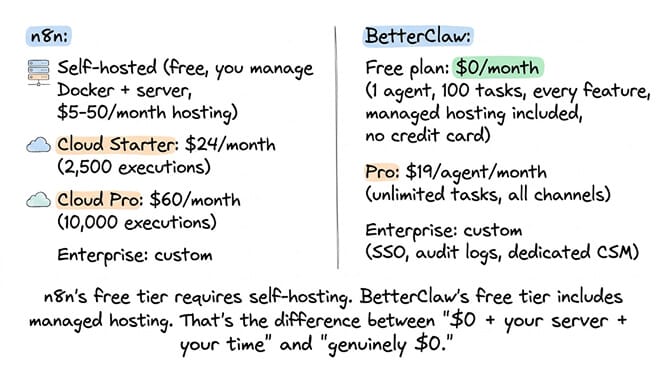
n8n pricing:
Self-hosted: Free (open-source). You manage Docker, a server ($5-50/month), and maintenance (5-15 hours/month).
Cloud Starter: $24/month. 2,500 executions. 5 active workflows.
Cloud Pro: $60/month. 10,000 executions. Unlimited workflows.
Enterprise: Custom pricing.
BetterClaw pricing:
Free: $0/month. 1 agent. 100 credits/month. 3 connectors. Managed hosting included. No credit card.
Pro: $49/month ($39/month billed annually). 5 agents. 12,000 credits/month. Unlimited connectors. 24h email support.
Enterprise: Custom. SSO. Audit logs. Dedicated CSM.
The key difference: n8n's free plan requires self-hosting (your server, your Docker, your maintenance). BetterClaw's free plan includes managed hosting. When you factor in hosting costs and maintenance time, n8n self-hosted is often more expensive than BetterClaw Pro. (Our AI agent cost breakdown puts real numbers on the self-hosted vs managed total cost of ownership.)
The honest middle ground (you might need both)
Here's what nobody tells you about workflow automation vs AI agents.
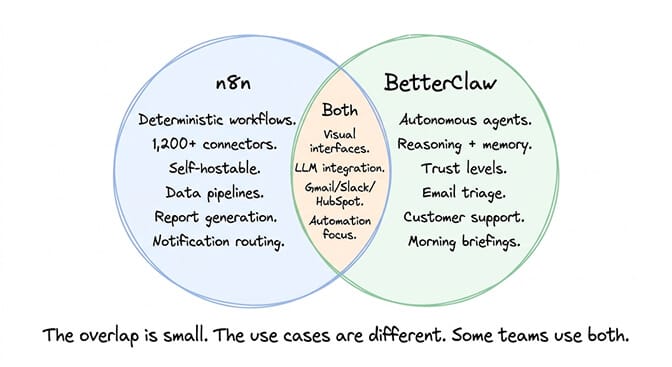
Some teams use both. n8n handles the deterministic data pipelines. BetterClaw handles the tasks that require reasoning. They don't compete. They serve different functions.
"When a new lead enters HubSpot, create a Notion page, assign it in Asana, and notify the team in Slack." That's n8n. Deterministic. Rule-based.
"Review each new lead, research their company, draft a personalized outreach email based on their industry and role, and send it if the lead score is above 70." That's BetterClaw. Reasoning. Personalization. Judgment.
The wrong question is "which platform is better?" The right question is "does this task need rules or reasoning?"
For how to evaluate workflow and agent tools together, our AI agent builders compared post includes a six-question checklist.
The limitations we're honest about
BetterClaw has fewer connectors than n8n. 25+ OAuth integrations and 200+ skills versus n8n's 1,200+ connectors. If you need to connect to a niche CRM, an obscure database, or a custom internal API, n8n probably has a connector. BetterClaw might not.
BetterClaw doesn't do visual workflow chaining. n8n's canvas lets you visually connect nodes into complex multi-step workflows with branching logic. BetterClaw agents work from natural language instructions, not workflow diagrams. If you think in flowcharts, n8n feels more natural.
n8n is self-hostable. BetterClaw isn't. If your compliance requirements demand that all processing happens on your own servers and no data touches a third-party platform, n8n's self-hosted option is the only choice.
These are real trade-offs. Not marketing spin. The right tool depends on what matters most for your specific use case.
The honest take
Here's the perspective that most comparison pages skip.
n8n and BetterClaw represent two different philosophies about automation. n8n says: define the process, and the system executes it perfectly. BetterClaw says: define the goal, and the agent figures out how to achieve it.
Both are valid. Both are useful. The automation market and the AI agent market will both grow massively. Gartner predicts 40% of enterprise applications will embed AI agents by end of 2026. That doesn't replace workflow automation. It adds a new layer on top.
The best teams in 2026 will use both. Workflows for the predictable. Agents for the unpredictable. The skill is knowing which is which.
If any of this resonated, give BetterClaw a try. Free plan with 1 agent and 100 credits a month. $49/month for Pro. Your first agent takes about 60 seconds to deploy. We handle the hosting. You handle the interesting part.
Frequently Asked Questions
What is the difference between n8n and an AI agent like BetterClaw?
n8n is a workflow automation platform. It executes predefined if-this-then-that sequences with 1,200+ app connectors. BetterClaw is an autonomous AI agent builder. Agents reason about goals, remember past interactions, and adapt to new situations without predefined rules. n8n is best for deterministic, rule-based automation. BetterClaw is best for tasks that require judgment, context, and adaptation.
Can n8n be used as an AI agent builder?
n8n includes AI/LLM nodes that add GPT or Claude processing as steps in a workflow. This makes n8n useful for "AI-enhanced workflows" (receive input → process through LLM → take action). But n8n lacks persistent memory between runs, trust levels, autonomous 24/7 operation, and agent-specific safety controls. For structured workflows with AI steps, n8n works well. For autonomous agents that reason and adapt, a dedicated agent platform is more appropriate.
How does n8n pricing compare to BetterClaw?
n8n self-hosted is free but requires your own server ($5-50/month) and maintenance time. n8n Cloud starts at $24/month for 2,500 executions. BetterClaw's free plan is $0/month with managed hosting included, 1 agent, and 100 credits a month. BetterClaw Pro is $49/month with 5 agents and 12,000 credits. When you include hosting and maintenance costs, n8n self-hosted often costs more than BetterClaw Pro.
Can I use both n8n and BetterClaw together?
Yes, and some teams do. n8n handles deterministic data pipelines (syncing records, generating reports, routing notifications). BetterClaw handles tasks requiring reasoning (email triage, customer support, morning briefings, competitor monitoring). They serve different functions and can complement each other within the same organization.
Is BetterClaw secure enough for tasks n8n currently handles?
BetterClaw includes security features that n8n's self-hosted version leaves to you: secrets auto-purge from agent memory after 5 minutes (AES-256), isolated Docker containers per agent, 4-layer skill audit (824 malicious submissions rejected), trust levels with action approval, and a one-click kill switch. 50+ companies including Carelon, Grainger, and Robert Half use BetterClaw in production.