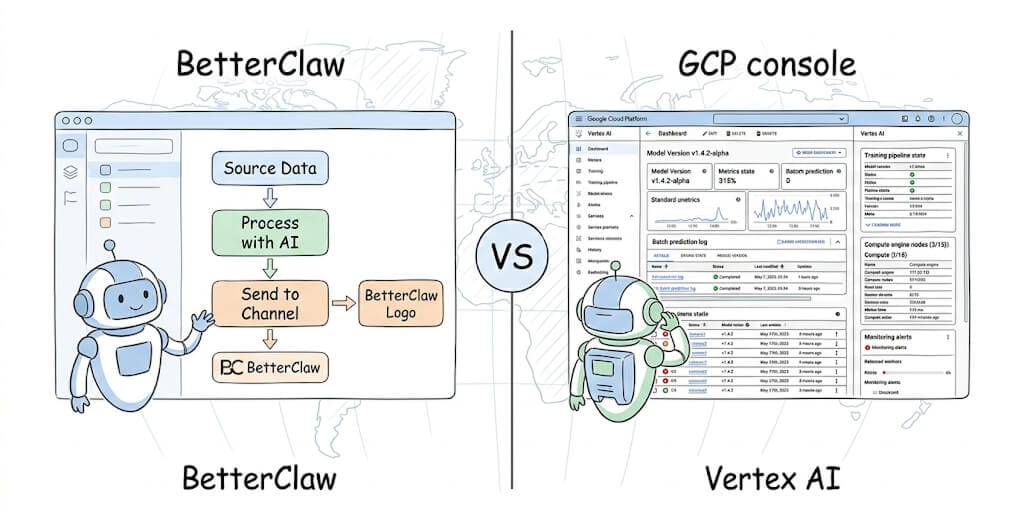
Two very different tools built for two very different teams. Here's an honest breakdown so you pick the right one.
| BetterClaw | Vertex AI Agent Builder | |
|---|---|---|
| Setup time | 60 seconds | Days to weeks |
| Code required | None | Python + GCP SDK |
| Hosting | Managed, included | GCP (your infrastructure) |
| Free plan | Yes ($0, no credit card) | No flat free plan, but a monthly free allowance on compute, memory and storage, plus express mode for 90 days with no billing account |
| Pricing model | $0 free / $49/month Pro ($39 annual) | Metered: Agent Compute, Agent Storage, Agent Search, model tokens |
| LLM providers | 28+ (BYOK, zero markup) | 200+ in Model Garden (Gemini, Claude, Llama), Gemini-first experience |
| Integrations | 25+ one-click OAuth | GCP-native + custom connectors |
| Cloud lock-in | None | GCP-locked |
| Skills marketplace | 200+ verified (4-layer audit) | No marketplace |
| Trust levels / kill switch | Yes | Custom-built required |
| Best for | Small teams, non-GCP shops, fast deploy | GCP-native enterprises, BigQuery data |
A CTO I spoke to last month had been evaluating Vertex AI Agent Builder for three weeks. His team was already on GCP. Their data lived in BigQuery. On paper, Vertex was the obvious pick.
But here's what happened. The cloud architect needed two sprints just to configure the agent environment. The product manager wanted to test an email triage use case... and couldn't. She didn't have GCP permissions, didn't know Python, and the internal request to provision a test environment was sitting in a Jira backlog.
Meanwhile, a founder I know in a completely different company built the same email triage agent in 4 minutes. On BetterClaw's free plan. No GCP. No Python. No Jira ticket. (Our free AI agent builder guide shows that same $0 setup step by step.)
Two different teams. Two different tools. Both valid choices. The question is which one matches your situation.
What is Google Vertex AI Agent Builder?
Vertex AI Agent Builder is Google Cloud Platform's native tool for building AI-powered agents and search applications. It's part of the broader Vertex AI suite, which includes model training, fine-tuning, and deployment infrastructure.
What it does well:
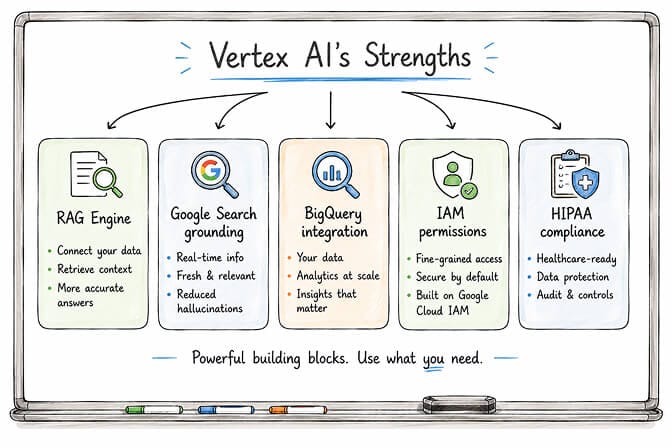
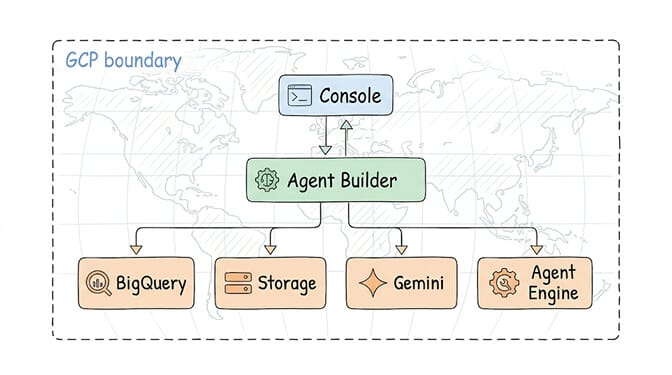
It excels at enterprise data grounding. If your company data lives in BigQuery, Cloud Storage, or Google Workspace, Vertex AI can connect agents directly to those data sources with built-in RAG (retrieval-augmented generation) pipelines. The data never leaves GCP's security perimeter. For companies with strict data residency requirements, that matters.
The grounding story goes further than most teams realize. You can ground responses on Google Search, on Google Maps data for agents that need geospatial context, or on licensed third-party datasets from providers like Dun and Bradstreet, S&P Global, and ZoomInfo. That fidelity is genuinely hard to replicate elsewhere, ours included.
Multi-agent orchestration is supported through Agent Runtime (formerly Agent Engine) using the Agent2Agent protocol. Observability dashboards track agent performance, token usage, and error rates. Enterprise governance tools provide audit trails and access controls that large organizations need, and the compliance surface (HIPAA, ISO, data residency controls) is the kind of thing a Fortune 500 procurement team puts on a 47-page checklist.
One naming note before we go further, because the search results are a mess right now. At Cloud Next 2026, Google rebranded the platform as the Gemini Enterprise Agent Platform and folded Agentspace into it. Vertex AI Agent Builder, Gemini Enterprise Agent Platform, Agentspace: same services, different shelf labels. Existing customers do not need to migrate. Vertex AI Search was renamed Agent Search in the same period, which matters below because every pricing article written before that uses the old name and the old rates.
As of May 2026, Google also announced Gemini Managed Agents API at I/O, allowing a single API call to spin up a full agent with persistent state. MCP (Model Context Protocol) support is rolling out, with Canva, OpenTable, and Instacart as launch partners for Gemini Spark (we cover the consumer side of that launch in our Gemini Spark alternatives guide).
Where it gets complicated:
Vertex AI Agent Builder is GCP-native. That means GCP billing, GCP IAM, GCP networking, GCP everything. If your team isn't already fluent in Google Cloud, the learning curve is significant.
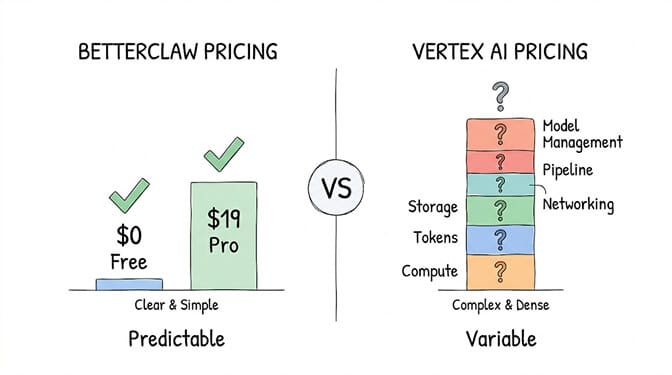
Pricing is metered and complex. As of September 2026 the meters are: Agent Compute at $0.085 per vCPU-hour and Agent Memory at $0.009 per GiB-hour for the runtime; Agent Storage at $0.30 per GiB-month for sessions and memories, plus read and write operations billed in compute units (one vCPU-hour per 3 million reads, one per 1 million writes) — a structure that went live on September 1, 2026, replacing the old flat per-1,000-events rate; Agent Search at $1.50 per 1,000 queries on Standard Edition or $4.00 on Enterprise Edition, with Advanced Generative Answers adding $4.00 per 1,000 user-input queries; and foundation model tokens on top of all of it.
One user asking one question can touch every one of those. Predicting the monthly number before you build is genuinely difficult, which is the complaint that shows up in almost every critical review. To be fair to Google, the free allowances are real — 50 vCPU-hours, 100 GiB-hours of memory, and 1 GiB-month of storage per account per month, plus express mode, which lets you build for up to 90 days with no billing account attached. What you do not get is a ceiling.
What is BetterClaw?
BetterClaw is a no-code AI agent builder. No GCP. No AWS. No Azure. No cloud platform required at all.
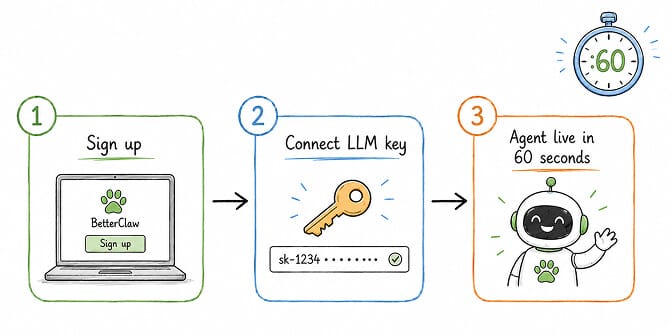
You sign up (no credit card), connect your own LLM API key from any of 28+ providers (OpenAI, Anthropic Claude, Google Gemini, Mistral, DeepSeek, Cohere, and more), build your agent in a visual interface, connect integrations via one-click OAuth, and deploy. The whole flow happens in the browser, which is what makes it an AI agent builder rather than an SDK with a console bolted on.
The whole process takes about 60 seconds.
What you get:
- Visual builder (no code, no YAML, no terminal)
- 200+ verified skills with a 4-layer security audit (824 malicious skills rejected)
- 25+ one-click OAuth integrations (Gmail, Calendar, HubSpot, Slack, Jira, LinkedIn, and more)
- 15+ chat platforms (Telegram, WhatsApp, Discord, Slack, Teams, and more)
- BYOK with zero inference markup (you pay providers directly)
- Trust levels (Intern, Specialist, Lead) with action approval and a one-click kill switch
- Secrets auto-purge from agent memory after 5 minutes (AES-256)
- Isolated Docker containers per agent
- Persistent memory with hybrid vector + keyword search
- Real-time health monitoring with auto-pause on anomalies
Pricing: Free plan at $0/month (1 agent, 100 credits a month, no credit card). Pro at $49/month (5 agents, 12,000 credits). Business at $149/month (25 agents, 40,000 credits). Enterprise at custom pricing with SSO, audit logs, and dedicated CSM.
50+ companies use BetterClaw including Carelon, Grainger, KeHE, Premier, and Robert Half.
The five differences that actually matter
1. Cloud lock-in vs cloud-agnostic
This is the biggest strategic difference.
Vertex AI ties you to GCP. Your agents, your data pipelines, your billing, your IAM policies, your networking... all GCP. If you ever want to move to AWS, Azure, or a multi-cloud setup, your agent infrastructure comes with you only if you rebuild it.
BetterClaw is cloud-agnostic. Your LLM key can be from any provider. Your data connects via standard OAuth. Your agent runs on BetterClaw's managed infrastructure regardless of where your other systems live. If you use GCP for storage but want Claude for reasoning, that works. If you switch from OpenAI to Gemini next month, you change one API key.
If you're 100% committed to GCP and plan to stay there, lock-in isn't a concern. If you're not sure, or if your team uses multiple cloud providers, cloud-agnostic is the safer bet.
2. Setup time and technical requirements
Vertex AI requires GCP expertise. Setting up an agent involves configuring IAM roles, provisioning resources, writing agent logic in Python using the Vertex AI SDK, setting up data stores for grounding, and deploying through GCP's infrastructure. For a team with a cloud architect, this is normal. For a team without one, it's a blocker.
BetterClaw requires no technical background. The visual builder is the same interface your ops manager, marketing lead, or founder would use. No Python. No SDK. No cloud console. The agent deploys in 60 seconds.
This isn't a quality judgment. It's a personnel question. Who on your team is going to build and maintain the agent?
3. Pricing transparency
Vertex AI meters four things at once — Agent Compute and Agent Memory for the runtime, Agent Storage plus read and write operations for sessions and memories, Agent Search queries, and model tokens — and that is before any other GCP service your agent touches. Estimating monthly cost before you've built anything is genuinely difficult. I've seen teams get surprised by costs from data processing jobs they didn't realize their agent was triggering.
BetterClaw's pricing is flat. $0 on free. $49/month on Pro, or $39 billed annually. $149/month on Business. LLM inference costs are separate and go directly to your provider at their published rates. Zero markup. Your monthly bill is predictable before you start.
4. LLM flexibility
Vertex AI is Gemini-first, not Gemini-only — a distinction plenty of comparison posts get wrong. Model Garden carries 200+ models including Claude, Llama, and Gemma alongside the Gemini family, all through one API surface. What is true is that the default path, the tooling, and the documentation are all built around Google's own models, so running a mixed fleet means more configuration than switching a dropdown. If you want to route by task and cost across providers day to day, you are working slightly against the grain.
BetterClaw supports 28+ LLM providers natively. Switch models by changing an API key. Use Claude for complex reasoning, GPT-5.5 for creative tasks, and Gemini Flash for high-volume low-cost work. All on the same platform, all with the same agent configuration.
5. Enterprise compliance vs built-in security
Here's where Vertex AI genuinely wins for certain teams.
If your company requires specific GCP compliance certifications (FedRAMP, HIPAA BAA through GCP, SOC 2 Type II via Google's infrastructure), Vertex AI inherits those from the GCP platform. For regulated industries with existing GCP compliance postures, this is a real advantage.
BetterClaw approaches security differently. Instead of inheriting compliance from a cloud provider, security is built into the agent layer itself. Secrets auto-purge after 5 minutes (AES-256). Each agent runs in an isolated Docker container. The verified skills marketplace has rejected 824 malicious skills through a 4-layer audit. Trust levels control what agents can do autonomously. A one-click kill switch stops any agent instantly.
For startups and mid-size companies that need strong security without the overhead of managing GCP compliance certifications, BetterClaw's built-in approach is simpler. For enterprises with regulatory mandates tied to specific cloud certifications, Vertex AI's inherited compliance has an edge.
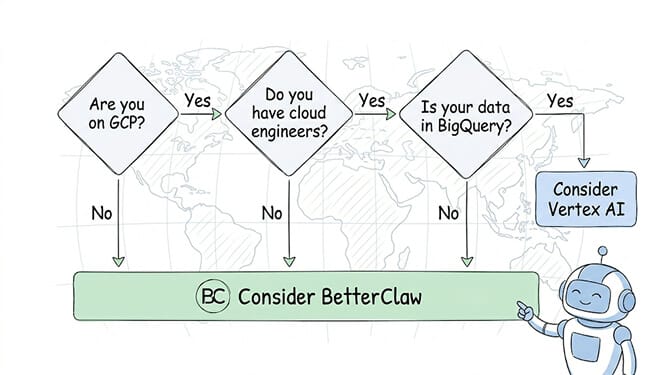
When Vertex AI Agent Builder is the right choice
We're going to be fair here. Vertex AI wins in specific scenarios:
Your data already lives in BigQuery. If your agent needs to query petabytes of structured data in BigQuery, Vertex AI's native integration is hard to beat. The data never leaves GCP's security perimeter, and the RAG pipeline is tightly integrated.
You're already deep in GCP. If your team manages GCP infrastructure daily, adding Vertex AI Agent Builder is an incremental step, not a new platform. The billing, IAM, and networking are already familiar.
You need specific GCP compliance certifications. FedRAMP, HIPAA BAA through GCP, or other certifications that your organization already maintains on GCP.
You have cloud engineers available. If your team includes GCP-certified architects who can configure, deploy, and maintain agent infrastructure, the complexity isn't a bottleneck.
If all four of those conditions are true, Vertex AI is probably the right fit.
If any of those conditions aren't true... that's where the evaluation gets more nuanced.
If you want the meter-by-meter cost detail rather than the head-to-head, our Vertex AI pricing guide walks every SKU. If you want to compare beyond BetterClaw, our roundup of Vertex AI Agent Builder alternatives covers the wider field.
When BetterClaw is the right choice
You're not on GCP (or not committed to it). If your infrastructure runs on AWS, Azure, a mix, or nothing at all, BetterClaw doesn't require any cloud platform.
Your team doesn't include cloud engineers. If the person building the agent is a founder, ops lead, or marketing manager, not a GCP architect, the visual builder is the right tool.
You want to test before committing. BetterClaw's free plan lets you build a real agent with real data and real integrations at $0. No credit card. No trial timer. If it works, upgrade to Pro. If it doesn't, you've lost nothing but a few minutes.
You need multi-provider LLM flexibility. If you want to use Claude for reasoning, GPT for creative tasks, and Gemini for high-volume work... all on the same platform... BetterClaw handles that natively.
You want agents running this week. Not next quarter. Not after a procurement process. Not after two sprints of cloud configuration. This week.
The RAG question, answered honestly
Vertex AI's retrieval is better than ours. There, said it.
Agent Search gives you out-of-the-box RAG, Vector Search combines vector and keyword approaches, and the grounding APIs are mature. If your entire agent value proposition depends on high-fidelity retrieval over a massive corpus of enterprise documents, Vertex is doing things we are not.
BetterClaw has persistent memory with hybrid vector and keyword search. It works well for the use cases most founders actually have. But if your agent needs to retrieve from a 500-million-row BigQuery table with sub-200ms latency and a Google Search grounding overlay on top, use the platform built for that.
The question is whether you need it. Most teams think they do because the demo videos make it look essential. In practice most production agents handle scoped tasks against well-structured data, and hybrid retrieval handles that fine. Be honest with yourself about which one you are.
The integration honesty check
Vertex integrates beautifully with the Google ecosystem: local files, Cloud Storage, Google Drive, Slack, Jira, BigQuery. Custom APIs are supported by defining function schemas.
That last part is the catch. Not every third-party API is wired for you. If you want your agent talking to HubSpot, GitHub, LinkedIn, Telegram, WhatsApp, or Discord, you are writing the integration: function schemas, auth flows, token refresh, webhook receivers.
BetterClaw ships 25+ one-click OAuth integrations already wired — Gmail, Calendar, HubSpot, GitHub, Slack, Jira, LinkedIn — plus 15+ chat platforms. You pick them from a dropdown.
For the use cases most small teams care about, that integration depth matters more than retrieval fidelity. Your agent does not need semantic search across BigQuery. It needs to read your Gmail and reply in Slack.
The honest take
These tools aren't really competing with each other. They're built for different teams at different stages with different constraints.
Vertex AI Agent Builder is an enterprise infrastructure tool. It's powerful, deeply integrated with GCP, and designed for organizations with cloud engineering teams and significant Google Cloud investment.
BetterClaw is a platform for getting agents working quickly. No cloud expertise required. No infrastructure to manage. A free plan with 1 agent and 100 credits a month and a 60-second deploy.
Gartner predicts 40% of enterprise applications will embed AI agents by end of 2026. That's a lot of teams making this exact decision. The right answer depends on your team, your infrastructure, and how fast you need to move.
If your organization already lives in GCP with cloud engineers on staff and compliance requirements tied to Google's certifications, Vertex AI is a natural extension of what you already have.
If you want to test the waters first, or if your team needs agents working before the next board meeting, start with BetterClaw's free plan. One agent, 100 credits a month, 3 connectors, every core security feature. No credit card. $49/month for Pro ($39 billed annually) when you're ready to scale. Full pricing here.
Frequently Asked Questions
What is Google Vertex AI Agent Builder?
Google Vertex AI Agent Builder is a GCP-native platform for building AI-powered agents and search applications. It provides enterprise RAG (retrieval-augmented generation) pipelines, multi-agent orchestration through Agent Runtime, observability dashboards, and governance tools. It bundles Agent Studio (the low-code visual builder), the Agent Development Kit for code-first Python work, Agent Search, and Agent Runtime (formerly Agent Engine), and it was rebranded the Gemini Enterprise Agent Platform at Cloud Next 2026. It requires a Google Cloud project, Python or Agent Studio fluency, and GCP infrastructure management. It's strongest when your data already lives in BigQuery and your team has cloud engineering expertise.
How does Vertex AI Agent Builder compare to BetterClaw?
Vertex AI is built for GCP-native enterprises with cloud engineering teams and data in BigQuery. BetterClaw is built for teams that want AI agents without cloud platform expertise. Key differences: BetterClaw deploys in 60 seconds (Vertex takes days to weeks), BetterClaw has a flat free plan while Vertex gives you a monthly free allowance on metered resources plus a 90-day express mode, BetterClaw supports 28+ LLM providers with BYOK while Vertex offers 200+ models in Model Garden behind a Gemini-first experience, and BetterClaw is cloud-agnostic where Vertex is GCP-locked. Both are valid choices for different teams.
How long does it take to set up an AI agent on Vertex AI vs BetterClaw?
Vertex AI Agent Builder typically takes days to weeks depending on your GCP environment, IAM configuration, data store setup, and agent logic complexity. BetterClaw takes about 60 seconds: sign up (no credit card), paste your LLM API key, write instructions in plain English, connect integrations via OAuth, and deploy. The difference comes down to whether you're configuring cloud infrastructure or using a visual builder.
How much does Vertex AI Agent Builder cost compared to BetterClaw?
Vertex meters four things: Agent Compute at $0.085 per vCPU-hour plus Agent Memory at $0.009 per GiB-hour, Agent Storage at $0.30 per GiB-month for sessions and memories plus read and write operations, Agent Search at $1.50 to $4.00 per 1,000 queries with a $4.00 Advanced Generative Answers add-on, and foundation model tokens. That makes costs hard to predict before building. BetterClaw has flat pricing: $0/month free plan (1 agent, 100 credits a month), $49/month Pro or $39 billed annually (5 agents, 12,000 credits a month), and $149/month Business for 25 agents and 40,000 credits. LLM inference costs are separate, paid directly to your provider with zero markup from BetterClaw.
Can BetterClaw handle enterprise security requirements without GCP?
Yes. BetterClaw includes security at the agent layer: secrets auto-purge from agent memory after 5 minutes (AES-256 encryption), isolated Docker containers per agent, a verified skills marketplace with 824 malicious skills rejected through 4-layer audit, trust levels (Intern/Specialist/Lead) with action approval, and a one-click kill switch. Enterprise plan adds SSO, audit logs, and dedicated CSM. 50+ companies including Carelon, Grainger, and Robert Half use BetterClaw. However, if you specifically need GCP compliance certifications (FedRAMP, HIPAA BAA through Google), Vertex AI inherits those from the GCP platform.