Twelve real jobs, what an agent does in each, what you still check, the hours it could save and what the model bill comes to at list prices.
AI agents for small business pay off on repetitive jobs with clear rules: inbox triage, lead follow-up, support replies, invoice reminders, weekly reporting and seven more below. Start with one job, keep a human approval step, and expect model costs from a few cents to about $28 a month per job at Anthropic's list prices.
| Question | Short answer |
|---|---|
| Best first job | Inbox triage or support reply drafts |
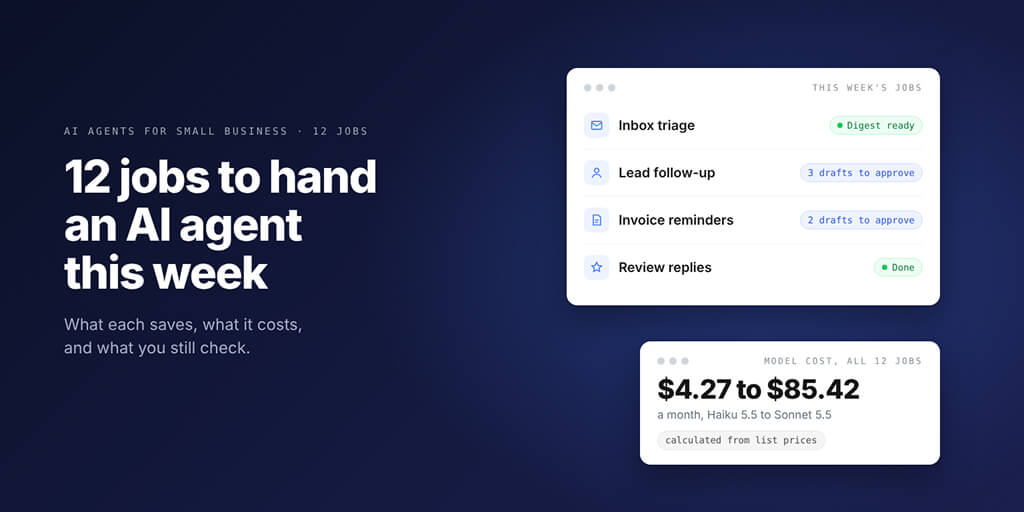
| Model cost, all 12 jobs | About $4.27 to $85.42 a month (calculated, see below) |
| Time saved | Estimated per job from stated assumptions, not measured |
| Never automate first | Anything that moves money or rejects a person |
Picture this: it's 9:40 on a Monday. You have 83 unread emails, two invoices three weeks overdue and a one-star review that has sat unanswered since Friday.
Which of these do I ignore today?
Wrong question. Ask which of them you can stop doing by hand.
You're not late, either. The US Census Bureau's Business Trends and Outlook Survey put AI use at 19.8% of US businesses in the period ending 3 May 2026, and fewer than 20% of firms with four or fewer employees said they used it. Among firms with fewer than 20 employees, use didn't change significantly between December 2025 and May 2026.
What AI agents for small business actually do (and what they don't)
A chatbot answers when you ask. An agent does a job on a trigger: a new email arrives, a payment fails, it's Monday at 8.
It reads from your apps, follows your written rules, and drafts or acts. What it does badly is judgement with no rules behind it, like pricing a custom quote or settling a refund dispute: keep those.
The best first job for an agent isn't the one you hate most. It's the one you could explain to a new hire in five minutes.
How we got the numbers. Every time-saved figure is our estimate from stated assumptions for a business with a few people, so swap in your own volumes. Every cost is calculated from Anthropic's API prices on 12 November 2026: Haiku 5.5 at $0.10 per million input tokens and $0.50 per million output, Sonnet 5.5 at $2 and $10.
Tokens per run cover instructions, the item and tool calls across all steps, before caching or batch discounts, over 22 working days a month. Other providers can be cheaper still, and our roundup of the cheapest AI models for agents compares them.
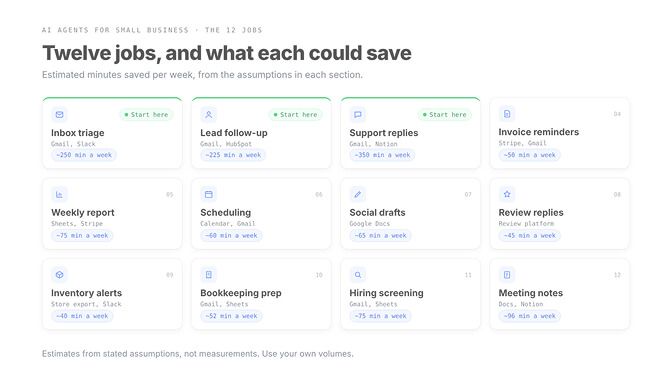
The 12 jobs, in the order we'd hand them over
The first three run all day and save the most time. The rest are smaller wins.
1. Inbox triage
The agent labels each new email (customer, supplier, invoice, noise), archives the noise and sends you one digest, with drafts for the easy replies.
- Connects to: Gmail, plus Slack for the digest.
- You still check: the digest, and every draft before it goes out.
- Time saved (estimate): 80 emails a day x 45 seconds to open, decide and file is 60 minutes a day. Reading a sorted digest takes about 10. That's 50 minutes a day, about 250 minutes a week.
- Model cost (calculated): 1,760 runs a month at 6,000 tokens in and 400 out comes to about $1.41 a month on Haiku 5.5 and $28.16 on Sonnet 5.5.
2. Lead capture and follow-up
When a lead arrives, the agent logs it, checks it against your ideal customer notes, drafts a first reply and two follow-ups for leads that go quiet.
- Connects to: Gmail, HubSpot or Google Sheets as the lead list.
- You still check: the first reply to every lead, and any lead marked high value.
- Time saved (estimate): 10 leads a day x 6 minutes to look up, log and reply is 60 minutes a day. Approving drafts takes about 1.5 minutes each, so 15. About 225 minutes a week saved.
- Model cost (calculated): 220 leads x 4 runs is 880 runs a month at 12,000 tokens in and 800 out: about $1.41 on Haiku 5.5, $28.16 on Sonnet 5.5.
3. Customer support replies
The agent reads each ticket, finds the answer in your help notes and drafts a reply in your tone. Anything about refunds, legal threats or angry repeat customers goes straight to you, undrafted.
- Connects to: Gmail (or your helpdesk), Notion or Google Docs for your help notes.
- You still check: every reply until drafts stop needing edits, then a daily sample.
- Time saved (estimate): 20 tickets a day x 5 minutes is 100 minutes a day. Editing and approving takes about 1.5 minutes each, so 30. About 350 minutes a week saved.
- Model cost (calculated): 440 runs at 15,000 tokens in and 600 out: about $0.79 a month on Haiku 5.5, $15.84 on Sonnet 5.5.
4. Invoicing and payment reminders
Each morning the agent checks which invoices are overdue and which payments failed, then drafts a polite first reminder and a firmer second one.
- Connects to: Stripe and Gmail.
- You still check: every reminder, and any customer you know is struggling.
- Time saved (estimate): 20 reminders a month x 6 minutes, plus 30 minutes a week matching payments, is about 60 minutes a week. Approving takes about 10. About 50 minutes a week saved.
- Model cost (calculated): 62 runs a month (daily check plus two rounds of reminders) at 8,000 tokens in and 500 out: about $0.07 on Haiku 5.5, $1.30 on Sonnet 5.5.
5. Weekly reporting
Every Monday the agent pulls last week's revenue, new customers and traffic into one sheet and writes five lines on what moved.
- Connects to: Google Sheets, Stripe, Google Search Console, Slack to post it.
- You still check: the numbers against the source for the first few weeks.
- Time saved (estimate): 90 minutes a week pulling numbers by hand, 15 to read and check the report. About 75 minutes a week saved.
- Model cost (calculated): 4 runs at 60,000 tokens in and 2,000 out: about $0.03 a month on Haiku 5.5, $0.56 on Sonnet 5.5.
Selling online? Our guide to AI agents for ecommerce stores covers order, ad and store support reports too.
6. Scheduling
The agent reads a meeting request, checks your Google Calendar and replies with two or three open slots, then adds the event once someone picks one.
- Connects to: Google Calendar and Gmail.
- You still check: anything outside your normal hours, and anything with a new client.
- Time saved (estimate): 15 requests a week x 5 minutes of back and forth is 75 minutes. Glancing at each takes about 1. About 60 minutes a week saved.
- Model cost (calculated): 60 runs at 9,000 tokens in and 500 out: about $0.07 a month on Haiku 5.5, $1.38 on Sonnet 5.5.
7. Social posting drafts
You drop a one-line idea in a doc and the agent turns it into three drafts in your voice.
- Connects to: Google Docs for drafts and your social scheduler for posting.
- You still check: every post. Your name is on it.
- Time saved (estimate): 5 posts a week x 20 minutes is 100 minutes. Editing a draft takes about 7. About 65 minutes a week saved.
- Model cost (calculated): 20 runs at 10,000 tokens in and 1,200 out: about $0.03 a month on Haiku 5.5, $0.64 on Sonnet 5.5.
8. Review replies
The agent drafts a short, specific reply to each new review, and flags anything under three stars for you before drafting.
- Connects to: your review platform, plus Slack or Telegram for approvals.
- You still check: every low-star reply, and anything that mentions a person by name.
- Time saved (estimate): 15 reviews a week x 4 minutes is 60 minutes. Approving takes about 1 each. About 45 minutes a week saved.
- Model cost (calculated): 60 runs at 4,000 tokens in and 300 out: about $0.03 a month on Haiku 5.5, $0.66 on Sonnet 5.5.
9. Inventory alerts
Each morning the agent reads your stock export, compares it to reorder levels and recent sales, and posts a short list of what to reorder.
- Connects to: your store platform or a stock export in Google Sheets, plus Slack.
- You still check: the reorder list. The agent never places orders.
- Time saved (estimate): 10 minutes a day scanning a stock sheet is 50 minutes a week. Reading the alert takes about 2 a day. About 40 minutes a week saved.
- Model cost (calculated): 22 runs at 40,000 tokens in and 800 out: about $0.10 a month on Haiku 5.5, $1.94 on Sonnet 5.5.
10. Bookkeeping prep
The agent finds receipts in your inbox, pulls the date, supplier, amount and tax, and logs each in a sheet for your accountant.
- Connects to: Gmail and Google Sheets, then your accounting software by export.
- You still check: a month-end pass over the sheet. Your accountant still does the books.
- Time saved (estimate): 120 receipts a month x 2 minutes is 240 minutes. A 30-minute month-end check replaces it. About 52 minutes a week saved.
- Model cost (calculated): 120 runs at 6,000 tokens in and 300 out: about $0.09 a month on Haiku 5.5, $1.80 on Sonnet 5.5.
Our Gmail invoice tracker tutorial walks through this exact job step by step.
11. Hiring screening
For one open role, the agent reads each application against your must-haves and writes a three-line summary with the evidence for each point.
- Connects to: Gmail, Google Sheets for the applicant list, Google Calendar for callbacks.
- You still check: every decision. The agent summarises, a person decides, and local employment rules still apply.
- Time saved (estimate): 100 applications a month x 4 minutes is 400 minutes. Reading summaries takes about 1 minute each. About 75 minutes a week saved.
- Model cost (calculated): 100 runs at 12,000 tokens in and 600 out: about $0.15 a month on Haiku 5.5, $3.00 on Sonnet 5.5.
12. Meeting notes and follow-ups
After each call the agent turns the transcript into decisions, owners and dates, and drafts the follow-up email.
- Connects to: your meeting recorder for the transcript, Google Docs or Notion for notes, Gmail for the follow-up.
- You still check: the follow-up email, and anything with a price or a promise in it.
- Time saved (estimate): 8 meetings a week x 15 minutes of notes and follow-ups is 120 minutes. Checking takes about 3 each. About 96 minutes a week saved.
- Model cost (calculated): 32 runs at 25,000 tokens in and 1,200 out: about $0.10 a month on Haiku 5.5, $1.98 on Sonnet 5.5.
What AI agents for small business cost to run
All twelve side by side, same assumptions, calculated from Anthropic's list prices on 12 November 2026.
| Job | Runs a month | Tokens in per run | Tokens out per run | Haiku 5.5 a month | Sonnet 5.5 a month |
|---|---|---|---|---|---|
| Inbox triage | 1,760 | 6,000 | 400 | $1.41 | $28.16 |
| Lead follow-up | 880 | 12,000 | 800 | $1.41 | $28.16 |
| Support replies | 440 | 15,000 | 600 | $0.79 | $15.84 |
| Invoice reminders | 62 | 8,000 | 500 | $0.07 | $1.30 |
| Weekly report | 4 | 60,000 | 2,000 | $0.03 | $0.56 |
| Scheduling | 60 | 9,000 | 500 | $0.07 | $1.38 |
| Social drafts | 20 | 10,000 | 1,200 | $0.03 | $0.64 |
| Review replies | 60 | 4,000 | 300 | $0.03 | $0.66 |
| Inventory alerts | 22 | 40,000 | 800 | $0.10 | $1.94 |
| Bookkeeping prep | 120 | 6,000 | 300 | $0.09 | $1.80 |
| Hiring screening | 100 | 12,000 | 600 | $0.15 | $3.00 |
| Meeting notes | 32 | 25,000 | 1,200 | $0.10 | $1.98 |
| All 12 | 3,580 | $4.27 | $85.42 |
Read the last row twice. All twelve jobs cost about $4.27 a month in tokens on Haiku 5.5, and about $85.42 on Sonnet 5.5.
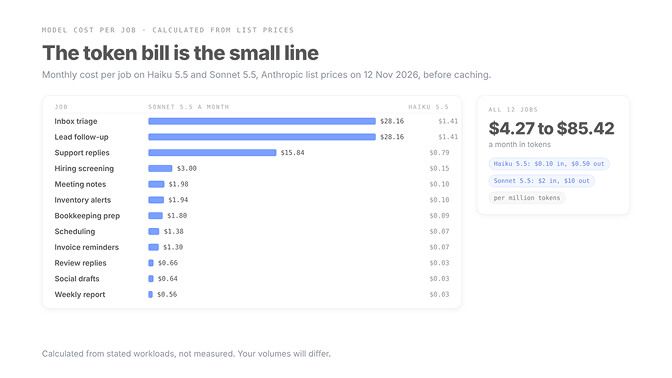
The model bill is the smallest number on this page. The real cost is the time you spend checking drafts, so pick jobs where checking is fast.
Our default: the cheap model for sorting and short drafts, the stronger one only where a bad draft costs you a customer.
Two caveats. Real token use depends on how long your emails and documents are, so measure a week of real runs. And the platform you run the agent on costs extra.
On BetterClaw, that platform side starts at $19 a month, Pro is $49 a month ($39 billed yearly), and your first workspace gets a 7-day free trial on any plan. Your model provider bills the tokens directly, and we add zero markup. See BetterClaw plans
Running these jobs on BetterClaw (one option among several)
You can build any of these yourself with code or a fixed workflow tool. An agent platform fits better when the job needs reading and judgement between steps. That's what we built BetterClaw for.
- Connectors: 500+ apps, including the ones named above (Gmail, Google Calendar, Google Sheets, Google Docs, Notion, Slack, HubSpot, Stripe). Any remote MCP server can be added by URL.
- Models: bring your own key across 28+ providers with zero markup, so Anthropic or whichever provider you pick bills you at its own rates.
- Chat channels: Telegram on Pro and above, and Slack. WhatsApp is not live yet.
- Security: ISO 27001 certified. Our SOC 2 Type II audit is in progress, not finished.
- Teams: Projects and Clients, if you run agents for several clients or brands.
The honest gaps: no WhatsApp yet, and if your review platform, store or accounting tool isn't in the catalog and has no MCP server, the agent works from exports.
How to start with one job this week
Don't set up twelve agents. Set up one, in draft-only mode, and let it earn the next.
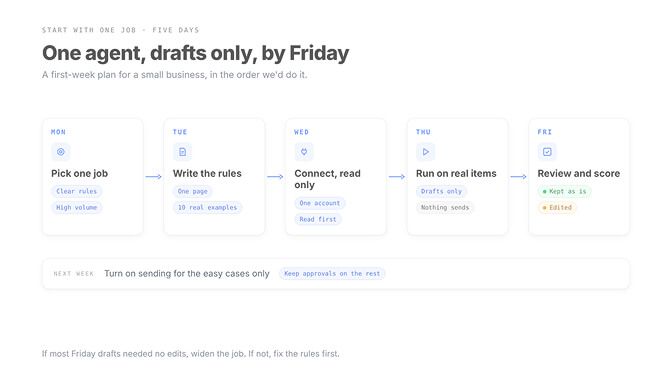
- Monday: pick one job with high volume and clear rules. Inbox triage and support drafts are the usual winners.
- Tuesday: write the rules on one page, the way you'd brief a new hire, and paste in 10 real examples of good replies.
- Wednesday: connect one account with the least access the job needs. Start read-only where the app allows it.
- Thursday: run the agent on real items in draft-only mode. Nothing sends without you.
- Friday: go through every draft and mark it kept, edited or wrong. Fix the rules where it went wrong.
Here's the thing. Friday's tally is your real time-saved number, not ours.
If most drafts needed no edits, let the agent send the easy cases next week and keep approvals on the rest. If half needed rewriting, the rules are the problem, not the model.
And if the job turns out to need no judgement at all, you may not need an agent. A fixed workflow is simpler to audit, and our list of n8n workflow ideas shows what that looks like.
Risks and guardrails before you hand anything over
Three guardrails cover most of the risk: approvals, permissions and data. Set all three before the agent touches a customer.
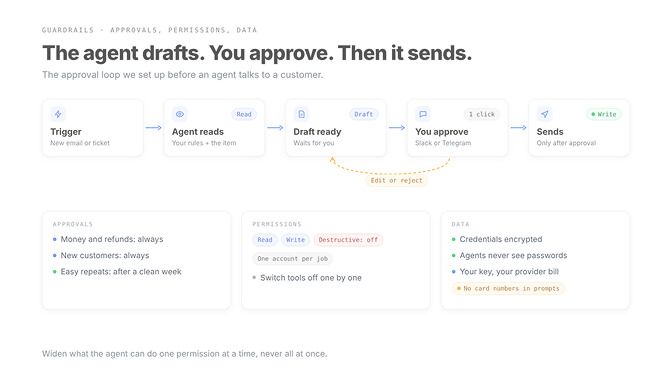
Approvals. Anything that moves money, makes a promise, or turns a person down needs a human click, forever, not just in week one.
Permissions. Give each job the least access it needs. On BetterClaw, tools from official MCP servers are labelled Read, Write or Destructive and you can switch any of them off, and you choose which agents can use which connected accounts.
Data. Your agent sends what it reads to the model provider you chose, so check that provider's data terms and keep card numbers, passwords and health details out of the job. On BetterClaw, credentials are stored encrypted and agents never see them.
Also set a monthly spend limit with your model provider where it offers one, and read a sample of the agent's work every week.
An agent that saves you five hours and costs you one customer is a bad trade. Approvals are how you keep the five hours and the customer.
The job you hate most can wait
Everyone wants to start with the job that ruins their Monday. Usually that's the messy one, full of exceptions only you understand.
Start with the boring one instead: clear rules, a hundred repeats a week, and a wrong draft costs you a minute, not a client.
Give it a week in draft-only mode. If Friday's drafts mostly go out untouched, you've got your first hire. By our numbers, its token bill stays under $30 a month even on Sonnet 5.5.
Frequently Asked Questions
What are AI agents for small business?
They're AI programs that do a recurring job on a trigger, such as sorting new emails or chasing overdue invoices. An agent reads from your apps, follows your written rules, and drafts or acts, with you approving anything important.
How much does it cost to run an AI agent for a small business?
The model bill is often small. By our calculation from Anthropic's list prices on 12 November 2026, the twelve jobs in this post cost about $4.27 a month in tokens on Haiku 5.5 and about $85.42 on Sonnet 5.5, before caching. The platform you run the agent on is a separate cost.
Which job should a small business automate first?
Pick a job with high volume, clear rules and cheap mistakes, such as inbox triage or support reply drafts. Run it in draft-only mode for a week and count how many drafts went out without edits. Leave money, refunds and hiring decisions on human approval.
Are AI agents safe to connect to my email and payments?
They can be, with guardrails. Give each job the least access it needs, keep approvals on anything that moves money or makes a promise, and check what data your model provider receives. On BetterClaw, credentials are stored encrypted, agents never see them, and you can switch off write or destructive tools.
How many small businesses use AI?
The US Census Bureau's Business Trends and Outlook Survey found 19.8% of US businesses used AI in the period ending 3 May 2026. Fewer than 20% of firms with four or fewer employees reported using it, and use among firms with fewer than 20 employees didn't change significantly from December 2025 to May 2026.
Can an AI agent reply to my customers on WhatsApp?
Not on BetterClaw today: WhatsApp is not live yet. You can talk to your agent through Telegram on Pro and above, or Slack, and email replies go through the Gmail connector.