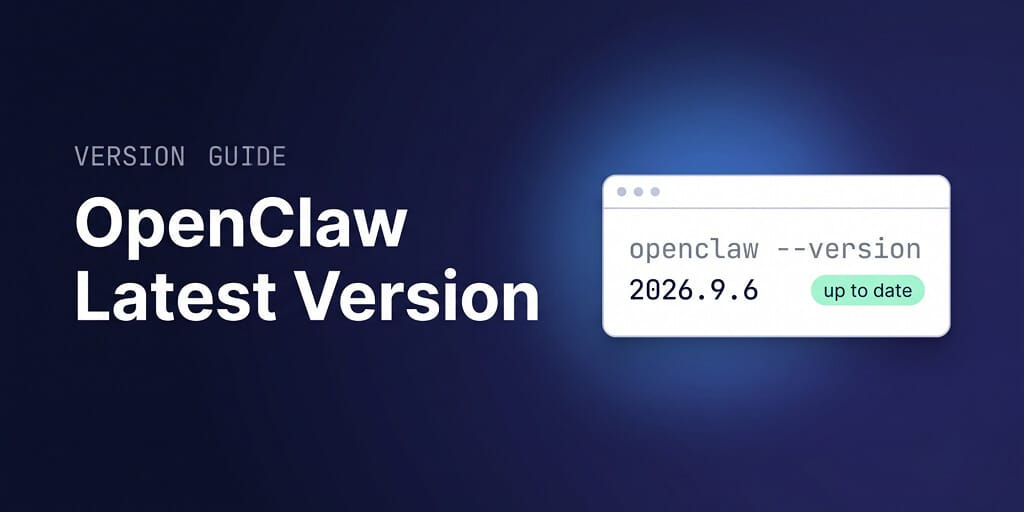
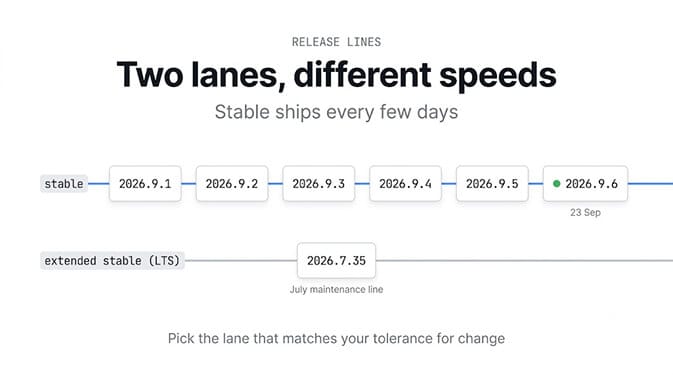
Current stable release: 2026.9.6, published 23 September 2026. Extended stable (the LTS line): 2026.7.35. Here's what's in the latest version, how to check what you're running, and how to update without breaking a working setup.
What is the latest version of OpenClaw?
2026.9.6, published on 23 September 2026 and marked Latest on the project's release page.
One thing to know if you're on macOS: the original 2026.9.6 macOS build crashed at launch, and it was replaced on 24 September at 09:52 UTC with a rebuilt, notarized build carrying the fix. If you installed the earlier build and the app won't open, install the DMG once more. The npm package was never affected.
| Channel | Version | Who it's for |
|---|---|---|
| Stable | 2026.9.6 | Most people |
| Extended stable (LTS) | 2026.7.35 | Servers and teams that value quiet over new |
| Beta | Published ahead of stable | Testing and early feedback |
Quick note on the LTS line, because the numbering confuses people: 2026.7.33 and 2026.7.34 were unstable and were never published as GitHub releases, so 2026.7.35 is the first proper release on the July maintenance line and carries their changelogs too. If you're on extended stable and skipped those, 2026.7.35 is where you should be.
How to check which version you're running
openclaw --version
If the Gateway is running but you want its full picture, including whether an update is waiting:
openclaw status --all
openclaw update status --json
Compare the result with 2026.9.6 above. Don't trust a version number you remember installing, because automatic updates may have moved you.
What's new in 2026.9.6
Straight from the project's release notes, this release focuses on managed updates, recovery and reporting rather than headline features:
- Clearer outcomes when a managed update runs, so you know whether it succeeded, failed or was deliberately skipped.
- Recovery for unfinished work after a restart, so queued and in-flight work isn't silently lost.
- Complete 30-day usage reporting across the full session report.
- A GitHub reader that puts public discussions and diffs beside your chat.
- Remote workspaces gain Files, Memory and Skills.
- Meeting notes that update while capture is still running.
- New chat-model support for Claude Opus 5.5, GPT-6 Sol and Luna, and Grok 4.7.
Two practical fixes worth calling out. The Windows installer can now continue after a failed Node package-manager attempt, falling back to downloading an official portable runtime into your user account with no administrator access required. And production npm installs are about 18 MiB smaller, with no configuration change needed.
Release scale: 2,614 pull requests, 178 direct commits, around 350 contributors.
How to update OpenClaw
openclaw update
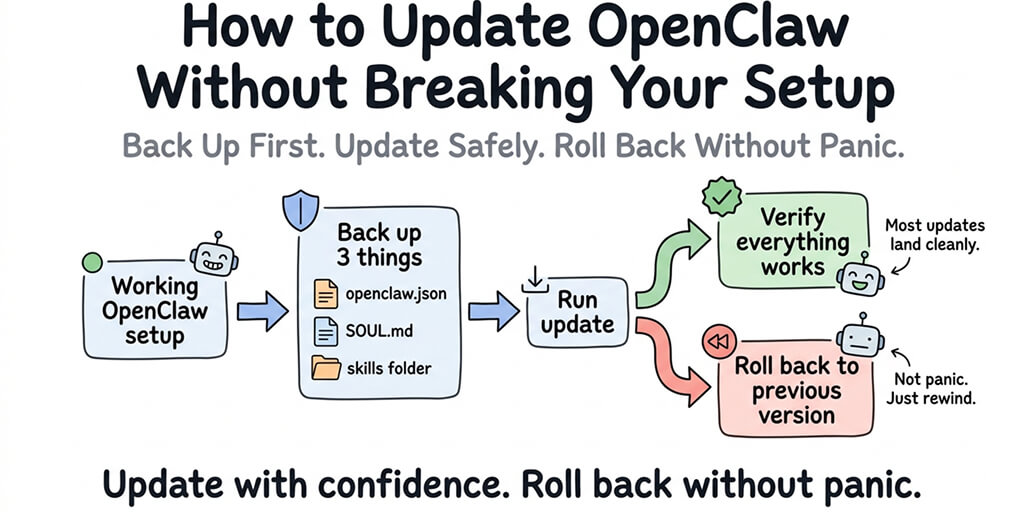
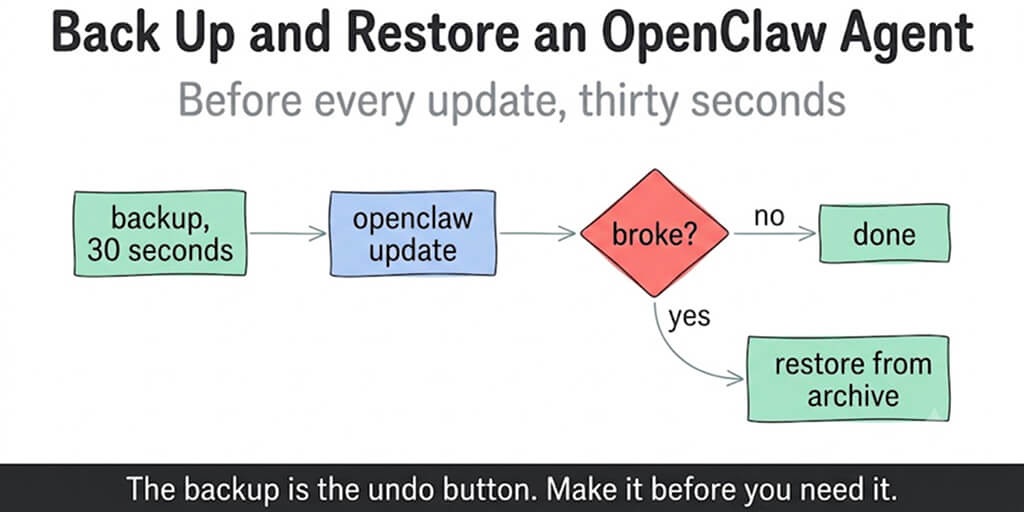
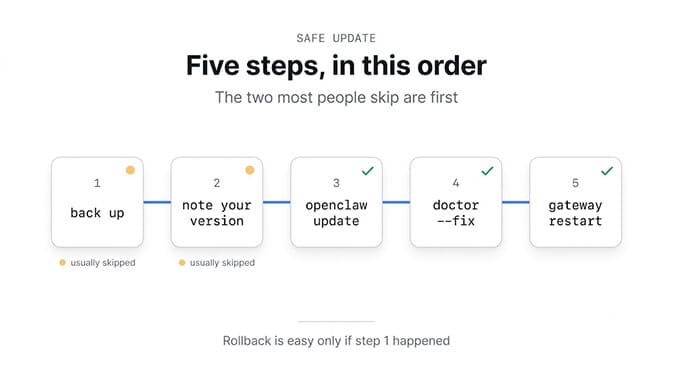
Before you run it, do three things. Take a backup, because an update that goes wrong at 2am is much easier to undo with one. Note the version you're on now, so you know what to roll back to. And read the release notes for the versions you're skipping, since defaults sometimes change between releases.
That last point matters more than it sounds. The 2026.9.2 release turned on Swarm sub-agents by default and opened cross-agent session visibility by default, which changes what your agents can see and do without you editing a single config line. We wrote that release up in the 2026.9.2 breakdown, and the full procedure, including rollback, is in how to update OpenClaw.
After updating:
openclaw doctor --fix
openclaw gateway restart
Doctor migrates configuration that moved between versions and repairs common breakage. Run it before you start debugging anything by hand.
An update that prints "success" has only proven that the package installed. Whether your config still validates and the Gateway came back are separate questions, and openclaw doctor --fix answers both.
Which release channel should you be on?
Stable is right for most people. You get fixes quickly and the cadence is fast enough that bugs rarely live long.
Extended stable is for anyone running OpenClaw as infrastructure: a server, a team Gateway, anything where an unexpected behaviour change costs more than a missing feature. It's a maintenance line that receives security and reliability backports rather than new features. The trade is that you're deliberately months behind on capability.
Beta exists if you want to help catch problems before they reach stable. Don't run it on the Gateway your business depends on.
The honest framing: the project ships fast, and that's a feature and a cost at the same time. In September alone there were six stable releases. If reading a changelog every few days isn't something you have time for, extended stable is the channel that respects that.
OpenClaw 2.0, and where it sits
People search for "OpenClaw 2.0" expecting it to be the latest version. It isn't, quite.
OpenClaw 2.0 is the marketing name for v2026.8.1, released at the end of August 2026 and listed in the docs as "v2026.8.1 (AKA OpenClaw 2.0)". It was the big one: a rebuilt web experience, much simpler onboarding that detects existing AI subscriptions and local models, stronger memory and session continuity, shared sessions, and automatic skill learning through Skill Workshop. It pulled in work from 933 developers across more than 16,000 pull requests.
Everything since, the 8.2 and 9.x releases, builds on that. So 2.0 is the current generation, and 2026.9.6 is the current version of it.
If the update breaks something
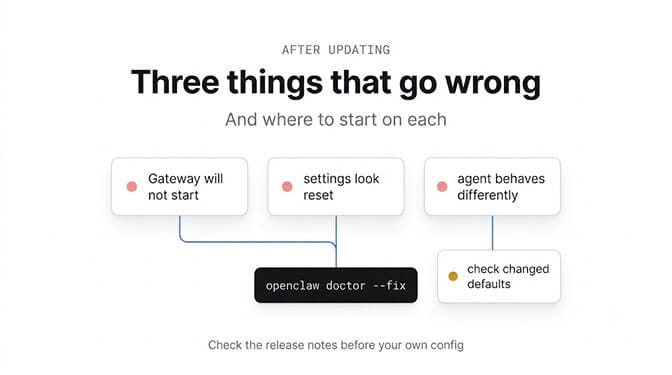
The most common outcomes, in rough order of frequency:
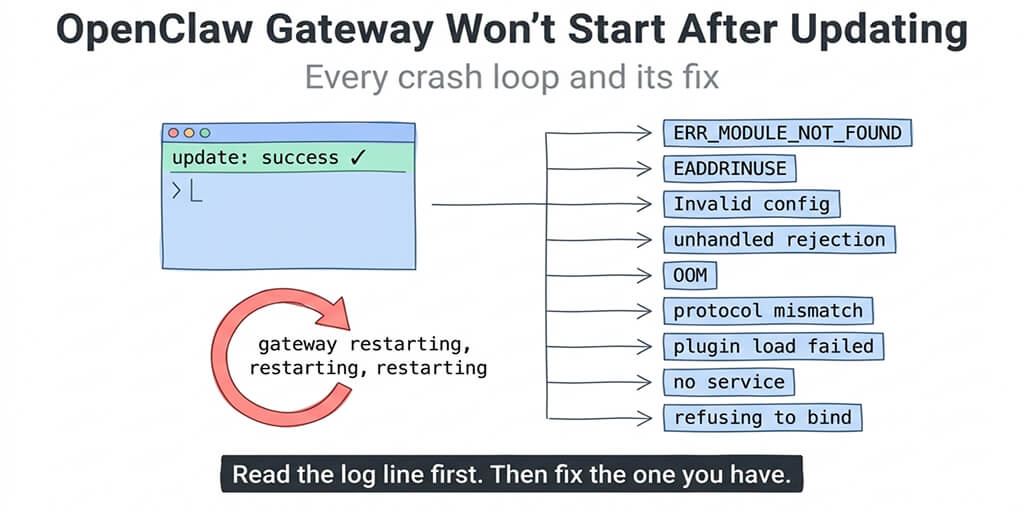
The Gateway won't start. Run openclaw doctor --fix, then openclaw gateway restart. If it still won't come up, the cause is usually an incomplete install, a config key that moved, or a supervisor entry pointing at the old install.
Settings or skills look reset. Newer releases preserve these through automatic updates, so if something is missing, check that the update actually completed with openclaw update status --json rather than assuming it wiped your setup.
An agent behaves differently. Check the release notes for changed defaults before you go looking for a bug in your own config. Swarm and session visibility are the two recent examples.
Our OpenClaw security checklist is worth a pass after any update that changes defaults, and if you want to understand what the Gateway is actually doing underneath all this, how OpenClaw works covers the architecture.
Do you need to update every time?
No, and chasing every release is a reasonable thing to opt out of. Update promptly for security fixes, update deliberately for features, and consider extended stable if the answer to "did anything change in this release?" is a question you don't want to ask every few days.
That cadence is exactly why managed hosting exists as a category. On BetterClaw, updates are staged and applied for you, so there's no changelog to read and no 2am Gateway that won't start. Plans start at $19 a month with your own model keys. Get started or see the full pricing.
Frequently Asked Questions
What is the latest version of OpenClaw?
OpenClaw 2026.9.6, published on 23 September 2026, is the current stable release. The extended stable (LTS) line sits at 2026.7.35. On macOS, make sure you have the rebuilt 2026.9.6 build from 24 September, since the original build crashed at launch. Check your own version with openclaw --version.
How do I update OpenClaw to the latest version?
Run openclaw update, then openclaw doctor --fix and openclaw gateway restart. Before updating, take a backup and note your current version so a rollback is straightforward. Read the notes for any releases you're skipping, because defaults occasionally change between versions.
Is OpenClaw 2.0 the same as the latest version?
Not exactly. OpenClaw 2.0 is the name for v2026.8.1, released at the end of August 2026, which brought the rebuilt web experience, simpler onboarding and stronger memory. Every release since, including 2026.9.6, builds on it. So you're on the 2.0 generation, and 2026.9.6 is its current version.
How often does OpenClaw release updates?
Every few days on the stable channel. September 2026 alone saw six stable releases, from 2026.9.1 through 2026.9.6, and individual releases routinely carry over a thousand pull requests. The extended stable line moves far more slowly and only receives security and reliability backports.
Should I use stable or extended stable?
Use stable if OpenClaw is a personal tool and you want fixes quickly. Use extended stable if it's infrastructure, since a maintenance line that changes rarely is worth more than new features when other people depend on the Gateway. Extended stable is currently 2026.7.35, which is the first published release on the July line after two unstable builds that were never released.