MiMo v2.6 Pro vs GLM 5.3 on price, coding, tool calling and self-hosting, with a clear pick for each job.
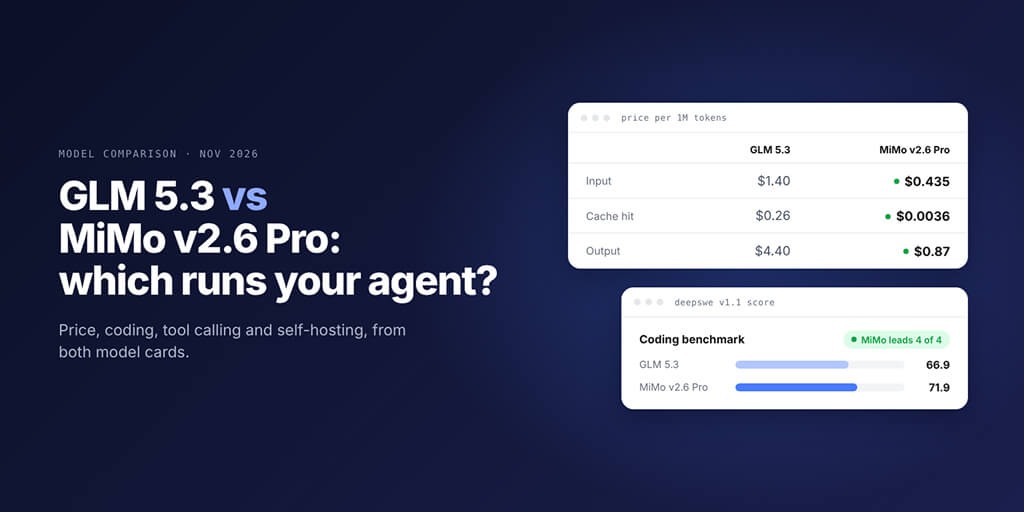
GLM 5.3 vs MiMo v2.6 Pro: for most agents, pick MiMo v2.6 Pro. It costs $0.435 input and $0.87 output per million tokens (GLM 5.3: $1.40 and $4.40) and wins every coding and tool-calling benchmark both model cards share. The MiMo v2.6 Pro vs GLM 5.3 answer flips for self-hosting, where GLM has wider engine support.
Picture this. It's 2 AM, your coding agent is mid-refactor, and you've just changed one line in its config: the model ID, now glm-5.3. Every request comes back as an error.
The culprit is a leftover flag. Your framework still sends thinking.type: "disabled", GLM 5.3 always reasons, and Z.ai's API rejects the call. So much for the drop-in upgrade.
That's the gap between a model card and an agent that runs all night. So we read both makers' cards, docs and pricing pages (checked 3 November 2026).
Both are open-weight mixture-of-experts models: GLM 5.3 from Z.ai, MiMo v2.6 Pro from Xiaomi. New to the name? Start with what GLM is and how it differs from an LLM.
GLM 5.3 vs MiMo v2.6 Pro at a glance: twins on paper
| GLM 5.3 | MiMo v2.6 Pro | |
|---|---|---|
| Released | 18 August 2026 | 22 September 2026 |
| Parameters | 744B total, 40B active (MoE) | 1.02T total, 42B active (MoE) |
| Context window | 1M tokens | 1M tokens |
| Max output | 128K tokens | 128K tokens |
| Input types | Text only | Text, image, video, audio |
| Licence | GLM-5.3 License (permissive, custom) | MIT |
| Input, per 1M tokens | $1.40 | $0.435 |
| Output, per 1M tokens | $4.40 | $0.87 |
On paper they look like twins. Three rows break the tie.
First, input types. GLM 5.3 is text-only. MiMo v2.6 Pro reads images, video and audio, so a support agent needs no second model for screenshots.
Second, the licence. GLM 5.2 was MIT, but GLM 5.3 uses its own GLM-5.3 License, which still allows commercial use, modification and redistribution.
The extra condition only hits model-as-a-service companies with over $10 billion in yearly revenue, who need Z.ai's security review first. MiMo v2.6 Pro is plain MIT.
Third, reasoning. GLM 5.3 always thinks, at low, high or max effort, with max as the default. That's the flag from our 2 AM story, and it drives your output bill too.
GLM 5.3 vs MiMo v2.6 Pro pricing: where the bills split
Now the twins part ways. Direct API prices per million tokens, from Z.ai's and Xiaomi's overseas (USD) pricing pages:
| Price per 1M tokens | GLM 5.3 | MiMo v2.6 Pro |
|---|---|---|
| Input (cache miss) | $1.40 | $0.435 |
| Input (cache hit) | $0.26 | $0.0036 |
| Output | $4.40 | $0.87 |
| Batch API | Not listed | $0.2175 input, $0.435 output |
MiMo v2.6 Pro costs about a third of GLM 5.3's price on fresh input and a fifth on output. On cache hits it's $0.0036 against $0.26.
And agents live on cache hits. Every turn resends the system prompt, tool definitions and history, so most of your input bill is repeated tokens.
Benchmarks tell you which model is smarter. The cache-hit price tells you which one you can afford to leave running all night.
Worked example: one coding-agent task
We fix the token counts and change only the price: 2,000,000 input tokens across all turns (1,800,000 cache hits, 200,000 fresh) and 75,000 output tokens. The output figure is Z.ai's own Code Bench number for GLM 5.3 at max effort; Xiaomi publishes none.
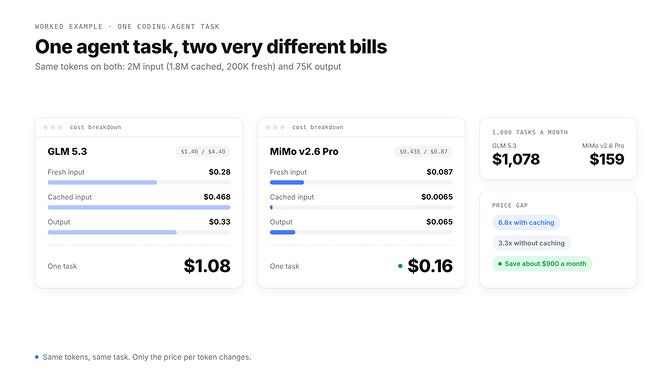
| Line item | GLM 5.3 | MiMo v2.6 Pro |
|---|---|---|
| 200,000 fresh input tokens | $0.28 | $0.087 |
| 1,800,000 cached input tokens | $0.468 | $0.0065 |
| 75,000 output tokens | $0.33 | $0.065 |
| One task | $1.08 | $0.16 |
| 1,000 tasks a month | $1,078 | $159 |
| One task with no cache hits | $3.13 | $0.94 |
That's about a 6.8x gap with caching and 3.3x without. Tokenizers and reasoning lengths differ, so log a week of your own traffic before you commit.
Our MiMo v2.6 Pro setup and cost guide walks through a full agent configuration.
Z.ai also sells the GLM Coding Plan, a points-based subscription where off-peak and weekend calls use 50% of the standard points.
Coding benchmarks: MiMo leads, but read the fine print
Four coding benchmarks appear on both model cards, and each card also scores GPT-5.6 Sol as a rough cross-check.
| Benchmark | GLM 5.3 | MiMo v2.6 Pro | GPT-5.6 Sol (GLM card / MiMo card) |
|---|---|---|---|
| Terminal Bench 2.1 | 88.2 | 89.9 | 88.8 / 88.8 |
| DeepSWE v1.1 | 66.9 | 71.9 | 72.7 / 73.0 |
| ProgramBench | 19.0 | 26.5 | 23.0 / 25.0 |
| Agents' Last Exam | 28.5 | 31.6 | 28.6 / 30.8 |
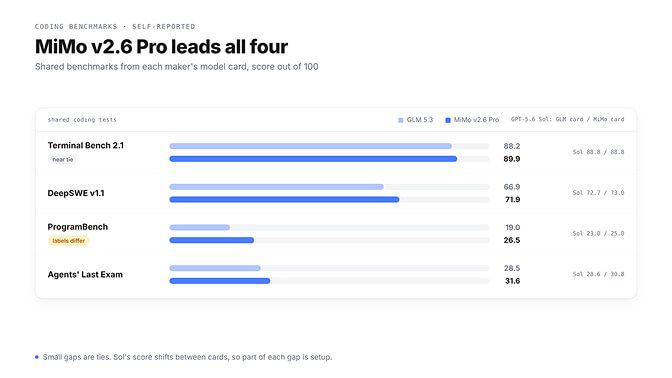
MiMo v2.6 Pro leads all four. Now the fine print.
Terminal Bench 2.1 is close to a tie. On DeepSWE, ProgramBench and Agents' Last Exam, Sol's own score moves between cards, so part of each gap is setup, not model.
Z.ai also labels its ProgramBench figure "Almost Solved" and Xiaomi doesn't, so handle that row with care.
Z.ai's in-house Code Bench is more useful for cost. GLM 5.3 scored 34.5% at max effort with roughly 75,000 output tokens per task, and 31.4% at high effort with roughly 50,000.
A third fewer output tokens for about three points less? For routine tasks, we'd take that trade.
GLM 5.3 tool calling vs MiMo: where agents really break
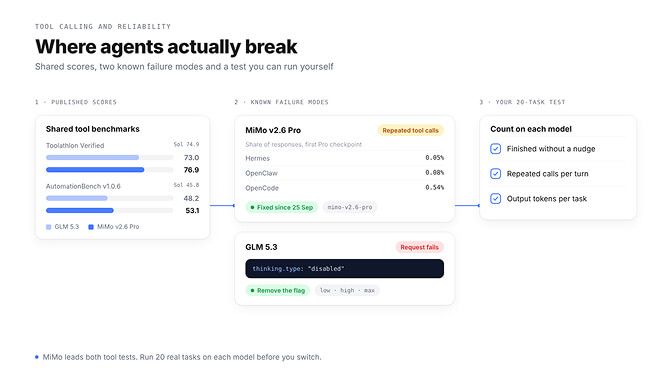
Both APIs support function calling, streaming and structured output. On the two shared tool-use benchmarks, GPT-5.6 Sol scores the same on both cards, so this is the cleanest comparison here.
| Benchmark | GLM 5.3 | MiMo v2.6 Pro | GPT-5.6 Sol (both cards) |
|---|---|---|---|
| Toolathlon Verified | 73.0 | 76.9 | 74.9 |
| AutomationBench v1.0.6 | 48.2 | 53.1 | 45.8 |
MiMo v2.6 Pro leads both. Now the part benchmarks miss. After launch, MiMo v2.6 sometimes repeated the same tool call, burning context while looking busy.
Xiaomi was open about it, measuring repeats in 0.05% (Hermes) to 0.54% (OpenCode) of the first Pro checkpoint's responses, with 0.08% in OpenClaw. It has served the fixed model under the same mimo-v2.6-pro ID since 25 September.
Self-hosting? Download the MOPD checkpoint, not the RL one. For GLM 5.3 the risk is configuration: a "thinking disabled" flag gets an error, not a faster answer.
A model that fails loudly is annoying. A model that loops quietly is expensive. Test for both.
We didn't run our own tool-calling test for this post. Before you switch, run 20 real tasks on each model and count three things: tasks finished without a nudge, identical tool calls repeated in one turn, and output tokens per task.
That test goes faster when both models sit behind one agent. Switch between GLM, MiMo and other models across 28+ providers on your own keys, with zero markup. Start your agent in 60 seconds
Self-hosting GLM 5.3 is a data-centre job
Can you run it yourself? Yes, but bring a rack. GLM 5.3's FP8 weights total about 755.6 GB on Hugging Face, and the BF16 version about 1.5 TB.
SGLang's GLM 5.3 cookbook has recipes for NVIDIA H200, B200, B300 and GB300, AMD MI300X, MI325X and MI355X, and Ascend NPUs. Its default FP8 command runs on one 8-GPU node (--tp 8; the GB300 recipe uses --tp 4).
This is GLM's home turf: six documented serving options (SGLang, vLLM, TokenSpeed, Transformers, KTransformers, Unsloth). Xiaomi documents two for MiMo v2.6 Pro, SGLang and vLLM, though MiMo's MOPD weights are smaller at about 573.5 GB.
Two GLM defaults to change: reasoning_effort is max unless you pass low or high, and the chat template's clear_thinking is false, which Z.ai says to set to true for chat use.
Rather not babysit a rack? Both models are on their makers' APIs and OpenRouter, and GLM 5.3 also runs on Cloudflare Workers AI. Our OpenRouter vs direct API comparison covers that trade-off.
The Cloudflare SGLang KV-cache incident
On 26 October, Cloudflare disclosed that between 27 August and 9 September, 155 responses from its hosted GLM 5.3 on Workers AI contained data from other customers' requests. All were on prompts longer than 681,280 tokens.
A researcher reported it on 8 September, and Cloudflare patched and restored the model on 9 September. It says it found no evidence of deliberate exploitation.
The cause sat in the serving stack, not the model weights. Cloudflare advertised the full 1,048,576-token context, but its KV cache pool held only 681,280 tokens. An SGLang bug in disaggregated prefill/decode mode let over-length requests read stale cache pages instead of failing.
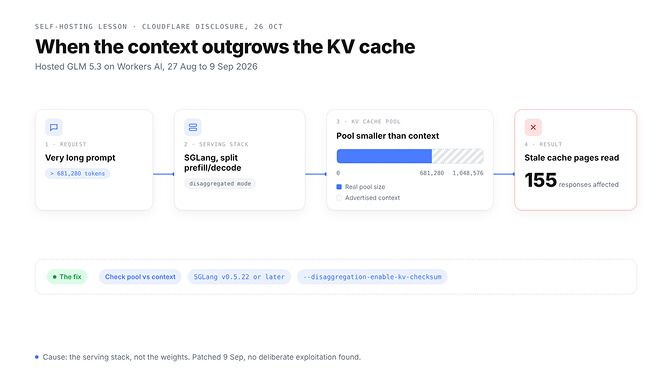
The lesson for self-hosters: after every config change, compare your KV pool size (it's in SGLang's startup log) with your context length, and run SGLang v0.5.22 or later. Cloudflare also points to --disaggregation-enable-kv-checksum, but says it does not yet cover every architecture, GLM 5.3 included, so the pool check is your real guard for now.
What Epoch AI found about GLM 5.3
On 29 October, Epoch AI published a test of whether GLM 5.3 could exploit the "patch gap": the window between a security fix being published and reaching users.
Given basic instructions and no further input, it built a webpage that read a local file from a Firefox visitor's computer and sent it to the attacker, for six releases from 156.0 to 158.0.1.
Each attempt had up to 48 hours, the fastest success took 12, and the marginal cost was about $1,000 in API fees per version. Each chain also used an unpublished sandbox bug, patched in Firefox 159.0 on 27 October, and the same setup had not succeeded against Chrome despite about $100,000 in API spend.
It's a capability story, not a GLM story. Z.ai's card shows GLM 5.3 more than doubling GLM 5.2 on exploitation benchmarks, and on CyberGym the two cards put GLM 5.3 at 84.5 (Z.ai's) and MiMo v2.6 Pro at 94.0 (Xiaomi's), each on its own setup.
Open models can now do long, multi-step technical work alone, which is also what makes them useful for agents. The practical response is ordinary hygiene for any model: least-privilege tools, sandboxed execution and human approval for risky actions.
Which to pick: our call for each agent job
Weighing closed models too? Our GLM 5.2 vs Sonnet 4.6 vs MiniMax M3 comparison runs the same cost exercise.
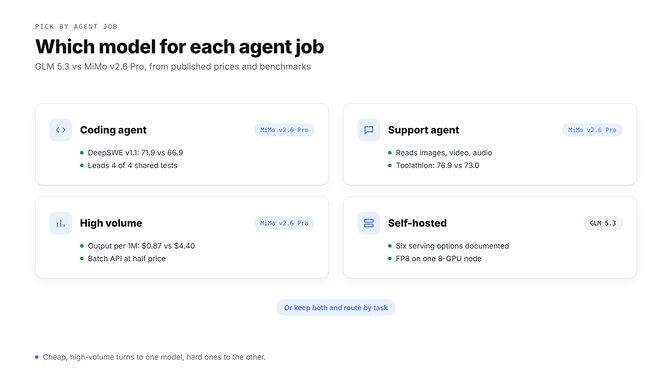
Coding agent: MiMo v2.6 Pro. It leads all four shared coding benchmarks and costs less per task. Choose GLM 5.3 if you already pay for the GLM Coding Plan.
Support agent: MiMo v2.6 Pro. It reads customer screenshots and voice notes natively, and it leads both tool-calling benchmarks.
High volume: MiMo v2.6 Pro. Output is $0.87 per million tokens, and half that on the Batch API for work that can wait. Our example saves about $900 a month per 1,000 tasks.
Self-hosted: GLM 5.3. More serving engines, SGLang recipes across NVIDIA, AMD and Ascend, and a licence that acts like MIT for almost everyone. Pick MiMo if MIT is a must or disk is tight.
Honestly? Most teams should keep both and route: cheap, high-volume turns to one model, hard ones to the other.
GLM 5.3 shipped on 18 August, and five weeks later a rival undercut it on price and edged it on every shared coding and tool-calling benchmark.
The model you pick today is a tenant, not a landlord. Build your agent so the next move takes minutes, and let the benchmarks fight it out.
Frequently Asked Questions
What is the difference between GLM 5.3 and MiMo v2.6 Pro?
Both are open-weight mixture-of-experts models with a 1M-token context. GLM 5.3 is Z.ai's text-only model; Xiaomi's MiMo v2.6 Pro also reads images, video and audio, costs less per token and is MIT-licensed.
Is GLM 5.3 better than MiMo v2.6 Pro for coding?
Not on published numbers. MiMo v2.6 Pro leads all four shared coding benchmarks, including DeepSWE v1.1 (71.9 vs 66.9) and Terminal Bench 2.1 (89.9 vs 88.2), a near tie. Scores are self-reported, so test both on your own repository.
Which is cheaper for agents, GLM 5.3 or MiMo v2.6 Pro?
MiMo v2.6 Pro, at $0.435 input and $0.87 output per million tokens against $1.40 and $4.40. In our worked example, one cached coding-agent task cost $0.16 on MiMo and $1.08 on GLM 5.3.
How do I switch my agent to GLM 5.3?
Change the model ID and remove any thinking.type: "disabled" setting, because GLM 5.3 always reasons and those requests fail. Set reasoning_effort to low or high if the default max is overkill, then test real tasks before moving production traffic.
Can I self-host GLM 5.3?
Yes. The FP8 weights (about 755.6 GB) run on one 8-GPU node with SGLang's default command. On disaggregated SGLang, run v0.5.22 or later and check KV pool size against context length.
Is GLM 5.3 open source?
It is open-weight under Z.ai's GLM-5.3 License, which allows commercial use, modification and redistribution. Only model-as-a-service companies with over $10 billion in yearly revenue must first pass Z.ai's security review.
What did Epoch AI find about GLM 5.3, and is it safe for agents?
Epoch AI's 29 October report found GLM 5.3 could autonomously turn published Firefox security fixes into working file-theft exploits for six releases, at about $1,000 in API fees per version. It's a capability finding that MiMo's cyber scores echo, so the safe setup is the same for both: least-privilege tools, sandboxing and human approval for risky actions.