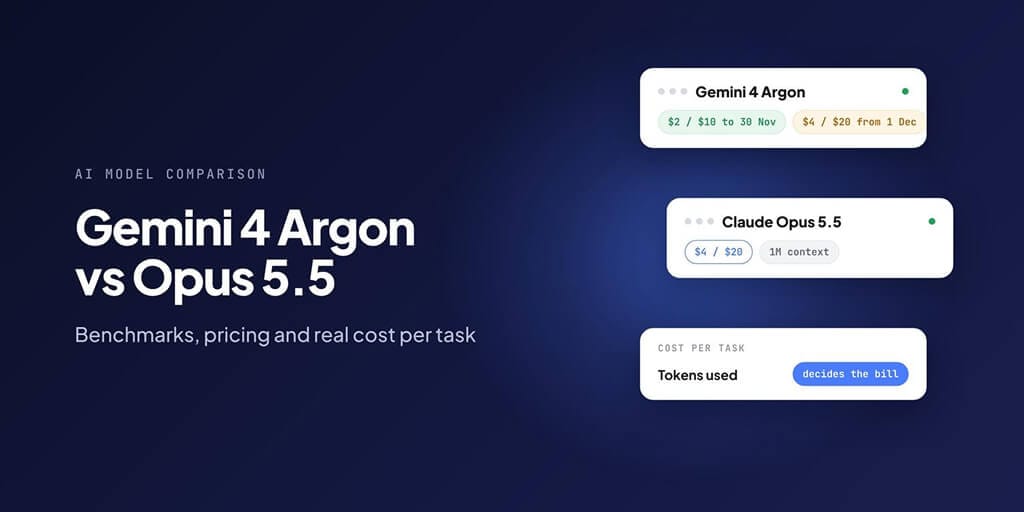
Argon is half the price of Opus until 30 November, then the same. Here's where each one wins, and what an agent run actually costs.
You moved your research agent to Gemini 4 Argon because the price sheet said half of Opus. A week later you open the bill, and it's barely moved.
That's not a billing bug. That's the most important thing to understand about Gemini 4 Argon vs Opus 5.5: price per token and cost per task are different numbers, and the gap between them decides which model is actually cheaper for your agent.
Here's the short version. Argon wins long-context and research-style agent work, hallucinates far less, and costs $2 / $10 per million tokens until 30 November 2026. Opus 5.5 wins terminal and DevOps work and scores higher overall. From 1 December, both cost $4 / $20 per million tokens, and the decision becomes about how many tokens each one burns to finish the job.
| If you want… | Pick |
|---|---|
| Long documents and research | Gemini 4 Argon |
| Coding and DevOps agents | Claude Opus 5.5 |
| Cheapest per token until 30 Nov | Gemini 4 Argon |
| Cheapest per token from 1 Dec | Tie ($4 / $20) |
| Fewest hallucinations | Gemini 4 Argon (15% vs 59% on AA-Omniscience) |
All prices, benchmarks and dates below were checked on 27 October 2026.
Gemini 4 Argon vs Opus 5.5 at a glance
Both are frontier models with a 1M-token window. They're built for different instincts.
| Gemini 4 Argon | Claude Opus 5.5 | |
|---|---|---|
| Released | Announced 30 Sep 2026 (to cyber defenders first); generally available 13 Oct | 22 Sep 2026 |
| Context window | 1,048,576 tokens, shared by input, thinking and output | 1M tokens |
| Max output per request | 65,536 by default; up to about 1M minus your input with long decode | 128K (300K on the Batch API, beta) |
| Price per 1M tokens | $2 / $10 until 30 Nov, then $4 / $20 | $4 / $20 |
| Long-context surcharge | None | None |
| Where you can use it | Gemini API (paid tier), Vertex AI, OpenRouter, Gemini app (AI Pro and Ultra) | Claude API, Bedrock, Vertex AI, OpenRouter, Claude apps |
One quiet win for both: neither charges extra for long prompts. A 900K-token request costs the same per token as a 9K one.
Pricing: the 30 November deadline
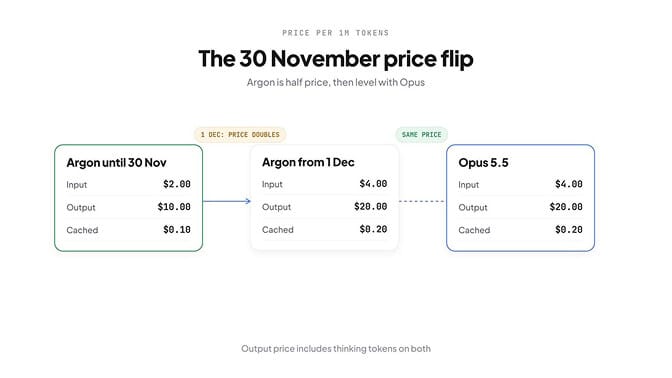
Here's the full price card, from Google's and Anthropic's own pricing pages.
| Per 1M tokens | Argon until 30 Nov | Argon from 1 Dec | Opus 5.5 |
|---|---|---|---|
| Input | $2.00 | $4.00 | $4.00 |
| Output (thinking included) | $10.00 | $20.00 | $20.00 |
| Cached input | $0.10 | $0.20 | $0.20 |
| Batch input / output | $1.00 / $5.00 | $2.00 / $10.00 | $2.00 / $10.00 |
Three details the launch coverage mostly skips:
- Thinking costs output prices on both. Google labels Argon's output "including thinking tokens"; Anthropic bills Opus's reasoning as output "even when the thinking text isn't returned to you."
- On Vertex AI, the promo is paid as 50% credits back on spend, and non-global endpoints cost 10% more.
- From 13 November, Vertex bills completions over 32K tokens even if your request times out. Long agent runs, set your timeouts accordingly.
Until 30 November, Argon is half price per token. After that, the sticker is identical, and the only thing that decides your bill is how chatty each model is.
Real cost per agent run (the table people want)
Start with the simple version. Take one typical agent run: 20,000 input tokens and 5,000 output tokens. Multiply by each model's price.
| Model | Price per 1M (in / out) | Cost per run | 100 runs a day for a month (3,000) |
|---|---|---|---|
| Gemini 4 Argon, until 30 Nov | $2 / $10 | $0.09 | $270 |
| Gemini 4 Argon, from 1 Dec | $4 / $20 | $0.18 | $540 |
| Claude Opus 5.5 | $4 / $20 | $0.18 | $540 |
| GPT-6.1 Sol | $2 / $10 | $0.09 | $270 |
| Meta Muse Wonder | $4 / $20 | $0.18 | $540 |
| DeepSeek V4.1 Flash (peak) | $0.30 / $1.20 | $0.012 | $36 |
The arithmetic: Argon at promo prices is 20,000 × $2/M plus 5,000 × $10/M, so $0.04 + $0.05 = $0.09. Every other row works the same way.
Here's the weird part. That table assumes every model uses the same number of tokens for the same job. They don't. Not even close.
Where the cheap model gets expensive
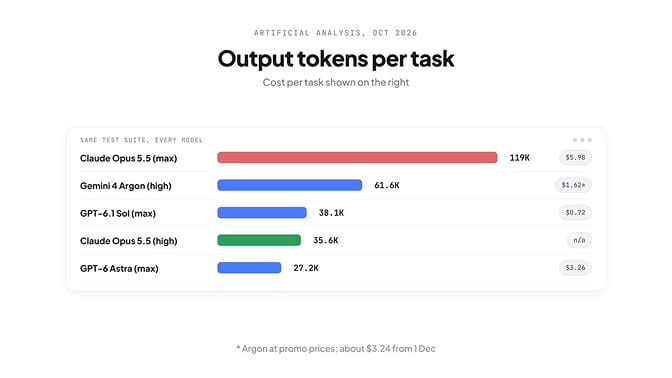
Artificial Analysis runs every model through the same agentic and reasoning test suite and records how many output tokens each one spends per task, and what that costs at list prices.
| Model (effort setting) | AA Intelligence Index | Output tokens per task | Cost per task |
|---|---|---|---|
| Gemini 4 Argon (high) | 52.6 | ~61.6K | $1.62 at promo prices |
| Claude Opus 5.5 (max) | 57.6 | ~119K | $5.98 |
| Claude Opus 5.5 (high) | 53.6 | ~35.6K | not published |
| GPT-6 Astra (max) | 52.7 | ~27.2K | $3.26 |
| GPT-6.1 Sol (max) | 51.8 | ~38.1K | $0.72 |
Read that table slowly, because it flips two things most comparisons assume.
First, Opus 5.5 at max effort is the hungriest model here, at about 119K output tokens per task, nearly twice Argon's. Anthropic says Opus 5.5 uses fewer tokens than Opus 5 did, and that's true. It still spends a lot when you let it think as long as it wants.
Second, the effort setting matters more than the model. Opus 5.5 at high effort used about 35.6K tokens, less than a third of its max-effort appetite, and still scored 53.6, above Argon's 52.6. If you run Opus in an agent, you're probably paying for max effort you don't need.
The break-even rule
Put the prices and the token appetite together and you get one rule you can use on your own agent:
- Until 30 November: Argon's tokens cost half of Opus's, so Argon is cheaper unless it needs more than twice as many tokens to finish the same task.
- From 1 December: the per-token price is identical, so the cheaper model is simply the one that uses fewer tokens on your work.
At promo prices, Argon's $1.62 per task in Artificial Analysis's suite becomes about $3.24 after the price doubles. That's level with GPT-6 Astra ($3.26) and still about half of Opus at max effort ($5.98).
One caveat we'd underline. Benchmark tasks aren't your tasks. Run 20 of your own agent jobs through each model, log the tokens, and divide. It takes an afternoon and it's the only number that matters.
Benchmarks that matter for agents
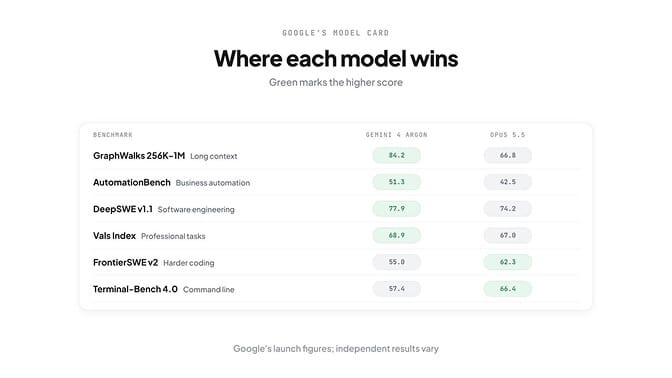
Google published a head-to-head table on Argon's model card. These are Google's own launch figures, so read them as Google's best foot forward.
| Benchmark (what it tests) | Gemini 4 Argon | Claude Opus 5.5 |
|---|---|---|
| Vals Index (broad professional tasks) | 68.9 | 67.0 |
| AutomationBench (business automation) | 51.3 | 42.5 |
| DeepSWE v1.1 (software engineering) | 77.9 | 74.2 |
| FrontierSWE v2 (harder software engineering) | 55.0 | 62.3 |
| Terminal-Bench 4.0 (command-line work) | 57.4 | 66.4 |
| GraphWalks 256K to 1M (long-context reasoning) | 84.2 | 66.8 |
The plain reading: Argon leads on long context and business automation; Opus leads on terminal work and harder coding. The GraphWalks gap is the biggest on the card, which is why Argon is the pick for agents that read whole contracts, codebases or research corpora.
Independent numbers tell a similar story with a twist. Artificial Analysis puts Opus 5.5 (max) at 58 on its Intelligence Index, ahead of Argon and GPT-6 Astra, which tie at 53.
And on its AA-Omniscience test, Argon hallucinated 15% of the time, against 51% for GPT-6 Astra and 59% for Opus 5.5 at max effort. For an agent that writes reports people trust, that's the most important number in this post.
One claim to treat carefully: Google's card shows Argon far ahead on Harvey's legal agent benchmark (19.6 vs 3.8). Artificial Analysis's own run of the same benchmark has the two nearly level (3.9% vs 4.2%). We'd want a third result before building a legal agent on it.
A hands-on test: where Argon tripped
Benchmarks are tidy. Real infrastructure isn't.
ComputingForGeeks ran a DevOps test on launch day: write Kubernetes manifests for an nginx service, deploy them, check they answer. Argon's manifests were clean. They passed every linter.
Then none of them ran. Across all four settings, Argon's 12 deployments went 0 for 12, because nginx needed writable cache folders the manifests never mounted. Opus 5.5 and GPT-6.1 Sol both deployed and answered HTTP 200 on all three of their runs.
But then something clicked. Shown the error, Argon fixed it every time.
The lesson isn't "Argon can't do DevOps." It's that "passes the linter" and "works" are different checks, and any agent that touches infrastructure needs the second one built in. Whichever model you pick, make the agent run the thing and read the result before it calls the job done.
Which one to use for which agent job
Here's how we'd assign them, job by job.
| Agent job | Our pick | Why |
|---|---|---|
| Long-document research and summaries | Gemini 4 Argon | Biggest long-context lead, lowest hallucination rate |
| Inbox and admin agents | Either | Light reasoning; Argon is cheaper until 30 Nov |
| Coding and DevOps agents | Claude Opus 5.5 | Leads Terminal-Bench and FrontierSWE; passed the hands-on deploy test |
| Legal and finance analysis | Argon, with checks | Strong on long documents; the legal benchmark results conflict |
| Cheap, high-volume tasks | Neither | Use DeepSeek V4.1 Flash or Claude Haiku 5.5 |
That last row matters more than the rest. For classifying emails or tagging support tickets, paying $4 / $20 per million tokens is like hiring a senior lawyer to sort the mail.
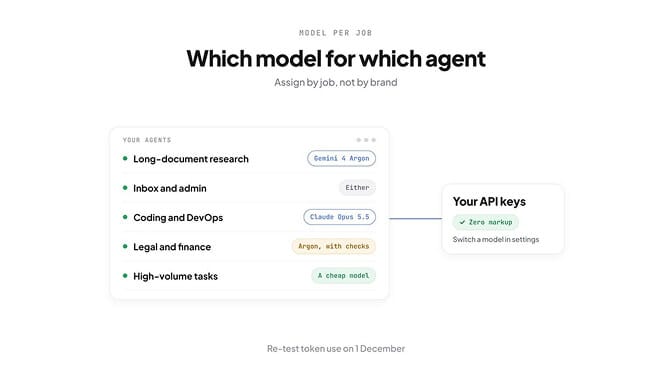
If you want to see what that per-job split looks like without wiring up three APIs yourself, that's what we built BetterClaw for. Each agent gets its own model, on your own key.
What about Meta Muse Wonder?
Meta's model landed in the middle of all this, on 12 October 2026, and it's priced like Opus: $4 / $20 per million tokens with a 1M context, on Meta's Model API and OpenRouter.
There's a catch in the naming. The stronger version, Muse Wonder Full, isn't on the API at all. It's only inside Muse Code subscriptions, at $50 and $200 a month.
Meta's own table puts Wonder Full at 56 and the API version at 52 on the Artificial Analysis index, against 58 for Opus 5.5. Independent testing is still thin. And don't confuse the two products: Muse Wonder is the model; Meta Muse is the personal agent app.
How to try Argon or Opus in an agent without rebuilding it
Getting Argon access takes one step most people miss: it isn't on the Gemini API free tier, and a Google AI Pro subscription only gets you Argon in the Gemini app, not on the API.
Your options:
- An API key from Google AI Studio on a paid, billed project.
- Vertex AI, on the global endpoint for the base price.
- OpenRouter, as
google/gemini-4-argonat the same $2 / $10 (output capped at 943,718 tokens there).
The smarter move is not to marry either model. Use Argon for research agents while the promo lasts, keep Opus on your coding agents, and re-run your own token test on 1 December. If your agent platform makes switching a model a rebuild, that's the real cost.
On BetterClaw, it isn't. You bring your own key from any of 28+ providers, pay the provider directly with zero markup, and change an agent's model in its settings.
The takeaway
The Argon launch is a preview of how model pricing works now. Promotional rates, effort settings, thinking tokens billed as output, and benchmark wins that depend on who ran the benchmark.
The per-token price is the least useful number on the page. The one that matters is what a finished task costs on your work, and the only way to know it is to measure. Put a calendar reminder on 1 December, run the same 20 jobs through both models, and let the token logs pick.
If any of this resonated, give BetterClaw a try. Starter is $19 a month for one agent, Pro is $49 a month for five, and every plan has a 7-day free trial. Bring any model, pay your provider directly. See full pricing.
Frequently Asked Questions
Is Gemini 4 Argon better than Claude Opus 5.5? It depends on the job. Argon leads on long-context reasoning, business automation and hallucination rate, and is half the per-token price until 30 November 2026. Opus 5.5 leads on terminal and harder coding benchmarks and scores higher on Artificial Analysis's overall index (58 vs 53).
How much does Gemini 4 Argon cost? $2 per million input tokens and $10 per million output tokens (thinking included) until 30 November 2026, then $4 and $20 from 1 December. Cached input is $0.10, then $0.20, and the Batch API is half price. There's no surcharge for long prompts.
When does the Gemini 4 Argon price increase? On 1 December 2026. From that date Argon costs $4 input and $20 output per million tokens, the same as Claude Opus 5.5, so the cheaper choice becomes whichever model uses fewer tokens on your tasks.
What is Gemini 4 Argon's context window? 1,048,576 tokens, shared by input, thinking and output. Output per request is 65,536 tokens by default, or up to about 1M minus your input with long decode and background execution.
Is Gemini 4 Argon free? No. It isn't available on the Gemini API free tier. Google AI Pro and Ultra subscribers can use it in the Gemini app, but API access needs a paid, billed project in AI Studio, Vertex AI or a router like OpenRouter.
Is Gemini 4 Argon good for coding? For many coding tasks, yes: it beats Opus 5.5 on DeepSWE v1.1 in Google's table. But Opus leads on Terminal-Bench 4.0 and FrontierSWE v2, and in a launch-day DevOps test Argon's Kubernetes deployments failed until it was shown the error. For coding and DevOps agents, we'd start with Opus 5.5 at high effort.