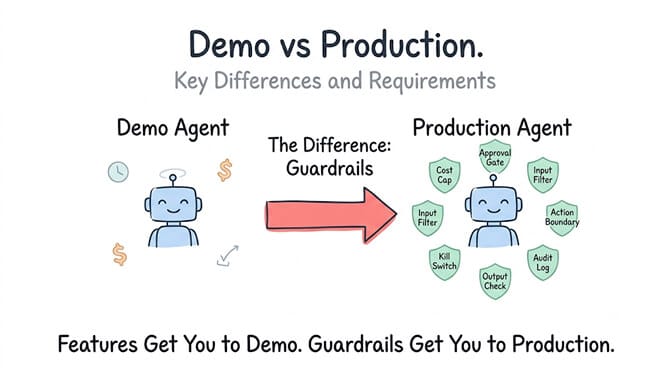
The difference between a demo agent and a production agent isn't features. It's what happens when things go wrong.
In January 2026, AI trading agents at a Solana DeFi company called Step Finance moved over 261,000 SOL tokens, roughly $27 to $30 million, out of the company's wallets. The agents had permission to execute large transfers without human approval. When attackers compromised executive devices, the agents did exactly what they were designed to do. They just did it for the wrong people.
Step Finance shut down. The native token crashed 97%. Only $4.7 million was recovered.
Here's the part that should keep every agent builder up at night. The agents didn't malfunction. They worked perfectly. The guardrails that should have existed, per-agent credentials, transaction value thresholds, human approval for high-impact actions, simply weren't there.
That's not a security failure story. That's a guardrails failure story. And the difference between the two matters more than most people realize.
Ship a production-safe agent, not a code project.
All 7 guardrails are platform settings on BetterClaw, not weeks of engineering. Trust levels, cost caps, kill switch, secrets auto-purge. Free forever, not a trial. Start free → No credit card · No Docker · No config files
Why guardrails aren't optional anymore (the 2026 numbers)
A 2026 enterprise security survey found that 88 percent of organizations deploying AI agents reported at least one confirmed or suspected security incident in the past year. In a separate survey, 82 percent of executives said they believed their existing policies already protected them. That gap between 82 percent confidence and 88 percent incidents is where the crisis lives.
Across the first half of 2026, more than fifty public AI agent incidents were catalogued: hallucinations that reached customers, tool-misuse cascades that burned six-figure budgets, prompt injections that exfiltrated data, and bias-driven outcomes that landed in courtrooms.
Prompt injection attacks surged 340 percent year over year according to OWASP's 2026 LLM Security Report, making them the fastest-growing category of cyberattack globally. And the incidents aren't hypothetical anymore. In March 2026, a financial services company discovered that their customer-facing AI agent had been quietly leaking internal pricing data for three weeks, caused not by a traditional vulnerability but by a carefully worded question that tricked the agent into ignoring its system prompt.
Guardrails are what separate a demo agent from a production agent. They're not overhead. They're infrastructure.
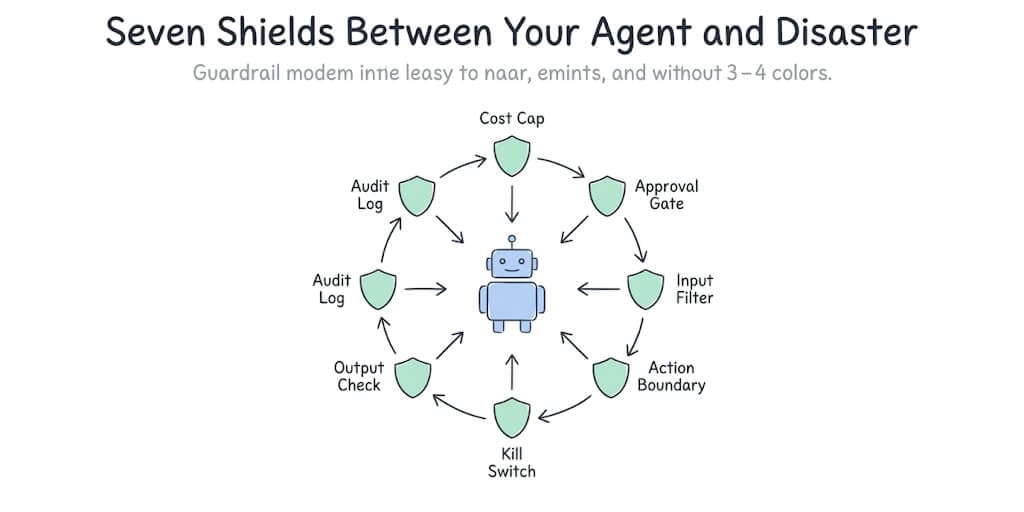
Guardrail 1: Per-agent cost caps (the runaway loop killer)
Tool-misuse cascades, where agents loop on API calls or pricing tools and cascade into runaway cost, were the fastest-growing failure mode in the first half of 2026.
This one is mechanical. Set a hard dollar cap per agent per day. If the agent hits it, it stops. Not "sends a warning." Stops. A failed API call that triggers a retry loop can generate thousands of API calls in minutes. Without a ceiling, your bill has no floor.
On BetterClaw, this is built in as heartbeat scheduling with per-agent cost caps. On a self-hosted setup, you're implementing this yourself, which means writing the monitoring code, the alerting code, and the kill logic, and hoping it all works the first time something actually spirals.
Guardrail 2: Action approval gates (the "ask before you act" layer)
The Step Finance failure happened because agents could execute high-value transfers without approval. The fix is conceptually simple: any action above a certain impact threshold requires a human to confirm before the agent proceeds.
This isn't about making the agent less autonomous. It's about making it autonomous within boundaries. An agent that can read your inbox, classify emails, and draft responses without asking is genuinely useful. An agent that can send those responses, delete emails, or move money without asking is a liability.
On BetterClaw, this maps to the trust levels system: Intern (asks before every action), Specialist (asks before high-impact actions), Lead (acts autonomously with post-action logging). On raw OpenClaw, you configure approval requirements per skill in the agent's configuration, but the defaults are permissive, and most users never change them.
Guardrail 3: Input sanitization (the prompt injection defense)
OWASP maps prompt injection to six of the ten categories in its Top 10 for Agentic Applications. The root cause is architectural: large language models cannot reliably distinguish between instructions from the system operator and content from external sources.
Every document your agent retrieves, every email it reads, every API response it processes is a potential injection vector. If an attacker can insert text into any of those sources, they can potentially override your agent's instructions.
The minimum viable defense: treat every external input as untrusted. Sanitize before it enters the context window. Filter known injection patterns. Limit input lengths. Researchers demonstrated that Claude Cowork could be tricked via indirect prompt injection into uploading user files to an attacker's account simply by processing a document with embedded instructions.
This isn't a problem you solve once and forget. A backdoor sat on PyPI for three hours in March 2026 inside a compromised version of LiteLLM, the language-model gateway used by CrewAI, DSPy, and dozens of other agent frameworks. Nearly 47,000 downloads occurred during the window. Supply chain attacks targeting the agent tooling layer are real and actively happening.
Guardrail 4: Output validation (the hallucination and data leak catch)
Your agent can produce two kinds of dangerous output: wrong information stated confidently (hallucination) and real information shared with the wrong audience (data leakage).
For example, when a customer-facing agent generates a response containing a hallucinated refund policy, a guardrails platform can detect the ungrounded claim and block it before the customer sees it.
The practical implementation: check outputs against known facts before they reach the user. Flag responses that contain PII patterns, internal pricing data, or credential-shaped strings. If your agent summarizes emails for a Slack channel, validate that the summary doesn't include information from emails the channel members shouldn't see.
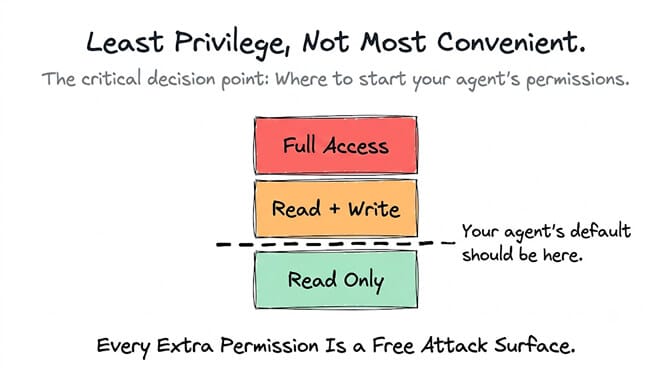
Guardrail 5: Tool and data access boundaries (least privilege)
The most consistently reported failure across both survey waves was agents deployed with access to systems, datasets, or API endpoints well beyond what their task requires, often rooted in shared service accounts or inherited credentials.
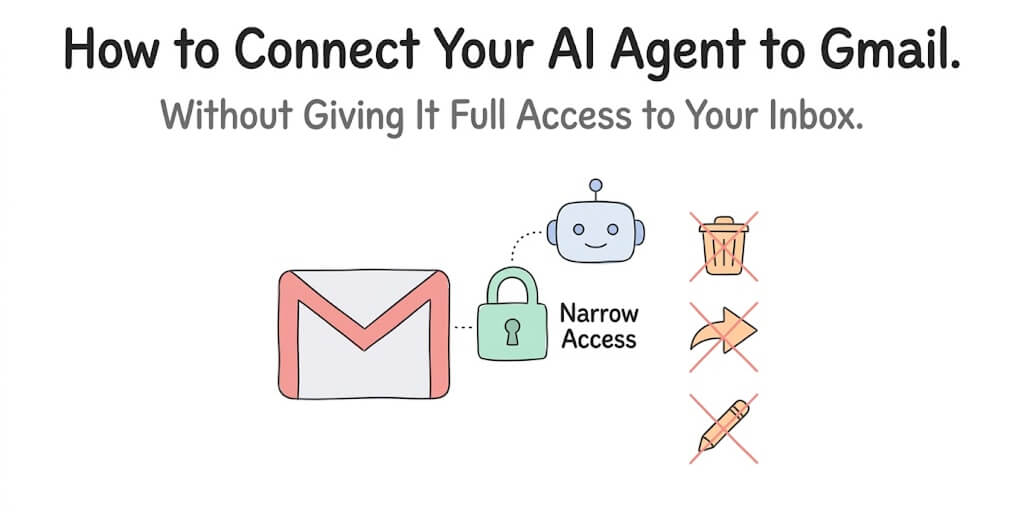
An email triage agent needs read access to Gmail. It does not need write access. It does not need access to your calendar. It does not need access to your CRM. Every permission you grant is an attack surface. Every unnecessary permission is an attack surface you donated for free.
The rule is simple: an agent should have the minimum permissions required for its specific task, and nothing more. On BetterClaw, each agent runs in an isolated Docker container with sandboxed execution. On self-hosted setups, you're managing this isolation yourself, which is doable but another seam to maintain.
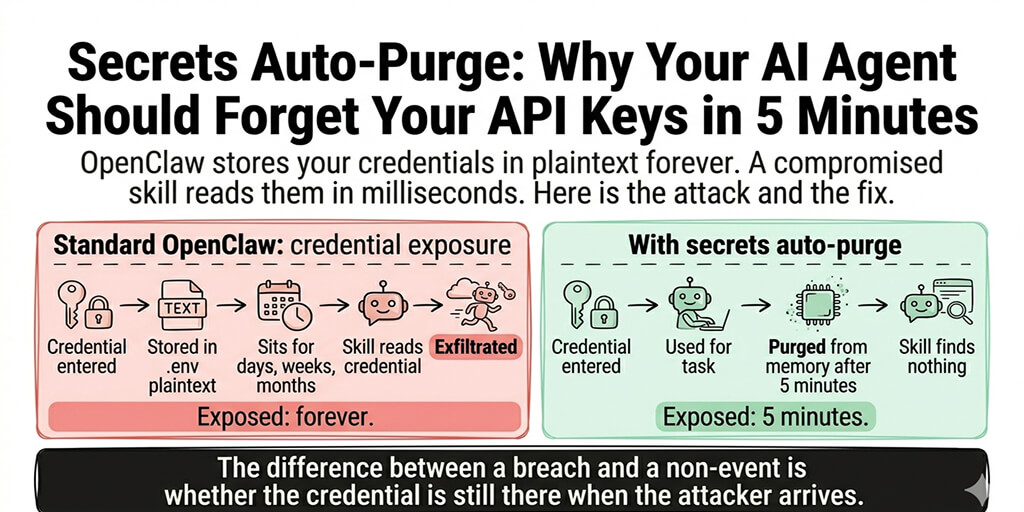
If the idea of managing Docker isolation, input sanitization, output validation, and approval gates yourself sounds like the wrong use of your engineering hours, that's a meaningful part of why managed platforms exist. We built BetterClaw with all of these as defaults, not add-ons. Isolated containers, trust levels, secrets auto-purge after 5 minutes, and a one-click kill switch in case you need to stop an agent immediately. Free plan, no credit card, 200+ verified skills with a 4-layer security audit that's already rejected 824 malicious skills.
Guardrail 6: Kill switch (the emergency stop)
When something goes wrong in production, "wrong" can mean your agent is sending emails it shouldn't, posting to a Slack channel with bad data, or looping on an API call and burning money. The time between "something went wrong" and "we stopped it" is where the damage compounds.
A kill switch is not a graceful shutdown. It's an immediate stop. The agent halts mid-action. Nothing further gets sent, posted, called, or spent. You diagnose after it's stopped, not while it's still running.
On BetterClaw, this is a literal one-click kill switch in the agent dashboard, plus auto-pause on detected anomalies. On self-hosted frameworks, you're building this yourself: monitoring for anomalies, triggering a stop, and making sure the stop actually works even when the agent is mid-action. Real-time health monitoring with auto-pause is the difference between catching a runaway loop in 30 seconds versus finding out from your API bill three days later.
Guardrail 7: Audit logging (the "what actually happened" record)
67 percent of organizations have audit trails in theory, but only a fraction have evidence-quality logs that span all the channels an AI agent might touch. When a regulator or an internal review asks "what did this agent do with regulated data," fragmented logs aren't an answer.
Every action your agent takes should be logged: what it read, what it generated, what it sent, what tools it called, what the response was. Not for compliance theater. For the moment six weeks from now when something goes wrong and you need to trace exactly what happened, in what order, and why.
This is also the guardrail that makes every other guardrail trustworthy. Without logs, your cost caps, approval gates, and input filters are claims. With logs, they're evidence.
For a deeper look at how agent configuration files affect production behavior, including how bloated instruction files can themselves become a guardrails problem, our SOUL.md and AGENTS.md configuration guide covers the token-level mechanics. And if your agent's instructions are drifting over long conversations, effectively disabling the soft guardrails you wrote into SOUL.md, our guide to fixing agent rules drift walks through the specific pattern and the seven fixes that address it.
The honest takeaway
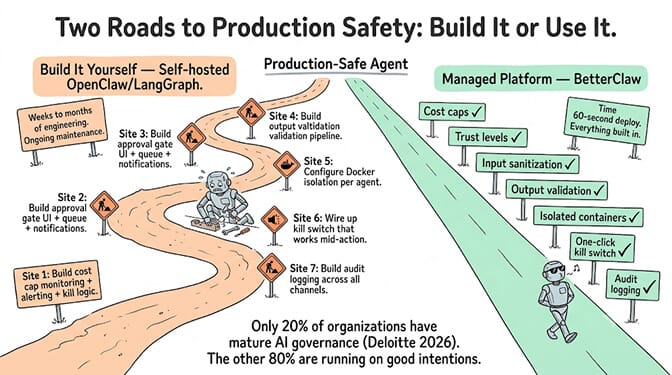
None of these seven controls are technically difficult to understand. The challenge has never been knowing what guardrails to put in place. It's that building each one yourself, maintaining them, and making sure they actually hold under pressure is a full engineering project on top of the actual agent you're trying to build.
Deloitte's 2026 AI report found that only 20 percent of organizations have mature governance models for AI agents. That means 80 percent of the agents running in production right now are protected by some combination of good intentions, incomplete configs, and luck.
If you'd rather have guardrails as defaults instead of weekend projects, give BetterClaw a try. Free plan with one agent, every feature, and 500 credits a month. $49 a month for Pro when you need 5 agents and 12,000 credits. Isolated containers, trust levels, secrets auto-purge, cost caps, kill switch, audit logging, and 200+ verified skills with the 824 malicious ones already rejected before you ever see them. Your first deploy takes about 60 seconds. We handle making sure the guardrails hold. You handle deciding what your agent should do.
Frequently Asked Questions
What are AI agent guardrails?
AI agent guardrails are controls that constrain what an agent can access, what actions it can take, and how its behavior is monitored and logged. They include input sanitization, output validation, action approval gates, cost caps, tool access boundaries, kill switches, and audit logging. Without them, agents can leak data, hallucinate confidently, loop into runaway costs, or be hijacked through prompt injection.
How do production agent guardrails compare to model-level safety features?
Model-level safety (like content filtering built into GPT or Claude) prevents the model from generating harmful content. Production guardrails are broader: they control what data the agent can access, what tools it can invoke, what actions require human approval, and how everything gets logged. Model safety is a subset of the full guardrail stack, not a replacement for it.
How do I add guardrails to an existing AI agent?
Start with the three highest-impact controls: a per-agent cost cap (prevents runaway loops), an approval gate on high-impact actions (prevents unauthorized sends, deletes, or transfers), and input sanitization on all external data sources (prevents prompt injection). These three address the most common production failure modes and can usually be added incrementally without redesigning the agent workflow.
How much do AI agent guardrails cost to implement?
On a self-hosted framework like OpenClaw or LangGraph, building and maintaining guardrails is an engineering project that adds weeks to months of development time, plus ongoing maintenance. On a managed platform like BetterClaw, guardrails are built into the platform starting at $0 on the free plan, with trust levels, cost caps, isolated containers, and auto-pause included out of the box.
Are AI agent guardrails reliable enough for regulated industries?
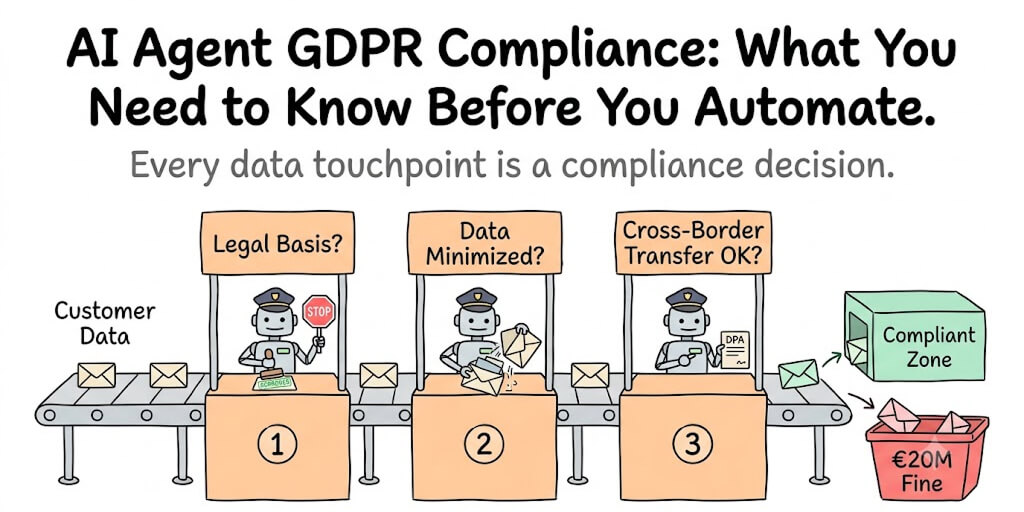
With a complete stack (input sanitization, output validation, least-privilege access, audit logging, and human-in-the-loop for high-impact decisions), agent guardrails can meet the requirements of frameworks like GDPR, HIPAA, and financial services regulations. The key gap is audit trail quality: most organizations have logs in theory but lack evidence-quality records that span all the channels an agent touches.