"Should I buy a DGX Spark or just rent GPUs in the cloud?" is the question underneath most DGX Spark research, and it rarely gets a straight numeric answer. Here is one.
This is the rent-versus-buy companion to our main DGX Spark alternatives guide, which ranks the full field by price. This page covers one decision only: own the hardware, or rent compute by the hour.
The break-even calculation
Buying:
| Cost component | Amount |
|---|---|
| DGX Spark purchase price | $4,699 |
| Amortised over 36 months | $130.53/month |
| Electricity (approximate, always-on) | ~$25/month |
| Effective monthly cost of owning | ~$156/month |
Renting, using an A100 80 GB on Vast.ai at approximately $0.29/hour:
| Usage pattern | Hours/month | Monthly cost |
|---|---|---|
| Light (2 hrs/day) | 61 | ~$18 |
| Working hours (8 hrs/day, 20 days) | 160 | ~$46 |
| Heavy (12 hrs/day, every day) | 365 | ~$106 |
| Break-even point | 536 | ~$156 |
| Always-on (24/7) | 730 | ~$212 |
The break-even is 536 GPU-hours a month. That is 17.6 hours a day, seven days a week. If your actual GPU utilisation is below that, renting costs less. Above it, owning costs less.
Be honest about which side of that line you fall on. Most people researching a DGX Spark are running inference for agent workloads, prototyping, or occasional fine-tuning - patterns that land in the 20 to 160 hour range. That is $6 to $46 a month of rental against $156 a month of ownership.
The comparison flatters cloud, and you should know why
One caveat that most rent-vs-buy posts skip: the A100 80 GB in the table above is a substantially more capable machine than a DGX Spark. It has far higher memory bandwidth and much stronger training throughput. So the $0.29/hour figure is not buying you Spark-equivalent compute - it is buying you more than a Spark, for less.
That makes the economics worse for buying, not better. If you rent a smaller, genuinely Spark-comparable instance, your hourly rate drops and the break-even moves further out. Either way, the direction of the conclusion holds.
What the hourly rate leaves out
Break-even math is necessary but not sufficient. Four factors don't appear in the table:
Residual value. A DGX Spark is an asset. Rented hours are not. If you resell the machine after two years at even 50% of purchase price, you recover roughly $2,350, which materially shifts the comparison toward buying. Rental spend is unrecoverable.
Data sovereignty. Renting means your data reaches the provider's hardware. For regulated workloads, health data, or client material under NDA, that can be disqualifying regardless of price. This is the single most common legitimate reason to buy.
Latency and availability. Cloud GPU supply fluctuates. Spot instances get reclaimed. If your workflow depends on a GPU being there at 9am, a machine on your desk is more reliable than a marketplace listing.
Time cost. Provisioning, environment setup, and data transfer are real recurring overhead on rented instances. A local box is configured once. At consultant rates, a few hours a month of setup friction is worth more than the price delta.
Offline capability. A rented GPU is useless without a connection. If you work on planes, in secure facilities, or anywhere with unreliable networking, local hardware is the only option.
When renting clearly wins
- Your GPU use is under ~500 hours a month - which covers most agent and inference work.
- Your workload is bursty: heavy for a week, idle for three.
- You are fine-tuning or training, where a Spark is underpowered anyway and renting an H100 for a weekend beats owning a weaker machine for three years.
- You are still deciding what you need. Renting is how you find out what your real utilisation is before committing $4,699.
- You want frontier models. No desktop hardware runs Opus 4.8 or GPT-5.5 at any price.
When buying clearly wins
- You genuinely run inference 18+ hours a day, every day.
- Data sovereignty is a hard requirement, not a preference.
- You need CUDA 13 specifically and want it locally - though note the ASUS Ascent GX10 runs the same GB10 chip from $2,999, which moves your break-even from 536 hours down to roughly 360.
- You need offline capability.
- You value a predictable fixed cost over a variable bill that scales with use.
The option most people should try first
There is a third path that this framing hides: don't buy or rent GPUs at all.
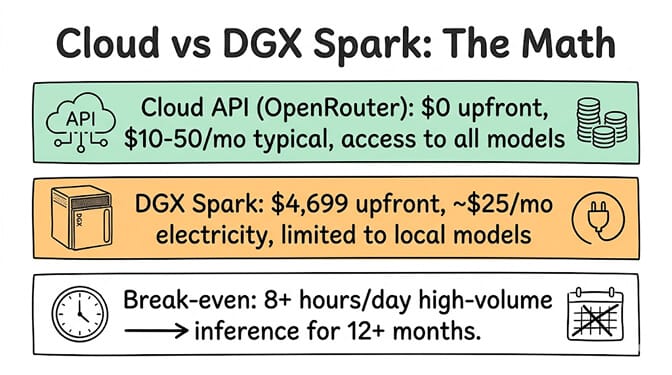
If the goal is running AI agents rather than running hardware, the model is a component you can rent per-token instead of per-hour. Cloud inference through OpenRouter, Groq, or Together costs $10 to $50 a month for typical agent workloads - roughly a third of the rental break-even and a sixth of ownership, with no provisioning and access to models no local box can run.
The sequence that costs least: run on cloud APIs first, measure your actual GPU-hours, then buy hardware only if you cross 536 hours a month. Buying first and measuring second is how $4,699 machines end up idle.
Frequently Asked Questions
Is it cheaper to rent GPUs than buy a DGX Spark?
For most workloads, yes. Owning a DGX Spark costs roughly $156/month over three years. Renting an A100 80 GB at $0.29/hour costs less than that up to 536 hours a month. Typical agent and inference workloads run 20 to 160 hours a month, where renting is 3 to 8 times cheaper.
What is the break-even point for a DGX Spark versus cloud GPU rental?
About 536 GPU-hours per month, or 17.6 hours per day every day. That compares $4,699 amortised over 36 months plus ~$25/month electricity against $0.29/hour rental.
Does renting cloud GPUs make sense for fine-tuning?
Usually yes. DGX Spark is weak for training relative to its price, so fine-tuning is the workload where renting has the strongest case. A rented H100 for a weekend typically outperforms a Spark that you own for three years.
What about data privacy with rented GPUs?
Your data reaches the provider's hardware. For regulated, confidential, or NDA-bound workloads this can rule out renting regardless of cost, and it is the most common legitimate reason to buy local hardware.
Is there a cheaper way to get the same chip as a DGX Spark?
Yes. The ASUS Ascent GX10 uses the identical GB10 silicon and starts at $2,999 - about $1,700 less. That lowers the rent-versus-buy break-even from roughly 536 hours a month to about 360. See the full price ranking.