They look like competing approaches. They're actually different layers of the same stack. Here's the decision framework that stops you from building the wrong thing.
We spent three days building a custom MCP server for our CRM integration. It worked. The agent could read contacts, create deals, update fields, query pipelines. Perfect tool access.
Then we asked the agent to write a weekly pipeline review. It connected to the CRM, pulled the data... and dumped a raw JSON blob into a Slack message. No formatting. No analysis. No prioritization. Just 47 deals as unfiltered JSON.
The agent knew how to reach the CRM. It didn't know what to do once it got there.
That's the difference between MCP and Skills in one sentence. And until you understand it, you'll keep building one half of what your agent needs.
The agent skills vs MCP confusion is the most common architecture mistake in the agent builder space right now. It looks like you have to pick one. You don't. They solve different problems at different layers.
Here's the decision framework.
What Skills actually are (and aren't)
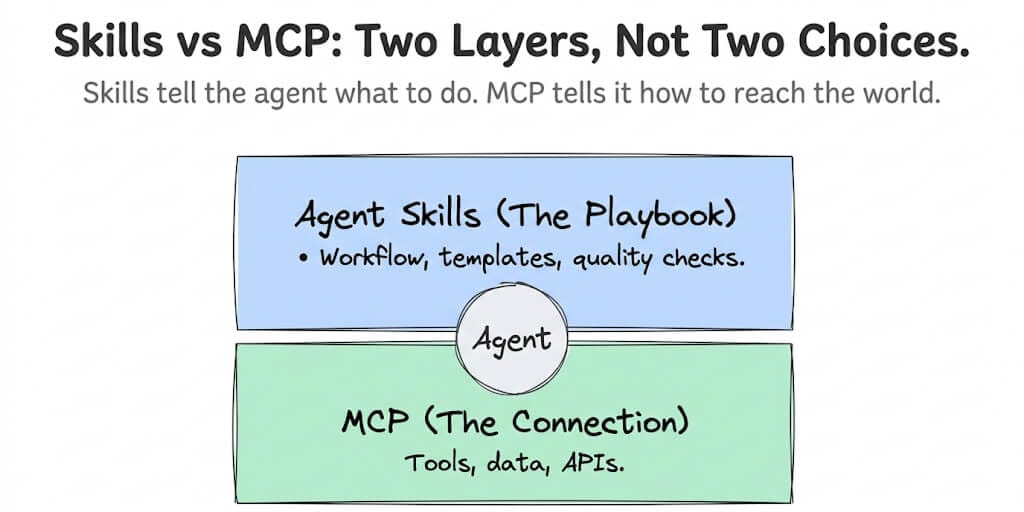
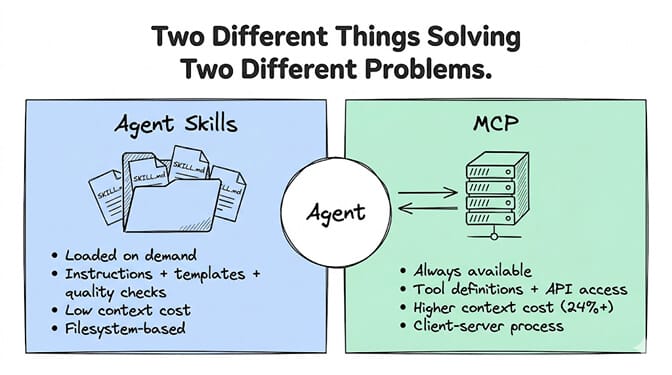
Agent Skills are pre-built packages of instructions, templates, and quality checks that tell an agent how to think about a specific type of work. A SKILL.md file sits on the filesystem and gets loaded on demand when the agent encounters a matching task.
A skill for "weekly pipeline review" might include: which CRM fields to pull, how to categorize deals (at risk, healthy, closing soon), the output template (formatted table with commentary), what counts as "done" (every stalled deal has a suggested action).
Skills are prompts, not code. They don't connect to anything. They don't execute API calls. They encode domain knowledge and workflow logic that the agent follows when triggered.
The critical design advantage: progressive disclosure. At startup, the agent loads only each skill's name and description. A few tokens each. The full content loads only when the agent determines the skill applies. This means you can install dozens of skills without bloating your context window. Compare that to MCP tool definitions, which consume context space on every request.
One analysis found that a Claude Code session can have 24% or more of its context window consumed by MCP tool definitions before a single conversation message is sent. Add a few feature-rich MCP servers and you're burning context tokens on tool schemas the agent doesn't need for this particular task.
Skills avoid that entirely by staying lightweight until needed. (For ready-made examples, see our roundup of the best OpenClaw skills for 2026.)
What MCP actually does (and where it stops)
MCP (Model Context Protocol) is a standardized protocol for connecting an agent to external tools and data sources. Think of it as the USB-C port for agents. One standard interface, any tool.
MCP provides three things: resources (data the agent can read), tools (actions the agent can execute), and prompts (templates the server can offer). With 97 million downloads and adoption by Anthropic, OpenAI, Google, and Microsoft, MCP is the default way agents talk to external systems in 2026. (For how MCP sits alongside agent-to-agent standards, see our A2A vs MCP vs ACP guide.)
But here's where most people get confused.
MCP gives you access, not method. It tells the agent "here's how to connect to Slack and what you can do there." It doesn't tell the agent "when writing a status update, pull from these three channels, summarize in this format, check for blockers, and get approval before posting."
The "what you can do" part is MCP. The "how to do it well" part is Skills.
LlamaIndex documented this exact tension while building their LlamaAgents Builder. They tried combining MCP documentation access with custom skills for their LlamaParse SDK. Their finding: MCP tools are straightforward API calls with clear input and output schemas. The challenge is deciding which tool to call and when. Skills, by contrast, give the agent precise workflow instructions, but success depends on the LLM's ability to interpret and execute them.
MCP solves the "N x M" connectivity problem. One server talks to every agent. Skills solve the "how to think about this problem" challenge. One playbook, reusable across tasks. You need both.
The decision matrix (use this before building anything)
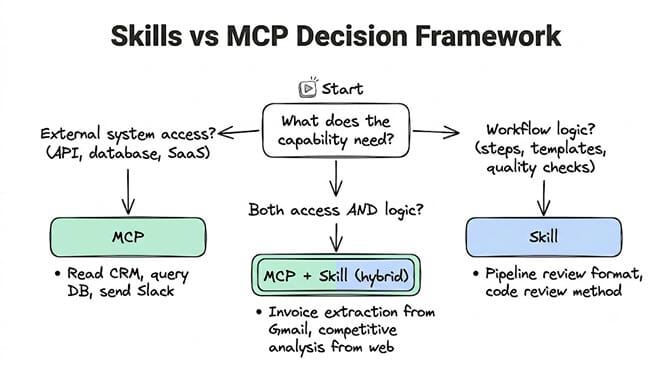
Here's the framework we use at BetterClaw when deciding whether a capability belongs as a Skill, an MCP server, or both.
Use a Skill when:
- The capability is about workflow logic, not system access. If the agent needs to know how to approach a task (what steps to take, what format to use, what quality bar to hit), that's a skill. Example: "When a customer asks about pricing, check their current plan first, then recommend based on usage patterns, format the response as a comparison table."
- You need it to work across different tools. A skill for "competitive analysis" works whether the agent pulls data from Ahrefs MCP, a custom web scraper, or a Google Sheets export. The workflow logic is tool-agnostic.
- Context cost matters. Skills use progressive disclosure. They cost almost zero tokens until triggered. If your agent has many potential capabilities but only uses 2-3 per session, skills are dramatically more context-efficient than loading every MCP tool definition upfront.
- You want cross-agent, cross-provider portability. The
SKILL.mdformat runs identically across Claude Code, OpenAI Codex, Gemini CLI, and Cursor. Write once, use everywhere.
Use MCP when:
- The capability requires live external system access. Reading a database. Querying an API. Sending a Slack message. Creating a Jira ticket. Any action that crosses the boundary between the agent's context and an external system needs MCP (or an equivalent tool interface).
- The agent needs bidirectional communication. Skills are read-only from the agent's perspective. MCP supports both reading from and writing to external systems.
- Multiple agents need the same connection. An MCP server is a shared resource. Deploy it once, and every agent in your organization can connect to it. Building the same integration as a skill per agent doesn't scale.
- You need strong schema validation. MCP tool definitions include JSON schemas for input and output. The model knows exactly what parameters to send and what to expect back. Skills rely on the LLM interpreting natural language instructions, which is less deterministic.
Use both when: The task requires external data AND specific workflow logic. This is the common case. The agent needs CRM data (MCP) AND a specific framework for analyzing it (Skill). It needs GitHub access (MCP) AND a specific code review methodology (Skill). It needs email access (MCP) AND an invoice extraction workflow (Skill).
The hybrid pattern (this is what production agents actually look like)
The most effective agents in production use both. Here's what the hybrid pattern looks like in practice.
Example: A support ticket triage agent
- MCP layer: Connect to Zendesk (read tickets), connect to Slack (post summaries), connect to CRM (look up customer tier).
- Skill layer: "When a new P1 ticket arrives, check if the customer is Enterprise tier. If yes, escalate to the on-call channel immediately. If no, classify by category (billing, technical, feature request). Draft a response using the appropriate template. Flag tickets with negative sentiment for human review."
The MCP layer gives the agent hands. The Skill layer gives it judgment.
Without the MCP connections, the agent can't see the tickets or communicate with the team. Without the Skill, the agent reads the tickets but doesn't know how to prioritize, what templates to use, or when to escalate.
Example: A weekly reporting agent
- MCP layer: Connect to Google Analytics, connect to Stripe, connect to HubSpot.
- Skill layer: "Pull this week's metrics: MRR, new signups, churn rate, top traffic sources. Compare to last week. Flag anything that changed more than 15%. Format as a Slack digest with emoji indicators (green for up, red for down). Include three bullet points of commentary."
MCP provides the data pipes. Skills provide the analysis framework.
This is why the "MCP vs Skills" framing is misleading. It's like asking "should I use a database or an API?" They serve different purposes. The question isn't which one. It's which combination.
On BetterClaw, this hybrid architecture is what the visual builder creates by default. You connect integrations (MCP layer) and configure agent behavior, output formats, and escalation rules (Skill layer) through the UI. 200+ verified skills with 25+ OAuth integrations. No MCP server to deploy. No SKILL.md files to manage. Free plan with 1 agent and 100 credits a month. $49/month on Pro. BYOK with zero markup.
The security gap between Skills and MCP
Here's the dimension most comparison articles skip.
Skills have a narrow attack surface. A skill is a text file on a filesystem. The worst case for a malicious skill is bad instructions that lead to poor output. Skills don't execute code by themselves. They don't connect to external systems. They can't exfiltrate data without an MCP connection to do it through.
MCP has a wide attack surface. An MCP server is a running process with network access, system permissions, and the ability to read/write external data. Between January and April 2026, researchers disclosed 40+ CVEs against MCP implementations. BlueRock Security found 36.7% of 7,000 MCP servers vulnerable to SSRF. Tool poisoning attacks (where a malicious server provides poisoned tool descriptions that alter LLM behavior) are a new attack class specific to MCP.
This matters for your architecture decision. If a capability can be a Skill (instruction-based, no external access needed), making it a Skill instead of an MCP server reduces your attack surface. Reserve MCP for capabilities that genuinely need external system access.
Every MCP server you add is an attack surface you maintain. Every Skill you add is a text file you review. The security math favors Skills for anything that doesn't require live system access.
On BetterClaw, the 4-layer security audit on 200+ verified skills exists precisely because of this risk differential. 824 malicious skills rejected. Secrets auto-purge after 5 minutes. Isolated Docker containers per agent. The Skill layer is safe by design. The MCP layer requires defense in depth.
Where this is heading (the trajectory worth watching)
The boundary between Skills and MCP is blurring. Skills can already contain executable code on the filesystem. MCP servers are getting lighter with Streamable HTTP replacing STDIO-only transports. The likely convergence: MCP becomes thin primitives (read, write, search, fetch) while Skills absorb the domain-specific logic.
A third pattern is also emerging: Agent-as-a-Service, where you call a managed agent endpoint and the service handles both the Skills layer and the MCP connections behind the API. Anthropic put Claude Managed Agents into public beta in April 2026. This is the "don't build the stack, call the endpoint" option.
Gartner projects 40% of enterprise apps will embed AI agents by end of 2026. McKinsey estimates the addressable market at $2.6-4.4 trillion. The teams that build production agents fastest are the ones who stop debating "Skills or MCP" and start asking "which combination gives this agent the access it needs AND the judgment to use it well?"
Build the connections. Build the playbooks. Ship the agent.
Give BetterClaw a look if you want both layers handled in a visual builder. Integrations (MCP layer) plus agent behavior configuration (Skills layer) through the UI. Free plan with 1 agent and 100 credits a month. $49/month on Pro. We handle the architecture. You handle the agent logic.
Frequently Asked Questions
What is the difference between agent Skills and MCP?
Agent Skills and MCP operate at different layers of the agent stack. MCP (Model Context Protocol) is a standardized protocol for connecting agents to external tools and data sources (databases, APIs, SaaS services). Skills are pre-built packages of instructions, templates, and quality checks that tell an agent how to approach a specific type of work. MCP gives the agent access to systems. Skills give the agent judgment about what to do with that access. Most production agents use both.
When should I use Skills over MCP for my agent?
Use Skills when the capability is about workflow logic rather than system access: task prioritization, output formatting, analysis frameworks, quality checks, escalation rules. Skills are also better when context cost matters (they use progressive disclosure, loading only when triggered) and when you want cross-provider portability (SKILL.md works across Claude Code, Codex, Gemini CLI, and Cursor). Use MCP when you need live bidirectional access to external systems (APIs, databases, messaging platforms).
How do I combine Skills and MCP in the same agent?
The hybrid pattern is straightforward: MCP handles "what can the agent connect to" and Skills handle "what should the agent do with the data." For example, connect to your CRM via MCP, then use a Skill to define how the agent analyzes the pipeline (which fields to prioritize, what format to output, when to escalate). On platforms like BetterClaw, you configure integrations (MCP layer) and agent behavior (Skills layer) through a visual builder without managing either layer manually.
Does using more MCP servers increase costs?
Yes, through context consumption. MCP tool definitions are loaded into the agent's context window, and one analysis found they can consume 24% or more of available context before any conversation begins. More MCP servers means more tool definitions means higher token costs per request. Anthropic's MCP Tool Search (January 2026) helps by dynamically loading tools only when needed, but the underlying tension remains. Skills, by contrast, use progressive disclosure with near-zero context cost until triggered.
Are MCP servers secure enough for production agents?
MCP requires active security management. Between January and April 2026, 40+ CVEs were filed against MCP implementations. The MCP specification doesn't include built-in authentication or authorization. Tool poisoning and SSRF are documented attack vectors. For production use: vet every third-party MCP server before connecting, use authentication wrappers, audit tool definitions for poisoning, and prefer verified skill marketplaces (like BetterClaw's 200+ audited skills) over unvetted community servers. See our MCP debugging guide for troubleshooting tool call failures.