NVIDIA raised the price to $4,699. AMD's 128GB alternatives start at $2,999. The ASUS version, same chip, now often costs more than NVIDIA's own. Cloud APIs cost $0.14/M tokens. Here are the four buyer profiles that justify the Spark, and the six that don't.
NVIDIA raised the DGX Spark from $3,999 to $4,699 in February 2026. Memory supply constraints. LPDDR5x pricing. The usual.
Two weeks later, GMKtec shipped the EVO-X2 with AMD's Ryzen AI Max+ 395, launching near $1,500. Same 128GB unified memory. Bandwidth within 6% of the Spark's. Token generation at a similar pace in independent testing. Less than half the price at launch, and still about $1,200 less after the 2026 memory shortage pushed the 128GB model to $3,499.99.
That changed the buying decision completely. The DGX Spark is no longer the only 128GB AI desktop. It's the most expensive one. For the full menu of options at every budget, see our DGX Spark alternatives guide. The question isn't "should you buy a DGX Spark?" It's "does the NVIDIA ecosystem premium justify up to $1,700 more than the competition?"
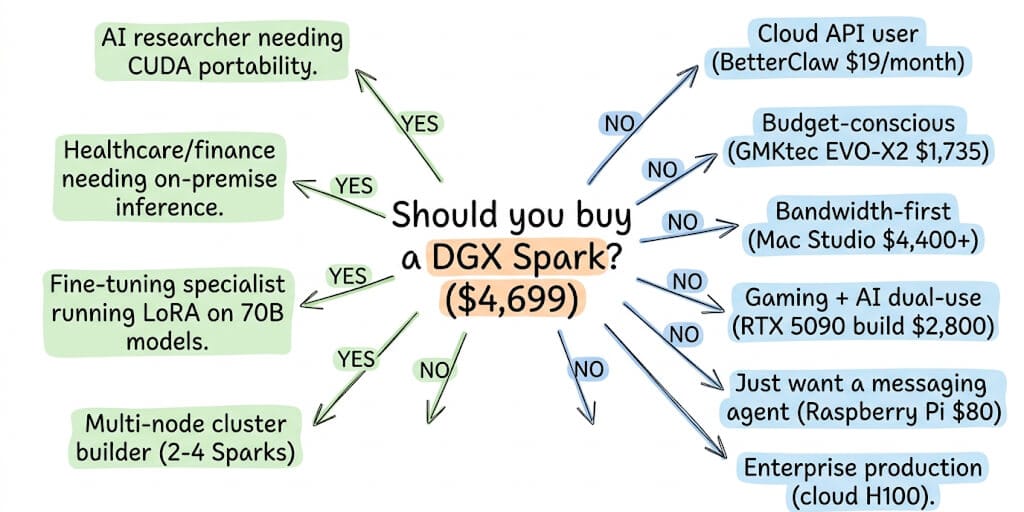
Here are the four buyer profiles where it does, and the six where it doesn't - along with the alternatives, or competitors depending on how you frame it, that make more sense for most people.
Not looking for DGX Spark specifically?
- DGX Station alternatives - the larger workstation-class machine. See DGX Station alternatives →
- NVIDIA DGX alternatives generally - if you are comparing the whole product line rather than just Spark, start with the family comparison. See all DGX alternatives →
This page covers DGX Spark specifically - who actually needs one and what to buy instead.
The four people who should actually buy a DGX Spark
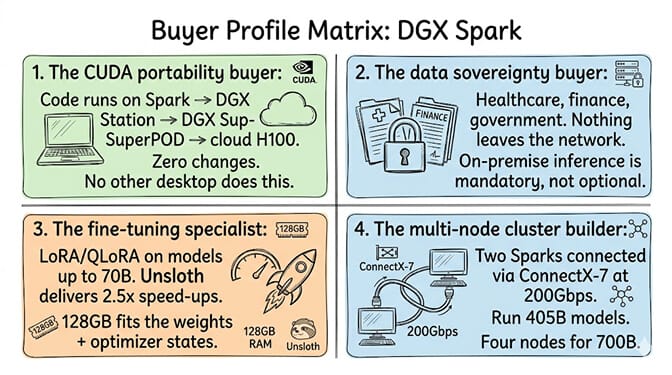
Profile 1: The CUDA portability developer
This is the DGX Spark's real value proposition. Code that runs on the Spark runs on DGX Station, DGX SuperPOD, and cloud NVIDIA instances with zero changes. (Shopping the bigger workstation instead? See our DGX Station alternative breakdown.) No other $4,699 desktop gives you that pipeline. If your workflow is "prototype locally → deploy to NVIDIA cloud," the Spark is the only desktop that eliminates the translation step.
Who this is: ML engineers at companies using NVIDIA infrastructure. Researchers submitting to conferences with NVIDIA benchmark requirements. Teams building products that will eventually run on NVIDIA cloud.
Profile 2: The data sovereignty buyer
Healthcare. Finance. Government. Legal. Any organization where sending patient data, financial records, or classified information to a cloud API is prohibited by regulation or policy. The DGX Spark runs inference entirely on-premise. Nothing leaves the network.
The honest caveat: If data sovereignty is the requirement but you only need 8-20B models, a 128GB Strix Halo box such as the Bosgame M5 at $2,999 meets the same requirement for $1,700 less. The Spark's premium only justifies itself if you also need CUDA or NVIDIA's software stack.
Profile 3: The fine-tuning specialist
128GB unified memory fits LoRA and QLoRA fine-tuning for models up to 70B parameters. Unsloth delivers 2.5x speed-ups over standard HuggingFace. NeMo AutoModel provides NVIDIA's fine-tuning pipeline. Three frameworks, all well-supported on the Spark.
Who this is: ML engineers customizing open-source models for specific domains. Teams building vertical AI products that need fine-tuned behavior. Researchers running ablation studies.
For the complete DGX Spark bandwidth analysis and model performance benchmarks, our guide covers which model sizes run at interactive speeds.
Profile 4: The multi-node cluster builder
Two DGX Sparks connected via ConnectX-7 (200Gbps aggregate) run models up to 405B parameters. Four nodes (announced at GTC 2026) support up to 700B with near-linear scaling. At $9,398 for two nodes or $18,796 for four, this is the cheapest way to run massive models locally.
The honest caveat: At $18,796 for four nodes, you could rent an H100 for 9,387 hours ($2/hour). That's over a year of 24/7 cloud access. The cluster only makes financial sense if you're running it daily for 12+ months.
The six people who should buy something else
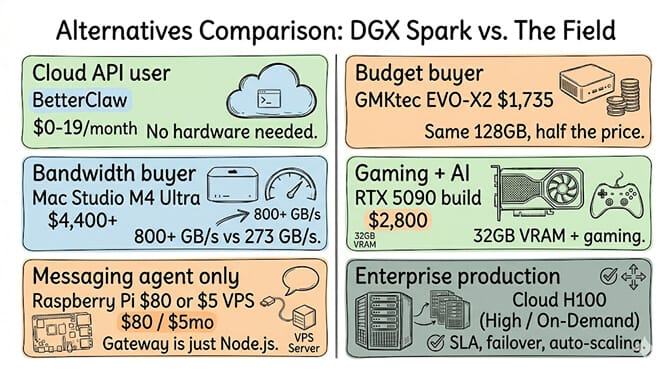
Alternative 1: You use cloud APIs (skip hardware entirely)
If your agents use Claude, GPT, or DeepSeek via API, the DGX Spark is a $4,699 messaging router. The agent gateway is a Node.js process that sends API requests. A $5/month VPS does the same job. A Raspberry Pi does the same job.
If you want an always-on agent on cloud APIs without any hardware purchase, BetterClaw handles the infrastructure for $0-49/month. 28+ model providers. BYOK. No hardware. No local inference required. Free tier with 1 agent. $49/month for Pro.
Alternative 2: You want 128GB but not the NVIDIA tax (GMKtec EVO-X2)
The cheapest 128GB DGX Spark equivalent starts at $2,999 (Bosgame M5). The better-tested GMKtec EVO-X2 is $3,499.99.
Same 128GB unified memory, ~256 GB/s of bandwidth against the Spark's 273, and independent testing puts its token generation at a similar pace to the Spark's. Full specs and benchmarks are in the DGX Spark alternatives guide.
The trade-off: ROCm instead of CUDA. If you don't need CUDA, this is the obvious budget pick.
Alternative 3: You need bandwidth more than capacity (Mac Studio M5 Ultra)
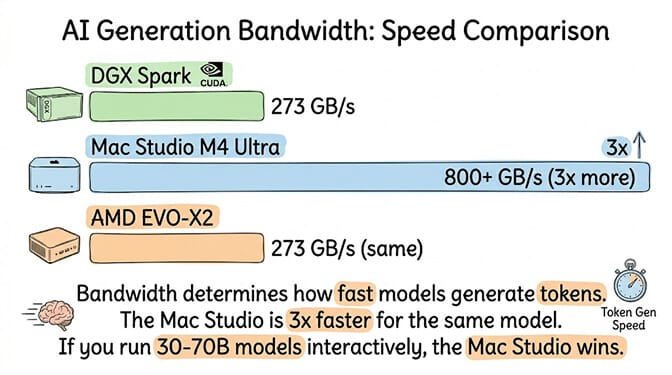
Apple refreshed the Mac Studio on 25 August 2026 to M5 Max and M5 Ultra, with deliveries from 22 September. The M5 Ultra runs 1.2 TB/s of memory bandwidth - roughly 4x the Spark's 273 GB/s - and scales to 512GB of unified memory, from $5,499. The M5 Max starts at $2,499 and reaches 614 GB/s on the 40-core GPU. (Older comparisons quote an "M4 Ultra" Mac Studio; that configuration never shipped, the previous generation was M4 Max and M3 Ultra.) Pricing tiers are broken out in the full alternatives guide. If your primary use case is running 30-70B models at interactive speed, the Mac Studio outperforms the Spark on the metric that matters most, which is exactly the DGX Spark memory bandwidth bottleneck we break down separately.
The trade-off: MLX and llama.cpp instead of CUDA. No TensorRT-LLM. No NIM. No NVIDIA ecosystem portability. For inference-only workflows, this doesn't matter.
Alternative 4: You also game (RTX 5090 build)
$2,800-3,200 for a custom RTX 5090 build (32GB GDDR7) - fastest inference under 20B, and it plays games, which the Spark cannot. For the full cost picture on a discrete GPU build, see our DGX Spark vs local GPU vs cloud comparison.
The trade-off: Only 32GB VRAM. Models above 30B require offloading to system RAM, which kills performance. The Spark's 128GB fits everything. But if 8-20B models are your range, the RTX 5090 is faster and cheaper.
Alternative 5: You just want a messaging agent (Pi or VPS)
The OpenClaw/Hermes gateway is a Node.js or Python process that sends API requests. It doesn't need local inference hardware. A Raspberry Pi 5 ($80) or a $5/month VPS runs the gateway. The AI model runs in the cloud. The hardware on your desk is irrelevant.
For the comparison of self-hosted versus managed agent deployment, our comparison covers when hardware matters and when it doesn't.
Alternative 6: You need enterprise production (cloud H100)
Spheron's analysis: "DGX Spark is a desktop computer with no managed uptime, no automatic failover, and no replacement SLA." If your AI agent is a production dependency serving customers 24/7, it doesn't belong on desktop hardware that throttles under sustained load.
The decision in one table
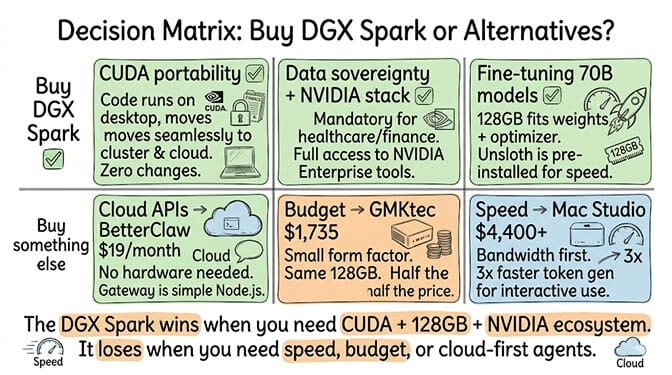
| If you need... | Buy this | Price |
|---|---|---|
| CUDA portability to NVIDIA cloud | DGX Spark | $4,699 |
| 128GB on a budget | Bosgame M5 or GMKtec EVO-X2 | $2,999-$3,499 |
| Fastest 30-70B inference | Mac Studio M5 Ultra | $5,499+ |
| Gaming + AI | RTX 5090 build | $2,800 |
| Just an agent on cloud APIs | BetterClaw (no hardware) | $0-49/month |
| Enterprise production SLA | Cloud H100 | ~$2/hour |
The DGX Spark is a great machine. It's just not the right machine for most people buying it. The four profiles that justify the price are specific and narrow: CUDA portability, data sovereignty with NVIDIA stack, fine-tuning, and multi-node clusters. Everyone else has a cheaper, faster, or simpler option.
If you want an always-on AI agent without buying, configuring, or maintaining any hardware, give BetterClaw a try. Free tier with 1 agent and BYOK. $49/month for Pro. 28+ model providers including local Ollama endpoints if you do have a Spark. No hardware required for the 90% of agent use cases that use cloud APIs. The agent runs. The hardware decision becomes irrelevant.
Frequently Asked Questions
Who should buy a DGX Spark?
Four specific buyer profiles: CUDA portability developers (code runs identically from Spark to cloud H100), data sovereignty buyers (healthcare/finance/government needing on-premise inference), fine-tuning specialists (LoRA/QLoRA on models up to 70B), and multi-node cluster builders (2-4 Sparks for models up to 700B). Everyone else has a cheaper or faster alternative.
What's the cheapest DGX Spark alternative with 128GB?
The Bosgame M5 at $2,999, or the better-tested GMKtec EVO-X2 at $3,499.99, offers the same 128GB unified memory with AMD's Ryzen AI Max+ 395, at ~256 GB/s of bandwidth against the Spark's 273. Independent testing puts its token generation at a similar pace to the Spark's, though the Spark is 2 to 3 times faster at prompt processing. The trade-off: ROCm instead of CUDA, so no NVIDIA NIM, TensorRT-LLM, or NemoClaw. The ASUS Ascent GX10 (same GB10 chip as the Spark) is no longer a reliable discount: ASUS lists the 1TB version at $6,999 and out of stock, so check current clone prices before assuming it saves you anything.
Is DGX Spark worth $4,699 for running AI agents?
For most agent users: no. If your agent uses cloud APIs (Claude, GPT, DeepSeek), the gateway is just a Node.js process that a $5/month VPS handles. BetterClaw offers managed agent deployment at $0-49/month with no hardware required. The Spark only makes sense for agents running local models in privacy-sensitive environments where data can't leave the network.
DGX Spark vs Mac Studio M5 Ultra for local AI?
Different strengths. Mac Studio M5 Ultra: 1.2 TB/s bandwidth (roughly 4x the Spark, and correspondingly faster token generation on 30-70B models), up to 512GB memory, silent operation. DGX Spark: full NVIDIA stack (CUDA, TensorRT-LLM, NIM, NemoClaw), 128GB, NVIDIA cloud portability. Choose Mac Studio for raw inference speed. Choose DGX Spark for NVIDIA ecosystem compatibility.
Can I run a production AI agent 24/7 on a DGX Spark?
Not recommended. Spheron: "DGX Spark is a desktop computer with no managed uptime, no failover, no SLA." Multiple reviewers document thermal throttling after 20-30 minutes of sustained load. For production 24/7 agents, use a cloud VPS ($5-10/month) or a managed platform like BetterClaw ($0-49/month). The Spark is a development machine, not a production server.