The best AI agent builder depends on who is building and what the agent has to do. An AI agent builder is software that lets you create an AI agent that plans and acts on its own, using tools like email, chat and your CRM, instead of only answering questions. We compared 12 on price (checked on each official pricing page on October 1, 2026), models, setup time and who each suits. Quick answer: best no-code, BetterClaw. Best for developers, CrewAI. Best free, Zapier Agents. Best for enterprise, Google's Gemini Enterprise Agent Platform.
They fall into four broad types, from no-code builders to code-first frameworks and cloud platforms, and the list below mixes all four so you can compare them in one place.
AI agent builders compared (2026)
| Tool | Type | Best for | Starting price | Free option | Models | Setup time |
|---|---|---|---|---|---|---|
| BetterClaw | No-code agent platform | Any model with your own keys, no code | $19/mo | No (7-day money-back) | 28+ providers, BYOK | About 60 seconds |
| Lindy | No-code assistant builder | Inbox and meeting assistants | $29.99/user/mo | No | "Most major models" | Minutes |
| Zapier Agents | No-code, inside Zapier | Teams already on Zapier | $0 | Yes, 400 activities/mo | Not stated on pricing page | Minutes |
| n8n | Low-code workflow automation | Technical teams building workflows | €20/mo (annual) | Yes, self-hosted Community Edition | Any, via AI nodes | 5 minutes (cloud) to 2 hours (self-hosted) |
| Gumloop | No-code automation builder | Marketing and ops automations | $37/mo | 14-day trial | 35+ models, BYOK | Under an hour |
| Relevance AI | Enterprise agent platform | Enterprise "AI workforce" projects | Talk to sales | No | Not stated publicly | Sales-led |
| CrewAI | Open-source Python framework | Developers building multi-agent systems | $0 | Yes, open source + free cloud tier | Any, via code | Hours |
| Google Gemini Enterprise Agent Platform | Cloud platform | Teams already on Google Cloud | Usage-based | Monthly free allowance | Gemini + Model Garden | 2 hours to 3 days |
| Manus | Autonomous agent app | Research and one-off tasks | $0 | Yes, 300 credits/day | Manus 2.0 Max, 2.0, Lite | Minutes |
| Grok Bot | Ready-made agent | Hands-off agent inside xAI | Included with SuperGrok ($30/mo) | No | xAI picks (no model picker) | Minutes |
| OpenAI Dots | Ready-made agent | ChatGPT Pro and Business users | Included with ChatGPT Pro | No | GPT-6 Astra | Minutes |
| Meta Muse | Ready-made agent | Personal errands (US, Canada) | $0 | Yes | Muse Spark | Minutes |
Setup time is our estimate for a first working agent. Prices are the cheapest paid plan; model tokens are usually billed on top.
The 9 best AI agent builders
These are the true builders: you decide what the agent does, which tools it can touch and when it runs. The ranking puts the broadest fit first, then moves toward more specialist and more technical options.
1. BetterClaw
What it is: A no-code AI agent builder where you pick a model, write instructions in plain English, connect your apps and go live.
Best for: Running any model with your own API keys, without code or servers. It's also our pick as the best AI agent builder for beginners, because the first agent is live in about a minute.
Pricing: Basic $19/month (1 agent), Pro $49/month or $39/month billed annually (5 agents), Business $149/month or $119/month billed annually (25 agents). Every plan has a 7-day money-back guarantee. Full pricing.
Models: 28+ providers. Bring your own key with zero markup on inference, or use managed keys on Pro and Business.
Strength: Model freedom and simple pricing. Slack, Telegram, Discord and Gmail are built in, plus webhooks and 120+ connectors, and agents run on schedules without you hosting anything.
Weakness: It isn't the best fit for complex visual workflows with dozens of branching steps. A canvas tool like n8n or Gumloop is better there. There's no self-hosting either.
We built BetterClaw, so weigh this entry accordingly. For how it compares with the framework it's often measured against, see BetterClaw vs OpenClaw.
2. Lindy
What it is: A no-code builder for business assistants that work your inbox, calendar and meetings.
Best for: Executive-assistant style agents: triaging email, taking meeting notes, scheduling.
Pricing: Plus $29.99 per user per month (3,000 credits), Pro $99.99 (15,000 credits), Max $199.99 (35,000 credits). Credits are pooled across the team and don't roll over. There's no free plan; teammates who join through a Slack invite get a 7-day trial before their seat is billed.
Models: Lindy says "most major models are available."
Strength: Polished templates for assistant work, so you start from something that already does 80% of the job.
Weakness: Per-user pricing adds up fast for teams, and unused credits vanish at the end of each month.
3. Zapier Agents
What it is: Zapier's agent builder, which lets agents act across the apps Zapier already connects.
Best for: Teams that already run their automations on Zapier.
Pricing: Free with 400 activities a month. Pro is $400 billed annually (about $33.33/month) for 1,500 activities. An activity covers actions, web browsing and knowledge lookups.
Models: Zapier's pricing page doesn't list which models agents use.
Strength: The biggest app catalog on this list, plus a genuinely free tier, which makes it the best AI agent builder free option for most non-technical people.
Weakness: Activity limits are low for busy agents. An agent that browses and looks things up burns several activities per task. Our Zapier Agents vs BetterClaw comparison runs the numbers.
4. n8n
What it is: A low-code workflow automation platform with AI agent nodes, self-hosted or on n8n Cloud.
Best for: Technical teams who want to design exactly how each workflow runs.
Pricing: Cloud Starter €20/month (billed annually) with 2,500 executions, Pro €50/month with 10,000, Business €667/month (self-hosted only) with 40,000. The Community Edition is free to self-host, and the cloud trial gives 1,000 executions with no card.
Models: Any provider with an n8n AI node, including local models.
Strength: As an AI agent platform open-source enough to self-host for free, it gives you full control over data and cost.
Weakness: Agents are workflows you design step by step, not autonomous by default, and someone has to maintain them. See n8n vs Make vs Zapier for AI agents and BetterClaw vs n8n.
5. Gumloop
What it is: A no-code visual builder for AI automations and agents, popular with marketing and ops teams.
Best for: Marketing and operations automations, such as enrichment, research and content pipelines.
Pricing: Pro from $37/month with 20,000 credits (no rollover), unlimited agents and seats, and a 14-day trial. No free plan.
Models: 35+ models. Bring your own key is supported, but the orchestration fee rises from 8% to 16% when you do.
Strength: A clean canvas, and unlimited seats make it cheap to roll out across a team.
Weakness: The BYOK fee. Bringing your own key usually saves money; here it doubles the platform's cut.
6. Relevance AI
What it is: An enterprise platform for building an "AI workforce" of agents that work together, including calling and meeting agents.
Best for: Large companies running agents across departments with SSO and role-based access.
Pricing: The pricing page shows only an Enterprise plan (talk to sales), with unlimited agents and users and 2,000+ integrations. No public self-serve price.
Models: Not listed publicly; model usage is covered by vendor credits in the contract.
Strength: It's built as an AI agent platform for enterprise from the ground up: SSO, RBAC and multi-agent teams.
Weakness: No way to try it on your own, and no published price to budget against.
7. CrewAI
What it is: An open-source Python framework (MIT license) for building teams of agents that hand work to each other, with a hosted cloud for running them.
Best for: Developers building multi-agent systems in Python.
Pricing: The framework is free. CrewAI's cloud Basic plan is $0 with 2 automations and 50 executions a month. Enterprise is custom.
Models: Any model you can call from code.
Strength: The most flexible option on the list for multi-agent designs, and you own the code.
Weakness: It isn't no-code. You need Python, and on the open-source route you host and secure it yourself. See BetterClaw vs CrewAI and our guide to AI agent frameworks.
8. Google Gemini Enterprise Agent Platform (formerly Vertex AI Agent Builder)
What it is: Google Cloud's platform for building, deploying and governing agents. It was renamed from Vertex AI Agent Builder in April 2026.
Best for: Teams already on Google Cloud with engineers who know IAM.
Pricing: Usage-based. Agent Runtime compute is $0.085 per vCPU-hour after the first 50 free vCPU-hours a month, and memory is $0.009 per GiB-hour after the first 100 free. Model tokens are billed separately.
Models: Gemini, plus third-party and open models (including Claude) through Model Garden.
Strength: Native BigQuery and Cloud Storage access, and governance that enterprise security teams already trust.
Weakness: Several billing meters per interaction make cost hard to predict, and setup takes days if you're new to GCP. Our Vertex AI pricing breakdown walks through three real monthly bills.
9. Manus
What it is: An autonomous agent app that takes a goal, then researches, browses and builds on its own in a cloud computer.
Best for: Research and one-off tasks you hand off and come back to. A good best AI agent builder for personal use when the job is a report rather than a recurring workflow.
Pricing: Free with 300 credits a day (Manus 2.0 Lite only). Pro is $20/month (4,000 credits) or $40/month (8,000 credits, with a 7-day trial). Team plans start at $20 per seat.
Models: Manus's own agent tiers: Manus 2.0 Max, 2.0 and Lite.
Strength: Remarkably good at long, open-ended research with no setup at all.
Weakness: Credits run out fast on long tasks, and it's built for one-off jobs rather than agents that run on a schedule. See our Manus use cases for where it shines.
Ready-made AI agents (not builders, but people compare them)
These three aren't builders. You don't design the agent; you get one that its maker designed. People still weigh them against builders, so here is how they fit.
10. Grok Bot (xAI)
xAI's hosted agent launched in beta on August 11, 2026 and opened to every SuperGrok tier on August 26. It comes with SuperGrok ($30/month), SuperGrok Plus ($100/month) and SuperGrok Heavy ($300/month), and with paid Cursor plans, with weekly usage limits. There's no model picker and no bring-your-own-key: xAI chooses the model for each task. It's the fastest way to get an agent if you live in xAI's ecosystem. See our Grok Bot comparison for how it stacks up against a builder.
11. OpenAI Dots
OpenAI launched Dots on September 29, 2026. Your first Dot is included with ChatGPT Pro and Business Premium, and it runs on GPT-6 Astra. At launch, Pro users in the EEA, the UK and Switzerland were excluded. It's a strong personal agent for ChatGPT power users, but you can't change its model or run it in your team's Slack the way you would a builder-made agent. Our OpenAI Dots comparison covers pricing, EU and UK access and what it costs next to a builder.
12. Meta Muse
Meta launched Muse on September 8, 2026, and Muse for Small Business on September 29. It runs on Meta's Muse Spark model, is free for most use with paid plans above that, and was US-only at launch. It handles errands like email, bookings and forms, through its own app, the web and WhatsApp. It reached Canada on September 18. For pricing, limits and what it can't connect to, see our Meta Muse comparison; for how it compares with another consumer agent, read Muse vs Instinct.
How to choose an AI agent builder
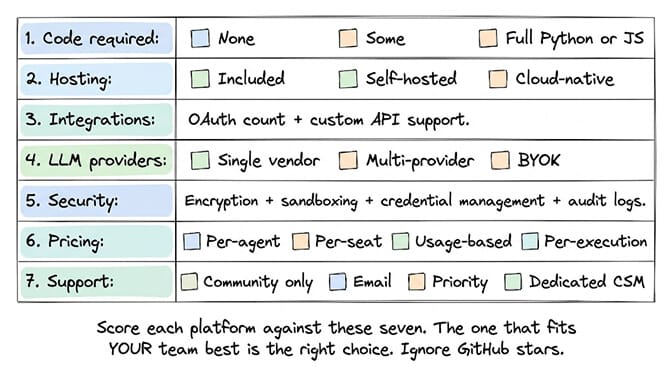
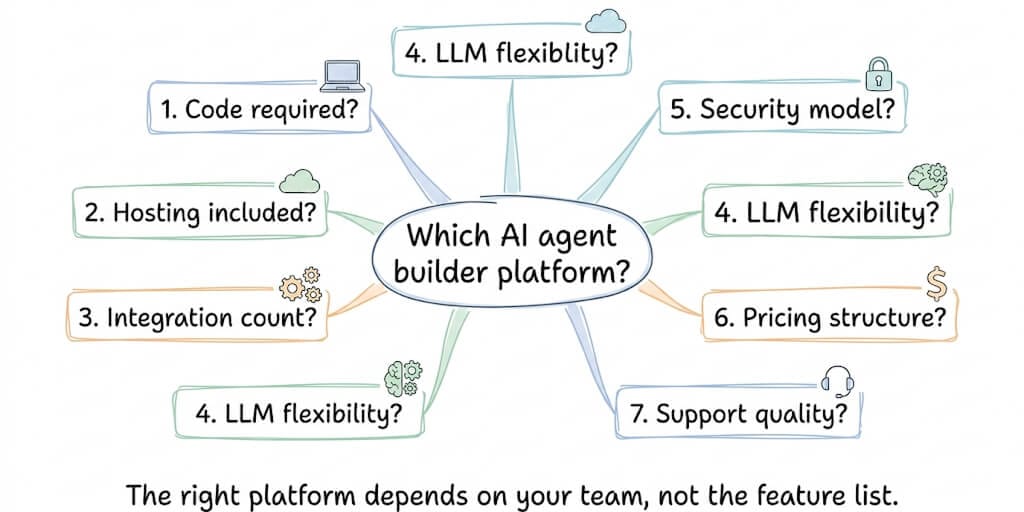
Six questions settle most decisions faster than any feature list.
1. No-code or code? If nobody on the team writes Python, cross off CrewAI and the cloud platforms. No-code builders (BetterClaw, Lindy, Zapier Agents, Gumloop) get you live in minutes. Low-code tools like n8n expect a technical owner. Code-first frameworks give the most control and the most work.
2. Which models can you use? A builder locked to one provider ties your costs and quality to that provider's roadmap. Look for a wide choice of models and the option to bring your own key.
3. How does it charge? Per user (Lindy), per credit (Gumloop, Manus), per activity (Zapier), per execution (n8n, CrewAI), per hour of compute (Google), or a flat plan with BYOK (BetterClaw). The same agent can cost five times more on one model than another, so price your real workload, not the entry plan.
4. Does it reach your channels and apps? Check that the specific tools you use (Slack, Gmail, your CRM) are supported with one-click sign-in, not just "available through the API."
5. How does it handle security and data? Ask where credentials are stored and for how long, whether agents run in isolation, whether skills or plugins are reviewed before you can install them, and whether you can require approval before sensitive actions.
6. Can you leave? Find out whether you can export your agents, prompts and data. Self-hosted open-source tools win here; closed platforms vary.
Best AI agent builder by use case
| If you are... | Pick | Why |
|---|---|---|
| A beginner | BetterClaw | A working agent in about 60 seconds, no code, any model |
| Looking for free | Zapier Agents | 400 activities a month on a genuinely free plan |
| Set on no code | BetterClaw | Plain-English instructions, built-in channels, no servers |
| Using it for personal tasks | Manus | Free daily credits and strong at one-off research |
| A developer | CrewAI | Open-source Python with full control over multi-agent design |
| An enterprise | Google Gemini Enterprise Agent Platform | Governance, IAM and Google Cloud data access |
| Already on Zapier | Zapier Agents | Your existing apps and Zaps are already connected |
| Already on Google Cloud | Google Gemini Enterprise Agent Platform | Native BigQuery and Cloud Storage access |
If you want the wider list of tools in this space, including frameworks and no-code AI agent builders side by side, see our guide to AI agent frameworks.
The hidden costs of AI agent platforms
The entry price is rarely the bill. Five costs catch people out.
Model tokens on top of the plan. Almost every platform charges for the model separately or meters it through credits. On Google's platform, compute, memory and model tokens are separate meters. With BYOK you pay the model provider directly, which is at least visible.
Credits that expire. Lindy and Gumloop credits don't roll over. A quiet month is money gone, and a busy month means buying more.
Per-seat pricing. Lindy's Plus plan is $29.99 per user. For a five-person team, that's about $150 a month before anyone builds a second agent.
BYOK fees. Bringing your own key should cut costs. On Gumloop, it raises the orchestration fee from 8% to 16%. Check whether "BYOK supported" also means "BYOK charged."
Overage and limits. Zapier's 1,500 activities, n8n's execution caps and CrewAI's 50 free executions all look generous until an agent loops or browses. Model the busiest week, not the average one. Our AI agent cost guide has worked examples.
Frequently Asked Questions
What is the best AI agent builder in 2026?
For most teams, BetterClaw, because it's no-code, works with 28+ model providers through your own keys and starts at $19 a month. Developers should look at CrewAI, teams on Zapier at Zapier Agents, and enterprises on Google Cloud at the Gemini Enterprise Agent Platform. The best AI agent builder tools differ by who is building, so match the tool to the team.
What is the best free AI agent builder?
Zapier Agents has the best no-code free plan, with 400 activities a month. If you can self-host, n8n's Community Edition and the CrewAI framework are free and open source, though you pay for the server and the model. Manus gives 300 free credits a day for one-off tasks.
What is the best no-code AI agent builder?
BetterClaw, for agents that run on a schedule and work in Slack, Telegram, Discord or Gmail with any model. Lindy is a strong alternative for inbox and meeting assistants, and Gumloop for visual marketing and ops automations.
What is an AI agent platform?
An AI agent platform is software for building, running and managing AI agents: programs that use a language model to plan steps and act through tools such as email, chat, a CRM or a browser. Platforms range from no-code builders to open-source frameworks and enterprise cloud services. This post works as an AI agent platform list covering all three.
Is n8n an AI agent builder?
Partly. n8n is a workflow automation tool with AI agent nodes, so you can build agents, but you design each workflow step by step. It suits technical teams who want control; it's less suited to agents that should decide their own steps.
Lindy vs Zapier Agents: which is cheaper?
Zapier Agents is cheaper to start, because it has a free plan with 400 activities a month. On paid plans, Lindy Plus is $29.99 per user per month for 3,000 credits, and Zapier's Pro plan is about $33.33 a month billed annually for 1,500 activities. Lindy charges per user, so it gets more expensive as your team grows.
Can I build an AI agent without coding?
Yes. No-code builders such as BetterClaw, Lindy, Zapier Agents and Gumloop let you build an agent by choosing a model, writing instructions in plain English and connecting apps with one click. On BetterClaw the first agent is live in about 60 seconds.
Which AI agent builder lets me use my own API key?
BetterClaw supports your own key from 28+ providers with zero markup on inference. Gumloop supports BYOK but doubles its orchestration fee to 16% when you use it. Open-source tools like n8n and CrewAI always use your own keys, because you run them yourself.
How we compared
Prices were checked on each tool's official pricing page on October 1, 2026: BetterClaw, Lindy, Zapier, n8n (shown in euros), Gumloop, Relevance AI, CrewAI, Google Cloud and the Manus help centre. Grok Bot, Dots and Muse facts come from xAI, Cursor, OpenAI and Meta launch announcements and launch coverage from August to September 2026; SuperGrok plan prices are as listed at launch. Setup times are our own estimates for a first working agent. Prices change often, so check the vendor's page before you buy.